Accounting rate of return on investment
Payback
Net present value
Internal rate of return
Note: Be sure to view the media for this week before starting this Assignment.
Include a detailed and thorough explanation of the conclusion you reached regarding the feasibility of each proposal supported by the calculations prepared in Part 1.
Explain at least five non-financial items (e.g., culture, language, etc.), which may impact the perceived desirability of each location.
Select the one location you recommend the Board invest in. Explain your rationale in precise and detailed language.
>Fall Term 2
Template
Given Information ,5 0,000
Initial cash outlay Useful life 20 ,0 ,000
Operating income 85,000
%
The cost of capital 9% 0%
Tax rate 40% Net cash flow Net Income Cash Flow Operating income Depreciation Net Income before taxes – 0 – 0 – 0 Tax, 40% – 0 – 0 Net Income $ – 0 net income and average book value of investment
Average net income and average book value of investment Net Income Year Net Income Avg BV of Investment – 0 6 – 0 – 0 7 – 0 – 0 10 – 0 – 0 11 – 0 – 0 12 – 0 – 0 13 – 0 – 0 14 – 0 – 0 16 – 0 – 0 17 – 0 – 0 18 – 0 – 0 19 – 0 Average – 0 ERROR:#DIV/0! a. Average rate of return on investment Put the answer in D49
b. Payback period years – using table page 126
c. Net present value – using table page 126 Amount Factor Present value $ – 0 Initial investment $ – 0 – 0 Annual net cash flow for 20 years – 0 Using MS Excel: PV of Annual net cash flow for 20 years d. Profitability Index e. Internal rate of return Using MS Excel: ERROR:#NUM! Period Better-made Appliances, Inc.is considering expanding its international presence. It sells 25% of all the toaster ovens sold in the United States but only 3% of the toaster ovens sold outside of the United States. The organization believes that it can sell more of its product if it has a production facility located overseas. Estimates concerning two possible locations, Kolkata, India and Dhaka, Bangladesh follow: Possible Location Kolkata, India Initial cash outlay $5,500,000 $3,500,000 Useful life 20 years 20 years Net cash inflows excluding depreciation $1,015,000 $885,000 The cost of capital 9% 9% Tax rate 40% 40% Student uses MS Excel, and the formulas and calculations are correct for both possible locations. There are no errors. Student uses MS Excel, and the formulas and calculations are correct for both possible locations. There are no errors. A clear, precise, and succinct written report is prepared for the Board of Directors. The intended audience is evident from the salutation and the language used throughout the report. The report includes a thorough and detailed explanation of the conclusion reached by student regarding the feasibility of each proposal that is supported by the calculations prepared in part one of the application. Student explains in detail at least five non-financial items which may impact the perceived desirability of each location and the rationale for choosing those items. Student selects one location that he/she recommends the Board invest in, provides a thorough and detailed explanation for selecting that location over the other location, and supports his/her assertion with a strong rationale. Writing exhibits strong evidence of thoughtful critical analysis and thinking; careful examination is made of assumptions and possible biases, with detailed supporting rationale. Writing synthesizes the classroom experiences and content; analyzes patterns or connections between theory and practice; and draws logical conclusions based on well-reasoned arguments. New questions are presented based on synthesis of ideas and input. 96 Harvard Business Review | October 2009 | hbr.org
Ju e u u | by Andrew Likierman
Performance The Five Traps of
1524 Oct09 Likierman layout.indd 961524 Oct09 Likierman layout.indd 96 9/4/09 12:38:55 PM9/4/09 12:38:55 PM hbr.org | October 2009 | Harvard Business Review 97
IIN AN EPISODE of Frasier, the television sitcom that follows the fortunes of a Seattle-based psychoana-lyst, the eponymous hero’s brother gloomily sum-marizes a task ahead: “Diffi cult and boring – my favorite combination.” If this is your reaction to the challenge of improving the measurement of your organization’s performance, you are not alone. In my experience, most senior executives fi nd it an So how should executives take ownership of per- In the following pages I present what I’ve found 1524 Oct09 Likierman layout.indd 971524 Oct09 Likierman layout.indd 97 9/4/09 12:39:06 PM9/4/09 12:39:06 PM The Five Traps of Performance Measurement
98 Harvard Business Review | October 2009 | hbr.org
Measuring the case, you’re at grave risk of falling into the fi rst To measure how well you’re doing, you need The trouble is that comparisons with your com- budgets. You have to be creative One way is to ask your cus- Of course you have to make tomers as you gather data. Think about how res- Another way to get data is to go to professionals Looking Backward point; a performance measurement system needs Look for measures that lead rather than lag the The quality of managerial decision making is Most senior executives fi nd » Specifi cally, they use them- » This article addresses each of » trap
trap IN BRIEF 1524 Oct09 Likierman layout.indd 981524 Oct09 Likierman layout.indd 98 9/4/09 12:39:13 PM9/4/09 12:39:13 PM hbr.org | October 2009 | Harvard Business Review 99
ecutive are usually more revealing than a formal “Evaluating the CEO,” by Stephen P. Kaufman, HBR It may sound trite, but how the company pre- Finally, you need to look not only at Putting Your Faith collect feedback on service from their customers. ers to include personal data, and in many cases the Numbers-driven companies also gravitate to- Promoter Score, which measures the likelihood Similar issues arise about the much touted link A particular bugbear of mine is the application of trap At one investment bank, if the deals that 1524 Oct09 Likierman layout.indd 991524 Oct09 Likierman layout.indd 99 9/4/09 12:39:20 PM9/4/09 12:39:20 PM The Five Traps of Performance Measurement 100 Harvard Business Review | October 2009 | hbr.org
help their cause. Indeed, ROI is oft en described as Suppose an HR manager undertakes to assign Think about this for a minute. How on earth can Gaming Your Metrics cate to senior associates work that could be done by Lawyers aren’t the only ones: A number of prom- ties trade for the Finnish government just before You can’t prevent people from gaming numbers, It helps to diversify your metrics, because it’s a You can also vary the boundaries of your mea- Finally, you should loosen the link between trap 1524 Oct09 Likierman layout.indd 1001524 Oct09 Likierman layout.indd 100 9/4/09 12:39:27 PM9/4/09 12:39:27 PM hbr.org | October 2009 | Harvard Business Review 101
panies get around the problem by giving manag- Sticking to Your trap. In the earliest stages, performance is all about It’s easy to spot the need for change In looking for a measure of customer The point is that if you specify the indicator AAA ratings to so many borrowers who turned out • • •
Why do organizations that excel in so many other A really good assessment system must bring fi – Andrew Likierman (alikierman@london.edu) is Reprint R0910L To order, see page 143.
The moment you choose to manage trap 1524 Oct09 Likierman layout.indd 1011524 Oct09 Likierman layout.indd 101 9/4/09 12:39:36 PM9/4/09 12:39:36 PM Copyright 2009 Harvard Business Publishing. All Rights Reserved. Additional restrictions 96 Harvard Business Review | October 2009 | hbr.org
Ju e u u | by Andrew Likierman
Performance The Five Traps of
1524 Oct09 Likierman layout.indd 961524 Oct09 Likierman layout.indd 96 9/4/09 12:38:55 PM9/4/09 12:38:55 PM hbr.org | October 2009 | Harvard Business Review 97
IIN AN EPISODE of Frasier, the television sitcom that follows the fortunes of a Seattle-based psychoana-lyst, the eponymous hero’s brother gloomily sum-marizes a task ahead: “Diffi cult and boring – my favorite combination.” If this is your reaction to the challenge of improving the measurement of your organization’s performance, you are not alone. In my experience, most senior executives fi nd it an So how should executives take ownership of per- In the following pages I present what I’ve found 1524 Oct09 Likierman layout.indd 971524 Oct09 Likierman layout.indd 97 9/4/09 12:39:06 PM9/4/09 12:39:06 PM The Five Traps of Performance Measurement
98 Harvard Business Review | October 2009 | hbr.org
Measuring the case, you’re at grave risk of falling into the fi rst To measure how well you’re doing, you need The trouble is that comparisons with your com- budgets. You have to be creative One way is to ask your cus- Of course you have to make tomers as you gather data. Think about how res- Another way to get data is to go to professionals Looking Backward point; a performance measurement system needs Look for measures that lead rather than lag the The quality of managerial decision making is Most senior executives fi nd » Specifi cally, they use them- » This article addresses each of » trap
trap IN BRIEF 1524 Oct09 Likierman layout.indd 981524 Oct09 Likierman layout.indd 98 9/4/09 12:39:13 PM9/4/09 12:39:13 PM hbr.org | October 2009 | Harvard Business Review 99
ecutive are usually more revealing than a formal “Evaluating the CEO,” by Stephen P. Kaufman, HBR It may sound trite, but how the company pre- Finally, you need to look not only at Putting Your Faith collect feedback on service from their customers. ers to include personal data, and in many cases the Numbers-driven companies also gravitate to- Promoter Score, which measures the likelihood Similar issues arise about the much touted link A particular bugbear of mine is the application of trap At one investment bank, if the deals that 1524 Oct09 Likierman layout.indd 991524 Oct09 Likierman layout.indd 99 9/4/09 12:39:20 PM9/4/09 12:39:20 PM The Five Traps of Performance Measurement 100 Harvard Business Review | October 2009 | hbr.org
help their cause. Indeed, ROI is oft en described as Suppose an HR manager undertakes to assign Think about this for a minute. How on earth can Gaming Your Metrics cate to senior associates work that could be done by Lawyers aren’t the only ones: A number of prom- ties trade for the Finnish government just before You can’t prevent people from gaming numbers, It helps to diversify your metrics, because it’s a You can also vary the boundaries of your mea- Finally, you should loosen the link between trap 1524 Oct09 Likierman layout.indd 1001524 Oct09 Likierman layout.indd 100 9/4/09 12:39:27 PM9/4/09 12:39:27 PM hbr.org | October 2009 | Harvard Business Review 101
panies get around the problem by giving manag- Sticking to Your trap. In the earliest stages, performance is all about It’s easy to spot the need for change In looking for a measure of customer The point is that if you specify the indicator AAA ratings to so many borrowers who turned out • • •
Why do organizations that excel in so many other A really good assessment system must bring fi – Andrew Likierman (alikierman@london.edu) is Reprint R0910L To order, see page 143.
The moment you choose to manage trap 1524 Oct09 Likierman layout.indd 1011524 Oct09 Likierman layout.indd 101 9/4/09 12:39:36 PM9/4/09 12:39:36 PM Copyright 2009 Harvard Business Publishing. All Rights Reserved. Additional restrictions WAL_WMBA6050_03_A_EN-CC.mp4
2
Week
3
Given Information
Kolkata, India
Dhaka, Bangladesh
Initial cash outlay
$
5
0
$ 3,500,000
Useful life
20
Operating income
1
15
8
The cost of capital
9
Tax rate
4
Net cash flow
Net Income
Cash Flow
Operating income
Depreciation
Net Income before taxes
– 0
Tax, 40%
Net Income
$ – 0
Net cash flow $ – 0 Net cash flow $ – 0
Average
Year
Avg BV of Investment
1 $ – 0 1 – 0
2 – 0 2 – 0
3 – 0 3 – 0
4 – 0 4 – 0
5 – 0 5 – 0
6
7
8 – 0 8 – 0
9 – 0 9 – 0
10
11
12
13
14
15 – 0 15 – 0
16
17
18
19
20 – 0 20 – 0
Average $ – 0
ERROR:#DIV/0!
a.
Average rate of return on investment
Type the formula her
e.
Type the formula here. Put the answer in I49
b.
Payback period
Type the formula here. Put the answer in D53
years
Type the formula here. Put the answer in I53
c.
Net present value
Amount
Factor
Present value
Initial investment
Annual net cash flow for 20 years
Net present value $ – 0 Net present value $ – 0
Using MS Excel:
Initial investment Initial investment
PV of Annual net cash flow for 20 years
Net present value $ – 0 Net present value $ – 0
d.
Profitability Index
Type the formula here. Put the answer in D68
Type the formula here. Put the answer in I68
0.00
d.
Internal rate of return
Using MS Excel:
ERROR:#NUM!
Period
0 0
1 1
2 2
3 3
4 4
5 5
6 6
7 7
8 8
9 9
10 10
11 11
12 12
13 13
14 14
15 15
16 16
17 17
18 18
19 19
20 20
Dhaka, Bangladesh
Student uses MS Excel, and the formulas and calculations are correct for both possible locations. There are no errors.
Student uses MS Excel, and the formulas and calculations are correct for both possible locations. There are no errors.
d
B
ff
m
Measurement
onerous if not threatening task. Thus they leave it
to people who may not be natural judges of per-
formance but are fl uent in the language of spread-
sheets. The inevitable result is a mass of numbers
and comparisons that provide little insight into
a company’s performance and may even lead to
decisions that hurt it. That’s a big problem in the
current recession, because the margin for error is
virtually nonexistent.
formance assessment? They need to fi nd measures,
qualitative as well as quantitative, that look past
this year’s budget and previous results to determine
how the company will fare against its competitors in
the future. They need to move beyond a few simple,
easy-to-game metrics and embrace an array of more
sophisticated ones. And they need to keep people on
their toes and make sure that today’s measures are
not about yesterday’s business model.
to be the fi ve most common traps in measuring per-
formance and illustrate how some organizations
have managed to avoid them. My prescriptions
aren’t exhaustive, but they’ll provide a good start.
In any event, they can help you steal a march on
rivals who are caught in the same old traps.
Against Yourself
The papers for the next
regular performance as-
sessment are on your
desk, their thicket of
numbers awaiting you.
What are those numbers?
Most likely, comparisons
of current results with a
plan or a budget. If that’s
trap of performance measurement: looking only
at your own company. You may be doing better
than the plan, but are you beating the competi-
tion? And what if the estimates you’re seeing were
manipulated?
information about the benchmarks that matter
most – the ones outside the organization. They will
help you defi ne competitive priorities and connect
executive compensation to relative rather than ab-
solute performance – meaning you’ll reward senior
executives for doing better than everyone else.
petitors can’t easily be made in real time – which is
precisely why so many companies fall back on mea-
surements against the previous year’s plans and
about how you fi nd the relevant
data or some proxy for them.
tomers. Enterprise, the car-rental
company, uses the Enterprise
Service Quality Index, which
measures customers’ repeat pur-
chase intentions. Each branch
of the company telephones a
random sample of customers
and asks whether they will use
Enterprise again. When the index
goes up, the company is gaining
market share; when it falls, cus-
tomers are taking their business
elsewhere. The branches post re-
sults within two weeks, put them
next to profi tability numbers on
monthly financial statements,
and factor them into criteria for
promotion (thus aligning sales
goals and incentives).
sure you don’t annoy your cus-
taurant managers seek feedback about the quality
of their service: Most oft en they interrupt diners’
conversations to ask if everything is OK; sometimes
they deliver a questionnaire with the bill. Either ap-
proach can be irritating. Danny Meyer, the founder
of New York’s Union Square Hospitality Group, gets
the information unobtrusively, through simple ob-
servation. If people dining together in one of his
restaurants are looking at one another, the service
is probably working. If they’re all looking around
the room, they may be wowed by the architecture,
but it’s far more likely that the service is slow.
outside your company. When Marc Eff ron, the vice
president of talent management for Avon Products,
was trying to determine whether his company was
doing a good job of fi nding and developing man-
agers, he came up with the idea of creating a net-
work of talent management professionals. Started
in 2007, the New Talent Management Network has
more than 1,200 members, for whom it conducts
original research and provides a library of resources
and best practices.
Along with budget fig-
ures, your performance
assessment package al-
most certainly includes
comparisons between
this year and last. If so,
watch out for the second
trap, which is to focus
on the past. Beating last
year’s numbers is not the
to tell you whether the decisions you’re making
now are going to help you in the coming months.
profi ts in your business. The U.S. health insurer Hu-
mana, recognizing that its most expensive patients
are the really sick ones (a few years back the com-
pany found that the sickest 10% accounted for 80%
of its costs), off ers customers incentives for early
screening. If it can get more customers into early or
even preemptive treatment than other companies
can, it will outperform rivals in the future.
another leading indicator of success. Boards must
assess top executives’ wisdom and willingness to
listen. Qualitative, subjective judgments based on
independent directors’ own experience with an ex-
performance measurement
diffi cult if not threatening, and
they’re reluctant to engage with
it in a meaningful way. As a result,
companies routinely fall into
fi ve traps.
selves rather than competitors
as benchmarks, focus on past
indicators of success, overvalue
numbers at the expense of quali-
tative measures, set easy-to-game
metrics, and cling to systems that
have outlived their usefulness.
the traps in turn, offering advice
about how to avoid them and ex-
amples of organizations that have
successfully done so.
IDEA
analysis of the executive’s track record (an unreli-
able predictor of success, especially for a CEO) or
his or her division’s fi nancial performance. (See
October 2008.)
sents itself in offi cial communications oft en signals
the management style of top executives. In August
2006 the Economist reported that Arijit Chatterjee
and Donald Hambrick, of Pennsylvania State Uni-
versity, had devised a narcissism index on which to
rate 105 company bosses, based on the
prominence of the CEO’s photo in the
annual report, his or her prominence in
press releases, the frequency of the fi rst
person singular in interviews with the
CEO, and his or her compensation rela-
tive to that of the fi rm’s second-highest-
paid executive.
what you and others are doing but also
at what you aren’t doing. The managers
of one European investment bank told
me that they measure performance by
the outcomes of deals they’ve turned
down as well as by the outcomes of deals they’ve
won. If the ones they’ve rejected turn out to be lem-
ons, those rejections count as successes. This kind of
analysis seems obvious once stated, but I’ve noticed
a persistent bias in all of us to focus on what we do
over what we don’t do. Good management is about
making choices, so a decision not to do something
should be analyzed as closely as a decision to do
something.
in Numbers
Good or bad, the metrics
in your performance as-
sessment package all
come as numbers. The
problem is that numbers-
driven managers often
end up producing reams
of low-quality data. Think
about how companies
It’s well known to statisticians that if you want eval-
uation forms to tell the real story, the anonymity
of the respondents must be protected. Yet out of a
desire to gather as much information as possible at
points of contact, companies routinely ask custom-
employees who provided the service watch them
fi ll out the forms. How surprised should you be
if your employees hand in consistently favorable
forms that they themselves collected? Bad assess-
ments have a tendency to mysteriously disappear.
ward the most popular measures. If they’re looking
to compare themselves with other companies, they
feel they should use whatever measures others use.
The question of what measure is the right one gets
lost. Take Frederick Reichheld’s widely used Net
that customers will recommend a product or ser-
vice. The NPS is a useful indicator only if recom-
mendations play the dominant role in a purchase
decision; as its critics point out, customers’ propen-
sity to switch in response to recommendations var-
ies from industry to industry, so an NPS is probably
more important to, say, a baby-food manufacturer
than to an electricity supplier.
between employee satisfaction and profi tability.
The Employee-Customer-Profi t Chain pioneered by
Sears suggests that more-satisfi ed employees pro-
duce more-satisfi ed customers, who in turn deliver
higher profi ts. If that’s true, the path is clear: Keep
your employees content and watch those profi ts
soar. But employees may be satisfi ed mainly be-
cause they like their colleagues (think lawyers) or
because they’re highly paid and deferred to (think
investment bankers). Or they may actually enjoy
what they do, but their customers value price above
the quality of service (think budget airlines).
fi nancial metrics to nonfi nancial activities. Anxious
to justify themselves rather than be outsourced,
many service functions (such as IT, HR, and legal)
try to devise a return on investment number to
managers have rejected turn out to be
lemons, those rejections count as successes.
the holy grail of measurement – a revealing meta-
phor, with its implication of an almost certainly
doomed search.
an ROI number to an executive training program.
Typically, he or she would ask program participants
to identify a benefi t, assign a dollar value to it, and
estimate the probability that the benefi t came from
the program. So a benefi t that is worth $70,000 and
has a 50% probability of being linked to the pro-
gram means a program benefi t of $35,000. If the
program cost $25,000, the net benefi t is $10,000 – a
40% ROI.
the presumed causal link be justifi ed? By a state-
ment like “I learned a production algorithm at the
program and then applied it”? Assessing any seri-
ous executive program requires a much more so-
phisticated and qualitative approach. First you have
to specify ahead of time the needs of the program’s
stakeholders – participants, line managers, and
sponsors – and make sure that the syllabus meets
your organizational and talent-management objec-
tives. Once the program has ended, you have to
look beyond immediate evaluations to at least six
months aft er participants return to the workplace;
their personal feedback should be incorporated in
the next annual company performance review. At
the soft drinks company Britvic, HR assesses its ex-
ecutive coaching program by tracking coachees for
a year aft erward, comparing their career trajecto-
ries with those of people who didn’t get coached.
In 2002 a leaked internal
memo from associates at
Cliff ord Chance, one of
the world’s largest law
firms, contended that
pressure to deliver bill-
able hours had encour-
aged its lawyers to pad
their numbers and cre-
ated an incentive to allo-
less expensive junior associates.
inent companies have been caught trying to manip-
ulate their numbers. Since 2004 Royal Dutch Shell
has paid $470 million to settle lawsuits relating to
its overstatement of reserves. Morgan Stanley was
reportedly willing to lose €20 million on a securi-
closing its books for 2004 in order to improve its
position in the league table for global equity capital
market rankings.
no matter how outstanding your organization. The
moment you choose to manage by a metric, you
invite your managers to manipulate it. Metrics are
only proxies for performance. Someone who has
learned how to optimize a metric without actually
having to perform will oft en do just that. To create
an eff ective performance measurement system, you
have to work with that fact rather than resort to
wishful thinking and denial.
lot harder to game several of them at once. Clif-
ford Chance replaced its single metric of billable
hours with seven criteria on which to base bonuses:
respect and mentoring, quality of work, excellence
in client service, integrity, contribution to the com-
munity, commitment to diversity, and contribution
to the fi rm as an institution. Metrics should have
varying sources (colleagues, bosses, customers) and
time frames. Mehrdad Baghai and coauthors de-
scribed in “Performance Measures: Calibrating for
Growth” (Journal of Business Strategy, July–August
1999) how the Japanese telecommunications com-
pany Soft Bank measured performance along three
time horizons. Horizon 1 covered actions relevant
to extending and defending core businesses, and
metrics were based on current income and cash
fl ow statements. Horizon 2 covered actions taken
to build emerging businesses; metrics came from
sales and marketing numbers. Horizon 3 covered
creating opportunities for new businesses; success
was measured through the attainment of preestab-
lished milestones. Multiple levels like those make
gaming far more complicated and far less likely to
succeed.
surement, by defi ning responsibility more narrowly
or by broadening it. To reduce delays in gate-closing
time, Southwest Airlines, which had traditionally
applied a metric only to gate agents, extended it
to include the whole ground team – ticketing staff ,
gate staff , and loaders – so that everyone had an
incentive to cooperate.
meeting budgets and performance; far too many
bonuses are awarded on that basis. Managers may
either pad their budgets to make meeting them
easier or pare them down too far to impress their
bosses. Both practices can destroy value. Some com-
ers leeway. The offi ce supplier Staples, for example,
lets them exceed their budgets if they can demon-
strate that doing so will lead to improved service for
customers. When I was a CFO, I off ered scope for
budget revisions during the year, usually in months
three and six. Another way of providing budget fl ex-
ibility is to set ranges rather than specifi c numbers
as targets.
Numbers Too Long
As the saying goes, you
manage what you mea-
sure. Unfortunately, per-
formance assessment
systems seldom evolve
as fast as businesses do.
Smaller and growing
companies are especially
likely to fall into this
survival, cash resources, and growth. Comparisons
are to last week, last month, and last year. But as
the business matures, the focus has to
move to profi t and the comparisons to
competitors.
aft er things have gone wrong, but how
can you evaluate your measures before
they fail you? The answer is to be very
precise about what you want to assess,
be explicit about what metrics are as-
sessing it, and make sure that everyone
is clear about both.
satisfaction, the British law fi rm Addle-
shaw Booth (now Addleshaw Goddard) discovered
from a survey that its clients valued responsiveness
most, followed by proactiveness and commercial-
mindedness. Most fi rms would interpret this fi nd-
ing to mean they needed to be as quick as possible.
Addleshaw Booth’s managers dug deeper into the
data to understand more exactly what “responsive-
ness” meant. What they found was that they needed
to diff erentiate between clients. “One size does not
fi t all,” an employee told me. “Being responsive for
some clients means coming back to them in two
hours; for others, it’s 10 minutes.”
precisely and loudly, everyone can more easily see
when it’s not fi t for the purpose. The credit-rating
agencies have come under attack because they gave
to be bad risks. The agencies have argued in their
own defense that lenders misunderstood what the
ratings meant. The AAA rating, they claim, was
awarded on the basis of borrowers’ credit records,
and it described the likelihood of default under
normal market conditions; it did not factor in what
might happen in the event of a massive shock to
the fi nancial system. Reasonable as this explanation
may be, it is no consolation to those who thought
they knew what the magic AAA represented.
ways fall into these traps? Because the people man-
aging performance frameworks are generally not
experts in performance measurement. Finance
managers are profi cient at tracking expenses, moni-
toring risks, and raising capital, but they seldom
have a grasp of how operating realities connect
with performance. They are precisely the people
who strive to reduce judgments to a single ROI
number. The people who understand performance
are line managers – who, of course, are crippled by
confl icts of interest.
nance and line managers into some kind of mean-
ingful dialogue that allows the company to benefi t
from both the relative independence of the former
and the expertise of the latter. This sounds straight-
forward enough, but as anyone who’s ever worked
in a real business knows, actually doing it is a rather
tall order. Then again, who says the CEO’s job is
supposed to be easy?
the dean of London Business School, a nonexecutive
director of Barclays Bank, and the chairman of the
UK’s National Audit Offi ce.
by a metric, you invite your managers
to manipulate it.
may apply including the use of this content as assigned course material. Please consult your
institution’s librarian about any restrictions that might apply under the license with your
institution. For more information and teaching resources from Harvard Business Publishing
including Harvard Business School Cases, eLearning products, and business simulations
please visit hbsp.harvard.edu.
d
B
ff
m
Measurement
onerous if not threatening task. Thus they leave it
to people who may not be natural judges of per-
formance but are fl uent in the language of spread-
sheets. The inevitable result is a mass of numbers
and comparisons that provide little insight into
a company’s performance and may even lead to
decisions that hurt it. That’s a big problem in the
current recession, because the margin for error is
virtually nonexistent.
formance assessment? They need to fi nd measures,
qualitative as well as quantitative, that look past
this year’s budget and previous results to determine
how the company will fare against its competitors in
the future. They need to move beyond a few simple,
easy-to-game metrics and embrace an array of more
sophisticated ones. And they need to keep people on
their toes and make sure that today’s measures are
not about yesterday’s business model.
to be the fi ve most common traps in measuring per-
formance and illustrate how some organizations
have managed to avoid them. My prescriptions
aren’t exhaustive, but they’ll provide a good start.
In any event, they can help you steal a march on
rivals who are caught in the same old traps.
Against Yourself
The papers for the next
regular performance as-
sessment are on your
desk, their thicket of
numbers awaiting you.
What are those numbers?
Most likely, comparisons
of current results with a
plan or a budget. If that’s
trap of performance measurement: looking only
at your own company. You may be doing better
than the plan, but are you beating the competi-
tion? And what if the estimates you’re seeing were
manipulated?
information about the benchmarks that matter
most – the ones outside the organization. They will
help you defi ne competitive priorities and connect
executive compensation to relative rather than ab-
solute performance – meaning you’ll reward senior
executives for doing better than everyone else.
petitors can’t easily be made in real time – which is
precisely why so many companies fall back on mea-
surements against the previous year’s plans and
about how you fi nd the relevant
data or some proxy for them.
tomers. Enterprise, the car-rental
company, uses the Enterprise
Service Quality Index, which
measures customers’ repeat pur-
chase intentions. Each branch
of the company telephones a
random sample of customers
and asks whether they will use
Enterprise again. When the index
goes up, the company is gaining
market share; when it falls, cus-
tomers are taking their business
elsewhere. The branches post re-
sults within two weeks, put them
next to profi tability numbers on
monthly financial statements,
and factor them into criteria for
promotion (thus aligning sales
goals and incentives).
sure you don’t annoy your cus-
taurant managers seek feedback about the quality
of their service: Most oft en they interrupt diners’
conversations to ask if everything is OK; sometimes
they deliver a questionnaire with the bill. Either ap-
proach can be irritating. Danny Meyer, the founder
of New York’s Union Square Hospitality Group, gets
the information unobtrusively, through simple ob-
servation. If people dining together in one of his
restaurants are looking at one another, the service
is probably working. If they’re all looking around
the room, they may be wowed by the architecture,
but it’s far more likely that the service is slow.
outside your company. When Marc Eff ron, the vice
president of talent management for Avon Products,
was trying to determine whether his company was
doing a good job of fi nding and developing man-
agers, he came up with the idea of creating a net-
work of talent management professionals. Started
in 2007, the New Talent Management Network has
more than 1,200 members, for whom it conducts
original research and provides a library of resources
and best practices.
Along with budget fig-
ures, your performance
assessment package al-
most certainly includes
comparisons between
this year and last. If so,
watch out for the second
trap, which is to focus
on the past. Beating last
year’s numbers is not the
to tell you whether the decisions you’re making
now are going to help you in the coming months.
profi ts in your business. The U.S. health insurer Hu-
mana, recognizing that its most expensive patients
are the really sick ones (a few years back the com-
pany found that the sickest 10% accounted for 80%
of its costs), off ers customers incentives for early
screening. If it can get more customers into early or
even preemptive treatment than other companies
can, it will outperform rivals in the future.
another leading indicator of success. Boards must
assess top executives’ wisdom and willingness to
listen. Qualitative, subjective judgments based on
independent directors’ own experience with an ex-
performance measurement
diffi cult if not threatening, and
they’re reluctant to engage with
it in a meaningful way. As a result,
companies routinely fall into
fi ve traps.
selves rather than competitors
as benchmarks, focus on past
indicators of success, overvalue
numbers at the expense of quali-
tative measures, set easy-to-game
metrics, and cling to systems that
have outlived their usefulness.
the traps in turn, offering advice
about how to avoid them and ex-
amples of organizations that have
successfully done so.
IDEA
analysis of the executive’s track record (an unreli-
able predictor of success, especially for a CEO) or
his or her division’s fi nancial performance. (See
October 2008.)
sents itself in offi cial communications oft en signals
the management style of top executives. In August
2006 the Economist reported that Arijit Chatterjee
and Donald Hambrick, of Pennsylvania State Uni-
versity, had devised a narcissism index on which to
rate 105 company bosses, based on the
prominence of the CEO’s photo in the
annual report, his or her prominence in
press releases, the frequency of the fi rst
person singular in interviews with the
CEO, and his or her compensation rela-
tive to that of the fi rm’s second-highest-
paid executive.
what you and others are doing but also
at what you aren’t doing. The managers
of one European investment bank told
me that they measure performance by
the outcomes of deals they’ve turned
down as well as by the outcomes of deals they’ve
won. If the ones they’ve rejected turn out to be lem-
ons, those rejections count as successes. This kind of
analysis seems obvious once stated, but I’ve noticed
a persistent bias in all of us to focus on what we do
over what we don’t do. Good management is about
making choices, so a decision not to do something
should be analyzed as closely as a decision to do
something.
in Numbers
Good or bad, the metrics
in your performance as-
sessment package all
come as numbers. The
problem is that numbers-
driven managers often
end up producing reams
of low-quality data. Think
about how companies
It’s well known to statisticians that if you want eval-
uation forms to tell the real story, the anonymity
of the respondents must be protected. Yet out of a
desire to gather as much information as possible at
points of contact, companies routinely ask custom-
employees who provided the service watch them
fi ll out the forms. How surprised should you be
if your employees hand in consistently favorable
forms that they themselves collected? Bad assess-
ments have a tendency to mysteriously disappear.
ward the most popular measures. If they’re looking
to compare themselves with other companies, they
feel they should use whatever measures others use.
The question of what measure is the right one gets
lost. Take Frederick Reichheld’s widely used Net
that customers will recommend a product or ser-
vice. The NPS is a useful indicator only if recom-
mendations play the dominant role in a purchase
decision; as its critics point out, customers’ propen-
sity to switch in response to recommendations var-
ies from industry to industry, so an NPS is probably
more important to, say, a baby-food manufacturer
than to an electricity supplier.
between employee satisfaction and profi tability.
The Employee-Customer-Profi t Chain pioneered by
Sears suggests that more-satisfi ed employees pro-
duce more-satisfi ed customers, who in turn deliver
higher profi ts. If that’s true, the path is clear: Keep
your employees content and watch those profi ts
soar. But employees may be satisfi ed mainly be-
cause they like their colleagues (think lawyers) or
because they’re highly paid and deferred to (think
investment bankers). Or they may actually enjoy
what they do, but their customers value price above
the quality of service (think budget airlines).
fi nancial metrics to nonfi nancial activities. Anxious
to justify themselves rather than be outsourced,
many service functions (such as IT, HR, and legal)
try to devise a return on investment number to
managers have rejected turn out to be
lemons, those rejections count as successes.
the holy grail of measurement – a revealing meta-
phor, with its implication of an almost certainly
doomed search.
an ROI number to an executive training program.
Typically, he or she would ask program participants
to identify a benefi t, assign a dollar value to it, and
estimate the probability that the benefi t came from
the program. So a benefi t that is worth $70,000 and
has a 50% probability of being linked to the pro-
gram means a program benefi t of $35,000. If the
program cost $25,000, the net benefi t is $10,000 – a
40% ROI.
the presumed causal link be justifi ed? By a state-
ment like “I learned a production algorithm at the
program and then applied it”? Assessing any seri-
ous executive program requires a much more so-
phisticated and qualitative approach. First you have
to specify ahead of time the needs of the program’s
stakeholders – participants, line managers, and
sponsors – and make sure that the syllabus meets
your organizational and talent-management objec-
tives. Once the program has ended, you have to
look beyond immediate evaluations to at least six
months aft er participants return to the workplace;
their personal feedback should be incorporated in
the next annual company performance review. At
the soft drinks company Britvic, HR assesses its ex-
ecutive coaching program by tracking coachees for
a year aft erward, comparing their career trajecto-
ries with those of people who didn’t get coached.
In 2002 a leaked internal
memo from associates at
Cliff ord Chance, one of
the world’s largest law
firms, contended that
pressure to deliver bill-
able hours had encour-
aged its lawyers to pad
their numbers and cre-
ated an incentive to allo-
less expensive junior associates.
inent companies have been caught trying to manip-
ulate their numbers. Since 2004 Royal Dutch Shell
has paid $470 million to settle lawsuits relating to
its overstatement of reserves. Morgan Stanley was
reportedly willing to lose €20 million on a securi-
closing its books for 2004 in order to improve its
position in the league table for global equity capital
market rankings.
no matter how outstanding your organization. The
moment you choose to manage by a metric, you
invite your managers to manipulate it. Metrics are
only proxies for performance. Someone who has
learned how to optimize a metric without actually
having to perform will oft en do just that. To create
an eff ective performance measurement system, you
have to work with that fact rather than resort to
wishful thinking and denial.
lot harder to game several of them at once. Clif-
ford Chance replaced its single metric of billable
hours with seven criteria on which to base bonuses:
respect and mentoring, quality of work, excellence
in client service, integrity, contribution to the com-
munity, commitment to diversity, and contribution
to the fi rm as an institution. Metrics should have
varying sources (colleagues, bosses, customers) and
time frames. Mehrdad Baghai and coauthors de-
scribed in “Performance Measures: Calibrating for
Growth” (Journal of Business Strategy, July–August
1999) how the Japanese telecommunications com-
pany Soft Bank measured performance along three
time horizons. Horizon 1 covered actions relevant
to extending and defending core businesses, and
metrics were based on current income and cash
fl ow statements. Horizon 2 covered actions taken
to build emerging businesses; metrics came from
sales and marketing numbers. Horizon 3 covered
creating opportunities for new businesses; success
was measured through the attainment of preestab-
lished milestones. Multiple levels like those make
gaming far more complicated and far less likely to
succeed.
surement, by defi ning responsibility more narrowly
or by broadening it. To reduce delays in gate-closing
time, Southwest Airlines, which had traditionally
applied a metric only to gate agents, extended it
to include the whole ground team – ticketing staff ,
gate staff , and loaders – so that everyone had an
incentive to cooperate.
meeting budgets and performance; far too many
bonuses are awarded on that basis. Managers may
either pad their budgets to make meeting them
easier or pare them down too far to impress their
bosses. Both practices can destroy value. Some com-
ers leeway. The offi ce supplier Staples, for example,
lets them exceed their budgets if they can demon-
strate that doing so will lead to improved service for
customers. When I was a CFO, I off ered scope for
budget revisions during the year, usually in months
three and six. Another way of providing budget fl ex-
ibility is to set ranges rather than specifi c numbers
as targets.
Numbers Too Long
As the saying goes, you
manage what you mea-
sure. Unfortunately, per-
formance assessment
systems seldom evolve
as fast as businesses do.
Smaller and growing
companies are especially
likely to fall into this
survival, cash resources, and growth. Comparisons
are to last week, last month, and last year. But as
the business matures, the focus has to
move to profi t and the comparisons to
competitors.
aft er things have gone wrong, but how
can you evaluate your measures before
they fail you? The answer is to be very
precise about what you want to assess,
be explicit about what metrics are as-
sessing it, and make sure that everyone
is clear about both.
satisfaction, the British law fi rm Addle-
shaw Booth (now Addleshaw Goddard) discovered
from a survey that its clients valued responsiveness
most, followed by proactiveness and commercial-
mindedness. Most fi rms would interpret this fi nd-
ing to mean they needed to be as quick as possible.
Addleshaw Booth’s managers dug deeper into the
data to understand more exactly what “responsive-
ness” meant. What they found was that they needed
to diff erentiate between clients. “One size does not
fi t all,” an employee told me. “Being responsive for
some clients means coming back to them in two
hours; for others, it’s 10 minutes.”
precisely and loudly, everyone can more easily see
when it’s not fi t for the purpose. The credit-rating
agencies have come under attack because they gave
to be bad risks. The agencies have argued in their
own defense that lenders misunderstood what the
ratings meant. The AAA rating, they claim, was
awarded on the basis of borrowers’ credit records,
and it described the likelihood of default under
normal market conditions; it did not factor in what
might happen in the event of a massive shock to
the fi nancial system. Reasonable as this explanation
may be, it is no consolation to those who thought
they knew what the magic AAA represented.
ways fall into these traps? Because the people man-
aging performance frameworks are generally not
experts in performance measurement. Finance
managers are profi cient at tracking expenses, moni-
toring risks, and raising capital, but they seldom
have a grasp of how operating realities connect
with performance. They are precisely the people
who strive to reduce judgments to a single ROI
number. The people who understand performance
are line managers – who, of course, are crippled by
confl icts of interest.
nance and line managers into some kind of mean-
ingful dialogue that allows the company to benefi t
from both the relative independence of the former
and the expertise of the latter. This sounds straight-
forward enough, but as anyone who’s ever worked
in a real business knows, actually doing it is a rather
tall order. Then again, who says the CEO’s job is
supposed to be easy?
the dean of London Business School, a nonexecutive
director of Barclays Bank, and the chairman of the
UK’s National Audit Offi ce.
by a metric, you invite your managers
to manipulate it.
may apply including the use of this content as assigned course material. Please consult your
institution’s librarian about any restrictions that might apply under the license with your
institution. For more information and teaching resources from Harvard Business Publishing
including Harvard Business School Cases, eLearning products, and business simulations
please visit hbsp.harvard.edu.
Essay Writing Service Features
Our Experience
No matter how complex your assignment is, we can find the right professional for your specific task. Achiever Papers is an essay writing company that hires only the smartest minds to help you with your projects. Our expertise allows us to provide students with high-quality academic writing, editing & proofreading services.
Free Features
Free revision policy
$10Free bibliography & reference
$8Free title page
$8Free formatting
$8How Our Dissertation Writing Service Works
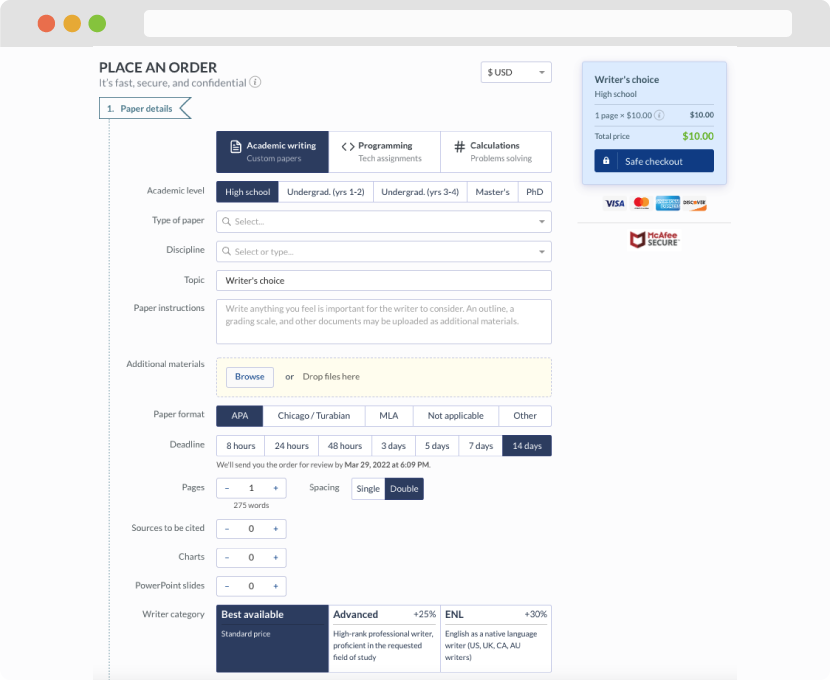
First, you will need to complete an order form. It's not difficult but, if anything is unclear, you may always chat with us so that we can guide you through it. On the order form, you will need to include some basic information concerning your order: subject, topic, number of pages, etc. We also encourage our clients to upload any relevant information or sources that will help.
Complete the order form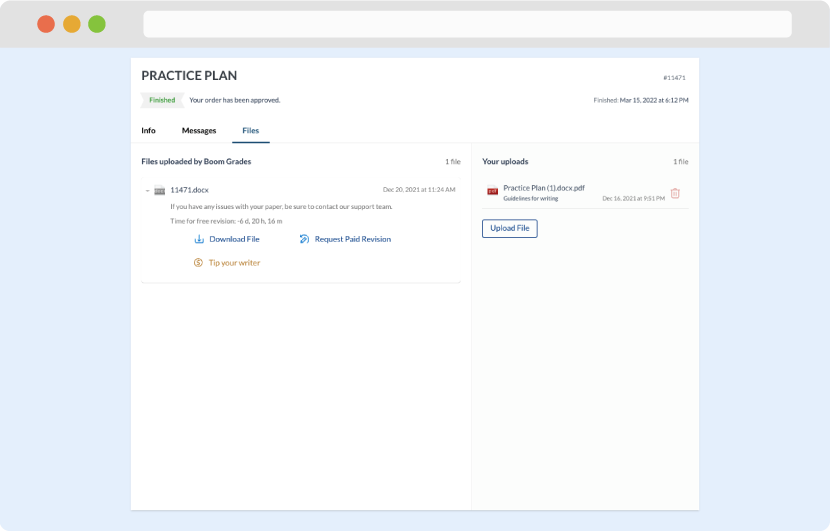
Once we have all the information and instructions that we need, we select the most suitable writer for your assignment. While everything seems to be clear, the writer, who has complete knowledge of the subject, may need clarification from you. It is at that point that you would receive a call or email from us.
Writer’s assignment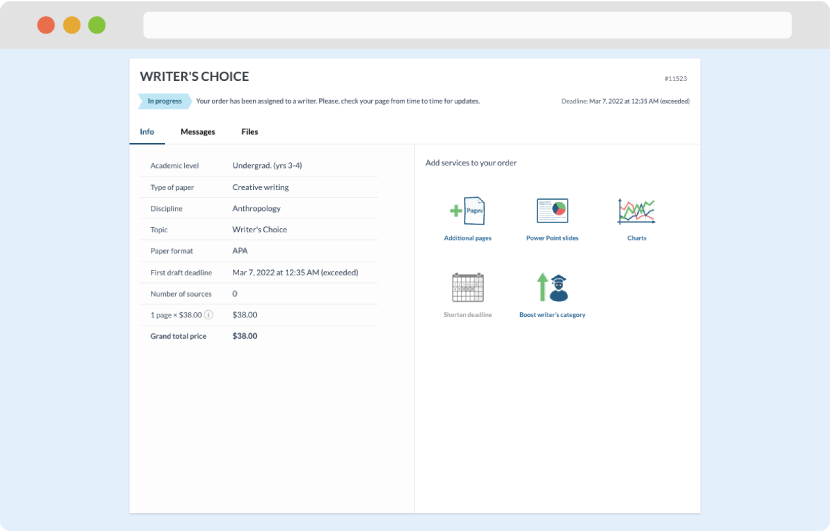
As soon as the writer has finished, it will be delivered both to the website and to your email address so that you will not miss it. If your deadline is close at hand, we will place a call to you to make sure that you receive the paper on time.
Completing the order and download