Discussion: Graphing and Describing Data in Everyday Life
Required Resources
Read/review the following resources for this activity:
Holmes, A., Illowsky, B., & Dean, S. (2017). Introductory business statistics. OpenStax.
https://openstax.org/details/books/introductory-bu…
OpenStax Book: Chapter 2—Section 2.1
Introductory Statistics Textbook:
2.1 Display Dat
Lesson
Minimum of 1 scholarly source
Instructions
Suppose that you have two sets of data to work with. The first set is a list of all the injuries that were seen in a clinic in a month’s time. The second set contains data on the number of minutes that each patient spent in the waiting room of a doctor’s office. You can make assumptions about other information or variables that are included in each data set.
For each data set, propose your idea of how best to represent the key information. To organize your data would you choose to use a frequency table, a cumulative frequency table, or a relative frequency table? Why?
What type of graph would you use to display the organized data from each frequency distribution? What would be shown on each of the axes for each graph?
Consider how different distributions might affect the different graphs. How might other variables affect the graphs? How could graphs be made to be biased? If a graph were biased, how might you change it to guard against that bias?
Lesson 2
Lesson: Graphing and Describing Data
Graphing and Describing Data
Essential Information
Each week will include a Lesson that focuses on the Essential
Information for that week. It is important to read this information for
two reasons:
•
It will give you the skills, concepts, and material to be successful in the
homework, and
•
You will find a link to that week’s Excel spreadsheet if one is included. Since
this course focuses on the concepts and interpretation of statistics, these spreadsheets
are designed to do the calculations for you. You will need the spreadsheets to
complete the homework effectively and efficiently.
Frequency Distributions
Sometimes we have too much data to make a decision without organizing it first. A
frequency table is a very useful way to organize data. A basic frequency table consists
of two columns—the first column consists of the categories or classes, and the second
column is a frequency count for each record in the data set pertaining to that category
or class.
For example, data were collected regarding the colors of 20 waste management bags:
Yellow, Red, Blue, Red, Green, Red, Green, Blue, Yellow, Red, Black, Yellow, Red,
Black, Blue, Yellow, Yellow, Black, Red, Black
These data will make more sense if you organize them in the following way:
Bag Color
Tally
Frequency Count
Yellow
XXXXX
5
Red
XXXXXX
6
Blue
XXX
3
Green
XX
2
Black
XXXX
4
20 (Total or n-count)
Now the data have meaning. Look at the table and make a statement about the colors
of waste management bags. Which is the most common bag color? The least? How
many bags were recorded? Once the data are organized, it is easier to talk about the
findings.
Once the frequency table is started, columns will be added to find out other
interesting facts.
Relative Frequency: The percentage of each category/class to the whole. Calculate as:
Category Frequency/Total. For example, the color red has a relative frequency of 6/20
or .3 or 30% of the whole. Cumulative Frequency: The percentage of that category
added to the percentages of previous categories. Calculate as: Adding relative
frequencies for that category with relative frequencies of categories above.
Remember, this is cumulative frequency, so the calculation accumulates the relative
frequencies as one goes down the table. For example, the color red has a relative
frequency of 0.30 added with that of yellow (0.25) to get 0.55.
We can extend the columns and add this information.
Bag Color
Tally
Frequency
Relative
Cumulative
Count
Frequency
Frequency
Yellow
XXXXX
5
5/20 or .25
.25
Red
XXXXXX
6
6/20 or .30
.55
Blue
XXX
3
3/20 or .15
.70
Green
XX
2
2/20 or .10
.80
Black
XXXX
4
4/20 or .20
100%
20 (Total or
100% or 1.00
n-count)
The relative frequency is the percent of the total number of data points that are in
that row. The total of all the relative frequencies MUST equal 1.00 or 100%. The
cumulative frequency, on the other hand, totals each row percentage from row to row
until the last row, when you have 100%.
Look at the table and talk about something specific with the relative frequency. You
can say anything. For example: 10% of the bags are green.
The cumulative frequency gives an added view. For example: More than 50% of the
bags are red or yellow—55%, to be exact. What other statements can you make about
the data in the cumulative frequency column?
Graphing
We have taken our raw data of the 20 waste management bag colors and organized
them so that they are more meaningful. Now let’s present the data in a graph.
Graphs are very helpful to take raw data and organize them into a picture. But, as we
learned in Week 1, you have to understand what kind of data you have before you
just pick any graph.
Graphing Qualitative Data (Pie and Bar Charts)
•
Pie Chart: Good for graphing the relative frequencies, using the
raw data. Add the percentage to the graph so that you can tell at a glance what
percentage of the whole each pie piece represents.
•
Bar Chart: Effective for graphing qualitative data.
Once you have the graphs completed, talk about what you see. It is important to learn
to speak about what you see. For example, what is the most frequent bag color? What
is the least frequent bag color?
Graphing Quantitative Data (Histogram, Stem-and-Leaf, and Line
Graph)
Different graphs are better at presenting quantitative data. Consider the ages of a
group of patients. First, the ages are constructed into a frequency table with bins of
ages 20-29, 30-39, and so on. Here is the frequency table.
Bin
Frequency
Midpoint
Rel. Freq
20–29
1
24.5
0.01
30–39
27
34.5
0.32
40–49
35
44.5
0.42
50–59
14
54.5
0.17
60–69
6
64.5
0.07
70–79
1
74.5
0.01
84
1.00
Histogram Graph: Graph best used with quantitative, usually continuous data. A
histogram is similar to a bar chart, except that the bars are right next to each other,
without space between them, by the definition of a histogram. Frequency counts by
bins will be graphed in the histogram. The middle of each bar is determined by the
midpoint of its associated bin. For example, the bar for bin 20-29, would have its
middle at (20+29)/2 or 24.5. Here is the associated histogram:
The columns touch, being right next to each other, based on the definition of a
histogram and consistent with the use of continuous data.
Stem-and-Leaf Plot: The stem-and-leaf graph uses the tens as the stem and the units
as the leaves. This graph uses the actual data, rather than the bins. So, the stems
would be 2, 3, 4, 5, 6, and 7 for the 10’s values of 20, 30, 40, 50, 60, and 70. The leaves
are the ones digits and are based on each data point in the data set. Your stem-andleaf graph for the patients would look like the following:
Notice that if you turned the graph so that the 2, 3, 4, 5, 6, and 7 are along the
horizontal x-axis, then the graph would match the histogram in terms of shape.
Be sure to read about the other types of graphs that can be used to display data.
Understand what kind of data is used for the specific type of graph.
Essay Writing Service Features
Our Experience
No matter how complex your assignment is, we can find the right professional for your specific task. Achiever Papers is an essay writing company that hires only the smartest minds to help you with your projects. Our expertise allows us to provide students with high-quality academic writing, editing & proofreading services.
Free Features
Free revision policy
$10Free bibliography & reference
$8Free title page
$8Free formatting
$8How Our Dissertation Writing Service Works
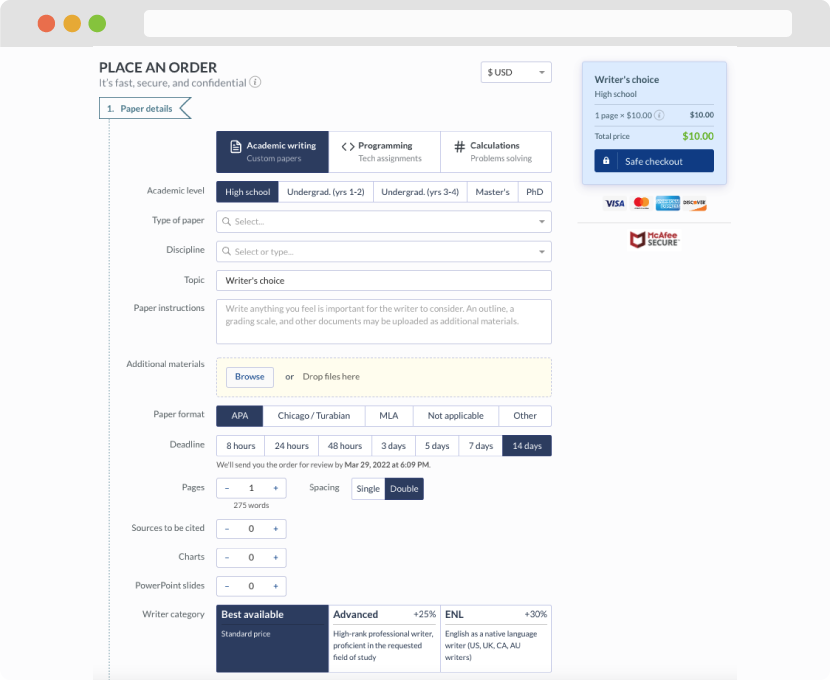
First, you will need to complete an order form. It's not difficult but, if anything is unclear, you may always chat with us so that we can guide you through it. On the order form, you will need to include some basic information concerning your order: subject, topic, number of pages, etc. We also encourage our clients to upload any relevant information or sources that will help.
Complete the order form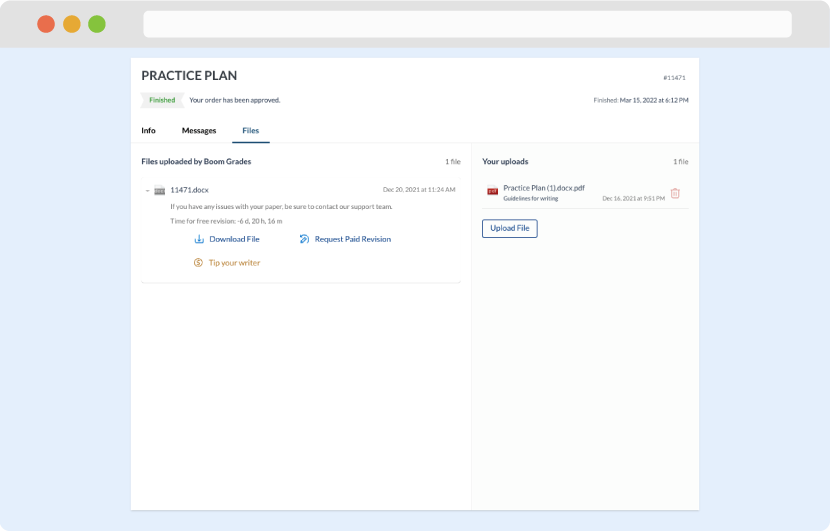
Once we have all the information and instructions that we need, we select the most suitable writer for your assignment. While everything seems to be clear, the writer, who has complete knowledge of the subject, may need clarification from you. It is at that point that you would receive a call or email from us.
Writer’s assignment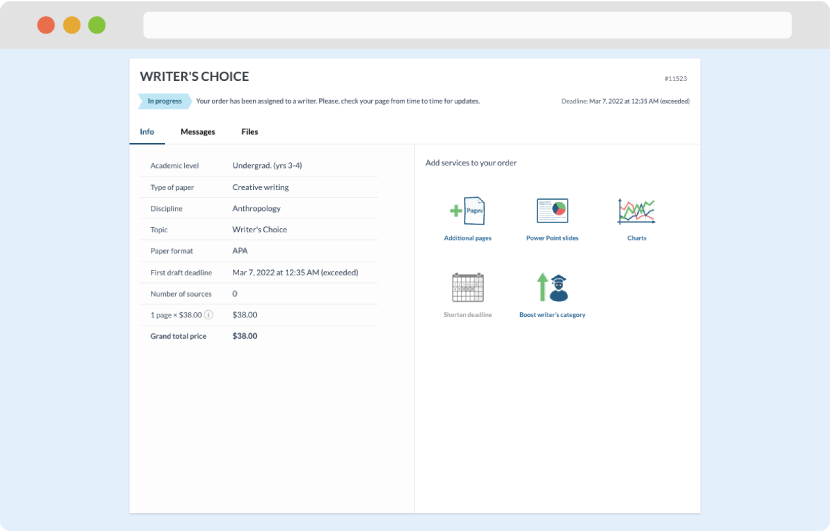
As soon as the writer has finished, it will be delivered both to the website and to your email address so that you will not miss it. If your deadline is close at hand, we will place a call to you to make sure that you receive the paper on time.
Completing the order and download