This assignment requires you to make connections between high-quality assessment and learning and innovation skills. Additionally, using the
Framework for 21st Century learning (Links to an external site.)
as a resource, you will redesign or modify a prior activity from one of your courses in the master’s program. There are several approaches you could take with this assignment. For example, you may redesign an instructional plan with assessment plans embedded throughout or a full assessment plan including a summative assessment you may have constructed. These are just two ideas out of numerous possibilities. If you do not have previous work to use for this assignment, please contact your instructor for guidelines on how to proceed. As needed, refer to your
program learning outcomes (PLOs) list
(MACI, MAECEL, MAED, MASE, or MATLT).
NOTE* Before you select the PLO’s you will highlight in this assignment, be sure to read the
final assignment
for this course to ensure that you will cover each of your programs PLOs adequately.
Create your assignment to meet the content and written communication expectations below.
Content Expectations
The Redesign expectations explain what you are required to do with the prior coursework you choose to redesign. The Summary expectations are for the separate written portion of this assignment.
& Innovation Skills, assess how it could be used as a tool for ongoing evaluation of student progress, and evaluate how it could be used as a guide for teacher and student decision making.
Written Communication Expectations
All sources on the references page need to be used and cited correctly within the body of the assignment.
For information related to APA style, including samples and tutorials, please visit the
Ashford Writing Center (Links to an external site.)
.
Next Steps: Review and Submit the Assignment
Review your assignment with the Grading Rubric to be sure you have achieved the distinguished levels of performance for each criterion. Next, submit the assignment for evaluation no later than Day 7.
Teacher Designated Assessment
Sharon A. Mitchell
ECE: 657 Assessment to Support Young Children
Dr. Latisha Shipley
September 17, 2020
Step 1
The teacher-designed assessment 1 ‘Even and Odd Assessment’ was chosen.
Step 2
The test is correlated with learning outcomes because it assesses the ability of students to count numbers up to 20. It also tests the knowledge of students on odd and even numbers and various shapes. The cognitive skills of students are tested adequately in the test. They are tested on the ability to think logically and problem-solve. Each section of the test has clear directions. The questions are also arranged from the simplest to the complex as the first one involves counting stars that are arranged in a way that is easy to determine whether they are odd or even. The last question asks students to determine odd and even numbers from shapes that do not have a pattern.
Point values for every question have clearly been stated. Various types of questions were not included because all the questions seemed to test the same concept of counting odd and even numbers. Questions types have been grouped because all of them have shapes that require the students to count. The questions were typed clearly and there was ample room for answers. There were multiple choices in all the questions for the students to choose from. The appropriate reading level for students was used because those in the 6th grade are supposed to know how to count up to 20.
Step 3
The objective of the assessment was guiding teacher planning because it identified the skills and competencies that should have been acquired by the students. The instructor could notice that some of the students would not differentiate even and odd numbers. This would guide his/her planning as a focus on the teaching of odd and even numbers would be increased. The assessment would assess the problem-solving skills of students and their ability to count numbers and various shapes.
The teacher-designed assessment meets the characteristics of a quality teacher-designed assessment because it is content valid. The assessment matches the intended content closely. “An assessment should measure what it has been intended to measure” (Duman, 2017). The focus is only on math skills because there are short sentences for the questions. The assessment is also reliable because the assessment results of the students would be consistent. The student results in the assessment will be the same because there are multiple choices already provided. Students can tick the correct answer from the provided ones. Closed-ended questions are provided to ensure that standard answers are given by the students.
The assessment is appropriate for preschoolers because it tests the recognition of odd and even numbers and the counting of numbers. Preschoolers are supposed to have mastered the number system and should be able to count numbers correctly (McWilliam et al, 2020). They should also be able to recognize patterns such as shapes and numbers and problem-solve. The assessment consists of shapes arranged in a pattern that makes it easy for students to identify it. It also enhances their problem-solving skills because they are asked to count shapes.
There is alignment with the purposes of teacher-designed assessments because the odd and even assessment can be used to support the teacher’s decisions on the instruction of each student. The teacher can collect objective data on student learning from the assessment. “Teacher designed assessments provide additional information to make instructional decisions” (Buzzelli, 2018). The teacher can change his/her instruction on a student based on performance on the test.
The two ways in which the assessment could be used to inform instruction are determining the areas of focus from the assessment results and the topics that the instructor should not focus on. If all the students perform poorly on the differentiation between odd and even numbers, the teacher could be forced to repeat the topic. If they perform well, the teacher can look for more advanced topics to teach because it shows that students have grasped the concepts that have previously been taught.
REFERENCES
Buzzelli, C. A. (2018). The moral dimensions of assessment in early childhood education. Contemporary Issues in Early Childhood, 19(2), 154-166.
Duman, G. (2017). Using performance-based assessment in early childhood education. Educational Research and Practice, 225.
McWilliam, R. A., Morales-Murillo, C. P., & Stevenson, C. M. (2020). Assessment of Early Childhood School and Classroom Environments. Psychoeducational Assessment of Preschool Children.
Running head: ASSESSMENTS 1
Dr. Miller
April 16, 2018
ASSESSMENTS 2
Introduction
The lesson plan that I have chosen to modify for this week’s assignment, has been
modified to include different assessment throughout the lesson, both formative and summative.
The assessments that I have included throughout this modified lesson plan, include Specific
Learning and Innovation skills, specifically from the Creativity and Innovation section, as well
as the Communication and Collaboration section. In addition to the added assessments, I have
also included Program Learning Outcomes, PLO’s, from the Masters of Arts in Special
Education, MASE, program. The specific PLO’s that I have chosen for this lesson are PLO 1,
PLO 2, and PLO 6. PLO 1 is designing appropriate learning experiences for students with
exceptionalities that are informed by diverse cultural experiences and varied patterns of learning
and development. PLO 2 is creating a safe, inclusive, culturally responsive environment that
cultivates active and effective learning for students with exceptionalities. Lastly, PLO 6 is
integrating positive collaborative practices with various stakeholders to address the needs of
students with exceptionalities across a range of learning experiences (Ashford University, n.d.).
With the combination of these aspects, I feel that I have modified a lesson plan with assessments
that promotes learning, as well as promotes 21st Century Learning Skills.
Lesson Plan Modification
I modified my lesson plan to specifically provide evidence of mastery of the PLO’s, 1,2,
and 6. When it comes to PLO 1, I modified my lesson plan to include a variety of different ways
that I can present my instruction, as well as a variety of different activities that my students can
learn. This is evident throughout my lesson plan if you look at my lesson introduction, my lesson
development, the differentiation that is included in my lesson, the different assessment
opportunities that I have provided, as well as in the closing section of my lesson plan. There is
ASSESSMENTS 3
evidence of PLO 2 in the differentiation section of the lesson. I have differentiated this specific
lesson for a specific student based on their needs. By doing this, I am creating an environment
that is inclusive and cultivates active and effective learning for students with exceptionalities,
which is what PLO 2 is. With the last PLO that I chose, PLO 6, you can see evidence of this PLO
in the collaborative groups portion of the lesson plan, that is listed under the Assessment section.
Having the students work collaboratively together, I am providing them with a variety of
learning experiences and so are their peers by working collaboratively together.
In addition to the modifications that I made to include evidence of the PLO’s of the
MASE program, I also modified the lesson to include assessments, both formative and
summative. The goal of formative assessments is to monitor student learning to provide ongoing
feedback that can be used by instructors to improve their teaching and by students to improve
their learning (Eberly Center, n.d.). One way that teachers can improve their teaching and
students can improve their learning is through differentiated instruction. One thing that I found
very interesting about differentiated instruction is that by paying attention to the learning needs
of individual students, you can improve the academic outcomes for all students (Burnaford &
Brown, 2014). So, in order to improve the academic outcomes for all students, I feel that the
frequent use of formative assessments is very important. The formative assessments that I have
included in this lesson plan are whole group discussion with all of the students and collaboration
between the students. By providing those two opportunities, I can provide immediate feedback to
my students, as well as change the direction of my instruction to better meet my student’s needs.
When it comes to summative assessments, the goal of them is to evaluate student learning at the
end of an instructional unit by comparing it against standards or benchmarks (Eberly Center,
n.d.). The summative assessments that I have included in my lesson plan are by having them list
ASSESSMENTS 4
5 goals after the lesson was introduced in the first section of the lesson plan and by having them
complete a journal entry to include what they have learned, as well as to include specifics of the
CCSS that I have listed on this lesson plan. By having them complete those two assessments, I
am able to assess that the goal and the objective of the lesson was met.
Lesson Plan Evaluation
The assessments that I chose, promote Learning and Innovation Skills. The first
assessment that I have listed is under the Introduction portion of the lesson and that is when I
have the students list 5 goals that they would like to complete. This assessment is done after a
whole groups discussion about goals and why they are important. I have this specific assessment
meeting the Creativity and Innovation outcome under the Learning and Innovation Skills
outcome. This assessment meets the Creativity and Innovation outcome because I am having the
student brainstorm what 5 goals they would like to meet and using a wide range of idea creation
techniques is listed under the Creativity and Innovation outcome (Framework for 21st century
learning, n.d.). By having this assessment, I am able to decide what additional information may
be needed when the second session of the lesson resumes the following day. I can also use it as a
tool for ongoing evaluation by comparing it to the final project for this lesson. Under the
Communication and Collaboration outcome of the Framework for 21st Century Learning, I have
the summative assessment of having students write/type a journal response on a goal that they
have set for themselves and why goals are important. This summative assessment is listed under
the Written Response portion of the Assessment section of the lesson plan. In addition to these
requirements, students are also expected to have proper sentence and paragraph structure. This
summative assessment meets the Communication and Collaboration outcome because the
students are articulating thoughts and ideas effectively using oral, written, and non-verbal
ASSESSMENTS 5
communication skills in a variety of forms and contexts, as well as they are using communication
for a range of purposes (Framework for 21st century learning, n.d.). This is also a great
assessment for me to decide what direction I need to go in the future with instruction when it
comes to general information, as well as mechanics in writing. An assessment like this can also
be used in a student’s portfolio to show parents progress throughout the year. It is also a great
way to see what the student decides as being an important goal, as well as why goals are
important. Under this same outcome, I have also listed two formative assessments. The first one
is of a whole group conversation that is listed under the Checking for Understanding section
under the Lesson Development portion of the lesson plan. This assessment also meets this
outcome because students are listening effectively to decipher meaning, including knowledge,
values, attitudes, and intentions (Framework for 21st century learning, n.d.). Formative
assessments like whole group conversations are great because you can provide students with
immediate feedback and you can also decide as a teacher what direction you need to go with
your instruction. As with the summative assessments that I have chosen, you can also use whole
group conversations as an ongoing evaluation by asking frequent questions to your students to
identify what their needs may be. The second formative assessment that I also have listed under
Communication and Collaboration, is listed under the Collaborative Groups section of the
Assessment portion of the lesson plan and it is having students work together collaboratively. By
doing this, students are demonstrating their ability to work effectively and respectfully with
diverse teams, as well as they are assuming responsibility for collaborative work, and value the
individual contributions made by each team member (Framework for 21st century learning, n.d.).
As with the other formative assessment that I have included with this lesson plan, having small,
collaborative groups, you as the teacher can also guide a conversation, as well as provide
ASSESSMENTS 6
immediate feedback in order to direct your students in the right direction with the lesson. You
are also allowing the opportunity for your students to learn from one another and this promotes
students to make their own decisions when it comes to their learning.
Lesson Plan Reflection
When deciding what lesson plan I wanted to use for this assignment, I really took the
time on deciding what lesson I would chose based on how I could incorporate assessments that
would be beneficial to the students, as well as the teacher. This was a challenge because I found
out that my lesson plans were lacking a lot of qualities that could be beneficial for both the
students and the teacher. To overcome this challenge, I decided what assessments I wanted to
add and then I added the specific qualities that would support those assessments, as well as the
students and the teacher. The second challenge was to modify my lesson plan with the Learning
and Innovation Skills. In order to overcome this challenge, I broke down the assessments that I
wanted to use and aligned them with the Learning and Innovation Skills. I was more confident
when it came to adding the PLO’s from the MASE program and because of that, I added more
than what was required. Overall, the modification of this lesson was easier than the previous two
assignments because I have learned to break down the necessary aspects and components of the
lesson plan and add the necessary details to each section.
Conclusion
With the modification of this lesson plan, I have learned even more important aspects
when it comes to lesson planning. The specifics of this lesson plan that I learned more about
were assessments and aligning them to the 21st Century Framework Outcome of Learning and
Innovation Skills. In addition to learning more about assessments, I also learned even more on
how to show evidence of the PLO’s of the MASE program. All in all, lesson plans have been
ASSESSMENTS 7
very intimidating to me due to the many ways that you can design them, as well as everything
that has to be included. When I started this course a couple of weeks ago, I listed that as one of
my challenges and with that being said, I would have never thought that I would feel this much
more confident about lesson plans and adding more components to them.
ASSESSMENTS 8
Content Area or Developmental Focus: ELA
Age/Grade of Children: Second Grade
Length of Lesson: Two Sessions: First Session- 45 Minutes/ Second Session 1 hour
Goal Students will learn the importance of goal setting and how to set a goal.
Objective By the end of the lesson, students will be able to set a goal and be able to
describe how they are going to meet that goal.
Standards Included
CCSS.ELA-Literacy.W.2.2
Write informative/explanatory texts in which they introduce a topic, use
facts and definitions to develop points, and provide a concluding statement
or section.
CCSS.ELA-Literacy.W.2.6
With guidance and support from adults, use a variety of digital tools to
produce and publish writing, including in collaboration with peers.
CCSS.ELA-Literacy.SL.2.1
Participate in collaborative conversations with diverse partners about grade
2 topics and texts with peers and adults in small and larger groups.
Materials • Goal Setting Template: I want to (list behavior goal), by (date you want
to achieve the goal by). I will (what will you do in order to meet that
goal) to meet my goal (Boschen, n.d.).
• Crayons
• Markers
• Construction Paper
• Scissors
Introduction
(First Session of Lesson:
45 Minutes)
• To begin the lesson, have each student trace their hand on construction
paper and then cut it out. Have them set it aside.
• Start a large group discussion on what a goal is and give examples.
Talk about as a class why it is important to have goals, no matter how
old you are. Give the class some examples of what a goal can be. Take
one of the examples and as a class, break down the goal and come up
with ways that you can achieve that goal.
• Have the students take their hand that they traced and cut out and have
them write 5 goals about anything (Boschen, n.d.). It can be about
school, at home, with sports, with friends… (Summative Assessment:
Check the students’ hand cut outs with goals. Make sure there are 5
goals listed. If students have not filled out their hand cut out with the
assigned 5 goals, support them as needed in order for them to fill it out
correctly.)
http://www.corestandards.org/ELA-Literacy/W/2/2/
http://www.corestandards.org/ELA-Literacy/W/2/6/
http://www.corestandards.org/ELA-Literacy/SL/2/1/
ASSESSMENTS 9
Lesson Development
(Second Session of
Lesson: 1 Hour)
Direct Instruction:
Review as a class what a goal is.
-Vocabulary Words to Review:
Goals (Keep it simple. Explain to students that having a goal is having a plan
of action.)
-Guided Practice:
As a class, talk about what some of the goals that the students listed on their
hand cut out were.
Examples:
– I will use kind words when talking to my teacher, my peers, my siblings, my
parents…
– I will follow directions in the classroom.
– I will finish my chores before I leave for school.
– I will remember to pack my P.E. shoes on Tuesdays and Thursdays.
– I will be nice to my brother/sister.
– I will help my mom out more at home.
Now, as a class take on of those examples and break it down on how you will
achieve the specific goal using the formula:
I want to (list behavior goal), by (date you want to achieve the goal by). I will
(what will you do in order to meet that goal) to meet my goal (Boschen, n.d.).
Examples:
• I want to finish my chores before I go to school, by the end of April. I
will get up 30 minutes earlier in order to meet my goal.
• I want to be nicer to my brother, by the end of next week. I will start
allowing him to hang out with my friends and me in order to meet my
goal.
• I will help my mom out more at home, by the end of this month. I will
start cleaning up the kitchen for her and helping her with dinner to
meet my goal.
-Check for Understanding (Whole Group):
Ask the students:
What is a goal and why are they important?
(Formative Assessment: Depending on the students’ answers, base the
direction of your instruction off of that.)
Differentiation • Give Bianca an example of the goal writing sheet with the formula that
was gone over as a class.
• Sit Bianca in the front to lessen distractions and to help with listening
comprehension.
• When doing collaborative groups, make sure groups are no larger than
3. Structure groups based on strengths and weaknesses of the
individuals of the group. Also, give roles to group members to
encourage all students to participate.
ASSESSMENTS 10
• Bianca will write her future goal which is a requirement of the written
response portion of the lesson plan. For the explanation of why goals
are important, Bianca will orally present that explanation to the teacher.
Assessment
(Practice/ Checking for
Understanding)
Collaborative Groups:
• Group students in groups no larger than 3.
• Have each group come up with a goal that they will be able to use in
the classroom.
• They will fill out their own goal setting template with the required
template that they need to follow. I want to (list behavior goal), by
(date you want to achieve the goal by). I will (what will you do in order
to meet that goal) to meet my goal (Boschen, n.d.).
• As a group, they will present the goal to the classroom and how they
are going to achieve the goal.
• Encourage students in the audience to ask questions to the students that
are presenting about their goals.
CCSS.ELA-Literacy.SL.2.1
Participate in collaborative conversations with diverse partners about grade
2 topics and texts with peers and adults in small and larger groups.
(Formative Assessment: Have students collaborate about a goal and fill out
the goal setting template. Based on their responses and discussions, the teacher
will be able to determine whether or not they comprehend the concept of goal
setting.)
Written Response:
• Each student will type a journal response on one goal they have for
themselves in the future. It can a goal that they have for the next day,
the next week, or even years later. They will also explain within their
journal response why goals are so important.
• The journal response will be 2-3 paragraphs. Students will use proper
sentence structures, as well as proper paragraph structure.
Summative Assessment: Students’ journals will assess whether or not
students understand the concept of goal setting. Their journals will also assess
their understanding of the CCSS:
CCSS.ELA-Literacy.W.2.2
Write informative/explanatory texts in which they introduce a topic, use
facts and definitions to develop points, and provide a concluding statement
CCSS.ELA-Literacy.W.2.6
With guidance and support from adults, use a variety of digital tools to
produce and publish writing, including in collaboration with peers.
http://www.corestandards.org/ELA-Literacy/SL/2/1/
http://www.corestandards.org/ELA-Literacy/SL/2/1/
http://www.corestandards.org/ELA-Literacy/W/2/2/
http://www.corestandards.org/ELA-Literacy/W/2/2/
http://www.corestandards.org/ELA-Literacy/W/2/6/
http://www.corestandards.org/ELA-Literacy/W/2/6/
ASSESSMENTS 11
Closing Close the lesson with posting all of the groups goals in the classroom. Explain
to the students that as a class all of these goals will be revisited to see if they
have achieved them or not.
***When the goals are completed, celebrate as a whole class.***
Assessment Plan Summative Assessments:
Creativity and Innovation:
• Using a wide range of idea creation techniques, such a brainstorming
(Framework for 21st century learning, n.d.).
To meet this assessment goal, have students brainstorm 5 goals that they
would like to complete and listing them on the cut out of their hand.
Communication and Collaboration:
• Articulate thoughts and ideas effectively using oral, written, and
nonverbal communication skills in a variety of forms and contexts
(Framework for 21st century learning, n.d.).
• Use communication for a range of purposes (e.g. to inform, instruct,
motivate, and persuade.) (Framework for 21st century learning, n.d.).
To meet this assessment goal, have students complete a journal entry on a goal
that they would like to complete, as well as why goals are so important.
Students must follow specific sentence and paragraph structure in order to
meet the CCSS: CCSS.ELA-Literacy.W.2.2 and CCSS.ELA-
Literacy.W.2.6.
Formative Assessments:
Communication and Collaboration:
• Listen effectively to decipher meaning, including knowledge, values,
attitudes, and intentions (Framework for 21st century learning, n.d.).
To meet this assessment goal, check for understanding after guided practice.
This can be done through whole group discussion.
Communication and Collaboration:
• Demonstrate ability to work effectively and respectfully with diverse
teams (Framework for 21st century learning, n.d.).
• Assume shared responsibility for collaborative work, and value the
individual contributions made by each team member (Framework for
21st century learning, n.d.).
To meet this assessment goal, have students work together in collaborative
groups of no more than 3 students. Have them come up with a goal and fill out
the goal template together. Students will present the goal to the class.
Evidence Based
Strategies for Teaching
Self-Determination
Skills Within This
Lesson
Develop Goal Setting and Planning
• Teach children and youth family values, priorities, and goals.
• Define what a goal is and demonstrate the steps to reach a goal.
• Support children and youth in developing values and goals.
Promote Self-Advocacy
http://www.corestandards.org/ELA-Literacy/W/2/2/
http://www.corestandards.org/ELA-Literacy/W/2/6/
http://www.corestandards.org/ELA-Literacy/W/2/6/
ASSESSMENTS 12
• Encourage communication and self-representation.
• Provide opportunities for leadership roles at home and in school.
Facilitate Development of Self-Esteem
• Create a sense of belonging within schools and communities.
Bianca’s Goals Within this lesson, the following goals of Bianca’s will be supported:
• Reading Comprehension
• Written Expression
• Listening Comprehension
• Initiating and Maintaining Peer Interactions
• Conversation
• Social Language/Body Language
• Learning Through Visuals
ASSESSMENTS 13
Ashford University. (n.d.). EDU 696 Course Syllabus . Retrieved from
https://ashford.instructure.com/courses/20955/assignments/syllabus
Boschen, J. (n.d.). Student Goal Setting in Elementary School. Retrieved from What I Have
Learned Teaching: https://www.whatihavelearnedteaching.com/student-goal-setting-in-
elementary/
Burnaford, G., & Brown, T. (2014). Teaching and learning in 21st century learning
environments: A reader. Lachina Publishing Services .
Eberly Center. (n.d.). What is the difference between formative and summative assessment?
Retrieved from Carnegie Mellon University:
https://www.cmu.edu/teaching/assessment/basics/formative-summative.html
Framework for 21st century learning. (n.d.). Retrieved from http://www.p21.org/our-work/p21-
framework
Read the Standards. (n.d.). Retrieved from http://www.corestandards.org/read-the-standards/
EDU 696: Capstone 2: Culminating Project
Lesson Plan Template
References
Lesson Plan Template
– Overview
Subject:
Grade:
Topic:
Duration:
Goals/Objectives:
This is what students will be able to know or do at the end of the less
Standards Covered:
Standards might be by state (visit your State Department of Education website), Common Core (http://www.corestandards.org), NAEYC (http://www.naeyc.org) or even performance-based. Standards are the knowledge or skills that students will be expected to demonstrate.
Materials:
The list of all items needed throughout a lesson.
Introduction:
Teachers will activate students prior knowledge and experience to help them relate to the lesson and to peak their interest.
Lesson Development:
The information that will be covered and how (through modeling, direct instruction, centers, etc.), along with the questions that will be covered. This is where you will share what you will do to teach your students the concept.
Practice/ Checking for
Understanding:
Students are given the opportunity to apply what they have learned. It can be through guided practice and/or independent practice. Guided practice allows students to demonstrate their understanding of the material while the teacher is present and can provide needed assistance. Independent practice might be group work, projects or homework.
Closing:
Here the teacher reviews the highlights of a lesson and brings closure to the activity.
Personal Reflection:
Here the teacher reflects on what went well during the lesson, what might need to be adjusted next time, and any information that still needs to be addressed in order for students to meet their goals or objectives.
Lesson Plan Template
Subject: Reading/English
Grade: This lesson is designed for first grade students.
Topic: We’re going on a Mouse Hunt!
Duration: Week one
Goals/Objectives:
When given pictures and vocabulary clues, the student will be able to respond orally to a book that is read. The student will be able to use apply critical thinking by telling what is expected to happen in the story.
Standards Covered:
GA-GPS.ELA 1R3.h Applies learned phonics skills when reading and writing words, sentences, and stories.
STANDARD-The student demonstrates the ability to read orally with speed, accuracy, and expression.
Materials:
Vocabulary cards, pencils, and Journals
Introduction:
The purpose of teaching this unit lesson is use informational, non, informational, and electronic text to teach reading and writing.
Lesson Development:
The questions that will be covered are, Why do you think the mouse will make a good pet? Why do you think the mouse would not make a good pet? What types of food does the mouse eat? What type of home does the mouse live in?
Practice/ Checking for
Understanding:
After reading the story and showing the pictures and vocabulary clues, the teacher will walk around and observe the students pictures, the teacher will have a checklist that will check for the following, the mouse in the picture, pictures about the book and any words.
Closing:
Personal Reflection:
I feel that this lesson is very valuable, if I am the facilitator, but the students will have no reservation about joining in on the lesson. This is especially true when it comes to the discussion and sharing their pictures.
Essay Writing Service Features
Our Experience
No matter how complex your assignment is, we can find the right professional for your specific task. Achiever Papers is an essay writing company that hires only the smartest minds to help you with your projects. Our expertise allows us to provide students with high-quality academic writing, editing & proofreading services.
Free Features
Free revision policy
$10Free bibliography & reference
$8Free title page
$8Free formatting
$8How Our Dissertation Writing Service Works
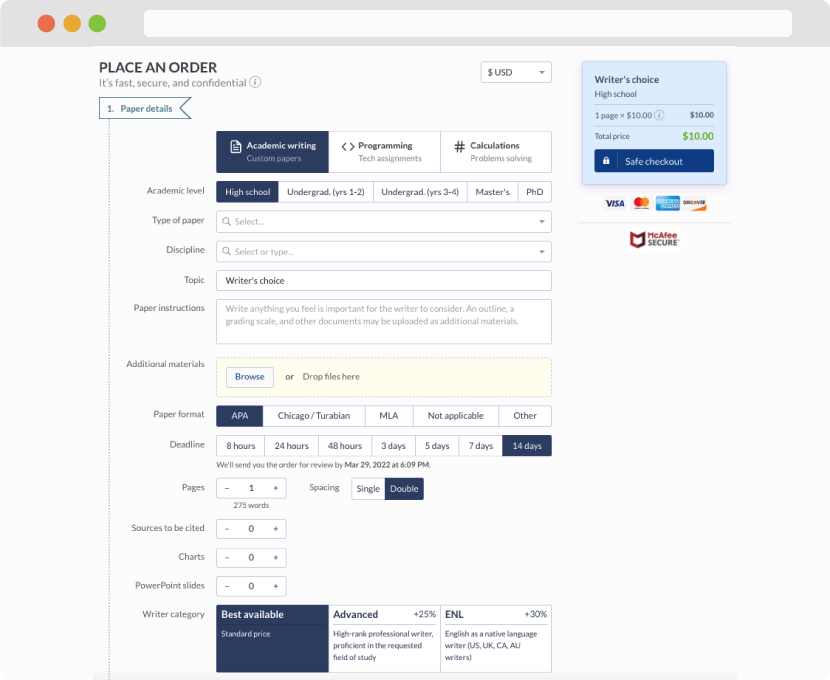
First, you will need to complete an order form. It's not difficult but, if anything is unclear, you may always chat with us so that we can guide you through it. On the order form, you will need to include some basic information concerning your order: subject, topic, number of pages, etc. We also encourage our clients to upload any relevant information or sources that will help.
Complete the order form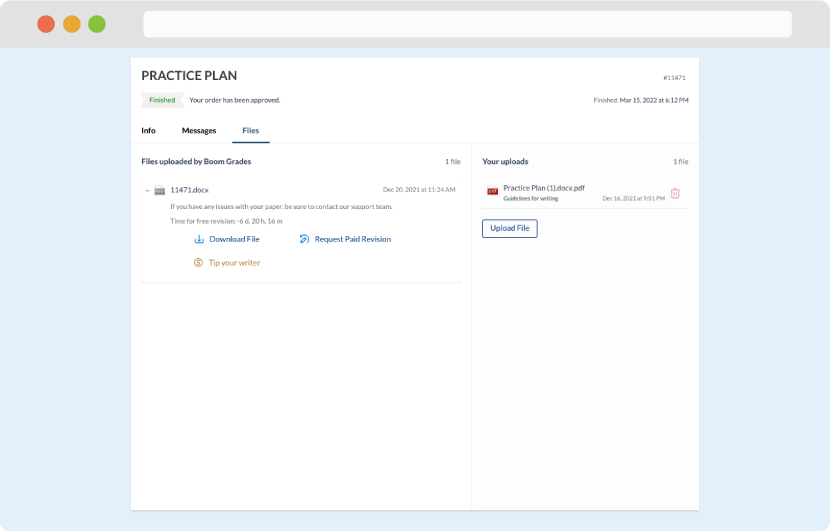
Once we have all the information and instructions that we need, we select the most suitable writer for your assignment. While everything seems to be clear, the writer, who has complete knowledge of the subject, may need clarification from you. It is at that point that you would receive a call or email from us.
Writer’s assignment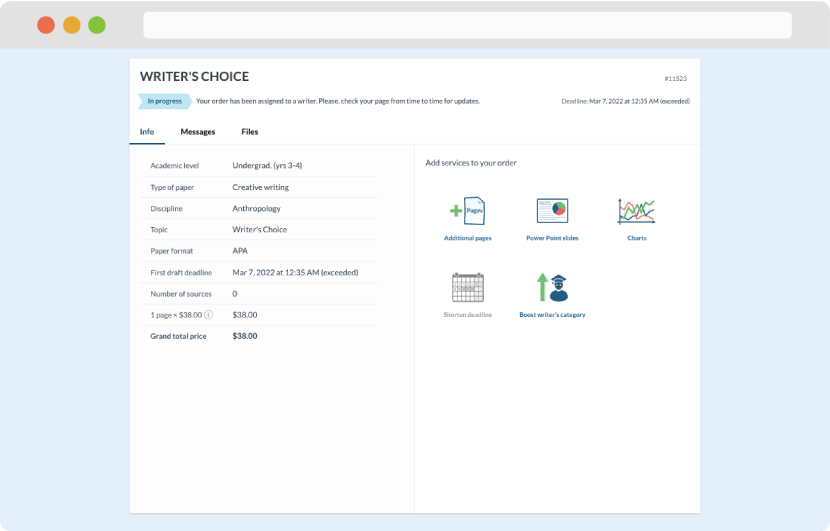
As soon as the writer has finished, it will be delivered both to the website and to your email address so that you will not miss it. If your deadline is close at hand, we will place a call to you to make sure that you receive the paper on time.
Completing the order and download