Submit your 2- to 3-page Individual Reflection. Your Individual Reflection must:
Assignment:Individual Reflection: Following and Leading
If you take a closer look at the many roles leaders have in the business world, you might notice that many of them are followers as well as leaders. Most executives within organizations, while they may lead their specific departments, must answer to someone higher in the organization. Even the CEOs of Fortune 500 companies must report to and follow a board of directors. As you progress through your career, you may find that there are many times that your role within an organization requires both effective leadership and followership.
For the Week 2 Individual Reflection, you will write a 2- to 3-page personal reflection on the kind of leader and follower you are, and you will consider qualities you would like to cultivate to be a more effective leader and follower. First, take “The Big Five Personality Test.” Consider what it says about your personality, the challenges you may have in working with others, and the challenges others might have when working with you. For example, perhaps you are respectful and kind to others, but you are disorganized. While you may be pleasant to work with, you have difficulty meeting deadlines and need to remember appointments. If you disagree with the results of the test, consider asking a trusted friend to review the results and see if he or she agrees or not.
Submit your 2- to 3-page Individual Reflection. Your Individual Reflection must:
· Summarize the results of the “Big Five Personality Test”
Free Big Five Personality Test – Accurate scores of your personality traits (truity.com)
and state whether you agree with the results. Provide a rationale to support your conclusion.
· Assess how your personality influences how you lead and how you follow. Draw on your professional and personal experience to provide examples.
· Analyze how you, as a follower, can contribute to effective leadership in a business organization. Provide an explanation to support your analysis.
· Analyze how you, as a leader, can encourage effective followership in a business organization. Provide an explanation to support your analysis.
· Finally, select one personal quality you would like to improve to become a more effective leader and follower. Provide a justification as to why this improvement would be a benefit to you and an organization.
Grading Information
Grading criteria as following:
· APA citing 7th edition
· No Plagiarism
· Click the Week 2 Assignment Rubric
https://class.waldenu.edu/webapps/bbgs-deep-links-BBLEARN/app/course/rubric?course_id=_16795705_1&rubric_id=_2130376_1
to review the Grading Criteria for the Assignment.
The Leadership-followership Dynamic: Making the
Choice to Follow
Raymond W. Cox Ⅲ, The University of Akron, Ohio, USA
Gregory K. Plagens, The University of Akron, Ohio, USA
Keba Sylla, The University of Akron, Ohio, USA
Abstract: Leadership studies generally focus on the role and importance of the positional or formal
leader. The paradigmatic leader is the great military or political figure—the historian’s “great man.”
There is no coherent foundational perspective on followership that is not the resultant of leadership.
This work offers a framework for a follower-centric view of leadership that reveals the importance of
followership. Leaders and followers exhibit different attributes depending upon the organizational
setting. To acting of following requires the organizational attribute of a willingness to be lead, but
also the interpersonal attribute of the capability to respond (knowledge, experience). Understanding
each other’s role and values is essential in this transformation of the traditional view in organizations.
To lead requires the organizational attributes of decisiveness, problem recognition and the capacity
to prioritize, but also the interpersonal attribute of the willingness to conduct a talent search (finding
someone to follow). Followership is not merely the actions of a subordinate who accepts and obeys
the dictates of the organizational authority figures. Therefore, followership is not the same as following.
Following is impelled (consciously or unconsciously influenced) by actions of leaders. Following is
reactive. In contrast followership is an a priori choice (self-conscious) of the individual in the context
of his or her relationship to the nominal leader. Issues of authority and rank play little or no role in
such a choice. Followership is interactive. Followers are in control the situation by the choices made.
Therefore, organizational success is in the hands of followers.
Keywords: Leadership, Inter-personal Relations, Management, Decision-making, Problem-solving
Introduction
THE IDEA AND ideal of leadership has long been a topic of study for historians,sociologists, political scientists, social psychologists, and those in business adminis-tration. Intermittently it has been a topic in public administration. The study of
leadership in the public sector has changed considerably over the years, in part based
upon which disciplinary perspectives those in public administration chose to borrow. For
much of the last one hundred years and with the notable exception of Weber’s (1946) studies
on the bases for “authority,” leadership studies have inevitably focused on the role and im-
portance of the positional or formal leader. The simple assumption affirmed by the surveys
and studies is that the leader is synonymous with institutional authority. The paradigmatic
leader is the great military or political figure—the historian’s “great man.” As Plagens (2009)
notes:
Formal leaders are not the only individuals in an organization that can shape outcomes,
however. In the leadership literature attention is given to the idea of leadership from
The International Journal of Interdisciplinary Social Sciences
Volume 5, Number 8, 2010, http://www.SocialSciences-Journal.com, ISSN 1833-1882
© Common Ground, Raymond W. Cox Ⅲ, Gregory K. Plagens, Keba Sylla, All Rights Reserved,
Permissions: cg-support@commongroundpublishing.com
within or from below, suggesting that anyone, regardless of formal title or rank, can
contribute as a leader (Covey 1989, 2004; Kouzes and Posner 2007). The importance
of informal leaders cannot be denied, but they are not as easily identified and their
formal controls in organizations are often limited or nonexistent (p. 85).
Regardless of the orientation to leadership in the literature, one constant seems to be the
importance of the leader in organizational decision-making and organizational effectiveness.
Whether it is a book on the philosophy of Sun Tzu (Michaelson, 2003), biographies of
Douglas MacArthur (Manchester, 1978; Haugen, 2006), a treatise on ethics and leadership
(Ciulla, 2004), or a straight-forward exploration of leadership (Selznick, 1957), each begins
from the seemingly unassailable assumption that good (positional) leadership makes organ-
izations better.
One compendium on leadership suggests that there are “almost as many different
definitions of leadership as there are persons who have attempted to define the concept”
(Bass 1990:11). Still, Bass goes on to classify the many definitions of leadership into
eleven categories. Among the classifications are…. leadership as a means of focusing
on group change, activity, and process; leadership as the activity of influencing change
in the conduct of people; and leadership as an instrument of goal achievement. By these
definitions, leadership is about relationships and about action… (Plagens, 2009, p. 84).
The leadership-followership dynamic was not fully studied in the literature of leadership in
organizations for decades. Most of the discussions have focused on the domination of leader
over the follower or subordinate in organizational settings. Baker (2007) points out that
followership or follower has been used in management and organizational literature since
the 1950s. It is only in the last three decades, as leadership theories began to emphasize
transformational leadership in contrast to transactional leadership, that a fuller understanding
of the relationship between those we call “leaders” and those we call “followers” was explored
(Bryman, 1996; Burns, 1978). While a few studies of followers have been offered in the last
few years, we do not yet have a coherent foundational perspective on followership that is
not merely the resultant of leadership. The goal of this work is to begin to fill that void in
the literature by offering a follower-centric view of leadership theory.
The first task is to provide two quick definitions. For the time being traditional viewpoints
will be presented. As this work progresses, more complex definitions will emerge. Leadership
is the capacity to exercise influence over the actions of others such that the others behave
in the manner the leader desires. Leading is the self-conscious actions of an individual vested
with the capacity and/or responsibility to exercise leadership. Traditionally, followership
(sometimes called “followship”) represents the conscious and unconscious behaviors of
persons and groups in support of the goals and desires of a leader which have been expressed
in words or conduct.
Three bodies of literature from public administration, business administration and the
social sciences have contributed to our current understandings of leadership and followership.
In part because of the interest of academics in public and business administration, the exercise
and practice of leadership has typically been presented in the context of organizational
structures and processes. To understand where we stand with regard to the theory and practice
of leadership and followership, we must explore, first, the historical evolution of leadership
38
THE INTERNATIONAL JOURNAL OF INTERDISCIPLINARY SOCIAL SCIENCES
theory. As will be apparent from that history, our understanding of leadership changes, yet
never fully rejects earlier perspectives. Thus, even as that evolution suggests a shift from an
organizational to a more inter—personal and individual understanding of leaders and follow-
ers, leadership theory essentially follows two somewhat distinct pathways—one that continues
to see leadership as an intentional contributor to positive organizational outcomes, and a
second that sees leadership as isolated interactions between individuals that may or may not
connect within the context of an organization. Through the examination of, first, a historic
review of leadership theory and then a summary of the organizational and interpersonal ap-
proaches to the leader-follower dynamic, we lay the groundwork for the final element of the
paper—a follower-centric theory of leadership.
The Evolution of Leadership Theory
The interplay of theory and practice of leadership has followed a somewhat dialectic path.
Even as each theory is presented, there seems to emerge a counter-argument or opposing
perspective expressed by those in the academy. This synthesis-antithesis byplay is the basis
for the presentation of the literature on leadership. Thus each of the sections that follow will
offer, first, a central theme and then a commentary on the critics of that theme. Secondly,
the emphasis shifts from a primarily organizational perspective to an individual and/or inter-
personal perspective. This shift to a more interpersonal basis was necessary for a consideration
of followership. But it should be noted that current leadership theories exist on the parallel
planes of the organization and the individual.
Leadership as Command
Traditionally, leadership or a leader in an organization is viewed as a person who has the
capacity and the power to lead followers or subordinates. Well into the twentieth century
leadership was seen as the result of the singular will of the leader: Julius Caesar (I came, I
saw, I conquered) or Douglas MacArthur. The central understanding of leadership was based
on the notion that the leaders actively lead and the followers or subordinates, passively and
obediently, follow. The basic premise of this style of leadership is that leaders give orders
(commands) to homogeneous followers. Leadership can be characterized as the exercise of
power.
This conception of leadership was developed in the early twentieth century. The “Scientific
Management” theory introduced by Frederick Taylor (1911), the charismatic and authorit-
arian leader evoked by Max Weber (1946), and the command approach in administrative or
bureaucratic organizations, and in government (Gulick, 1937) all generate a kind of control
and power from the top down, and the subordinates in these organizations were practically
under the submission of the leader.
Counterpoint: Cooperative Leadership
From the beginning there were those who doubted and challenged this approach. Exemplars
of these critiques of the accepted views on leadership were Follett (1937; 1996) and Barnard
(1968). The vision of the leaders expressed here is that of a conciliator and facilitator. A half
39
RAYMOND W. COX Ⅲ, GREGORY K. PLAGENS, KEBA SYLLA
century later these writers would provide the basic frame of reference for advocates of a
more “follower-centric” approach to leadership.
Follett’s view on the giving of orders presages future works of much later scholarship. It
is in her work on orders that the emphasis on individualism and the dignity of the work come
through most clearly. Follett firmly believed that orders, like control, involved a reciprocal,
integrative activity. Compliance with orders was not simply the product of the authority of
the issuer of the orders (Follett, 1996).
Barnard’s The Functions of the Executive (1968) has influenced generations of organization
theorists. His emphasis on cooperation, leadership, and the informal group represents a major
departure from the structural and authoritarian assumptions characteristic of classical organ-
ization theory.
Leadership of Groups
During the middle and later decades of the twentieth century (and into this first part of the
twenty-first century) concern for the worker both as an individual and as part of a group
becomes paramount. This is a time when the human element in organizations becomes
defined as the most important factor in an organization’s success. Concerns as varied as in-
dividual motivation to managerial capability to lead are facets of human relations in the or-
ganization. The basic premise of this “group-based” style of leadership is that leaders must
work with followers who are heterogeneous and respond to quite different internal and ex-
ternal “stimuli”.
A dissatisfied or unmotivated worker will make little use of a well-structured facility, and
a motivated employee will be able to do better under adverse physical conditions.
The Hawthorne experiments were the emotional and intellectual wellspring of the or-
ganizational behavior perspective and modern theories of motivation. The Hawthorne
experiments showed that complex, interactional variables make the difference in motiv-
ating people—things like attention paid to workers as individuals, workers’ control
over their own work, differences between individuals’ needs, management willingness
to listen, group norms, and direct feedback (Roethlisberger, 1989, pp. 28–29).
Counterpoint: The Psychology of Leadership
Criticism of the group dynamics perspective came from both those who were unwilling to
relinquish the traditional views of leadership and from those (primarily psychologists) who
found the focus on group dynamics did not leave sufficient room to explore individual rela-
tionships.
Maslow first presented his views on human motivation in 1943.In that work he presented
his now famous hierarchy of needs. Those needs are: physiological, safety, love, esteem,
and self-actualization. First, it is important to understand the interrelationships among these
needs. Second, satisfaction need not be complete before the needs of a higher level are ad-
dressed. Third, and probably most important, is that these needs are generally unconscious.
While higher-level needs can be brought out in each of us and therefore become conscious,
this is not often the case. Fourth is that all behavior is motivated; some behavior is an expres-
sion of personality and experience rather than needs.
40
THE INTERNATIONAL JOURNAL OF INTERDISCIPLINARY SOCIAL SCIENCES
All this suggests that goals are the central principle within the concept of motivation.
Gratification through the attainment of goals is the basic process for determining a shift to
other needs (and therefore goals). The point is that the work setting must be taken into account
if the manager is to create a work environment where achievement of higher needs is possible
(Fiedler, 1967). For Fiedler, the differences are likely to be found in the flexibility and ad-
aptability of management style of the respective manager.
Another psychological approach comes in the exploration of the role of “power” and/or
authority in defining the relationship between leaders and followers. The more commonly
applied approach is that of French and Raven (1959), who explored the role of “power” in
structuring and defining relationships in an organizational setting. French and Raven offer
five different forms or types of power:
• Reward
• Coercive
• Legitimate
• Referent
• Expert
The idea of power and influence in organizations represents a logical starting point for a
broader study of leadership in organizations. This perspective differs from that which we
have just described, in that it is more socio-psychological rather than psychological.
Organizational Leadership
By the 1960s it was apparent that organizational leadership was more than merely giving
orders. While some of the very earliest theorists would affirm this assertion, the new gener-
ation of theorists would push the boundaries of our understanding of leadership by focusing
on the dynamic of the relationship as an element of organizational behavior. Much of the
work would focus on management and management styles. While in one sense the study of
management is a diversion from the study of leadership, it strengthens the sense of the inter-
connectedness of “leaders’ (managers) and “followers” (subordinates). The work of Herzberg
and Maslow both serve as foundation elements of these new studies. But two more new
perspectives are exemplars of the leadership literature. From decidedly different perspectives
(and even different generations) Douglas MacGregor and Max Weber offer critiques of or-
ganizational leadership.
McGregor (1960) suggested that the quality of performance in most organizations is at
least partially the product of the manager’s beliefs in, and expectations of, the abilities of
employees. He contrasts two management styles: one he designates as Theory X and the
other as Theory Y. McGregor postulates that these management styles are the result of a
manager’s beliefs about basic human nature. In contrast, the manager who has a more positive
view of human nature will adapt a management style to maximize those positive attributes.
The Theory X manager, who has little faith in human nature, is driven to develop a manage-
ment style that emphasizes control and accountability. The worker cannot be trusted; he
must be watched and bullied and bribed into doing any work. The Theory Y manager defines
the task of management as being that of unleashing human potential so that the worker can
get the job done. Like much other research, the point is not whether introducing Theory Y
41
RAYMOND W. COX Ⅲ, GREGORY K. PLAGENS, KEBA SYLLA
management would solve most problems of motivation and performance. Human nature
bears directly on trust and the extent to which certain organizational methods can be used
to control employee behavior.
Weber’s (1946) early work on the bases of authority becomes available in translation for
US researchers in the 1940s. This critical work suggests three forms of organizational author-
ity: traditional, charismatic and legal-rational. This is not the place to explore the full effect
of these classifications. One critical point is that authority is not the same as leadership.
Based upon this and other works by Weber, for the first time the simplistic notion that
leaders are the boss is challenged. This distinction will be critical for a future generation of
researchers.
Counterpoint: The New Public Management (NPM)
The New Public Management movement reasserts a predominately organizational and au-
thority-centric perspective on leadership. This third iteration of the economics/marketing-
based model of management (following public choice theory and the reinvention movement)
borrows perspectives from each of its predecessor approaches. The NPM is more strongly
analytic and applies techniques in which the appropriate “real world” behavior is based upon
statistical and mathematical modeling that begin with assumptions (all people are egotistical
and self-interested) and outlooks (altruism leads to bad outcomes) that are derived from
economics. The NPM is not a cohesive and unambiguous set of ideas; there have been some
internal variations among the proponents of this approach and among their ideas. The shared
values and perspectives inthe NPM are as follows:
• Analytic techniques
• Policy making and decision making
• Contracting out
• Limiting the scope and reach of government
• Renewed emphasis on the public choice goals of economy and efficiency
• Entrepreneurship (Cox, Buck and Morgan, 2011, p. 16).
The use of the words “new public” makes it easy to confuse New Public Administration and
New Public Management, but the two bodies of thought are quite different. They emerged
under different conditions, NPA during a time of social change and NPM in a time of focus
on economics and profiting from the private market. Though there are similarities, NPA and
NPM represent opposites on the continuum of values in public administration. NPA had a
“macro” orientation, with concern about conditions in the broader society, especially sub-
stantive equality and social justice. NPM has a “micro” orientation, concentrating on deliv-
ering services at the lowest per unit cost. In concept, citizens in NPM are separate from
government in the same way customers are separate from a business firm. They are people
who consume services, rather than people who gather to decide what should be done. The
expectation of public-service practitioners in NPM is that they carry out policy decisions
from elected officials and citizen survey opinion to fine-tune the techniques used in delivering
services.
As with public choice theory and “reinventing government” perspectives before it, the
NPM shares a suspicion about the capacity and capability of government organizations and
42
THE INTERNATIONAL JOURNAL OF INTERDISCIPLINARY SOCIAL SCIENCES
a faith in “market-driven” perspectives as the path to organizational effectiveness. These
perspectives also share the use of a set of techniques and practices (program evaluation,
cost-benefit analysis, etc.) that begin from an economic perspective (both academic and
practical). In this sense they represent an extension of the generic management movement
and the emergence of the science of social existence. These perspectives also yield the same
result. Public decisions are to be left to the expert. Decisions cannot be left to amateurs. The
criterion for “right decisions” is in who decides, not in the quality of the process (Cox, Buck
and Morgan, 2011, p. 17). In many ways the NPM offers a vision of leadership that is quite
like that of scientific management. The worker, the subordinate, and the citizen/customer
are simply situational factors to be considered in decision-making.
The Leadership-followership Dynamic
Infrequently, we get a glimpse of approaches to leadership that are not based upon hierarch-
ical assumptions —Follett (1926) and Barnard (1968) being the earliest best examples. Fol-
lowing that lead, Gulick would assert that the motivation of workers and their affinity for
the goals of the organization are critical. In a statement that broke with the scientific man-
agement tradition, Gulick commented:
Human beings are compounded of cogitation and emotion and do not function well
when treated as though they were merely cogs in motion. Their capacity for great and
productive labor, creative co-operative work, and loyal self-sacrifice knows no limits
provided the whole man, body-mind-and-spirit, is thrown into the program. . . .
It becomes increasingly clear, therefore, that the task of the administrator must be ac-
complished less and less by coercion and discipline and more and more by persuasion.
In other words, management of the future must look more to leadership and less to au-
thority as the primary means of co-ordination. (1937, p. 37, p. 39)
Four decades later Burns (1978) introduced transformational leadership as a reminder that
“cogitation and emotion,” when directed toward a shared mission, can transform an organiz-
ational culture.
One of the earliest theorists who referred to followership was Hollander (1955, 1992,
1997, 2004), who argued that leaders and followers are interdependent and must work to-
gether in order to improve the organization’s performance. Julian and Hollander (1969, cited
in Baker, 2007), concluded that leadership encompassed a “two way influence relationship”
(p.390) that contained an “implicit exchange relationship” (p.395) between the leaders and
the followers over time.
The leader cannot see himself or herself as someone who is holding an office with high
authority or someone who is always up to giving orders and or making all the decisions in
the organization. Leadership means understanding how to promote excellence and protect
values in the workplace (Locke, 2001, but also Arendt, 2003). This collaboration requires
changes in the assumptions about leadership and its definition. Leadership emerges through
a stance of flexibility and adaptability, trust from the followers, and accommodation to inev-
itable changes. This creates a partnership instead of a hierarchical relationship (Baker, 2007).
Transformational leadership, in contrast with the traditional views of leadership, generates
more collaboration between leader and follower, and this collaboration is, in general, based
43
RAYMOND W. COX Ⅲ, GREGORY K. PLAGENS, KEBA SYLLA
on trust of the leader or leadership in the organization. Jung and Avolio (2000) link increased
performance in an organization with trust in the leader. They assert that the followers’
commitment to the leader’s vision depends on the leader’s capability to build trust with fol-
lowers. High trust among followers is what enables a transformational leader and his or her
followers to persist in their efforts and to overcome obstacles. Leading by showing concern
for their needs, honoring agreements, demonstrating the capability and persistence to achieve
the vision, and possibly through their own willingness to sacrifice for the good of their group
forms the basis for the bond between the leader and the follower (Jung and Avolio, 2000,
pp.952).
Another aspect in the value congruence between follower/leadership relations in organiz-
ational settings concerns power. Burns (1978) and Carnevale (1995) are particularly emphatic
in their assertions that leadership is not power. Burns argues that power is applied to meet
the goals of the power wielder, whether or not these are the goals of the respondents (recip-
ients). Leadership over human beings is exercised when persons with certain motives and
purposes mobilize, in competition or conflict with others, institutional, political, psycholo-
gical, and other resources so as to arouse, engage, and satisfy the motives of followers (Burns,
1978).
While not wholly endorsing the Burns and Carnevale perspectives, Raven (2008) extends
his decades old analysis of power through an examination of what he defines as the three
different types of strategies available for a leader in his/her interaction with peers and subor-
dinates in an organization.
• Power that leads to socially independent change (informational power)
• Power that results in socially dependent change with surveillance necessary (reward and
coercive power)
• Power that leads to socially dependent change with surveillance unnecessary (legitimate,
expert and referent power) (2008, pp. 2-3).
These strategies are based on motivations which can be used by a leader to achieve the goals.
It also helps us to detect or to determine the behavior of the leader. The first type of power
is added by Raven to denote the response to the acquisition of data and knowledge—inform-
ational power. This is described by Raven as socially independent, because the willingness
to respond is based upon the material fact of the knowledge presented, not the provider of
the information.1 The second type of power relationship is characteristic of transactional
leadership, rather than transformational leadership. The third power relationship can be an
element of either transactional or transformational leadership. While the first of these three
understandings of power-legitimate power is associated with hierarchy and rule-based organ-
izations — it is personal in the sense that the choice to join the organization may be dependent
upon a perception of the legitimacy of the organization (and, therefore the organizational
leadership). The last form of power – expert power – is the individually constructed assess-
ment of the expertise of persons that drive informal networks. People seek out “experts” in
the hope/expectation of getting answers to questions. The search for expertise (or talent) is
the key to the emergence of informal networks and organizations inside the formal structure.
1 If the provider is relevant then we are in the realm of socially dependent change without surveillance. For example
an individual may judge a media outlet as biased. In that case the decision to accept the information is tempered
by the perceived bias.
44
THE INTERNATIONAL JOURNAL OF INTERDISCIPLINARY SOCIAL SCIENCES
It is the quality of these interpersonal interactions that yields circumstances in which both
the follower and the leader are looking for talent to follow and to lead. This interpersonal
dynamic becomes a driving force to introduce changes in the relations between both the
follower and the leader but also in the organization.
Redefining Leadership in Terms of Followership
Karl Weick (1979) famously said “How do I know what I said, until I see what I said?” This
odd little question summed up the then emerging theory on communications. Weick described
his model of communication as the “double interact.” The interaction is simply a feedback
loop, but in a different medium. Thus one person speaks to another and both observe and
hear the response. Based upon the twin response, the initiator of the conversation determines
if he/she was understood, triggering either new communication or a modification of the initial
communication (in an attempt to be understood). The “communication” is incomplete until
that understanding has been achieved. The burden of and responsibility for achieving under-
standing is on the initiator of the conversation. If we use the double interact framework to
understand the leadership-followership dynamic, a quite different perspective on leaders and
followers emerges.
Leading by Following
If, as has been asserted, organizations are networks of formal and informal relationships,
then network and communications theories go a long way toward explaining the dynamic
of informal organizations. As suggested earlier the foundational perspective of such networks
is trust. If organizations are to be successful, both the formal and the informal aspects of the
organization must be predicated on the following understandings of trust:
• Trust should affirm the organizational-interpersonal link;
• Trust should promote cultural values such as respect, vision, diversity, and empowerment;
• Trust should be built through the application of the skills of: talent searching, communic-
ating, deciding, self-assessing, enabling, culture creating, and culture affirming.
In summary, leaders and followers both must have the ability to interchange their role.
Meaning that the leader must be decisive and desirous of becoming the follower, and the
follower must be capable as well as desirous of leading. In addition, leadership is not only
a behavioral attitude but it also includes ethics and intention. An ethical leader is someone
who harmonizes beliefs and behaviors in his or her relations with followers. By doing so,
the leader enhances fairness, innovates and creates a good environment for all and, therefore,
the leader is doing what is “right” for the organization (Burns, 1978; Carnevale, 1995, Ciulla,
2004). This follower/leader dynamic reveals the importance of the followers and the accept-
ance of the leader to not use power or authority over the followers. This dynamic further
leads to understanding the effects of this duality at the organizational and interpersonal levels.
45
RAYMOND W. COX Ⅲ, GREGORY K. PLAGENS, KEBA SYLLA
Leadership as Talent Search
One of the basic responsibilities of organizational leaders is to resolve organizational prob-
lems. By reframing Weick’s notion of the double interact, a different way of understanding
the relationship between the “leader” and the “follower” can be offered. The “problem” in
problem solving is finding the person with the capacity and capability to address the problem.
Stated another way, problem solving is about searching for talented people to answer ques-
tions. This talent search also highlights the desire for the leader to understand when to become
a follower. Therefore, knowing one’s limits in a group or organization is a good thing in the
relationship. The process works as follows:
Having determined that a problem exists, a member of the organization seeks those
who might have knowledge and understanding of the problem. In seeking help the
leader is looking for a talented individual from whom to get answers to all or, more
likely, parts of the answers to the questions. This is a process that works through informal
channels. The first point, having identified the person who potentially has answers, is
not the same as having an answer. The “talent” must choose to answer the questions.
In hearing the answers, the initiator must then decide whether more questions remain
(i.e. he/she does not yet sufficiently understand to act). Therefore, the search for talent
must continue. It is in this way that both parties to the discussion exercise leadership;
the person takes responsibility for resolving the problem by gaining understanding. The
talented person chooses to help create understanding (an act of leadership). Then the
originator of the process decides when he/she has sufficient understanding to act (also
the exercise of leadership). In other words the leader chooses to become a follower,
allowing the follower to lead which in turn permits the leader to again lead.
Toward A General Theory of Leadership (Part I)
In 1978 James MacGregor Burns offered a glimpse at a “general theory of leadership” (pp.
422-443). It is his summary of the evolution of leadership theory after some 60 years of
academic discourse. His general theory begins from an assumption that there are two types
of leadership (Transactional and Transformational). The distinction between the two types
of leadership is in the values that form the basis of the act of leading:
• Transactional leadership to address modal values (values of means… honesty, fairness,
responsibility)
• Transformational leadership to address end-values (raise followers to seek principles
such as liberty, justice, equality)
Burns then adds three elements to complete his general theory. First and most critically,
leadership is “common” in the sense that all in an organization are capable of leading.
Secondly, organizational structures matter. Authority and power are important to the work
of an organization, though it may not explain organizational success. The organizational
structure is both a means by which to reach, or to be closed off from, followers. Third,
“political” leadership is a useful model for understanding leadership, because at its best it
is both loosely institutional and closely interpersonal. Lastly, leadership is an activity; it is
goal oriented (strategic perspective, decisiveness and problem solving). From the distance
46
THE INTERNATIONAL JOURNAL OF INTERDISCIPLINARY SOCIAL SCIENCES
of another thirty years, more elements can be added to our understanding of this dynamic.
First is that leadership, while most apparent in formal organizational settings, is sustained
through interpersonal relations. As a corollary, both leaders and followers exhibit different
attributes depending upon the role/perspective required in a given setting. For example, to
be a follower requires one to exhibit the organizational attribute of a willingness to be lead,
but the interpersonal attribute of the capability to respond (knowledge, experience). Similarly,
to be a leader requires the organizational attributes of decisiveness, problem recognition and
the capacity to prioritize, but the interpersonal attribute of the willingness to conduct a talent
search (finding someone to follow).
Conclusion
The challenge given at the outset can be restated as creating a theory of leadership which
complies with the definition offered by Burns… “the function of leadership is to engage
followers, not merely activate them, to commingle needs and aspirations and goals in a
common enterprise, and in the process to make better citizens of both leaders and followers
(Burns, 1978, p. 460).”
This definition affirms the importance and the centrality of leadership/followership in any
modern organization. The follower is no longer a mere subordinate who accepts and obeys
the dictates of the leader. The leader or leadership also is transformed due to the complexity
and the necessity of collaboration. Understanding each other’s role and values is essential
in this transformation of the traditional view in organizations. This complicity in the workplace
is the new face of any dynamic organizational setting, private or public. Their collaboration
creates a consensual basis for less conflict, and it generates empowerment for the organization
and for its personnel. It has also been observed that the leadership/followership dynamic
leads to ethical progress in the organization.
Leadership is a distinct kind of moral relationship between people. Power is a defining
aspect of this relationship. Whenever there is a change in the distribution of power
between leaders and followers, there is a change in the specific rights, responsibilities,
and duties in the relationship. Both sides have to be honest when they make these
changes and have to understand fully what they mean. Bogus empowerment attempts
to give employees or followers power without changing the moral relationship between
leaders and followers. Empowerment changes the rights, responsibilities, and duties of
leaders as well as followers. It is not something one does to be nice in order to gain favor
with people. Over the past fifty years, business leaders have tried to harness the insights
of psychology to make people feel empowered. These attempts have often failed and
led to cynicism among employees because business leaders have ignored the moral
commitments of empowerment. Without honesty, sincerity, and authenticity, empower-
ment is bogus and makes a mockery of one of America’s most cherished values, the
freedom to choose (Ciulla, 2004, p.80).
At the interpersonal level, the relationship is based on influence, courage and comprehension
from both sides. The leader must know how to become a follower, and the follower must
take responsibility and voice his or her concerns about the organization. Another distinction
is apparent from this study; followership is not the same as following. Following is impelled
47
RAYMOND W. COX Ⅲ, GREGORY K. PLAGENS, KEBA SYLLA
(consciously or unconsciously influenced) by actions of leaders. In this sense the follower
has no choice. Whether it is the influence of informational power or that impelled through
coercion or reward or by acceptance of authoritative rule, the following is a foregone conclu-
sion: the leader is in control. Stated another way, following is reactive. A successful leader-
follower relationship is predicated on the “proper” reaction of the follower to the initiative
of the leader. Therefore, the “action” closes with response of the follower. This dynamic is
often codified in the hierarchy. These formal (rule bound) relationships may be critical to
organizational processes (both the “leader” and the “follower” have to know their role). In
this sense the leader looks for a following.
In contrast followership is an a priori choice (self-conscious) of the individual in the
context of his or her relationship to the nominal leader. Issues of authority and rank play
little or no role in such a choice. Followership is interactive. Weick’s double interact
demonstrates the interactive character of the leadership-followership dynamic. The leadership
double interact requires that both leader and follower have a choice in whether or not to
participate; the leader is the reactor to request for help, which requires that organization au-
thority figures look for opportunities to follow. Finally, this is an informal process involving
a virtually continuous search for new data and knowledge through interpersonal interaction
with others.
Summary
To this compendium we suggest additional attributes of leaders and followers; a general
theory of leadership part II as it were.
About leaders….
• Leaders are persons in search of the opportunity to follow
• Leaders know when to become followers
• Success rests with the informal organizations
Followers can make “good” authority figures successful, but they cannot substitute
for “bad” leaders
•
• There is no permanent substitute for authority
About leadership….
• Leadership is learned
• Experiences (good and bad)
• Talent search
Giving in and giving over to more talented persons•
• Leadership is about exhibiting and affirming ethical values
Future oriented•
• Concerned about consequences
• Leadership is open-minded/consensus building
• Leadership is not only ethical, intellectual, analytic and rational, but it is also emo-
tional, intuitive and visceral (instinctual?)
• Leadership is the desire to serve
• May be as simple as answering questions
48
THE INTERNATIONAL JOURNAL OF INTERDISCIPLINARY SOCIAL SCIENCES
• Participation in the “informal” organization
About followership…
• Followership is a choice
• Cannot have leaders without followers
• The follower is in charge/controls the situation by the choices made
• “Success” is in the hands of followers
• Interactive partnership; it is not a hierarchical relationship
• Followers must be capable as well as desirous of following
References
Arendt, Hannah. (2003) Responsibility and Judgment. New York: Schocken Press.
Baker, Susan. (2007). Followship: the theoretical foundation of a contemporary construct”. Journal
of Leadership & Organizational Studies, 14(1), 50-60.
Bass, Bernard M. (1990). Bass & Stogdill’s Handbook of Leadership: Theory, Research, and Mana-
gerial Application, 3rd edition. New York: The Free Press.
Baumard, Phillipe. (1999). Tacit Knowledge in Organizations. Thousand Oaks, CA: Sage.
Burns, James MacGregor. (1978) Leadership. New York: Harper Collins.
Bryman, A. (1996). “Leadership in organization”. In Clegg, S., C.Hardy, and W. Nord. (Eds). Handbook
of Organization Studies. Sage, London, 276-292.
Carnevale, David (1995). Trustworthy Government: Leadership and Management Strategies for
Building Trust and High Performance. San Francisco: Jossey-Bass.
Ciulla, Joanne B. (2004). “Leadership and the Problem of Bogus Empowerment” In Joanne Ciulla
(Ed).Ethics, the Heart of Leadership.Westport, CT: Praeger Publishers, 59-82.
Covey, Stephen R. (1989).The 7 Habits of Highly Effective People: Restoring the Character Ethic.
New York: Simon & Schuster.
___________. (2004). The 8 th Habit: From Effectiveness to Greatness. New York: Simon & Schuster.
Cox III, Raymond W., Susan Buck and Betty Morgan. (2011). Public Administration in Theory and
Practice, 2nd edition. New York: Longman.
Cox, Jr., Taylor. (1993) Cultural Diversity in Organizations: Theory Research and Practice. San
Francisco, CA: Berret-Koehler Publishers, Inc.
Fayol, Henri. (1937). “The Administrative Theory in the State.” In Gulick and Urwick (Eds). Papers
on the Science of Administration. New York: Institute of Public Administration.
Fiedler, Fred E. (1967). A Theory of Leadership Effectiveness. New York: McGraw-Hill.
Fiedler, Fred and Joseph Garcia. (1987). New Approaches to Effective Leadership: Cognitive Resources
and Organizational Performance. John Wiley & Sons. New York, NY.
Follett, Mary Parker. (1937). “The Process of Control.” In Luther Gulick and Lyndall Urwick (Eds.)
Papers on the Science of Administration. New York: The Institute of Public Administration,
160–169.
__________. (1996). “The essentials of leadership.” In P. Graham (Ed.), Mary Parker Follett:
Prophet of management. Boston: Harvard Business School Publishing, 163-177
French, Jr. J. R. P. and B. H. Raven (1959).”The Bases of Social Power.” In D. Cartwright (Ed.).
Studies in Social Power. Ann Arbor, MI: Institute for Social research, 150-167.
49
RAYMOND W. COX Ⅲ, GREGORY K. PLAGENS, KEBA SYLLA
Gulick, Luther (1937). “Notes on the Theory of Organization.” In Luther Gulick and LyndallUrwick
(Eds.). Papers on the Science of Administration. New York: Institute of Public Administration,
3–46.
Haugen, Brenda (2006). Douglas MacArthur: America’s general Minneapolis, MN: Compass Point
Books.
Hollander, E.P. and W. B. Webb (1955). “Leadership, followership, and friendship: An analysis of
peer nominations.” Journal of Abnormal and Social Psychology, Vol. 50, 163-167.
Hollander, E.P.(1992). Leadership, Followership, self and others. The Leadership Quarterly, Vol. 3.
43-54.
________. (1997). “How and why active active followers matter in leadership”. In Adams &Webster
(Eds). Kellogg leadership studies project working papers: The balance of leadership and
followership. College Park, MD: Academy of Leadership Press, 11-30.
_________. (2004). “Ethical Challenges in the Leader-Follower Relationship” in Joanne B. Ciulla.
Ed. Ethics, the heart of leadership. Westport, CT: Praeger Publishers, 47-58.
Jung, Dong and Bruce Avolio. (2000). “Opening the black box: an experimental investigation of the
mediating effects of trust and value congruence on transformational and transactional lead-
ership”. Journal of Organizational Behavior, 21(8), 949-964.
Kouzes, James M., and Barry Z. Posner. (2007). The Leadership Challenge, 4thed. San Francisco, CA.:
Josey-Bass.
Locke, Chiok-Foong. (2001). “Leadership behaviours: effects on job satisfaction, productivity and
organizational commitment”. Journal of Nursing Management, Vol 9, 191-204.
Manchester, William (1978). American Caesar, Douglas MacArthur, 1880-1964. Boston: Little, Brown.
Michaelson, Gerald (2003). Sun Tzu for success: how to use the art of war to master challenges and
accomplish the most important goals in your life. Avon, MA: Adams Media Corp
Plagens, Gregory K. (2009). “The Role of Formal Leaders in Growing and Maintaining Social Capit-
al”.The International Journal of Interdisciplinary Social Sciences, 3 (12), 83-91.
Raven, Bertram. (2008). “The Bases of Power and the Power/Interaction Model of Interpersonal Influ-
ence”. Analyses of Social Issues and Public Policy, 8(1), 1-22.
Taylor, Frederick. (1911). The Principles of the Scientific Management. New York: Harper Brothers.
Weber, Max (Gerth and Mills, Trans). (1946). From Max Weber. New York: Oxford University Press.
Weick, Karl. (1979) Social Psychology of Organization 2nd ed. Reading, MA: Addison-Wesley Pub-
lishing.
About the Authors
Dr. Raymond W. Cox Ⅲ
Raymond W. Cox III is a Professor and Interim Chair of the Department of Public Adminis-
tration and Urban Studies at the University of Akron. He received his PhD in Public Admin-
istration and Policy from Virginia Tech. Dr. Cox is the author of nearly sixty academic and
professional publications (including three books with another being readied for publication),
a dozen reports for government agencies, as well as nearly fifty professional papers. His
articles have appeared in the leading journals in the field of public management, including
Public Administration Review, Public Administration Quarterly, Public Integrity, the Inter-
national Journal of Public Administration and the American Review of Public Administration.
His service to the profession was recognized with the prestigious Donald C. Stone Award
from the American Society for Public Administration (ASPA). In served a two-year term as
the Chair of ASPA’s Section on Ethics and next year begins a term as Chair of the Section
on Intergovernmental Administration and Management. He is also the Chair of the Local
50
THE INTERNATIONAL JOURNAL OF INTERDISCIPLINARY SOCIAL SCIENCES
Government Management Education Committee of the National Association of Schools of
Public Affairs and Administration (NASPAA). During a career that has spanned considerably
more than three decades Dr. Cox has had three stints in the public service, first as a legislative
analyst (Speaker’s Office, Massachusetts House of Representatives), as a Program Man-
ager/Director for the National Science Foundation and as the Chief of Staff to a Lieutenant
Governor (New Mexico). Because of this combination of professional and academic exper-
ience he was approved for the Fulbright Senior Specialist Program. His first assignment was
to develop a performance measurement training program for mid-level managers in the
government of Latvia. Later he created a career development training program for that gov-
ernment. In 2007 he was selected as Research Chair in Public Policy at McGill University
under the Fulbright Program.
Gregory K. Plagens
Professor Plagens’s research interests are in public policy, education policy, public adminis-
tration, social capital, human resource management, state and local government, and leader-
ship. He is currently teaching courses in quantitative analysis, public policy, and leadership
at the University of Akron, where he arrived in 2006 after completing a doctoral degree in
political science at the University of South Carolina. Preceding full-time graduate studies,
Professor Plagens held cabinet-level public relations and communications positions in South
Carolina in three public school districts, the last of which had 4,500 employees and 26,000
students. He has an undergraduate degree from Bowling Green State University in journalism
and spent 18 months as a newspaper reporter before entering public service.
Keba Sylla
Mr. Sylla is a doctoral student in Public Administration at The University of Akron, USA.
51
RAYMOND W. COX Ⅲ, GREGORY K. PLAGENS, KEBA SYLLA
Copyright of International Journal of Interdisciplinary Social Sciences is the property of Common Ground
Publishing and its content may not be copied or emailed to multiple sites or posted to a listserv without the
copyright holder’s express written permission. However, users may print, download, or email articles for
individual use.
Essay Writing Service Features
Our Experience
No matter how complex your assignment is, we can find the right professional for your specific task. Achiever Papers is an essay writing company that hires only the smartest minds to help you with your projects. Our expertise allows us to provide students with high-quality academic writing, editing & proofreading services.
Free Features
Free revision policy
$10Free bibliography & reference
$8Free title page
$8Free formatting
$8How Our Dissertation Writing Service Works
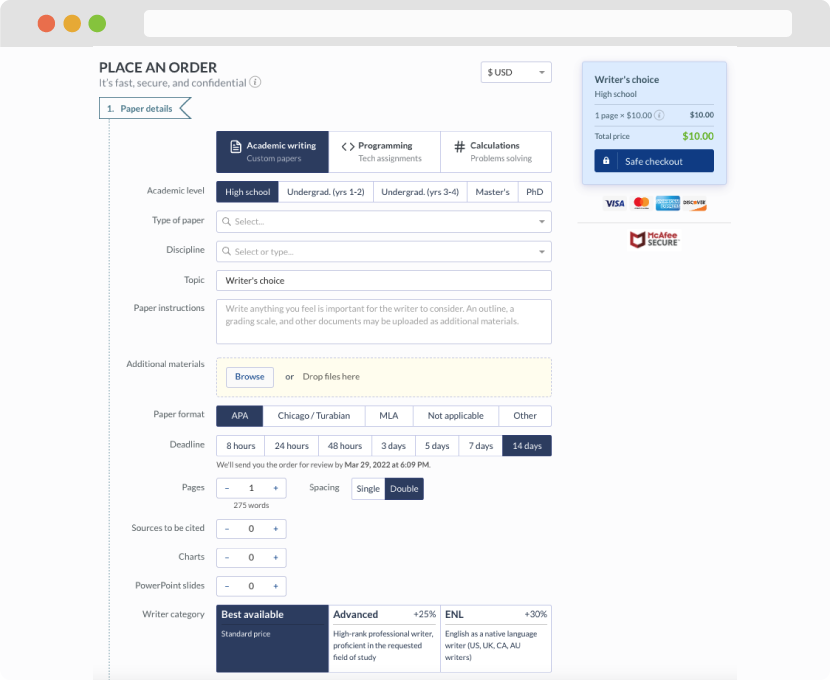
First, you will need to complete an order form. It's not difficult but, if anything is unclear, you may always chat with us so that we can guide you through it. On the order form, you will need to include some basic information concerning your order: subject, topic, number of pages, etc. We also encourage our clients to upload any relevant information or sources that will help.
Complete the order form
Once we have all the information and instructions that we need, we select the most suitable writer for your assignment. While everything seems to be clear, the writer, who has complete knowledge of the subject, may need clarification from you. It is at that point that you would receive a call or email from us.
Writer’s assignment
As soon as the writer has finished, it will be delivered both to the website and to your email address so that you will not miss it. If your deadline is close at hand, we will place a call to you to make sure that you receive the paper on time.
Completing the order and download