see attached
Respond to the following in a minimum of 175 words:
Read the article, Special Issue on Brand Equity, Branding, and Marketing Communications in Emerging Markets.
What are some significant marketing trends that you have personally recognized in the macroenvironment?
Can you identify some of the core strategy issues that firms face when they go global?
Can you explain three ways that economies of scale produce cost advantages in your industry?
Journal of Global Marketing, 23:
171
–176, 2010
Copyright c© Taylor & Francis Group, LLC
ISSN: 0891-1762 print / 1528-6975 online
DOI: 10.1080/08911762.2010.487417
INTRODUCTION
Special Issue on Brand Equity, Branding, and Marketing
Communications in Emerging Markets
There has been much discussion about
globalization and how Internet and communi-
cation technologies are flattening the world and
opening up massive opportunities in emerging
markets from Asia, Latin America, and eastern
Europe. In 2008, emerging markets accounted
for about 45% of global GDP (evaluated at
purchasing power parity exchange rates). This
share will rise above 50% by 2013, and by
2050, emerging markets may well account for
around 80% of global economic activity (Klein,
2008). From a marketing perspective, emerging
markets offer some of the largest opportunities
to build and expand brands. While the lure is ob-
vious for many global companies to seek growth
opportunities in the vast majority of emerging
markets, significant challenges remain as to how
to tap into indigenous inspiration and use global
influence, involvement, and commitment to
make a meaningful difference in these emerging
markets. Although there are signs of worldwide
consumer convergence of tastes and preferences
(Dholakia & Talukdar, 2004), brand meanings
and consumer-brand associations seem to be
largely interpreted within the social fabric of lo-
cal context (Eckhardt & Houston, 2002). Given
that most emerging markets have confronted
much of the impact of an increasingly global
flow of goods, people, information, knowledge,
and images, they need to be closely examined in
specific aspects of worshipping things foreign
or local that are weaved into the unique cultural
associations and local realities.
Recognizing the power and importance of
understanding local knowledge for branding
and marketing communications in the develop-
ing or emerging countries, Keller and Moorthi
(2003) pointed to the inability of some of
the global power brands to build strong con-
nections with the emerging-market consumers.
They highlighted two types of dysfunctionali-
ties of these global power brands in emerging
markets, termed “value dysfunctionlity”flthe in-
ability to deliver what is important to the lo-
cal consumer; and “image dysfunctionality”flthe
inability to communicate what is important to
the local consumer. In their analysis, these de-
ficiencies are due to several reasons, which
include inadequate understanding of the con-
sumer’s perceptions of brand value and improper
or lack of marketing communications in rela-
tion to brand identity in the home countries of
emerging-market consumers. As they explained,
“Failures in communication distort the mean-
ing of the brand and can cause it to be inter-
preted wrongly, narrowly, and often negatively”
(p. 56). Therefore, there is an important need
to re-think brand communication strategy to the
local needs/desires and competitive situation in
emerging economies.
In a recent book, Asian Brand Strategy, Roll
(2009) provides general guidelines to emerging
171
172 JOURNAL OF GLOBAL MARKETING
market branding. The author emphasized that
global brands must retain their brand identity at
the strategic level but localize the tactical im-
plementation through more relevant and adap-
tive product modifications and communication
strategies. In doing so, global brands would be
able to leverage the unique local culture to re-
late to the consumer and increase their chances
to create a strong differentiation and weave into
the fabric of the local society and make the brand
a part of the community (Roll, 2009). While
global brands rely on unique local cultures to re-
produce themselves in emerging markets, local
brands that aspire to compete successfully with
foreign or global offerings must strive to tap into
local myths and to rejuvenate their appeals to
the mass segments of local consumers (Dawar
& Frost, 1999). Interestingly, Young & Rubi-
cam’s Brand Asset Valuator survey looked at ten
emerging markets and identified their most re-
spected local brandsflnot necessarily the largest
or most valuable but that with the highest level
of esteem. And in some cases, the little guys
command even higher ratings than the giants.
Given the scope of the Journal of Global
Marketing, this special issue attempts to address
broad issues of brand equity, branding, and mar-
keting communications in emerging markets. In
the Calls for Papers, we have highlighted the
following research questions: (a) What are the
most effective marketing communication strate-
gies for building global, regional, or local brands
in emerging markets? (b) What are the rela-
tive advantages of global, regional, and local
brands in emerging markets? How are these ad-
vantages sustained and enhanced in the face of
increasing challenges in these emerging mar-
kets? (c) In what ways are consumers in emerg-
ing markets engaged with global, regional, or
local name brands? What are the variations
across different consumer segments in emerg-
ing markets? (d) How is brand equity measured
across cultures/nations? (e) What are various
advertising-related issues for brand communi-
cation in emerging markets? How are these is-
sues evolved in the marketplace? What are the
managerial implications for brand-building in
these markets? (f) How do emerging market con-
sumers perceive the equity of global, regional, or
local brands? In which aspects can brand equity
be created through marketing communication
strategies? (g) How do local consumers respond
to global/regional companies’ brand acquisition
strategy at their home markets? (h)What types of
relationships are evolving concerning consumer
tastes, consumption behavior, and brand prefer-
ences in various consumer segments in emerg-
ing markets? (i) What are the opportunities for
emerging market consumers to engage with cor-
porations and brands through various online so-
cial networks? (j) How effective is the use of
online social networks for building brand rela-
tionships with the target audience?
We were impressed with the number of papers
submitted to this special issue. After rigorous
and blind peer review process, a total of six pa-
pers were selected for publication in this special
issue of the journal. In their article, “The Ef-
fect of Brand Credibility on Consumers’ Brand
Purchase Intention in Emerging Economies: The
Moderating Role of Brand Awareness and Brand
Image,” Xuehua Wang and Zhilin Yang build
on the literature on brand credibility and ex-
tend the general findings based predominantly
in the Western context to the international
joint-venture automobile brands available to
the Chinese consumers. While brand credibil-
ity, pertaining to expertise, trustworthiness, and
attractiveness, is found crucial to affect con-
sumers’ purchase intention, the facilitating role
of brand awareness and brand image in the brand
credibility effect seems to reflect the consumer
desire for a clearer brand identity and meaning-
fulness related to their consumption experience.
Although not directly addressed in their analy-
sis, the challenges due to the tension between the
global and local brand connotations involved in
marketing communications, as evident in many
emerging markets, may characterize the need to
have distinctive brand images in order to grasp
the brand performance in emerging markets.
In the study of multicultural advertising
effects in the “new” South Africa, Guillaume D.
Johnson, Roger M. Elliott, and Sonya A. Grier
look into a localized marketing communication
framework featuring multicultural aspects
and indigenous consumer identification with
culturally embedded brand value. They define
multicultural advertising as a type of advertising
targeted at a culturally diverse target audience
Introduction 173
through the use of cultural representations, such
as advertisement sources, symbols, traditions
beliefs, values, attitudes, and/or objects from
multiple cultural backgrounds. Based on their
comprehensive literature review on multicultural
marketing and advertising specific to emerging-
market consumers, the authors highlight two
aspects of the consumer social-identification
processes, namely the “similarity process” and
the “corporate social responsibility” (CSR) pro-
cess, pertaining to the effectiveness of advertis-
ing for building stronger brands in the politically
and culturally/racially hypersensitive society of
South African markets. The similarity process
advocates the persuasiveness of advertising that
conveys the consumer association and identifi-
cation with the symbols, models, and cultural
values in the ads, whereas the CSR process is ex-
pected to create local consumer sentiment about
larger goodwill of brands for South African
society. Although such themes of multicultural
advertising are not necessarily unique to the
emerging market of South Africa, the country’s
colonial and apartheid past has resulted in
an extreme diversity of culture and human
development, and therefore the ability to com-
municate the larger social role of multinational
brands can potentially curtail perceptions of
neo-colonialism in countries like South Africa.
From this point of view, their conceptualization
reflects the acceptability and responsiveness
of emerging-market consumers to indigenous
values and the opportunity to enhance their
perception of themselves.
In the article “How Consumer Ethnocentrism
and Animosity Impair the Economic Recovery
of Emerging Markets,” T. S. Chan, Kenny K.
Chan, and Lai-cheung Leung propose a con-
ceptual framework that looks into the effects of
product and country images, consumer ethno-
centrism, and animosity on attitudes for imports
and overseas travel. They build on the country-
of-origin literature by linking product-country
images with protectionism and international af-
fairs. Using a sample of respondents from two
Asian emerging markets, India and Vietnam, the
authors empirically affirm a reciprocal relation-
ship between product image and country image
in determining an individual’s intention to visit a
foreign country or welcome its exports. Their re-
sults also reveal how consumer animosity toward
a specific foreign country interacts with a general
tendency of consumer ethnocentrism in affect-
ing the product-country image effects within the
context of the study. Overall, this article points
to the challenges of establishing consumer sen-
timent in the developing world for the imports
from the developed nations and tourism. It will
require a holistic view of the buy-in from a broad
spectrum of diverse entities, constituencies and
special interests that are susceptible to partisan
politics and conflicts of interests (Papadopoulos
& Heslop, 2002; Pike, 2005).
The study of “The Endorser’s Persuasiveness
on the Purchase Intention of High-Involvement
Products: A Comparison Between a Newly
Launched Product and a Mature One” by Vin-
cent Cho investigates how the endorser’s persua-
siveness (with the endorser being an expert or a
celebrity) affects consumer purchase intention of
high involvement products, which usually need
prolonged considerations before making a pur-
chase. The author separates products into two
types: newly launched and mature ones. As a
result, there are four scenarios being created:
(a) using an expert as the endorser for a newly
launched product, (b) using a celebrity as the en-
dorser for a newly launched product, (c) using
an expert as the endorser for a mature product,
and (d) using a celebrity as the endorser for a
mature product. This would help us to better
understand the endorser’s persuasiveness in an
advertisement in different situations.
In the theoretical framework, which is based
on the theory of reasoned actions (TRA) from
Fishbein and Ajzen (1980), the author sug-
gested that the endorser’s persuasiveness would
significantly affect purchase intention of high-
involvement products in different ways accord-
ing to the type of endorsers and the stage in a
product life cycle. Consumers purchasing high-
involvement products usually seek related in-
formation (Holmes & Crocker, 1987) and pay
attention to the opinion of people around them
before decision making (Charters & Pettigrew,
2006). Based on these characteristics, this re-
search also revealed that social influence and
consumer knowledge of the health care product
are two significant moderators that affect con-
sumers’ purchase intention.
174 JOURNAL OF GLOBAL MARKETING
The study findings showed that the impact
of a celebrity’s persuasiveness on purchase in-
tention is higher than that of an expert’s one
for a newly launched product. In contrast, for
mature products, the impact of an expert’s per-
suasiveness on purchase intention is more in-
fluential than that of a celebrity’s one. These
findings are confirmed with Biswas et al. (2006)
and Friedman and Friedman (1979) suggesting
that celebrity would arouse more awareness of a
newly launched product and expert would have a
more sustainable persuading effect for a mature
product.
For the moderation effect, both social influ-
ence and consumer knowledge are proved to be
important moderators in the relationship of per-
ceived effectiveness of health care product and
consumer purchase intention.
A trusting relationship with customers is criti-
cal to a brand’s success in today’s highly compet-
itive global market. Marketers have tried to seize
every opportunity to enhance consumers’ trust,
including improving product quality and per-
formance, stimulating favorable word of mouth
(WOM) and increasing advertising efforts. How-
ever, little is known of the mechanisms through
which user experience and other information
sources influence brand trust. Better understand-
ing of whether and how different information
sources affect brand trust should provide valu-
able insights for both practitioners and market-
ing scholars.
In the article titled “How Do They Really
Help? An Empirical Study of the Role of Dif-
ferent Information Sources in Building Brand
Trust,” Wang Xingyuan, Fuan Li, and Yu Wei
examine how user experience affects brand trust
in comparison with the effects of advertising
and WOM communication. The fundamental as-
sumption of this study is that brand knowledge
affects brand trust and mediates the impact of in-
formation sources on consumers’ trust. Informa-
tion obtained from past consumption experience,
WOM communication or exposure to advertise-
ments determines consumers’ brand knowledge,
which in turn affects consumers’ trust in the
brand.
Data used to test proposed hypotheses were
collected through central location interviews in
a major metropolitan area in China. The find-
ings indicate that the three information sources
exerted differential impacts on brand trust, with
user experience having the strongest effect. In
addition, user experience was shown to affect
brand trust both directly and indirectly. This is
not the case for WOM, and advertising for their
effects were fully mediated by brand knowledge.
Their findings confirm that enhancing brand
awareness and increasing consumer knowledge
of the product, company, and perceived value are
important ways to build and sustain consumers’
trust.
A closer look at the findings reveals that the
impact of different information sources on brand
knowledge varies. Advertising was shown to be
more effective in increasing brand awareness and
conveying information on products and com-
panies than in affecting consumers’ value per-
ception. In contrast, WOM had greater impact
on value perception than advertising, suggesting
that when it comes to forming or changing con-
sumers’ value perception, the focus of marketing
communication should shift to stimulating pos-
itive WOM. Their results also indicate that per-
ceived value is the predominant consideration
in consumer evaluation of high-tech brands. En-
hancing consumers’ knowledge of the company
and expanding brand awareness are also effec-
tive ways to build and strengthen consumer’s
trust.
From the empirical test conducted with a
sample of Chinese consumers in an emerging
economy, their results demonstrate the univer-
sal applicability of the findings of the previous
studies that were conducted in North America.
The strong effect of user experience found in
this study provides additional support for previ-
ous findings. It confirms that ensuring positive
user experience is the best way for marketers
to foster consumers’ trust regardless of whether
their product is marketed in the United States or
in another country.
The present study demonstrates the dif-
ferential impacts of various dimensions of
brand knowledge and the different mechanisms
through which information sources affect brand
trust. These findings should enhance our un-
derstanding of the role each information source
Introduction 175
may play in shaping consumers’ brand knowl-
edge and consequently their trust in the brand.
They should also provide valuable insights for
practitioners on how to build brand trust as
well as how to make the most efficient use
of marketing resources in communicating with
customers.
If asked “What drives international market-
ing strategy in MNCs?” or “What determines
the success and failure of brands around the
world?” the answers could be recognized from
international marketing and strategic manage-
ment perspective as multilevel influences (i.e.,
firm, industry, and country factors). Brand value
is a measure of the output from a series of brand
investments and initiatives not only from finan-
cial and economic perspectives but also from a
marketing perspective. How to manage a brand
across country borders becomes a salient issue
in strategic thinking and practice.
In the article “The Persistence of Brand
Value at Country, Industry, and Firm Levels,”
Yi-Min Chen addresses these issues by using
brand value as an economic performance mea-
sure to explore what accounts for the persis-
tence rate of firm, industry, and country ef-
fects on long-term brand value in the context of
Interbrand’s brand valuation formula. Encour-
agingly, in general the results show that each
effect is able to generate positive incremental
benefits on brand value in the future and do not
lend support to arguments that different speeds
of convergence occur among firm, industry, and
country effects. The findings yield the follow-
ing managerial implications for the bridge of
strategic management and international market-
ing.
First, since country, industry, and firm effects
are equally important to long-term brand value,
the findings can gain insight into how these
factors associated with international marketing
strategy may compare with the other strategic
options that firms pursue to improve their com-
petitive positions in the domestic and foreign
markets. For example, various research investi-
gations on MNCs’ global marketing strategies
provide the consistent evidence of the deploy-
ment of standardized marketing strategies. Fi-
nally, the concept of strategic fit asserts the
importance of matching international market-
ing strategy to the context in which the firm
operates.
Erdener Kaynak
Editor, Journal of Global Marketing,
Professor of Marketing, School of Business
Administration, Pennsylvania State
University at Harrisburg, Middletown
Pennsylvania, USA
Lianxi Zhou
Department of Marketing and International
Business, Brock University, St. Catharines
Ontario, Canada
REFERENCES
Biswas, D., Biswas, A., & Das, N. (2006). The differential
effects of celebrity and expert endorsements on con-
sumer risk perceptions. Journal of Advertising, 15(2),
17–29.
Charters, N., & Pettigrew, S. (2006). Product involvement
and the evaluation of wine quality. Qualitative Market
Research, 9(2), 181–193.
Dawar, N., & Frost, T. (1999). Competing with giants: Sur-
vival strategies for local companies in emerging mar-
kets. Harvard Business Review, 77(2), 119–129.
Dholakia, U. M., & Talukdar, D. (2004). How social influ-
ence affects consumption trends in emerging markets
an empirical investigation of the consumption trends in
emerging markets: An empirical investigation of the
consumption convergence hypothesis. Psychology &
Marketing, 21(10), 775–797.
Eckhardt, G. M., & Houston, M. J. (2002). Cultural para-
doxes reflected in brands: McDonald’s in Shanghai,
China. Journal of International Marketing, 10(2), 68–
82.
Fishbein, M., & Ajzen, I. (1980). Predicting and under-
standing consumer behavior: Attitude behavior corre-
spondence. In I. Ajzen & M. Fishbein (Eds.), Under-
standing attitudes and predicting social behavior (pp.
149–172). Englewood Cliffs, NJ: Prentice Hall.
Friedman, H., & Friedman, L. (1979). Endorser effective-
ness by product type. Journal of Advertising Research,
19(5), 63–71.
Holmes, J. H., & Crocker, K. E. (1987). Predispositions
and the comparative effectiveness of rational, emotional
and discrepant appeals for both high involvement and
low involvement products. Journal of the Academy of
Marketing Science, 15(1), 27–35.
Keller, K. L., & Moorthi, T. L. R. (2003). Branding in
developing markets. Business Horizon, 46(3), 49–59.
Klein, M. (2008). The international financial crisis:
What next for emerging markets? The World Bank.
176 JOURNAL OF GLOBAL MARKETING
Retrieved June 28, 2009, from http://web.worldbank.
org/WBSITE/EXTERNAL/NEWS/
Papadopoulos, N., & Heslop, L. (2002). Country equity
and country branding problems and prospects. Journal
of Brand Management, 9(4/5), 294–314.
Pike, S. (2005). Tourism destination branding complexity.
Journal of Product and Brand Management, 14(4), 258–
259.
Roll, M. (2009). Asian brand strategy: How Asia builds
strong brands. New York: Pelgrave Macmillan.
Copyright of Journal of Global Marketing is the property of Taylor & Francis Ltd and its content may not be
copied or emailed to multiple sites or posted to a listserv without the copyright holder’s express written
permission. However, users may print, download, or email articles for individual use.
Essay Writing Service Features
Our Experience
No matter how complex your assignment is, we can find the right professional for your specific task. Achiever Papers is an essay writing company that hires only the smartest minds to help you with your projects. Our expertise allows us to provide students with high-quality academic writing, editing & proofreading services.
Free Features
Free revision policy
$10Free bibliography & reference
$8Free title page
$8Free formatting
$8How Our Dissertation Writing Service Works
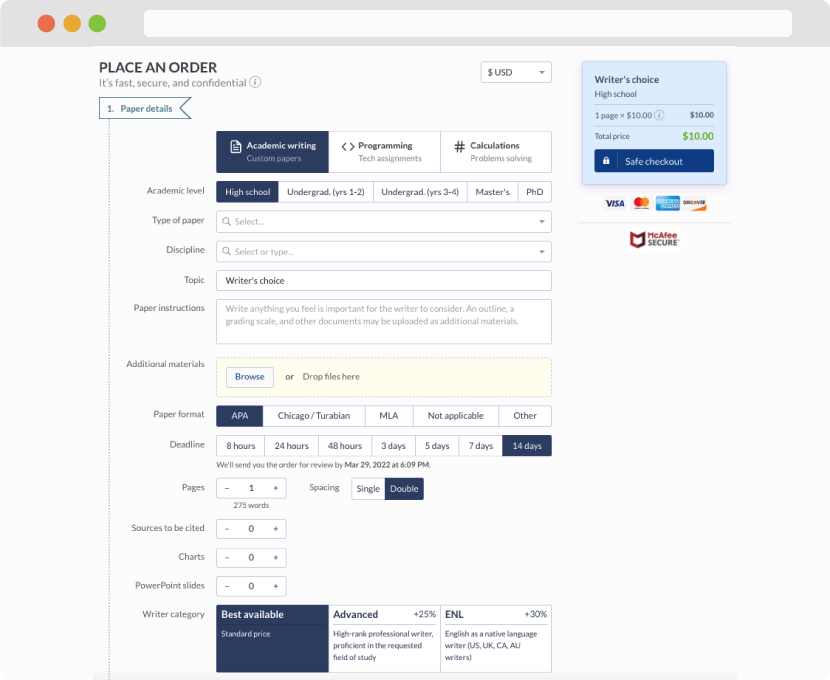
First, you will need to complete an order form. It's not difficult but, if anything is unclear, you may always chat with us so that we can guide you through it. On the order form, you will need to include some basic information concerning your order: subject, topic, number of pages, etc. We also encourage our clients to upload any relevant information or sources that will help.
Complete the order form
Once we have all the information and instructions that we need, we select the most suitable writer for your assignment. While everything seems to be clear, the writer, who has complete knowledge of the subject, may need clarification from you. It is at that point that you would receive a call or email from us.
Writer’s assignment
As soon as the writer has finished, it will be delivered both to the website and to your email address so that you will not miss it. If your deadline is close at hand, we will place a call to you to make sure that you receive the paper on time.
Completing the order and download