Purpose
The purpose of the graded collaborative discussions is to engage faculty and students in an interactive dialogue to assist the student in organizing, integrating, applying, and critically appraising knowledge regarding advanced nursing practice. Scholarly information obtained from credible sources as well as professional communication are required. Application of information to professional experiences promotes the analysis and use of principles, knowledge, and information learned and related to real-life professional situations. Meaningful dialogue among faculty and students fosters the development of a learning community as ideas, perspectives, and knowledge are shared.
Activity Learning Outcomes
Through this discussion, the student will demonstrate the ability to:
Integration of Evidence: The student post provides support from a minimum of one scholarly in-text citation with a matching reference andassigned readings or online lessons, per discussion topic per week.
What is a scholarly resource? A scholarly resource is one that comes from a professional, peer-reviewed publication (e.g., journals and government reports such as those from the FDA or CDC).
Contains references for sources cited
Written by a professional or scholar in the field and indicates credentials of the author(s)
Is no more than 5 years old for clinical or research articles
What is not considered a scholarly resource?
Newspaper articles and layperson literature (e.g., Readers Digest, Healthy Life Magazine, Food, and Fitness)
Information from Wikipedia or any wiki
Textbooks
Website homepages
The weekly lesson
Articles in healthcare and nursing-oriented trade magazines, such as Nursing Made Incredibly Easy and RNMagazine (Source: What is a scholarly article x; Created 06/09 CK/CL Revised: 02/17/11, 09/02/11 nlh/clm)
Can the lesson for the week be used as a scholarly source?
Information from the weekly lesson can be cited in a posting; however, it is not to be the sole source used in the post.
Are resources provided from CU acceptable sources (e.g., the readings for the week)?
Not as a sole source within the post. The textbook and/or assigned (required) articles for the week can be used, but another outside source must be cited for full credit. Textbooks are not considered scholarly sources for the purpose of discussions.
Are websites acceptable as scholarly resources for discussions?
Yes, if they are documents or data cited from credible websites. Credible websites usually end in .gov or .edu; however, some .org sites that belong to professional associations (e.g., American Heart Association, National League for Nursing, American Diabetes Association) are also considered credible websites. Websites ending with .com are not to be used as scholarly resources.
Nursing knowledge is classified in a variety of ways, one of which is Carper’s Patterns of Knowing (Carper, 1978). Carper’s framework offers a lens through which the nurse can reflect upon insights acquired through empirical, ethical, personal, and aesthetic knowledge (Carper, 1978). Through intentional reflection using Carper’s Patterns of Knowing, nurses can process experiential learning and knowledge acquired through practice. The purpose of this assignment is to reflect upon a specific practice situation and better understand the professional knowledge and insights obtained through that experience.
Criteria for Content
As a method of refection, use Carper’s Patterns of Knowing to analyze the situation. In your discussion, address ONE of the following Patterns of Knowing:
What do you think was the underlying reason for the situation? (Esthetics)
What were your thoughts and feeling in the situation? (Personal)
What was one personal belief that impacted your actions? (Ethics)
What evidence in nursing literature supports the nursing importance of the identified issue? (Empirical)
Must be 300-350 words
Once you are down with the initial post complete a 1-2 paragraph reflection
Write 1-2 paragraphs reflecting on ways of knowing and the use of metaparadigm in the NP role. Then save the reflection as a Word Document for submission later in the course. In week 8, you will submit all reflections as a single document.
This reflection is worth 5 points and the final reflection document in week 8 is worth 15 points.
You will need to post your reflection here before you are able to see other students’ posts.
Asselin, M. E. (2011). Reflective narrative: A tool for learning through practice. Journal for Nurses in Staff Development, 27(1), 2-6. https://doi.org/10.1097/NND.0b013e3181b1ba1a
Boden, C. J., Cook, D., Lasker-Scott, T., Moore, S., & Shelton, D. (2006). Five perspectives on reflective journaling. Adult Learning, 17(1-4), 11-15. https://doi.org/10.1177/104515950601700105
Coleman, D., & Willis, D. S. (2015). Reflective writing: The student nurse’s perspective on reflective writing and poetry writing. Nurse Education Today, 35(7), 906-911. https://doi.org/10.1016/j.nedt.2015.02.018
Kennison, M. (2012). Developing reflective writing as effective pedagogy. Nursing Education Perspectives, 33(5), 306-311. https://doi.org/10.5480/1536-5026-33.5.306
McEwen, M., & Wills, E. (2014). Theoretical basis for nursing (4th ed.). Lippincott, Williams & Wilkins.
Meleis, A. (2012) Theoretical nursing: Development and progress (5th ed.). Lippincott Williams & Wilkins
Melnyk, B. M., & Fineout-Overholt, E. (2011). Evidence-based practice in nursing and healthcare: A guide to best practice (2nd ed.). Lippincott, Williams & Wilkins.
Polifroni, E. C. (2015). Philosophy of science: An introduction. In J. B. Butts & K. L. Rich (Ed.), Philosophies and theories for advanced nursing practice(2nd ed.) (pp. 3-18). Jones & Bartlett Learning.
Parker, M. E., & Smith, M. C. (2015). Nursing theories and nursing practice (4th ed.). F. A. Davis Company.
Reed, P. G., & Crawford Shearer, N. B. (2012). Perspectives on nursing theory (6th ed.). Wolters Kluwer.
Shearer, J. E. (2015). Critique of nursing as caring theory: Aesthetic knowing and caring in online learning. International Journal for Human Caring, 19(2), 45-49. https://doi.org/10.20467/1091-5710-19.2.45
Walker, L. O., & Avant, K. C. (2011). Strategies for theory construction in nursing (5th ed.). Pearson
Essay Writing Service Features
Our Experience
No matter how complex your assignment is, we can find the right professional for your specific task. Achiever Papers is an essay writing company that hires only the smartest minds to help you with your projects. Our expertise allows us to provide students with high-quality academic writing, editing & proofreading services.
Free Features
Free revision policy
$10Free bibliography & reference
$8Free title page
$8Free formatting
$8How Our Dissertation Writing Service Works
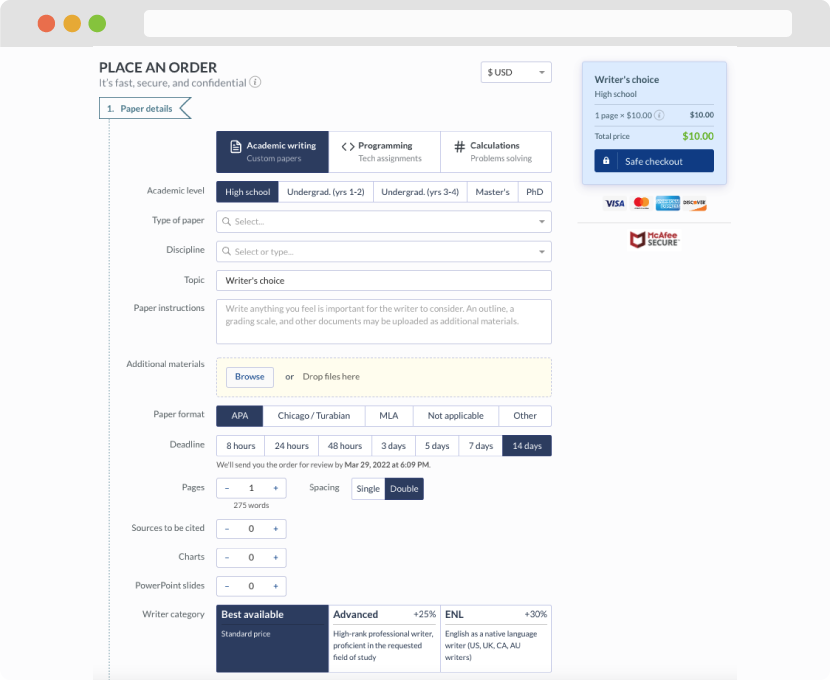
First, you will need to complete an order form. It's not difficult but, if anything is unclear, you may always chat with us so that we can guide you through it. On the order form, you will need to include some basic information concerning your order: subject, topic, number of pages, etc. We also encourage our clients to upload any relevant information or sources that will help.
Complete the order form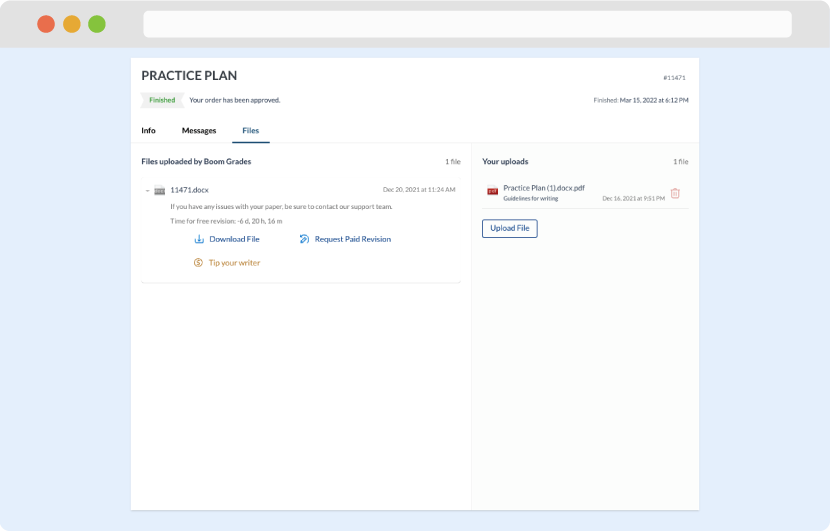
Once we have all the information and instructions that we need, we select the most suitable writer for your assignment. While everything seems to be clear, the writer, who has complete knowledge of the subject, may need clarification from you. It is at that point that you would receive a call or email from us.
Writer’s assignment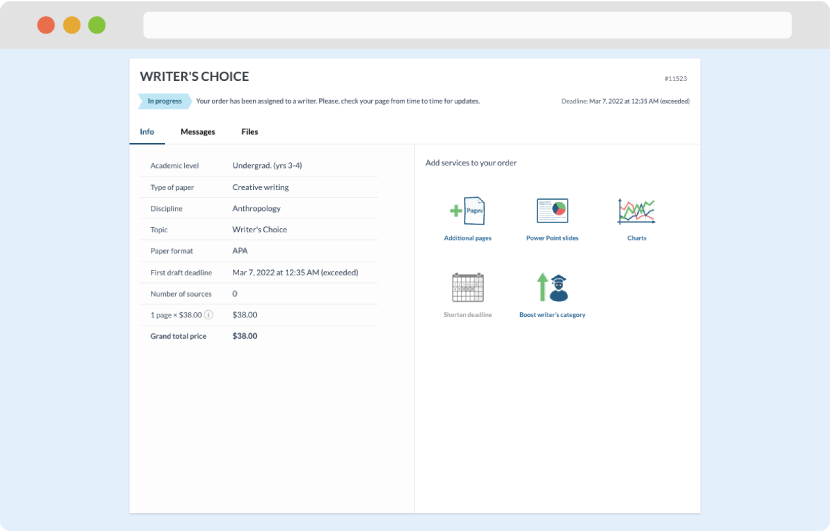
As soon as the writer has finished, it will be delivered both to the website and to your email address so that you will not miss it. If your deadline is close at hand, we will place a call to you to make sure that you receive the paper on time.
Completing the order and download