Assignment 4Due: November 11th at 8pm EST
Instructions: This is an individual assignment, not group work. Though you may discuss the problems with your
classmates, you must solve the problems and write the solutions independently. As stated in the syllabus, copying
code from a classmate or the internet (even with minor changes) constitutes plagiarism. You are required to submit
your answers in pdf form (use LATEX) in a file called -hw4.pdf to courseworks. The code for the
programming assignment should be appended at the end of this pdf. Late submissions will be penalized, except
in extenuating circumstances such as medical or family emergency. Submissions submitted 0-24 hours late will be
penalized 10%, 24-48 hours late by 20%, 48-72 hours late by 30%, and later than 72 hours by 100% (i.e., zero credit).
Questions 1 and 2 are worth 7 points, question 3 is 16 points, for a total of 30 points.
Problem 1
Consider the simple 3-variable model in Figure 1 where all variables (including the latent L1 ) are jointly Gaussian.
Recall that this implies that the variables are related by linear structural equations, the coefficients of which are α, β, γ.
Show that any value for the covariance (and hence correlation) between observed variables X1 and X2 can be achieved
by some setting of the parameters β, γ. Explain the significance of this fact.
β
X1
L1
α
γ
X2
Figure 1
Problem 2
Consider the latent variable DAG in Figure 2. What would a CPDAG-learning algorithm (such as PC) learn from
data generated according to this structure, in the limit of infinite sample size? (That is, assume PC makes no mistakes
about conditional independence relations among the observed variables. Obviously it only “knows” about observed
variables, not anything latent.) Draw the implied CPDAG (i.e., what PC would learn in the limit), and summarize the
output in words. You may ignore the orientation rules (R1-R4) at the end of PC – these are not important here.
How would you interpret this result? Is there something “right” or “wrong” about it (from an independence
perspective and/or from a causal perspective)?
What would the FCI algorithm learn from data generated according to this structure? (Again, you may ignore the
propogation of the orientation rules (R1-R10) at the end of FCI – these are not important here.) Finally, what would an
algorithm that learns a Markov Random Field (undirected graph) learn from data generated according to this structure?
Answer the same questions for the structure in Figure 3.
1
L1
X1
L2
X2
X3
X4
X5
Figure 2
L1
X1
L2
X2
X3
X4
Figure 3
Problem 3
On Courseworks you’ll find a .zip folder with some simulated data, generated from a Gaussian graphical model with
20 variables. Use the PC algorithm (in the R package pcalg) to estimate a CPDAG from this data. Use the glasso
(graphical lasso) method to estimate an undirected graph from this data (use the R package huge)1 . Both algorithms
depend on a tuning parameter: α in the PC algorithm corresponds to the conditional independence test threshold; λ
in glasso corresponds to the sparsity penalty (effectively a threshold for deciding when the elements of the precision
matrix are “small” enough to count as zero). Explore some ways of choosing the tuning parameter, and show how
the estimated graph (or some features of the graph, like the number of missing edges) varies as you vary the tuning
parameter. Explain every step of what you do with this data, visualize the results, and include your code.
1 The huge package implements a number of ways to estimate undirected graphs, including glasso. There is a document which explains the
features of this package here: https://CRAN.R-project.org/package=huge (see “reference manual” and “vignette”)
2
Essay Writing Service Features
Our Experience
No matter how complex your assignment is, we can find the right professional for your specific task. Achiever Papers is an essay writing company that hires only the smartest minds to help you with your projects. Our expertise allows us to provide students with high-quality academic writing, editing & proofreading services.
Free Features
Free revision policy
$10Free bibliography & reference
$8Free title page
$8Free formatting
$8How Our Dissertation Writing Service Works
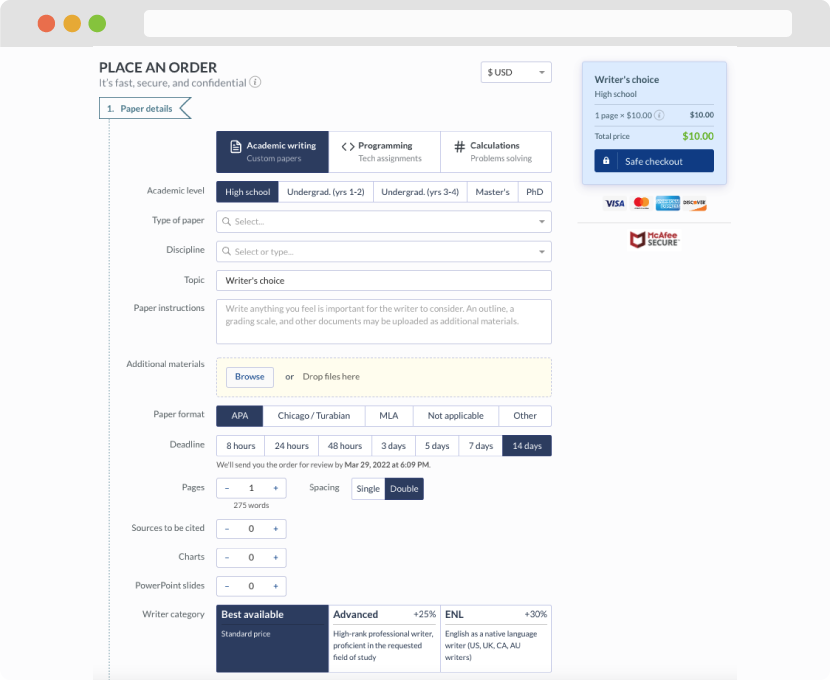
First, you will need to complete an order form. It's not difficult but, if anything is unclear, you may always chat with us so that we can guide you through it. On the order form, you will need to include some basic information concerning your order: subject, topic, number of pages, etc. We also encourage our clients to upload any relevant information or sources that will help.
Complete the order form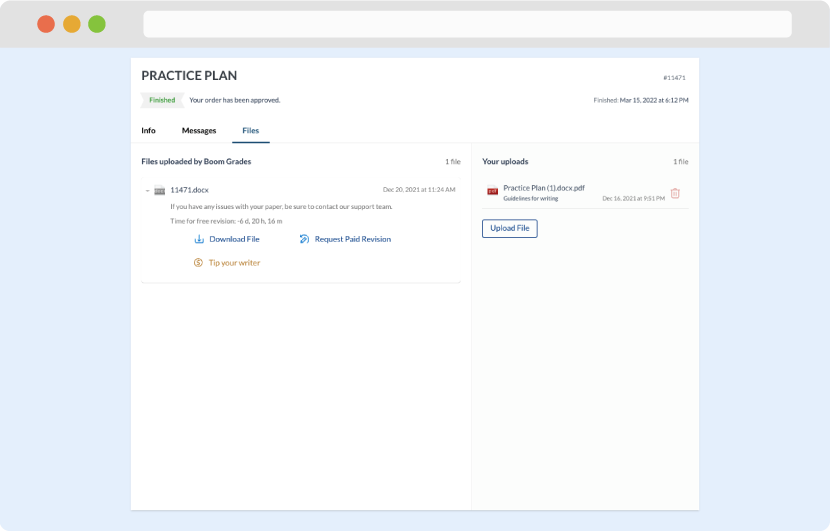
Once we have all the information and instructions that we need, we select the most suitable writer for your assignment. While everything seems to be clear, the writer, who has complete knowledge of the subject, may need clarification from you. It is at that point that you would receive a call or email from us.
Writer’s assignment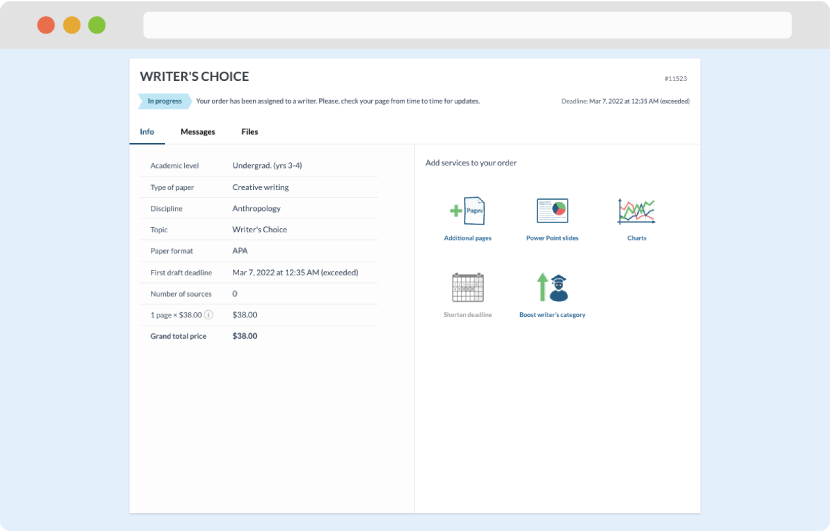
As soon as the writer has finished, it will be delivered both to the website and to your email address so that you will not miss it. If your deadline is close at hand, we will place a call to you to make sure that you receive the paper on time.
Completing the order and download