Detailedbest work
****Please submit Steps 4, 5, 6, and 7 separately, before submitting the completed project 1****
In CCA 610: Cloud Services and Technology, you assumed the role of an IT analyst at BallotOnline, a company providing electronic voting solutions worldwide. Your proposal to begin migrating systems to the cloud has been approved.
BallotOnline has now initiated preparations for the cloud deployment. The company decided to start with deeper investigations of crucial technologies enabling cloud computing. You became acquainted with the basics of these technologies in CCA 610.
In this project, you will conduct more in-depth investigation of cloud networking, which makes cloud connectivity on-demand operations possible. You need to have a good understanding of this as you prepare the BallotOnline network for migration to the cloud as well as designing the appropriate network infrastructure in the cloud for BallotOnline.
To do that, you will assume the role of a BallotOnline network engineer. You will explore the network protocols that enable the company and its customers to connect to the cloud, as well as technologies making it possible to create on-demand in-cloud virtual networks into which the cloud resources will be deployed.
You will conduct two lab experiments exploring the TCP/IP protocols and software-defined networking. You will also perform a subnetting task to demonstrate your understanding of TCP/IP network addressing. Your final deliverable will be the technical report describing your findings and explaining the use of these technologies for BallotOnline’s cloud deployment.
Step 1: Review Networking Concepts
In this step, you will establish an understanding of networking concepts and terms. It will help the recipients of your technical report, including BallotOnline’s technical management, to become familiar with networking vocabulary and definitions.
You will start with reviewing basic networking concepts such as local area network (LAN), Ethernet, and packet switching—the technique of splitting transmitted data into smaller portions and transmitting them separately.
Splitting data into packets, transmitting the packets reliably, and reassembling the data is performed by networking software. It is important to know about
basic networking concepts
since they serve as the underlying technology for cloud computing. This will ultimately prepare you to submit your technical report for this project. (http://intronetworks.cs.luc.edu/current/html/intro.html)
Networking software follows the popular model of layered design of
network protocols
, with each layer using the functionality of the layer below it and implementing new functionality to be used by the layer above. The technical report should include the popular internet suite of protocols—
TCP/IP
. Application protocols such as HTTP or SMTP are implemented in layers above TCP/IP. (http://intronetworks.cs.luc.edu/current2/html/tcpA.html?highlight=transmission%20control%20protocol)
Other basic networking concepts include Domain Name Service, network firewalls, and Network Address Translation. As the network engineer for BallotOnline, you know that these protocols play an important role in enabling cloud computing.
Step 2: Explore Internet Packet Switching—IP
The Internet Protocol (IP) is the workhorse of today’s internet connectivity. As the network engineer for BallotOnline, you know that today’s cloud computing is built on top of IP. Most communication between systems in the cloud is done using this protocol.
IP employs the technique of packet switching, which breaks the data to be transmitted into smaller parts, called packets or datagrams, that are sent over the network independently. Understanding IP is crucial to designing and maintaining cloud deployments, which are provisioned within virtual IP networks and accessed via global internet. You will review the basic elements of IP protocol and include their brief discussion in your technical report.
Network devices have a network address to allow other devices to connect to it. The network addresses used in IP are called
IP addressing
. BallotOnline will need IPv4 addressing to be able to provide network addresses to a cloud system and to create a virtual network in the cloud.
Every system on the network must have an IP address. The assignments of IP addresses to the network systems can be done manually or dynamically through a
Dynamic Host Configuration Protocol (DHCP)
server. As the network engineer for BallotOnline, you know that manually assigning IP addresses is time-consuming and should only be used on a small number of systems where the IP address will not change frequently. (http://intronetworks.cs.luc.edu/current/html/ipv4.html#dynamic-host-configuration-protocol-dhcp)
Because numeric addresses are not human-friendly, a domain/machine naming convention defines human-readable names for internet hosts. An internet-based service called
DNS (Domain Name System)
provides translation between the IP addresses and the domain names. In general, people will use the domain names when addressing a system on the internet instead of using its IP address. You will need to explain in the technical report how DNS is used alongside IP addresses.
As the network engineer for BallotOnline, you also know the importance of IP routing, the mechanism used to route the IP packets across the internet from the sender to the recipient.
IP routing
of IP packets is accomplished by network routers, which determine the next destination for each packet and are able to learn new routes. (http://dtucker.cs.edinboro.edu/IPRouting.htm) (https://www.learncisco.net/courses/icnd-1/lan-connections/packet-delivery-process-at-l3.html)
Step 3: Investigate Internet Transport—TCP
As robust as the IP protocol is, it does not perform the actual transmission of the data. In this step, you will investigate the network protocol called
Transmission Control Protocol (TCP)
, responsible for creation, reliability of delivery, and proper assembling of data packets.
In addition to IP, TCP is also widely used on the internet, especially for any network communication where it is essential to confirm receipt of the transmission. Many of the network protocols used to implement cloud computing use both TCP and IP. You will review TCP’s workings and discuss them in your final technical report.
In general, there is no guarantee that a data packet will reach its destination. Packets can get lost or corrupted during transmission, and there are network applications where you need assurance that the packets have reached their destination. To achieve reliability, TCP establishes connections between communicating hosts, using port numbers to refer to applications on these hosts. Then, packets are created, sequenced, transmitted, acknowledged, and retransmitted if missing or containing errors. Finally, at the destination, they are reassembled into the original messages.
To synchronize the flow of packets between sender and receiver, and avoid packet congestion in case of varying speeds, TCP uses
sliding windows
for packets remaining in processing at a given time, at both the sender and receiver ends. (http://intronetworks.cs.luc.edu/current/html/slidingwindows.html#sliding-windows)
Step 4: Review Advantages of IP Subnetting
One of the drawbacks of IPv4 is the maximum number of network devices it can support. IPv4 addressing uses a 32-bit network address. This allows for 232,, or a little over 4 billion devices. However, today there are significantly more devices on the internet. Even though the more robust IPv6 version has been introduced and efforts are under way to assure wide adoption, IPv4 is still widely used.
One method used to more efficiently use the IPv4 network addresses is a technique to optimize the addresses by splitting them into network addresses and host addresses within designated networks. You will need to take advantage of IP address splitting so that you can efficiently use and allocate the IPv4 network addresses that have been assigned to BallotOnline.
For a given large network, rather than addressing all the hosts using the host part of the address,
subnetting
allows for splitting the network into several smaller ones by borrowing the host part bits and adding them to the network bits. ( http://intronetworks.cs.luc.edu/current/html/ipv4.html#ipv4-subnets ). It supports efficient management of local networks composed of multiple LANs. In this step, you will investigate subnetting conventions and discuss them in your final report in order to lay ground for the use of subnets by BallotOnline.
As the network engineer for BallotOnline, you know that subnetting a network into several smaller and variable-sized networks will be best for the organization’s needs. BallotOnline has been assigned a network address block by the
Internet Assigned Numbers Authority (IANA)
. ( https://www.iana.org/ )
Because BallotOnline has several offices around the world, you will need to subnet this network address to assign just the right number of addresses to each office location based on the number of systems at that office location (the network address assigned by IANA and the number of offices along with their sizes is provided bellow).
Your task is to create the appropriate number of subnets with the right size to optimize the network.
Your technical report should include
Classless Interdomain Routing (CIDR)
notation, which allows for specifying a variable-length network as part of the IPv4 address, leaving the rest for addressing hosts within the network. ( https://opensource.com/article/16/12/cidr-network-notation-configuration-linux )
***Network address assigned by IANA and the number of offices along with their sizes***
+++Submission for Project 1: Subnetting+++
The first interim deliverable for Project 1 is for you to learn about subnetting and demonstrate that you know how to do this.
Below, please find a list of 30 subnetting problems. Make sure no two students select the same project. Please select one that you want to do. Please reply to this thread with your selected problem number. As I see them, I will scratch them from the list.
You are to perform subnetting on your given network. The deliverable is for you to provide the following information for each of the subnet identified (there are four of them for each problem):
· Network address
· Subnet Mask
· Range of IP Addresses available
· Broadcast Address
· The number of subnets that you will be able to get
· The number of hosts that each subnet will be able to have
You will also need to show the calculation on how you get your answers.
1. 214.135.174.0/24 subnetted to 23 subnets and provide information for subnets #1, #4, #5, and #23
2. 209.44.165.0/24 subnetted to 18 subnets and provide information for subnets #1, #4, #5, and #18
3. 208.101.170.0/24 subnetted to 16 subnets and provide information for subnets #1, #4, #5, and #16
4. 201.107.51.0/24 subnetted to 9 subnets and provide information for subnets #1, #4, #5, and #9
5. 196.4.85.0/24 subnetted to 13 subnets and provide information for subnets #1, #4, #5, and #13
6. 197.231.214.0/24 subnetted to 9 subnets and provide information for subnets #1, #4, #5, and #9
7. 217.86.213.0/24 subnetted to 14 subnets and provide information for subnets #1, #4, #5, and #14
8. 219.141.75.0/24 subnetted to 21 subnets and provide information for subnets #1, #4, #5, and #21
9. 217.64.152.0/24 subnetted to 18 subnets and provide information for subnets #1, #4, #5, and #18
10. 199.90.199.0/24 subnetted to 16 subnets and provide information for subnets #1, #4, #5, and #16
11. 208.198.235.0/24 subnetted to 14 subnets and provide information for subnets #1, #4, #5, and #14
12. 200.203.113.0/24 subnetted to 26 subnets and provide information for subnets #1, #4, #5, and #26
13. 212.166.231.0/24 subnetted to 14 subnets and provide information for subnets #1, #4, #5, and #14
14. 207.229.107.0/24 subnetted to 26 subnets and provide information for subnets #1, #4, #5, and #26
15. 202.46.198.0/24 subnetted to 16 subnets and provide information for subnets #1, #4, #5, and #16
16. 197.142.43.0/24 subnetted to 24 subnets and provide information for subnets #1, #4, #5, and #24
17. 197.183.21.0/24 subnetted to 10 subnets and provide information for subnets #1, #4, #5, and #10
18. 219.62.162.0/24 subnetted to 29 subnets and provide information for subnets #1, #4, #5, and #29
19. 200.103.113.0/24 subnetted to 22 subnets and provide information for subnets #1, #4, #5, and #22
20. 208.142.121.0/24 subnetted to 18 subnets and provide information for subnets #1, #4, #5, and #18
21. 199.228.167.0/24 subnetted to 16 subnets and provide information for subnets #1, #4, #5, and #16
22. 197.216.7.0/24 subnetted to 18 subnets and provide information for subnets #1, #4, #5, and #18
23. 211.220.70.0/24 subnetted to 22 subnets and provide information for subnets #1, #4, #5, and #22
24. 200.199.177.0/24 subnetted to 24 subnets and provide information for subnets #1, #4, #5, and #24
25. 197.7.221.0/24 subnetted to 10 subnets and provide information for subnets #1, #4, #5, and #10
26. 211.30.43.0/24 subnetted to 12 subnets and provide information for subnets #1, #4, #5, and #12
27. 212.96.179.0/24 subnetted to 22 subnets and provide information for subnets #1, #4, #5, and #22
28. 197.21.197.0/24 subnetted to 22 subnets and provide information for subnets #1, #4, #5, and #22
29. 200.190.92.0/24 subnetted to 16 subnets and provide information for subnets #1, #4, #5, and #16
30. 209.50.103.0/24 subnetted to 9 subnets and provide information for subnets #1, #4, #5, and #9
+++Submission for Project 1: Lab 1 Report+++ (File CCA 625 Project 1: Analyzing Network Traffic Using Wireshark attached)
Step 5: Capture and Analyze Network Traffic
Another skill that you will need as the network engineer for BallotOnline is being able to capture network traffic. It’s important to analyze network traffic to find and troubleshoot network issues. This method is commonly used to identify a malfunctioning network device or to detect a possible network issue, such as an ongoing network attack. Normally, this process can take hours, days, or even weeks, depending on the size of the network and the specific traffic that you are trying to capture and analyze. In this scenario, you will be provided with a captured network traffic and you will be directed to look for specific network packets.
You will use
Wireshark
, a popular open-source network traffic capture and analysis tool. To analyze the capture file provided to you, here is an introductory tutorial. (https://www.wireshark.org/) ( https://www.wireshark.org/video/wireshark/introduction-to-wireshark/ )
Follow the steps in the
Analyzing Network Traffic Using Wireshark Guide
and prepare a lab report with answers and screenshots to support your answers. The lab report will be attached to your final technical report to demonstrate your proficiency in using the tool to do basic network analysis.
Step 6: Explore Networks Inside the Cloud—SDN
Cloud computing defines network resources as needing to be “rapidly provisioned and released with minimal management effort or service provider interaction” (Mell & Grance, 2011), As cloud networks developed, it was clear that further virtualization of network devices such as switches and routers was needed.
This led to what is known as
software-defined networking (SDN)
technology, enabling programmatic interfaces to control functions of these devices. ( http://ipj.dreamhosters.com/wp-content/uploads/issues/2013/ipj16-1 ). You know that it will be important for management to understand how SDN supports cloud deployments like BallotOnline’s, so it will be a key part of your technical report.
Instead of manually programming network devices to configure a LAN, cloud management systems using SDN can set these devices up to forward packets to particular destinations by “calling” SDN APIs (application programming interfaces – libraries of software routines). This allows for the creation of virtual networks in the cloud by software.
The most popular SDN standard is OpenFlow by the
Open Networking Foundation
(https://www.opennetworking.org/). OpenFlow switches include SDN controllers, which maintain flow tables to control forwarding of IP datagrams, and they can learn routes as IP packets when particular source and destination addresses arrive.
References
Mell, P., & Grance, T. (2011). SP 800-145: The NIST definition of cloud computing. Retrieved from https://csrc.nist.gov/publications/detail/sp/800-145/final
Once you participate in the discussion below, proceed to the next step. There, you will use a network simulator to show how packets are transmitted.
Software-Defined Network Discussion
Discuss what software-defined networking is and what networking challenges it addresses. What is the role of OpenFlow protocol? Describe how BallotOnline could benefit from SDN in its cloud deployment.
Once you have submitted your post, make sure your response advances the conversation. Do not simply agree or disagree with a post, but instead explain the reasons for your opinions and how they relate to your experiences.
Use the discussion to develop awareness, share your thoughts, ask questions, and reflect.
Step 7: Simulate a Network With Mininet
Submission for Project 1: Lab 2 Report
Step 7: Simulate a Network With Mininet
To demonstrate your understanding how network packets are transmitted in the cloud, you will use
Mininet
, (http://intronetworks.cs.luc.edu/current/html/mininet.html#installing-mininet) a popular open-source network simulator that can be used together with Wireshark. This demonstration will be part of your technical report. Follow the steps in this
Simulating a Network Using Mininet and Analyzing Packets Using Wireshark Guide
. (https://leocontent.umgc.edu/content/dam/course-content/tgs/cca/cca-625/document/SimulatingaNetworkusingMininetandAnalyzingPacketsusingWireSharkGuide ?ou=535215).
During the lab, you will provision an
EC2 instance
in AWS using a preconfigured
AWS Machine Image (AMI)
and use the Mininet simulator in the EC2 instance to create two hosts. You will then use Wireshark to capture the packet exchanges. (https://aws.amazon.com/ec2/?ec2-whats-new.sort-by=item.additionalFields.postDateTime&ec2-whats-new.sort-order=desc) ( https://docs.aws.amazon.com/AWSEC2/latest/UserGuide/ec2-best-practices.html )
You will prepare a lab report as per the lab guide and attach it to your final technical report.
In the next step, you will put together your technical report for BallotOnline.
Step 8: Submit Networking in the Cloud Technical Report
As your final submission, you will write a technical report about networking in the cloud. It will be addressed to BallotOnline technical managers to help them understand how these networking technologies will be implemented as BallotOnline migrates to the cloud.
It will include technical review of the topics covered in the project. Follow the
Networking in the Cloud Technical Report Template
to cover all the topics required ( https://leocontent.umgc.edu/content/dam/course-content/tgs/cca/cca-625/document/CCA625Project1_NetworkingintheCloudTechnicalReportTemplate x?ou=535215 ).
Make sure you provide headings to clearly identify sections of your report. The technical review part of the report should be eight to 12 pages. You should also include both Project 1 lab reports (1 and 2), with incorporated feedback from Steps 5 and 7 if any.
Essay Writing Service Features
Our Experience
No matter how complex your assignment is, we can find the right professional for your specific task. Achiever Papers is an essay writing company that hires only the smartest minds to help you with your projects. Our expertise allows us to provide students with high-quality academic writing, editing & proofreading services.
Free Features
Free revision policy
$10Free bibliography & reference
$8Free title page
$8Free formatting
$8How Our Dissertation Writing Service Works
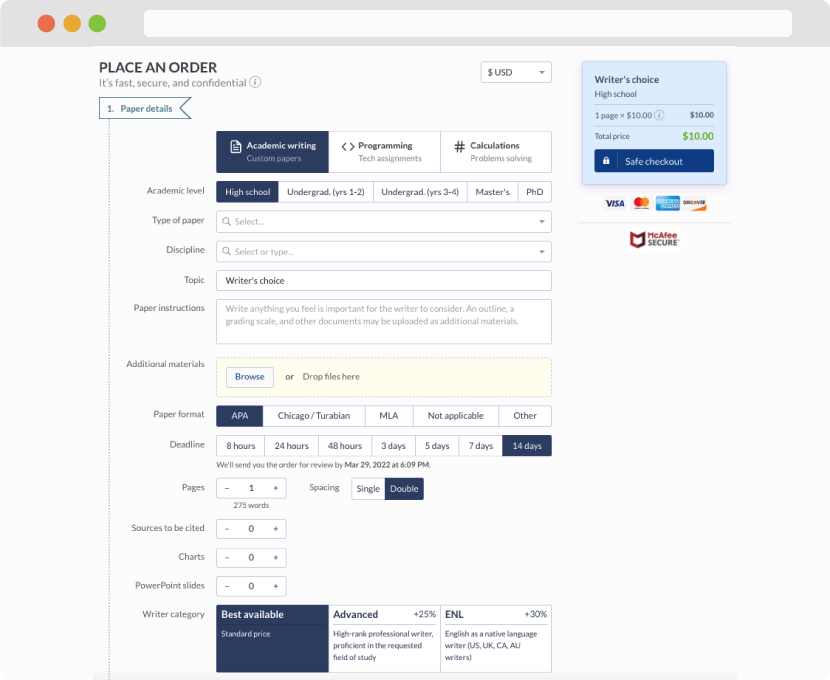
First, you will need to complete an order form. It's not difficult but, if anything is unclear, you may always chat with us so that we can guide you through it. On the order form, you will need to include some basic information concerning your order: subject, topic, number of pages, etc. We also encourage our clients to upload any relevant information or sources that will help.
Complete the order form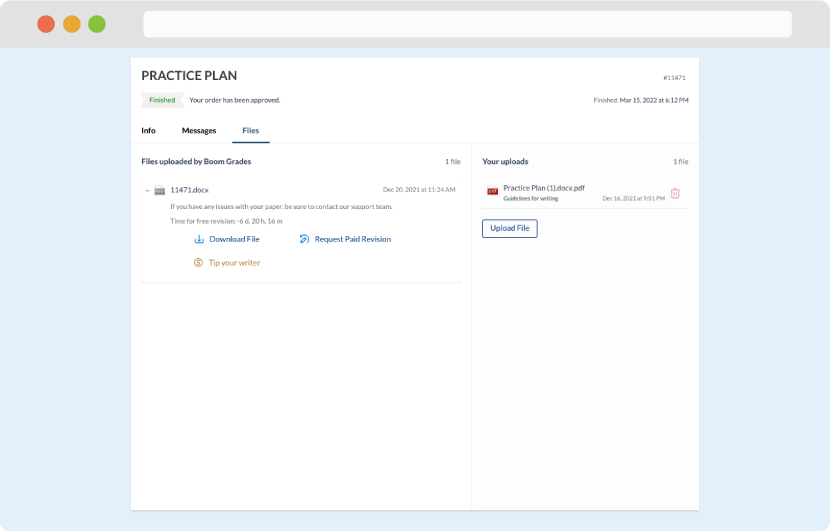
Once we have all the information and instructions that we need, we select the most suitable writer for your assignment. While everything seems to be clear, the writer, who has complete knowledge of the subject, may need clarification from you. It is at that point that you would receive a call or email from us.
Writer’s assignment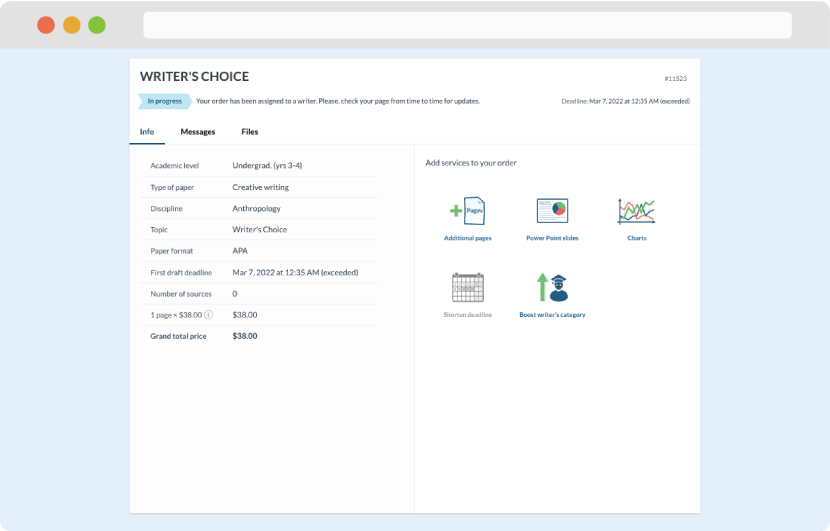
As soon as the writer has finished, it will be delivered both to the website and to your email address so that you will not miss it. If your deadline is close at hand, we will place a call to you to make sure that you receive the paper on time.
Completing the order and download