EPY 6214EPY 6214 Educational and Psychological Statistics
Final Paper Instruction and Rubric
Your final paper is limited to 2‐4 pages (no less than 2 and no more than 4 pages),
double‐spaced, not including references. Use Times New Roman 12‐point font and 1‐inch
margins on the top, bottom and sides. A title page and references do not count as part of the
page limit requirements. The text will be followed by a list of references. Your citations and
reference list must follow APA format 7th edition. If you are uncertain about APA format, refer
to the Publication Manual of the American Psychological Association, several copies are located
in the library and it is advisable for all doctoral students in education to have a copy of their
own.
Your paper must include the following sections and provide sufficient information in
regard to the bullet‐point content listed below. Remember, the final paper is a research paper,
not an article critique. You need to analyze a real dataset by yourself.
Introduction
Problem
What is the problem? Provide a statement of the problem. Be explicit!
Provide some background info (with a couple of references) of the problem
Indicate the variables of interest and their hypothesized relations
Research Questions
List all of the research questions
Restate the variables and their hypothesized relationships
Method (Must use one of the quantitative methods covered in the lectures)
Participants
Describe the population
Describe the sample
Demographics info. If available
Instruments
Describe the instruments/measures
Procedure
How were data collected if such information is available
Results
Present the appropriate statistics
See example APA write ups
Discussion
Conclusion and Recommendations
Discuss each result in relation to your research questions
Discuss potential problems with the study and how the study might be improved in the
future
Recommendations for future research
10
EPY 6214
Performance Rubric: EPY 6214 Capstone Project
Criteria
Novice/Not
Mentioned
APA Formatting
0%. References or
(10 pts)
citations not given;
Single spaced;
Headings/subheadings
not used;
Introduction &
Research Questions
(15 pts)
0%. No linkage of
introduction to RQ(s);
RQs omit IV(s) and/or
DV, or are not
testable.
Participants,
Instruments, &
Procedure
(15 pts)
Design & Analysis
Used
(15 pts)
0%. One or none of
the sections suitably
addressed.
Variables
(5 pts)
0%.
IV(s) and/or DVs not
indicated, or reversed.
Results
(20 pts)
0%.
Lacks summary
statistics; Omits key
statistical test results;
Fails to include and
explain ES estimates;
Mis‐interprets test
results.
Conclusions &
Recommendations
(10 pts)
0%. Conclusions
and/or
recommendations
absent; important
conclusions missing or
incorrectly drawn.
0%. No necessary
output attached.
Appendices
(10 pts)
0%.
Design and/or analysis
absent or incorrect.
Competent/Not
Clearly Defined
50%. Some style
errors, but not
enough to detract
from presentation.
Tables might be cut
and pasted; A few
reference errors, or
failed to italicize all
symbols.
50%. RQs are testable
and include variables,
but may be
awkwardly worded.
Introduction may be
weak, but linked to
RQ(s).
50%. Two of the
three sections are
suitably addressed.
50%.
Partial or incomplete
description of
statistical design,
analysis.
50%. DV indicated;
IV(s) may be poorly
indicated (e.g.,
conflating levels of an
IV with number of IVs)
60%.
Possible omission of
some summary
statistics and/or
parameter
estimates/test results,
but otherwise correct;
Too many statistics
given in text when a
table is preferred.
50%. Not all
conclusions supported
by data;
Recommendations
absent or
“boilerplate.”
50%. Output attached
but not organized or
not necessary info.
Proficient/Clearly Defined
100%. Double spaced; tables/figures in
APA format (not cut and pasted SPSS
output); appropriate # decimal places;
Headings/subheadings appropriate;
Citations correctly given in text and
matched to references. Symbols
italicized.
100%. Introduction makes case for the
present study; research question(s) are
clearly stated, include appropriate IV(s),
DV, and are testable.
100%. All three elements suitably
addressed; clearly explained.
100%.
Be specific about what analysis you are
using (e.g., t‐tests, one‐way ANOVA,
simple linear regression, Chi‐square,
Binomial tests)
100%.
For ANOVA: clearly define all your
factors (with all levels of each factor) and
DV; For regression: clearly define all
predictor(s) and the outcome variable.
100%. For ANOVA: Descriptive statistics
(Ms and SDs) for every group and all
necessary F ratios with the effect sizes;
For regression: Descriptive statistics (Ms
and SDs) for all variables included in the
analysis, and appropriate R2, adjusted R2,
change statistics if applicable, ANOVA
results, and regression parameters (B,
beta, and associated p values).
100%. Conclusions supported by
analyses, are linked back to research
questions/hypotheses;
recommendations tied to results; Clear
explanation.
100%. Only all necessary output
attached.
11
Data Sources
What if you need some data, either for a presentation, project or other application, but don’t
happen to have any at hand? There are many good resources for data, univariate or mulitvariate,
that may be obtained at no cost from a variety of sources. Here are a few such resources, with a
note or two about what each has to offer.
•
•
•
•
•
•
•
•
•
Data and Story Library (DASL). DASL is a resource maintained at Carnegie-‐Mellon University
which has a variety of data sets, some oriented toward a specific data analysis method, others
could be handled in a variety of ways. Though the data sets are numerous, they tend to be small,
that is, based on a relatively small number of cases. The data sets also tend to be somewhat
dated. That doesn’t decrease their utility, however. Perhaps the biggest deficiency is that there
is often little information about the actual source of the data, explanation of how the data were
collected, and, in a few instances, the choice of how the data are quantified. Some of the data
may be fictitious-‐-‐drawn from text examples rather than real data.
Australasian Data and Story Library. OzDASL is similar to DASL, though the data sets tend to be
somewhat better documented.
National Center for Education Statistics (NCES). NCES is the home for all of the data collected
and summarized in the “Nation’s Report Card,” which is based on the National Assessment of
Educational Progress (NAEP) test series. There is much you can find here; some of which is in
summary form, and some of which can be obtained in raw form.
Inter-‐university Consortium for Political and Social Research (ICPSR). ICPSR is a treasure trove of
data sets, many of which are from very large studies, sometimes done longitudinally over many
years. Most of the data sets come from survey-‐type studies, but you should have no problem
finding something here.
Mississippi Assessment and Accountability Reporting System (MAARS). MAARS is a convenient
resource for school, district, and state-‐level information relative to test performance of
Mississippi students from elementary school through high school. The basic retrieval system for
MAARS gives data at a specific unit level (e.g., aggregated for a school, a district, or the state),
but the Mississippi Department of Education web site also has some larger-‐level files that can be
downloaded as well.
StatSci.Org list of data sets. Here’s a large list of links to data sets, some of which have been
listed above (like DASL), some from textbooks, some from elsewhere. If you can’t find something
from this site, you’re just not trying!
HUD USER data sets. From the department of Housing and Urban Development comes a variety
of electronically-‐distributed data sets that can be accessed. These are data sets that have been
obtained from the Office of Policy Development and Research (PD&R) at HUD.
Journal of Statistics Education data sets. A variety of data sets, usually larger than those in DASL,
which are submitted by authors to accompany their articles in JSE. Each data set typically has a
corresponding file with a description, though you can always consult the article.
Need more? Just type “data set” into Google or some other internet search engine, then enjoy
the ride.
Essay Writing Service Features
Our Experience
No matter how complex your assignment is, we can find the right professional for your specific task. Achiever Papers is an essay writing company that hires only the smartest minds to help you with your projects. Our expertise allows us to provide students with high-quality academic writing, editing & proofreading services.
Free Features
Free revision policy
$10Free bibliography & reference
$8Free title page
$8Free formatting
$8How Our Dissertation Writing Service Works
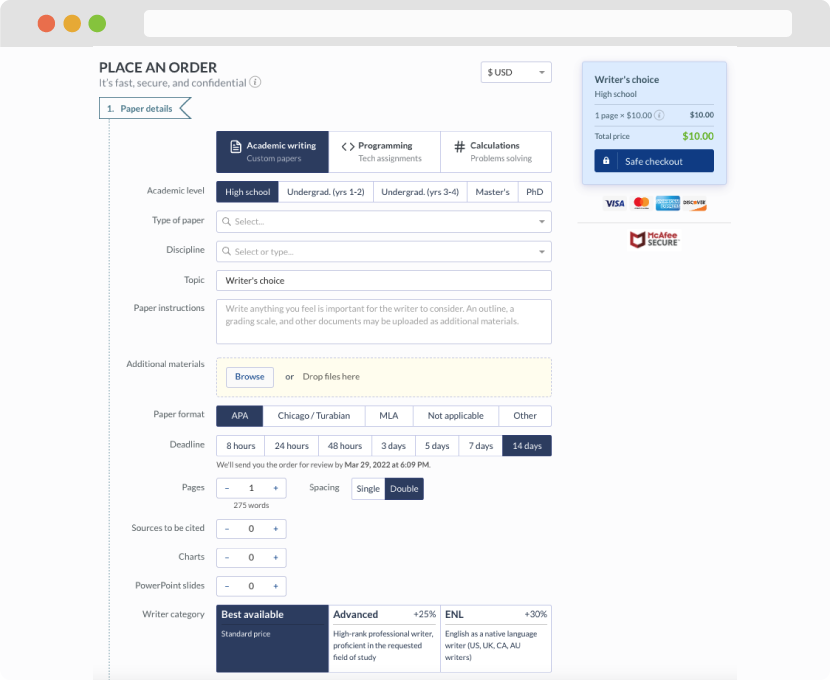
First, you will need to complete an order form. It's not difficult but, if anything is unclear, you may always chat with us so that we can guide you through it. On the order form, you will need to include some basic information concerning your order: subject, topic, number of pages, etc. We also encourage our clients to upload any relevant information or sources that will help.
Complete the order form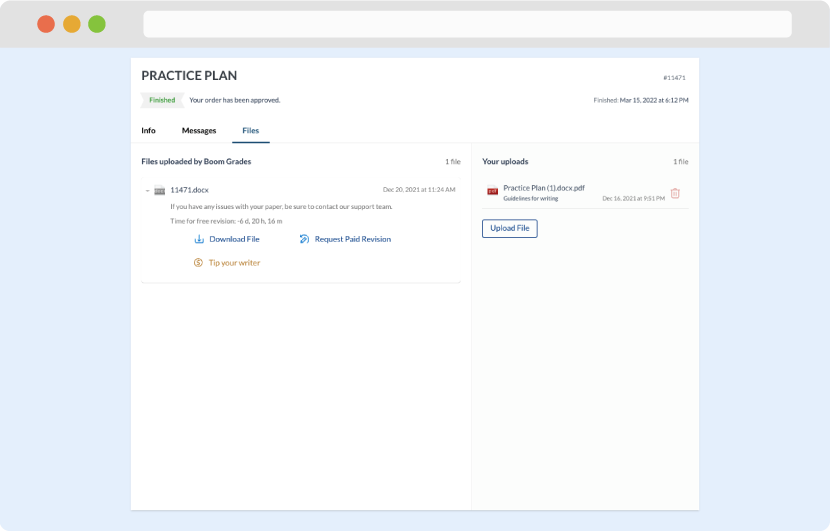
Once we have all the information and instructions that we need, we select the most suitable writer for your assignment. While everything seems to be clear, the writer, who has complete knowledge of the subject, may need clarification from you. It is at that point that you would receive a call or email from us.
Writer’s assignment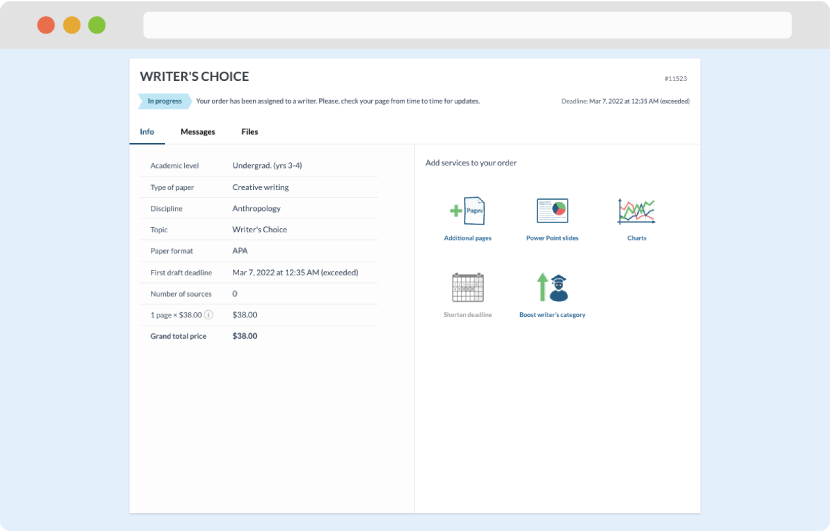
As soon as the writer has finished, it will be delivered both to the website and to your email address so that you will not miss it. If your deadline is close at hand, we will place a call to you to make sure that you receive the paper on time.
Completing the order and download