Stroop Test1
Title
HAFSA KHAN
PSYCHOLOGY DEPARTMENT, NORTHEASTERN UNIVERSITY
Abstract
The purpose of the experiment was to determine whether the time to determine the color of a
word is slower when the letters spell a different color, compared to when the color and word are
the same. Our study showed that Stroop Effect was significant and the mean reaction time, when
color and word were the same, was significantly lower than the mean reaction time when color
and word were different. In other words, the time to determine the color of a word is indeed
slower when the letters spell a different color, compared to when the color and word are the
same. Another purpose of the study was to determine whether asking participants to imagine that
the letters on the screen are meaningless symbols can reduce the Stroop Effect. Our study
showed that the magnitude of the Stroop effect for the group receiving ‘suggestion’ instructions
Stroop Test
2
was significantly smaller than the magnitude of the Stroop effect for the group receiving regular
instructions. However, our study showed that meaningless symbols cannot significantly reduce
the Stroop Effect, and asking the participants to imagine that the letters on the screen are
meaningless symbols cannot significantly reduce the Stroop Effect.
Introduction
The Stroop effect is a psychological phenomenon described as our tendency to experience
difficulty naming a physical color when it is used to spell the name of a different color. This
effect was first described in the 1930s by psychologist John Ridley Stroop. The following study
was a partial replication of two previous studies, one by Stroop (1935) and the other by Raz et al.
(2006).
A hypothesis test was performed to determine whether reaction time is faster when the color and
word are the same compared to when they are different (i.e., a test for the Stroop Effect). A
second hypothesis test was performed to determine whether the Stroop Effect (increased reaction
time when color and word are different) is smaller when participants are asked to imagine that
the letters are meaningless symbols. A third hypothesis test was performed to compare the
magnitude of the Stroop effect for “suggestion” instructions versus regular instructions. A fourth
hypothesis test was performed for comparing the magnitude of the Stroop effect for respondents
whose first language was English and for those whose first language was not English
Method
Participants
The participants of this study were 31 students from three sections of the senior-level research
methods and statistics course (2 nonbinary, 22 female, and 7 male). The students participated in
Stroop Test
3
the experiment as part of a class project. Participants ranged in age from X to X (M = XX.X, SD
= X.XX).
Materials
The materials needed to complete this Qualtrics survey were; access to the internet/wifi,
computer/laptop, the survey link, the experiment link, working keyboard.
Procedure
For this study, everyone was to take a survey online called the Qualtrics Survey. Each student
had to answer a couple of questions such as; age, gender, class section, etc… once you answer
these questions you click to move forward and are given a list of instructions. There are two sets
of instructions you can get in the survey it is randomized so you won’t know which one you or a
classmate has gotten. The objective of this study is to correctly identify the color the word is
written in, not the color in which the word is spelled. For instruction number one the rule that is
given is to imagine that the letters are meaningless symbols Your job is to decide what color the
meaningless symbols are. If they are red press the “r” key as fast as you can. If they’re blue press
“b”, if they’re green press “g” and if they’re yellow press “y”. The group who got the second
instruction was told Your job is to decide what color the letters are. If they are red press SHORT
TITLE 4 with the “r” key as fast as you can. If they’re blue press “b”, if they’re green press “g”
and if they’re yellow press “y”. Once you get your instructions you click on the survey link
which opens a new tab, are not close the survey tab, because you will need to come back to it
after you finish your trails. When all the trials are done you had to click the view results button
and scroll down to where it says “ average time for different color/word” and “ average time for
same color/word. You take the results and submit them back into your survey. Once everything is
filled out you can submit the survey and exit the tabs.
Stroop Test
4
Results
A paired t-test was performed for testing the presence of the Stroop Effect, i.e., the discrepancy
in reaction time. The paired t-test tested whether the mean reaction time when color and word
were the same was smaller as compared to the mean reaction time when color and word were
different.
Table 1. Paired samples T-Test Results for Presence of Stroop Effect
statistic df
Same
Different
Student’s t
-2.91
Cohen’s d
-0.523
p
Effect Size
30.0
0.003
Note. Hₐ μ Measure 1 – Measure 2 < 0
Table 2. Descriptive Statistics for Presence of Stroop Effect
N
Different
Same
31
31
3034
2502
1385
1206
Mean
Median SD
4652
3783
SE
835
679
The mean reaction time when color and word were the same (M = 2502, SD = 3783) was
significantly smaller as compared to the mean reaction time when color and word were different
(M = 3034, SD = 4652); t (df = 30) = -2.91, p-value = 0.003. The effect size was medium with
Cohen’s d = -0.523.
An independent samples t-test was performed for comparing the magnitude of the Stroop
effect for regular instructions versus “suggestion” instructions. Levene's test was significant (p <
.05), suggesting a violation of the assumption of equal variances for the two groups of the
independent variable. Hence an independent samples t-test, assuming unequal variances, was
performed to test whether the magnitude of the Stroop effect for the group receiving ‘suggestion’
Stroop Test
5
instructions was smaller than the magnitude of the Stroop effect for the group receiving regular
instructions.
Table 3. Independent Samples T Test Results (IV: Group, DV: Stroop Effect)
Statistic
df
p
ᵃ Levene's test is significant (p < .05), suggesting a violation of the assumption of equal variances
Note. Hₐ μ suggestion instructions < μ regular instructions
Stroop Effect
Student's t
-2.43
ᵃ
29.0
0.011
Median
SD
Table 4. Descriptive Statistics (IV: Group, DV: Stroop Effect)
Group
Stroop
Effect
N
Mean
SE
suggestion
instructions
18
182
148
250
59.0
regular instructions
13
1016
315
1437
399
The magnitude of Stroop effect for the group receiving ‘suggestion’ instructions (M = 182,
SD = 250) was significantly lower than the magnitude of Stroop effect for the group receiving
regular instructions (M = 1016, SD = 1437); t (df = 29) = -2.43, p-value = 0.011. The effect size
was large with Cohen’s d = -0.883.
An independent samples t-test was performed to determine whether asking participants to
imagine that the letters on the screen are meaningless symbols can reduce the Stroop Effect.
Table 5. Independent Samples T Test Results (IV: Check, DV: Stroop Effect)
Stroop Effect
Student's t
Statistic
df
p
-1.43 ᵃ
29.0
0.082
Effect Size
Cohen's d
-0.535
Stroop Test
6
Note. Hₐ μ meaningless symbols < μ letters
ᵃ Levene's test is significant (p < .05), suggesting a violation of the assumption of equal variances
Table 6. Descriptive Statistics (IV: Check, DV: Stroop Effect)
Group
Stroop
Effect
N
Mean
Median
SD
SE
meaningless
symbols
11
186
196
174
52.5
letters
20
722
304
1230
275
There was no significant difference in the magnitude of Stroop effect for letters (M = 722, SD =
1230) and meaningless symbols (M = 186, SD = 174); t (df = 29) = -1.43, p-value = 0.082. The
effect size was small with Cohen’s d = -0.535.
An independent samples t-test was performed for comparing the magnitude of the Stroop
effect for respondents whose first language was English and for those whose first language was
not English (1 = Yes, 2 = No). Levene's test was significant (p < .05), suggesting a violation of
the assumption of equal variances for the two groups of the independent variable.
Table 7. Independent Samples T Test Results (IV: English, DV: Stroop Effect)
Stroop Effect
Student's t
Statistic
df
p
1.29 ᵃ
29.0
0.208
Effect Size
Cohen's d
0.495
ᵃ Levene's test is significant (p < .05), suggesting a violation of the assumption of equal variances
Table 8. Descriptive Statistics (IV: English, DV: Stroop Effect)
Stroop Test
7
Group
Stroop Effect
N
Mean
Median
SD
SE
yes
21
693
223
1205
263
no
10
194
213
201
63.6
There was no significant difference in the magnitude of Stroop effect for the respondents
whose first language was English (M = 223, SD = 1205) and for those whose first language was
not English (M = 194, SD = 201); t (df = 29) = 1.29, p-value = 0.208. The effect size was small
with Cohen’s d = 0.495.
Discussion
Our study showed that Stroop Effect was significant. The hypothesis was that the mean reaction
time, when color and word were the same, was significantly lower than the mean reaction time
when color and word were different. The hypothesis was supported by the results, and it was
found that the time to determine the color of a word is indeed slower when the letters spell a
different color, compared to when the color and word are the same. The result was consistent
with previous research by Stroop in 1935, where he found that “the interference of conflicting
word stimuli upon the time for naming 100 colors (each color being the print of a word which
names another color) caused an increase of 47.0 seconds or 74.3% of the normal time for naming
colors printed in squares.” (Stroop, 1935). Our findings were also consistent with the findings of
the study by Elliott in 2015, where he showed that people tend to be faster at identifying the font
color when the word name and font color are the same and slower when they are different.
(Elliott, 2015). “Two factors underlie Stroop interference: dimensional imbalance and
dimensional uncertainty. Dimensional imbalance reflects how correlated the two dimensions of a
Stroop Test
8
stimulus are and how surprising a stimulus is and determines the ease of recovery of a stimulus
representation from memory. Dimensional uncertainty reflects how salient a stimulus is, notably
how likely or unlikely it is in the context of other (recently presented) stimuli.” (C. M. MacLeod,
2015). Our study showed that the magnitude of the Stroop effect for the group receiving
‘suggestion’ instructions was significantly smaller than the magnitude of the Stroop effect for the
group receiving regular instructions. This result was also consistent with previous research by
Raz et al in 2006, where the researchers had examined the effects of suggestion on Stroop
interference in highly suggestible individuals, where participants had completed the Stroop task
with and without a suggestion to perceive Stroop words as meaningless symbols. “Suggestion
produced a significant reduction in Stroop inhibition, accounting for about 45% of the variance
in Stroop responding, regardless of whether hypnosis had been induced. These findings indicate
that suggestion can at least partially overcome the automaticity associated with the Stroop
effect”. (Raz et al., 2006). However, our study showed that meaningless symbols cannot
significantly reduce the Stroop Effect, and asking the participants to imagine that the letters on
the screen are meaningless symbols cannot significantly reduce the Stroop Effect. This result did
not support our hypothesis and was not consistent with previous research by Raz et al in 2006.
(Raz et al., 2006). This might be owing to the small sample size considered in our study. Our
study also showed that there was no significant difference in the magnitude of the Stroop effect
for the respondents whose first language was English than those whose first language was not
English.
Stroop Test
9
References
Elliott, Charles. (2015). The Stroop Effect on Color and Word Identification.
MacLeod, Colin M. (2015). The Stroop Effect. Encyclopedia of Color Science and Technology
DOI 10.1007/978-3-642-27851-8_67-1. Springer Science + Business Media New York 2015
Raz, A., Kirsch, I., Pollard, J., & Nitkin-Kaner, Y. (2006). Suggestion reduces the Stroop effect.
Psychological Science, 17(2), 91-95. https://doi.org/10.1111/j.1467-9280.2006.01669.x
Stroop Test
10
Stroop, J. R. (1935). Studies of interference in serial verbal reactions. Journal of Experimental
Psychology, 18(6), 643-662. https://doi.org/10.1037/h0054651
Checklist for SRM II Paper Assignment – Fall 2022
Below are the sections required for the assignment and the key elements of each section
Overall Format – 1st Submission
Manuscript follows APA Style (7th Edition); Use APA permitted font (recommended Times New Roman 12 pt)
Margins need to all be 1”
Page header should be identical for all pages of manuscript
To start a new page, insert a page break by pressing Ctrl-Enter, not by repeatedly pressing Enter until you get to
a new page (this will cause later formatting problems)
Title Page – 1st Submission
Page header needs to be in APA format (and include short title)
Manuscript title, name, and departmental/institutional affiliation need to be in APA format (Professional Paper)
Title needs to be relevant to study
Abstract – 3rd Submission (have designated page with section header in 1st Submission)
Needs to be in APA format (no indent to first line!)
Maximum 250 words (per APA guidelines – see Abstract & Keywords guide here)
Includes: relevant background information, basics of study method, major findings, and major conclusions
Introduction – 3rd Submission (have designated section header only in 1st submission)
Title and section need to be in APA format
Need to present information from and cite Stroop (1935) and Raz et al. (2006) articles and minimum of two
additional peer-reviewed empirical articles relevant to study hypotheses (the required papers + 2 additional
papers are available in Unit 6 on D2L)
Bonus credit (½ point) can be earned for each additional reference incorporated after 4 cited (2 points maximum)
Need to present background information relevant to the key aspects of study: Stroop effect & evidence, effect of
suggestion on Stroop effect
Need to define and describe key terms (e.g., what does Stroop effect mean?)
Needs to be organized thematically, not as a series of summaries of prior research studies
Section needs to end with a paragraph setting up the current study – noting in what ways study replicates or is
testing hypotheses from prior research, how it is different, stating research hypotheses or questions, etc.
Method – 1st Submission
Section begins immediately following Introduction (no page break)
Section header and section subheadings need to be in APA format
Method needs to be written in past tense (study is now complete)
Participants: include sample size, description of important characteristics (depending on characteristic may be
frequencies, mean, standard deviation, range, etc.), how participants were recruited to be in the study
Materials: describe the survey used in the current study (see PDF posted on D2L) – avoid block quoting,
paraphrase instead, do not include survey in an appendix
Procedure: describe the steps that were followed to conduct the experiment & collect the data
Results – 2nd Submission (have designated section header only in 1st submission)
Section begins immediately following Method (no page break)
Section header needs to be in APA format
Mandatory analysis 1: paired t-test comparing reaction time for when color & word are the same versus different
(you are testing for the presence of the Stroop Effect, i.e., the discrepancy in reaction time)
Mandatory analysis 2: independent t-test comparing size of Stroop effect for regular instructions vs. “suggestion”
instructions
Mandatory analysis 3: one additional independent t-test of your choice, related to the topic of the study
You can get extra credit (1 point per analysis) for additional analyses if they are meaningful, relevant, and
summarized appropriately, plus accompanied by a Table or Figure (2 points maximum extra credit)
Each finding should be fully reported in proper APA format with all relevant information
You must refer to a Table or Figure for EACH result that you present (recommendation: for t-tests use Figures!)
Findings should be presented in separate paragraphs unless closely linked (e.g., same independent variable)
Format each result as follows: describe what you tested & how, refer to either a Figure or Table, then summarize
your findings (statistical test in APA format, give descriptive stats – M and SD if you have a Figure)
Avoid repeating the exact same sentence structure in writing up each result
Discussion – 3rd Submission Outline Only; 4th Submission completed (section header only in 1 st/2nd submissions)
Section begins immediately following Results (no page break)
Section header needs to be in APA format
Summarize in words and then discuss each major finding (DO NOT report statistics here!)
Discuss each finding/group of related findings separately – only discuss issues relevant to that finding (i.e., was
the hypothesis supported? Is it consistent or inconsistent with previous research? Why do you think we got the
finding that we did?)
When you are discussing a result that was also tested in research that you cited in the Introduction, you need to
clearly compare your result and cite the original study – note if you obtained similar or different findings
Have a separate paragraph at the end about “Limitations & Directions for Future Research” where you talk about
general methodological limitations to the study overall and how you would address these in future studies
References – 3rd Submission (have designated page with section header in 1st Submission)
Section begins on a new page following Discussion
References need to be reported in proper APA format
You must include all references cited (and no extras!)
You must include the required Stroop (1935) and Raz et al. (2006) papers and at least 2 additional references
To get extra credit for extra references, they MUST be included in the 3rd submission, and they must be discussed
in some detail in the Introduction and/or Discussion sections
Tables (Optional) – 2nd Submission (and all subsequent submissions)
Tables need to be numbered in the order in which they are referenced in the Results section
Each Table goes on a separate page
Table number and Table title need to be in proper APA format
The body of the Table (including borders, headers, and content) needs to be in proper APA format
If Tables are included, all Tables need to be placed before Figures; numbering starts at “1” for Tables and Figures
Figures – 2nd Submission (and all subsequent submissions)
A minimum of two Figures is required, and you must have either a Figure or a Table (not both!) for each analysis
Figures need to be numbered in the order in which they are referenced in the Results section
Each Figure goes on a separate page
Figure number and figure caption need to be in proper APA format
General Writing Style – ALL Submissions
Manuscript needs to be written in past tense
Avoid use of first or second person pronouns (i.e., I, we, you)
Avoid language that is too informal or colloquial (such as slang)
Do not use contractions
Remember that even in the more technical sections (such as Method and Results), your sections still need to
read as a narrative – you need to have complete sentences that are grammatically correct
Remember that you can earn up to 2 points of extra credit for additional references and/or additional
analyses
Figure 1
Mean Reaction: Stroop Effect.
Figure 2
Mean Stroop Effect: Instructions on Stroop Effect.
Figure 3
Mean Stroop Effect: English first language (yes or no) on Stroop Effect.
SHORT TITLE
1
Match the right ink color
Hafsa Khan
Psychology Department, Northeastern University
Stats & Research Method II
Nadia Silverthorn
October 12, 2022
SHORT TITLE
2
Abstract
Introduction
Method
Participants
The participants of this study were college students in SRM II. There are three sections of
the SRM II class. You could be a participant from either of the three sections; MW 11:30, MW
5:40, or TR 1:40. From the three sections there was a total of 31 participants. Which consisted of
2 nonbinary, 22 females, and 7 males.
Materials
The materials you need to complete this Qualtrics survey are; access to the internet/wifi,
computer/laptop, the survey link, the experiment link, working keyboard.
Procedure
For this study, everyone was to take a survey online called the Qualtrics Survey. Each
student had to answer a couple of questions such as; age, gender, class section, etc… once you
answer these questions you click to move forward and are given a list of instructions. There are
two sets of instructions you can get in the survey it is randomized so you won’t know which one
you or a classmate has gotten. The objective of this study is to correctly identify the color the
word is written in, not the color in which the word is spelled. For instruction number one the rule
that is given is to imagine that the letters are meaningless symbols Your job is to decide what
color the meaningless symbols are. If they are red press the “r” key as fast as you can. If they’re
blue press “b”, if they’re green press “g” and if they’re yellow press “y”. The group who got the
second instruction was told Your job is to decide what color the letters are. If they are red press
the “r” key as fast as you can. If they’re blue press “b”, if they’re green press “g” and if they’re
yellow press “y”. Once you get your instructions you click on the survey link which opens a new
tab, are not close the survey tab, because you will need to come back to it after you finish your
SHORT TITLE
3
trails. When all the trials are done you had to click the view results button and scroll down to
where it says “ average time for different color/word” and “ average time for same color/word.
You take the results and submit them back into your survey. Once everything is filled out you can
submit the survey and exit the tabs.
Results
Paired Samples T-Test
Differen
t
Same
Student's
t
statistic
df
p
Effect Size
2.91
30.
0
0.00
3
Cohen's d
0.523
Note. Hₐ μ Measure 1 - Measure 2 > 0
Descriptives
N
Mean
Median
SD
SE
Differen
t
3
1
3034
1385
465
2
83
5
Same
3
1
2502
1206
378
3
67
9
Statistic
df
p
-2.43 ᵃ
29.0
0.011
^ 1. test for Stroop effect (1-tailed)
Independent Samples T-Test
StroopEffect
Student’s t
Effect Size
Cohen’s d
Note. Hₐ μ suggestion instructions < μ regular instructions
ᵃ Levene's test is significant (p < .05), suggesting a violation of the assumption of equal
variances
-0.883
SHORT TITLE
4
Group Descriptives
Group
StroopEffec
t
N
Mean
Median
SD
SE
1
8
182
148
250
59.
0
1
3
1016
315
143
7
399
suggestion
instructions
regular instructions
2 test effect of experimental instructions - Independent t IV: group DV: Stroop effect (1-tailed)
Independent Samples T-Test
StroopEffect
Statistic
df
p
1.29 ᵃ
29.0
0.208
Student's t
Effect Size
Cohen's d
ᵃ Levene's test is significant (p < .05), suggesting a violation of the assumption of equal
variances
Group Descriptives
Group
StroopEffec
t
yes
no
N
Mean
Median
SD
SE
2
1
693
223
120
5
263
1
0
194
213
201
63.
6
0.495
SHORT TITLE
5
3 IV: English ID: Strrop effect
Independent Samples T-Test
Same
Student's t
Statistic
df
p
Effect Size
1.16 ᵃ
28.0
0.257
Cohen's d
0.438
ᵃ Levene's test is significant (p < .05), suggesting a violation of the assumption of equal
variances
Group Descriptives
Group
Same
under 25
25 and
older
N
Mean
Median
SD
SE
1
9
3160
1235
471
3
108
1
1
1
1486
1170
909
274
3 IV: Age group DV: same
Independent Samples T-Test
Different
Student's t
Same
Student's t
Statistic
df
p
1.07 ᵃ
28.0
0.293
1.16 ᵃ
28.0
0.257
Effect Size
Cohen's d
Cohen's d
0.406
0.438
SHORT TITLE
6
ᵃ Levene's test is significant (p < .05), suggesting a violation of the assumption of equal
variances
Group Descriptives
Group
Differen
t
under 25
25 and
older
Same
under 25
25 and
older
N
Mean
Median
SD
SE
1
9
3784
1510
579
2
132
9
1
1
1871
1368
132
3
399
1
9
3160
1235
471
3
108
1
1
1
1486
1170
909
274
Statistic
df
p
1.07 ᵃ
28.0
0.293
3 DV: differnt & same IV: Age group
Independent Samples T-Test
Different
Student's t
Effect Size
Cohen's d
ᵃ Levene's test is significant (p < .05), suggesting a violation of the assumption of equal
variances
0.406
SHORT TITLE
7
Group Descriptives
Group
Differen
t
N
Mean
Median
SD
SE
1
9
3784
1510
579
2
132
9
1
1
1871
1368
132
3
399
under 25
25 and
older
3 IV: Age group DV: different
Discussion
Reference
Table(s) (optional)
Figure (s)
Essay Writing Service Features
Our Experience
No matter how complex your assignment is, we can find the right professional for your specific task. Achiever Papers is an essay writing company that hires only the smartest minds to help you with your projects. Our expertise allows us to provide students with high-quality academic writing, editing & proofreading services.
Free Features
Free revision policy
$10Free bibliography & reference
$8Free title page
$8Free formatting
$8How Our Dissertation Writing Service Works
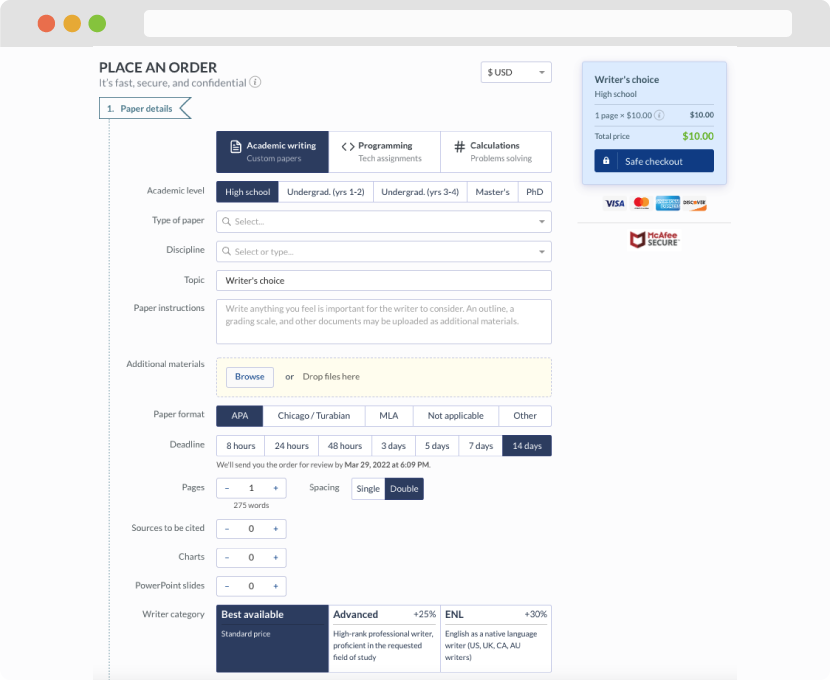
First, you will need to complete an order form. It's not difficult but, if anything is unclear, you may always chat with us so that we can guide you through it. On the order form, you will need to include some basic information concerning your order: subject, topic, number of pages, etc. We also encourage our clients to upload any relevant information or sources that will help.
Complete the order form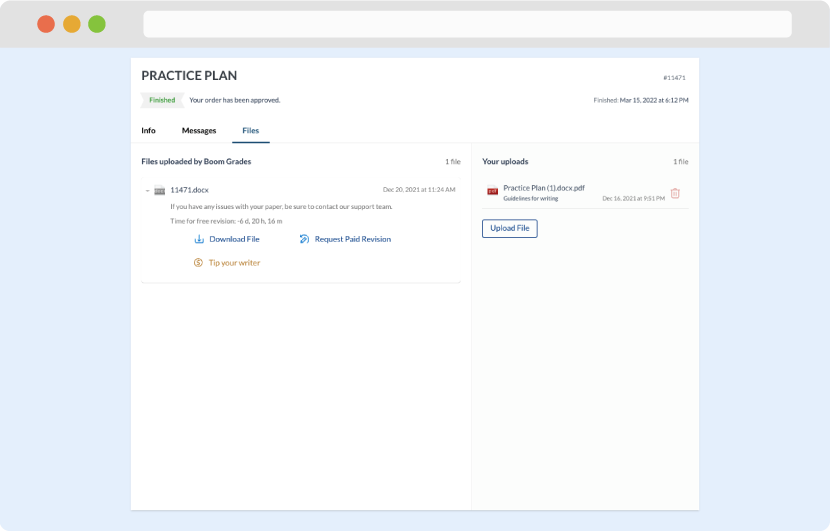
Once we have all the information and instructions that we need, we select the most suitable writer for your assignment. While everything seems to be clear, the writer, who has complete knowledge of the subject, may need clarification from you. It is at that point that you would receive a call or email from us.
Writer’s assignment
As soon as the writer has finished, it will be delivered both to the website and to your email address so that you will not miss it. If your deadline is close at hand, we will place a call to you to make sure that you receive the paper on time.
Completing the order and download