Seeing the relevance of statistics in everyday life is a big part of this course. The five step process discussed in Module 9 is used for hypothesis testing, but I’m guessing you use a similar process in your everyday life to make decisions (whether you think about it like that or not).
Consider a question you have had or have come across in your college, career, or personal life. Describe and apply the five steps below. Have fun with this discussion and feel free to comment on a classmate’s post.
Note: An example is provided to help guide you. Please do not use this example or one too similar to it.
Five Step Process for Hypothesis Testing:
Step 1: State the hypothesis to be tested.
Step 2: Specify the decision rule.
Step 4: Make a decision.
Step 5: Take action based on the decision.
Step 1: State the hypothesis to be tested.
Ho: I will go to class today, Ha: I will not go to class today.
Step 3: Collect data and calculate necessary statistics to test the hypothesis.
Statistics for today:
Weather Channel: P(rain)=0.50
Local News: P(rain)=0.40
Step 4: Make a decision.
All of the statistics showed a P(rain) of 0.65 or less, so Fail to Reject Ho. I will go to class.
Step 5: Take action based on the decision.
https://web.microsoftstream.com/video/f25919fb-c2e…Hypothesis Testing in Excel Demo
Book Name :Applied Statistics in Business and Economics By David Doane
LO9-1: Know the steps in testing hypotheses and define H0 and H1.
LO9-2: Define Type I error, Type II error, and power.
LO9-3: Formulate a null and alternative hypothesis for μ or π.
LO9-4: Explain decision rules, critical values, and rejection regions.
LO9-5: Perform a hypothesis test for a mean with known σ using z.
LO9-6: Use tables or Excel to find the p-value in tests of μ.
LO9-7: Perform a hypothesis test for a mean with unknown σ using t.
LO9-8: Perform a hypothesis test for a proportion and find the p-value.
LO9-9: Check whether normality may be assumed in testing a
proportion.
LO9-10: Interpret a power curve or OC curve (optional).
LO9-11: Perform a hypothesis test for a variance (optional).
Chapter 9
One-Sample
Hypothesis Tests
Copyright © 2022 McGraw Hill. All rights reserved. No reproduction or distribution without the prior
written consent of McGraw Hill.
Copyright © 2022 McGraw Hill. All rights reserved. No reproduction or distribution
without the prior written consent of McGraw Hill.
1-1
6
Chapter 9
Chapter Learning Objectives
1-7
7
Hypothesis Testing
Copyright © 2022 McGraw Hill. All rights reserved. No reproduction or distribution
without the prior written consent of McGraw Hill.
The business analyst asks questions, makes assumptions, and
proposes testable theories about the values of key parameters of
the business operating environment.
Each assumption is tested against observed data. If an assumption
has not been disproved, in spite of rigorous efforts to do so, the
business may operate under the belief that the statement is true.
The analyst states the assumption, called a hypothesis, in a format
that can be tested using well-known statistical procedures.
The hypothesis is compared with sample data to determine if the
data are consistent or inconsistent with the hypothesis.
When the data are found to be inconsistent (i.e., in conflict) with the
hypothesis, the hypothesis is either discarded or reformulated.
Copyright © 2022 McGraw Hill. All rights reserved. No reproduction or distribution
without the prior written consent of McGraw Hill.
1-8
8
LO 9-1
Hypothesis testing is used in science and business to
test assumptions and theories and guide managers
when facing decisions.
We will first explain the logic behind hypothesis testing
and then show how statistical hypothesis testing helps
businesses make decisions.
Chapter 9
Hypothesis Testing
1-9
9
Hypothesis Testing
Copyright © 2022 McGraw Hill. All rights reserved. No reproduction or distribution
without the prior written consent of McGraw Hill.
10
Chapter 9: One Sample Hypothesis
Tests
All business managers need at least a basic understanding of
hypothesis testing because managers often interact with specialists,
read technical reports, and then make recommendations on key
financial or strategic decisions based on statistical evidence.
Copyright © 2022 McGraw Hill. All rights reserved. No reproduction or distribution
without the prior written consent of McGraw Hill.
1-10
LO 9-1
LO 9-1
Hypothesis Testing as an Ongoing
Process
1-11
11
1
Step 1: State the Hypothesis
Formulate a pair of mutually exclusive, collectively
exhaustive statements about the world. One statement
or the other must be true, but they cannot both be true.
H0 must be stated in a precise way so that it can be
tested against empirical evidence from a sample.
If H0 happens to be an established theory, we might not
really expect to reject it, but we try anyway.
If we reject H0, we tentatively conclude that the
alternative hypothesis H1 is the case.
H0 represents the status quo (e.g., the current state of
affairs), while H1 is sometimes called the action
alternative because action may be required if we reject
H0 in favor of H1.
The two statements are hypotheses because the truth is
unknown.
Efforts will be made to reject the null hypothesis.
Copyright © 2022 McGraw Hill. All rights reserved. No reproduction or distribution
without the prior written consent of McGraw Hill.
LO 9-1
LO 9-1
Step 1: State the Hypothesis
Copyright © 2022 McGraw Hill. All rights reserved. No reproduction or distribution
without the prior written consent of McGraw Hill.
1-12
12
1-13
13
Step 2: Specify the Decision Rule
Criminal Trial In a criminal trial, the hypotheses are
H0: The defendant is innocent
H1: The defendant is guilty
Our legal system assumes a defendant is innocent unless the
evidence gathered by the prosecutor is sufficient to reject this
assumption.
Drug Testing When an Olympic athlete is tested for performanceenhancing drugs (“doping”), the presumption is that the athlete is in
compliance with the rules. The hypotheses are
H0: No banned substance was used
H1: Banned substance was used
Samples of urine or blood are taken as evidence and used only
to disprove the null hypothesis because we assume the athlete
is free of banned substances.
Copyright © 2022 McGraw Hill. All rights reserved. No reproduction or distribution
without the prior written consent of McGraw Hill.
LO 9-1
LO 9-1
Examples
Before collecting data to compare against the
hypothesis, the researcher must specify how the
evidence will be used to reach a decision about the null
hypothesis.
For example, in our legal system, the evidence
presented by the prosecutor must convince a jury
“beyond a reasonable doubt” that the defendant is not
innocent.
Copyright © 2022 McGraw Hill. All rights reserved. No reproduction or distribution
without the prior written consent of McGraw Hill.
1-14
14
1-15
15
Step 5: Take Action Based on Decision
Much of the critical work in hypothesis testing takes
place during steps 1 and 2.
Once the hypotheses and decision rule have been
clearly articulated, the process of data collection, while
occasionally time-consuming, is straightforward.
We compare the data with the hypothesis, using the
decision rule, and decide to reject or not reject the null
hypothesis.
This last step—taking action—requires experience and
expertise on the part of the decision maker.
Suppose the evidence presented at a trial convinces a
jury that the defendant is not innocent. What punishment
should the judge impose?
Appropriate action for the decision should relate back to
the purpose of conducting the hypothesis test in the first
place.
Copyright © 2022 McGraw Hill. All rights reserved. No reproduction or distribution
without the prior written consent of McGraw Hill.
16
Chapter 9: One Sample Hypothesis
Tests
LO 9-1
LO 9-1
Steps 3 and 4: Data Collection and
Decision Making
Copyright © 2022 McGraw Hill. All rights reserved. No reproduction or distribution
without the prior written consent of McGraw Hill.
1-16
1-17
17
2
Chapter 9
Chapter 9
The Logic of Hypothesis Testing – by example
The Logic of Hypothesis Testing – by example
Ho: The kid stole a pack of gum.
Ha: The kid did not steal a pack of gum.
Judgement
Not Guilty
Truth
Copyright ©2019 McGraw-Hill Education. All rights reserved. No reproduction or distribution without the
prior written consent of McGraw-Hill Education.
Guilty
Did not steal a
pack of gum
Stole a pack
of gum
Copyright ©2019 McGraw-Hill Education. All rights reserved. No reproduction or distribution without the
prior written consent of McGraw-Hill Education.
9-18
18
9-19
19
The Logic of Hypothesis Testing – by example
Ho: The kid stole a pack of gum.
Ha: The kid did not steal a pack of gum.
Ho: The kid stole a pack of gum.
Ha: The kid did not steal a pack of gum.
Judgement
Did not steal a
pack of gum
Stole a pack
of gum
Judgement
Guilty
Correct
Decision
Truth
Truth
Not Guilty
Correct
Decision
Copyright ©2019 McGraw-Hill Education. All rights reserved. No reproduction or distribution without the
prior written consent of McGraw-Hill Education.
Chapter 9
Chapter 9
The Logic of Hypothesis Testing – by example
Guilty
Did not steal a
pack of gum
Correct
Decision
Type I Error
(α)
Stole a pack
of gum
Type II Error
(β)
Correct
Decision
Copyright ©2019 McGraw-Hill Education. All rights reserved. No reproduction or distribution without the
prior written consent of McGraw-Hill Education.
9-20
20
Not Guilty
9-21
21
Type I and Type II Errors
No, we cannot prove a null hypothesis—we can only fail
to reject it.
A null hypothesis that survives repeated tests without
rejection is “true” only in the limited sense that it has
been thoroughly scrutinized and tested.
Today’s “true” hypothesis could be disproved tomorrow if
new data are found.
If we fail to reject H0, the same hypothesis may be
retested. That is how scientific inquiry works.
It is possible to make an incorrect decision regarding the
null hypothesis.
As illustrated in the table below, either the null
hypothesis is true or it is false.
We have two possible choices concerning the null
hypothesis. We either reject H0 or fail to reject H0.
Copyright © 2022 McGraw Hill. All rights reserved. No reproduction or distribution
without the prior written consent of McGraw Hill.
22
Chapter 9: One Sample Hypothesis
Tests
LO 9-2
LO 9-1
Can a Null Hypothesis Be Proved?
The true situation determines whether our decision was
correct. If the decision about the null hypothesis matches
the true situation, the decision was correct.
Copyright © 2022 McGraw Hill. All rights reserved. No reproduction or distribution
without the prior written consent of McGraw Hill.
1-22
1-23
23
3
Chapter 9
LO 9-2
Type I and Type II Errors
Types of Errors – by example
Ho: The kid stole a pack of gum.
Ha: The kid did not steal a pack of gum.
Rejecting the null hypothesis when it is true is a Type I
error (also called a false positive).
Failure to reject the null hypothesis when it is false is a
Type II error (also called a false negative).
In either case, an incorrect decision was made.
We can minimize the chance of error by collecting as
much sample evidence as our resources allow and by
choosing proper testing procedures.
Judgement
Copyright © 2022 McGraw Hill. All rights reserved. No reproduction or distribution
without the prior written consent of McGraw Hill.
Truth
Not Guilty
Ho is not true.
Guilty
Ho is true.
Did not steal a pack
of gum
(Reject Ho)
Correct Decision
Type I Error
(α)
Stole a pack of gum
(Fail to Reject Ho)
Type II Error
(β)
Correct Decision
1-24
24
Copyright ©2019 McGraw-Hill Education. All rights reserved. No reproduction or distribution without the
prior written consent of McGraw-Hill Education.
9-25
25
The consequences of these two errors are quite
different, and the costs are borne by different parties.
Example: Type I error is convicting an innocent
defendant, so the costs are borne by the defendant.
Type II error is failing to convict a guilty defendant, so
the costs are borne by society if the guilty person returns
to the streets.
Firms are increasingly wary of Type II error (failing to
recall a product as soon as sample evidence begins to
indicate potential problems).
Consequences of Errors – by example
Ho: The kid stole a pack of gum.
Ha: The kid did not steal a pack of gum.
Copyright © 2022 McGraw Hill. All rights reserved. No reproduction or distribution
without the prior written consent of McGraw Hill.
Judgement
Guilty
Ho is true.
Did not steal a pack of gum
(Reject Ho)
Correct Decision
Type I Error (α)
The kid is sad because
he did the right thing
but didn’t convince his
parents/others and got
in trouble.
Stole a pack of gum (Fail to
Reject Ho)
Type II Error (β)
The kid got away with
it, and he may try to do
it again.
Correct Decision
Truth
Not Guilty
Ho is not true.
1-26
26
Chapter 9
LO 9-2
Consequences of Type I and Type II Errors
Copyright ©2019 McGraw-Hill Education. All rights reserved. No reproduction or distribution without the
prior written consent of McGraw-Hill Education.
9-27
27
Power
The probability of a Type I error (rejecting a true null hypothesis) is
denoted α (the lowercase Greek letter “alpha”).
Statisticians refer to α as the level of significance.
The probability of a Type II error (not rejecting a false hypothesis) is
denoted β (the lowercase Greek letter “beta”)
Copyright © 2022 McGraw Hill. All rights reserved. No reproduction or distribution
without the prior written consent of McGraw Hill.
28
Chapter 9: One Sample Hypothesis
Tests
LO 9-2
LO 9-2
Probability of Type I and Type II Errors
The power of a test is the probability that a false
hypothesis will be rejected (as it should be).
Power equals 1 − β and is the complement of Type II
error.
Reducing β would correspondingly increase power
(usually accomplished by increasing the sample size).
Larger samples lead to increased power, which is why
clinical trials often involve thousands of people.
Copyright © 2022 McGraw Hill. All rights reserved. No reproduction or distribution
without the prior written consent of McGraw Hill.
1-28
1-29
29
4
Ho: The kid stole a pack of gum.
Ha: The kid did not steal a pack of gum.
Relationship Between α and β
Both a small α and a small β are desirable.
For a given type of test and fixed sample size, there is a
trade-off between α and β.
The larger critical value needed to reduce α risk makes it
harder to reject H0, thereby increasing β risk.
Both α and β can be reduced simultaneously only by
increasing the sample size.
Truth
Judgement
Not Guilty
Ho is not true.
Guilty
Ho is true.
Did not steal a pack
of gum
(Reject Ho)
Correct Decision
(1-β)
Type I Error
(α)
Stole a pack of gum
(Fail to Reject Ho)
Type II Error
(β)
Correct Decision
Copyright ©2019 McGraw-Hill Education. All rights reserved. No reproduction or distribution without the
prior written consent of McGraw-Hill Education.
LO 9-2
Chapter 9
Types of Errors – by example
Copyright © 2022 McGraw Hill. All rights reserved. No reproduction or distribution
without the prior written consent of McGraw Hill.
9-30
30
1-31
31
Decision Rules and Critical Values
The level of significance, α, is not calculated using a
formula. Instead, we choose a value based on our
willingness to risk making a Type I error.
Typical values are .01, .05, or .10.
Choosing a smaller value of α reflects a greater concern
with the consequences of a Type I error.
The value of β, and consequently power (1 − β), will vary
depending on the difference between the true mean μ
and the hypothesized mean μ0, the standard deviation σ,
the sample size n, and the level of significance α.
A statistical hypothesis is a statement about the value
of a population parameter that we are interested in. For
example, the parameter could be a mean, a proportion,
or a variance.
A hypothesis test is a decision between two competing,
mutually exclusive, and collectively exhaustive
hypotheses about the value of the parameter.
Copyright © 2022 McGraw Hill. All rights reserved. No reproduction or distribution
without the prior written consent of McGraw Hill.
Copyright © 2022 McGraw Hill. All rights reserved. No reproduction or distribution
without the prior written consent of McGraw Hill.
1-32
32
LO 9-3
LO 9-2
How are α and β Calculated
1-33
33
One-Tailed and Two-Tailed Tests
The null hypothesis states a benchmark value that we
denote with the subscript “0,” as in μ0 or π0.
The hypothesized value μ0 or π0 does not come from a
sample but is based on past performance, an industry
standard, a target, or a product specification.
Copyright © 2022 McGraw Hill. All rights reserved. No reproduction or distribution
without the prior written consent of McGraw Hill.
34
Chapter 9: One Sample Hypothesis
Tests
LO 9-3
LO 9-3
Decision Rules and Critical Values
For a mean, the null hypothesis H0 states the value(s) of μ0 that we
will try to reject. There are three possible alternative hypotheses:
The application will dictate which of the three alternatives is
appropriate. The direction of the test is indicated by which way the
inequality symbol points in H1:
Copyright © 2022 McGraw Hill. All rights reserved. No reproduction or distribution
without the prior written consent of McGraw Hill.
1-34
1-35
35
5
Decision Rule
Copyright © 2022 McGraw Hill. All rights reserved. No reproduction or distribution
without the prior written consent of McGraw Hill.
We specify our decision rule by defining an “extreme” outcome.
The area under the sampling distribution curve that defines an
extreme outcome is called the rejection region.
You may visualize the level of significance (α) as an area in the
tail(s) of a distribution (e.g., normal) far enough from the center that
it represents an unlikely outcome if our null hypothesis is true.
Copyright © 2022 McGraw Hill. All rights reserved. No reproduction or distribution
without the prior written consent of McGraw Hill.
1-36
36
LO 9-4
LO 9-3
Example
1-37
37
Critical Value
We will calculate a test statistic that measures the difference
between the sample statistic and the hypothesized parameter.
A test statistic that falls in the shaded region will cause rejection of
H0 .
The area of the nonrejection region (white area) is 1 − α.
Copyright © 2022 McGraw Hill. All rights reserved. No reproduction or distribution
without the prior written consent of McGraw Hill.
LO 9-4
LO 9-4
Decision Rule
The critical value is the boundary between the two
regions (reject H0, do not reject H0).
The decision rule states what the critical value of the
test statistic would have to be in order to reject H0 at the
chosen level of significance (α).
Example: if we are dealing with a normal sampling
distribution for a mean, we might reject H0 if the sample
mean 𝑥̅ differs from μ0 by more than 1.96 times the
standard error of the mean (outside the 95 percent
confidence interval for μ).
Copyright © 2022 McGraw Hill. All rights reserved. No reproduction or distribution
without the prior written consent of McGraw Hill.
1-38
38
1-39
39
Test Statistic
A test statistic measures the difference between a given
sample mean 𝑥̅ and a benchmark μ0 in terms of the
standard error of the mean.
The test statistic is the “standardized score” of the
sample statistic.
When testing μ with a known σ, the test statistic is a z
score.
Once we have collected our sample, we calculate a
value of the test statistic using the sample mean and
then compare it against the critical value of z.
Copyright © 2022 McGraw Hill. All rights reserved. No reproduction or distribution
without the prior written consent of McGraw Hill.
40
Chapter 9: One Sample Hypothesis
Tests
LO 9-5
LO 9-5
Testing A Mean: Known Population
Variance
If the true mean of the population is μ0, then the value of
a particular sample mean 𝑥̅ calculated from our sample
should be near μ0, and therefore the test statistic should
be near zero.
Copyright © 2022 McGraw Hill. All rights reserved. No reproduction or distribution
without the prior written consent of McGraw Hill.
1-40
1-41
41
6
LO 9-5
Critical Value
The test statistic is compared with a critical value from a table.
The critical value is the boundary between two regions (reject H0, do
not reject H0) in the decision rule.
The critical value shows the range of values for the test statistic
that would be expected by chance if the null hypothesis were true.
Recall this example…
Estimate with 98% confidence the mean gallons of
water used per shower for Dallas Cowboys after a
game if the population standard deviation is known to
be 10 gallons. The sample mean of 16 showers is
30.00 gal.
What if we suspect that the number of gallons
of water used is 32.5 gallons?
I am 98% confident that the true mean number
of gallons of water used per shower for the
Dallas Cowboys after a game falls between
24.175 gallons and 35.825 gallons.
Copyright © 2022 McGraw Hill. All rights reserved. No reproduction or distribution
without the prior written consent of McGraw Hill.
1-42
42
43
Chapter 9
What if we suspect that the number of gallons
of water used is 32.5 gallons?
Let’s try with Hypothesis Testing
• Step 1: State the hypothesis to be tested.
• Ho: The mean number of gallons of water used by the Dallas Cowboys
per shower after a game is 32.5 gallons
• Ho: µ=32.5 gallons
• Ha: µ≠32.5 gallons
• Step 2: Specify what level of consistency with the data will lead to
rejection of the hypothesis. This is called the decision rule.
• 𝛼 = .05
• Two-tailed (draw the darn picture!)
• Reject H0 if zcalc > 1.645 or zcalc < -1.645 , otherwise do not
reject H0.
I am 98% confident that the true mean number
of gallons of water used per shower for the
Dallas Cowboys after a game falls between
24.175 gallons and 35.825 gallons.
• Is 32.5 gallons inside the 95% CI?
• Yes!
• 32.5 gallons is a plausible value
Copyright ©2019 McGraw-Hill Education. All rights reserved. No reproduction or distribution without the
prior written consent of McGraw-Hill Education.
44
9-45
45
Chapter 9
Let’s try with Hypothesis Testing
Another hypothesis testing example
follows in your notes.
• Step 3: Collect data and calculate necessary statistics to test the
hypothesis.
• 𝑧
=
.
=-1.0
• Step 4: Make a decision. Should the hypothesis be rejected or not?
• Look at a picture of the “decision.” -1.645
Essay Writing Service Features
Our Experience
No matter how complex your assignment is, we can find the right professional for your specific task. Achiever Papers is an essay writing company that hires only the smartest minds to help you with your projects. Our expertise allows us to provide students with high-quality academic writing, editing & proofreading services.
Free Features
Free revision policy
$10Free bibliography & reference
$8Free title page
$8Free formatting
$8How Our Dissertation Writing Service Works
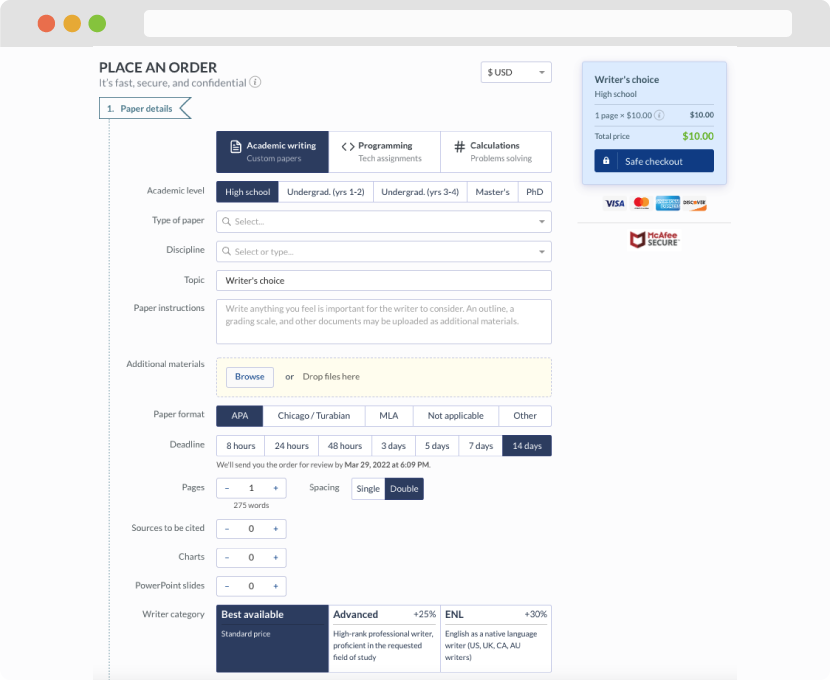
First, you will need to complete an order form. It's not difficult but, if anything is unclear, you may always chat with us so that we can guide you through it. On the order form, you will need to include some basic information concerning your order: subject, topic, number of pages, etc. We also encourage our clients to upload any relevant information or sources that will help.
Complete the order form
Once we have all the information and instructions that we need, we select the most suitable writer for your assignment. While everything seems to be clear, the writer, who has complete knowledge of the subject, may need clarification from you. It is at that point that you would receive a call or email from us.
Writer’s assignment
As soon as the writer has finished, it will be delivered both to the website and to your email address so that you will not miss it. If your deadline is close at hand, we will place a call to you to make sure that you receive the paper on time.
Completing the order and download