Answer the following questions either on paper (and upload as a pdf scan or insert into a slideshow) or on slides andattach a link.
1. Colleges frequently provide estimates of student expenses such as housing. A consultant hired by a community
college claimed that the average student housing expense was $650 per month. What are the null and alternative
hypotheses to test whether this claim is accurate?
2. A recent journal article reported that college students tend to watch an average of 12 hours of television per week.
Rosa, a college senior, believes that college students watch more than 12 hours of television per week. She
conducts a random sample of college students, defines her null hypothesis, and performs a t-test. Her results are
shown below.
Assuming her methods are sound and her results accurate, use Rosa’s t-test to answer the following questions.
T-Test
μ>12
t=1.398757212
P=.0873381648
x=14
A. What is the test statistic and what does it mean in this situation?
Sx=7.14920353
n=25
B. If Rosa tests with an {level of 0.05, what conclusion should she draw from her test?
I. College students watch 14 hours of TV per week.
II. College students watch 12 hours of TV per week.
III. College students watch more than 12 hours of TV per week.
IV. College students may watch 12 hours of TV per week but we can’t be sure.
3. Bottles of orange juice are supposed to have 16 fluid ounces. A random sample of 100 bottles from a large batch
contains an average of 15.7 ounces with an SD of 0.2 ounces. Test the hypothesis that the bottles are being filled
correctly, against the alternative that they are not full enough.Hypothesis Testing for the Population Proportion
The objectives of this activity are:
1. To give you guided practice in carrying out the z-test for the population proportion (л).
2. To learn how to use statistical software to help you carry out the test.
Background:
This activity is based on the results of a recent study on the safety of airplane drinking water that was conducted
by the U.S. Environmental Protection Agency (EPA). A study found that out of a random sample of 316 airplanes
tested, 40 had coliform bacteria in the drinking water drawn from restrooms and kitchens. As a benchmark
comparison, in 2003 the EPA found that about 3.5% of the U.S. population have coliform bacteria-infected drinking
water. The question of interest is whether, based on the results of this study, we can conclude that drinking water
on airplanes is more contaminated than drinking water in general.
Use your StatCrunch results to answer the LBD questions in this slide deck:
StatCrunch Instructions:
Open StatCrunch and select the Open StatCrunch button to open a new spreadsheet (there is no data file for this
question).
• Choose: Stat → Proportions → One Sample → with summary
• Enter the number of successes and observations (Notice in this case a “success” is the presence of bacteria)
• Select Hypothesis Test for p
• Enter a null value (this is a comparison value – in this case you use the 0.035 reported in the 2003 study) and
choose the form of the alternative hypothesis from the options: * (not equal), < (less than), and > (greater than)
• Press Compute!Use your StatCrunch results to answer the LBD questions in this slide deck:
StatCrunch Instructions:
Open StatCrunch and select the Open StatCrunch button to open a new spreadsheet (there is no data file for this
question).
• Choose: Stat → Proportions → One Sample → with summary
• Enter the number of successes and observations (Notice in this case a “success” is the presence of bacteria)
• Select Hypothesis Test for p
• Enter a null value (this is a comparison value – in this case you use the 0.035 reported in the 2003 study) and
choose the form of the alternative hypothesis from the options: * (not equal), < (less than), and > (greater than)
• Press Compute!
Answer the following questions in the slide deck linked above and submit the link below:
1. Let л be the proportion of contaminated drinking water in airplanes. Write down the appropriate null and
alternative hypotheses.
2. Based on the collected data, is it safe to use the z-test for л in this scenario (are the conditions for inference
satisfied)? Explain.
3. Now that we have established that it is safe to use the z-test for p for our problem, go ahead and carry out the
test. Paste the output below.
4. Note that, according to the output, the test statistic for this test is 8.86. Make sure you understand how this was
calculated, and give an interpretation of its value.
5. We calculated a p-value of 0 in this test. Interpret what that means, and draw your conclusions.Hypothesis Testing for the Population Mean
The purpose of this activity is teach you to run the z-test for the population mean while exploring the effect of
sample size on the significance of the results.
Background:
The SAT is constructed so that scores in each portion have a national average of 500 and standard deviation of
100. The distribution is close to normal. The dean of students of Ross College suspects that in recent years the
college attracts students who are more quantitatively inclined. A random sample of 4 students from a recent
entering class at Ross College had an average math SAT (SAT-M) score of 550. Does this provide enough evidence
for the dean to conclude that the mean SAT-M of all Ross college students is higher than the national mean of 500?
Assume that the standard deviation of 100 applies also to all Ross College students.
We saw that even though the sample mean was 550, which is substantially greater than the null value, 500, this
result was not significant, since it was based on data obtained from only 4 students. In other words, the data did
not provide enough evidence to reject Ho and conclude that the mean SAT-M score of all Ross College students is
|larger than 500, the national mean. If this sample mean were obtained from 5 students, would that result be
significant? If not, would 6 be enough? In other words, what is the smallest sample size for which a sample of
¯x=550 would be significant?
In this activity, we will use statistical software to explore this question.
Use your StatCrunch results to answer the LBD questions in the text box below.
For n = 4, we know that the result ¯x=550 is not significant. Using the StatCrunch instructions below and starting
with n =5 (and going up), create and fill in a table where the column headings are “n,” “z (test statistic),” “p-value,” and
“significant at the 0.05 level (yes/no).” Stop after the first time your result becomes significant at the 0.05 significance
level.Use your StatCrunch results to answer the LBD questions in the text box below.
For n = 4, we know that the result ¯x=550 is not significant. Using the StatCrunch instructions below and starting
with n =5 (and going up), create and fill in a table where the column headings are “n,” “z (test statistic),” “p-value,” and
“significant at the 0.05 level (yes/no).” Stop after the first time your result becomes significant at the 0.05 significance
level.
StatCrunch Instructions:
Open StatCrunch and select the Open StatCrunch button to open a new spreadsheet (there is no data file for this
question).
• Choose Stat →T statistics → One sample → with summary
• Enter Sample mean, standard deviation and sample size.
• Select Hypothesis Test for μ
• Enter a null value and choose the form of the alternative hypothesis from the options not equal, less than, and
greater than
• Check Store in data table
• Press Compute!
• Repeat, increasing the sample size by 1 each time until you get a statistically significant result.
Answer these questions in the text box below.
1. Before we do any kind of analysis, what do you think should be the smallest sample size for which a sample mean
SAT-M of 550 would be enough evidence to reject Ho and conclude that μ is greater than 500? Use your intuition
and personal feelings. There is no right or wrong answer here.
2. What was your result to the guess and check exercise above? Was your guess in question 1 about right?Recall the class data from the beginning of the semester. You were asked the following question:
Which type of award would you prefer to win? (Nobel, Oscar, Olympic Gold Medal).
The results of that question, separated by gender, are given in the pie charts below.
Gender-F
Gender=M
Which type of
Which type of
award would you
Nobel Prize
prefer to win?
Academy Award, 7,
25%
Nobel Prize, 17,
60.71%
Nobel Prize
Olympic Gold Medal,
4, 14.29%
award would you
prefer to win?
Academy Award, 2,
11.76%
Nobel Prize, 5,
29.41%
Olympic Gold Medal,
10, 58.82%
Olympic Gold Medal
We note that the proportions chosen by the respective genders are different in each category but let’s study the
results more deeply. Consider the proportions of the respective sub-populations that would choose a Nobel Prize. The
Mod 12 Study Guide may be of help answering these questions.
1. For both sub-groups (male and female), construct a 95% confidence interval.
2. Do the two intervals overlap or are they exclusive? What does this suggest about how the two groups compare on
their choice of prizes?
3. We should have started here, but are the conditions for inference met in both cases? (does the central limit
theorem apply to both sub-populations so that our confidence intervals are valid? – Remember this onvolves
checking whether nл ≥ 10 and n(1 – л) ≥ 10.)
4. From the result to the previous question it’s clear we need a larger sample size. Consider the sample below and
repeat the activities above (but check 3 first this time). What can we conclude?1. For both sub-groups (male and female), construct a 95% confidence interval.
2. Do the two intervals overlap or are they exclusive? What does this suggest about how the two groups compare on
their choice of prizes?
3. We should have started here, but are the conditions for inference met in both cases ? (does the central limit
theorem apply to both sub-populations so that our confidence intervals are valid? – Remember this onvolves
checking whether në ≥ 10 and n(1 – л) ≥ 10.)
4. From the result to the previous question it’s clear we need a larger sample size. Consider the sample below and
repeat the activities above (but check 3 first this time). What can we conclude?
Gender=F
Gender=M
Academy Award
Nobel Prize
Which type of award would
you prefer to win?
Academy Award
Nobel Prize
Olympic Gold Medal
Academy Award, 24, 31.17%
Nobel Prize, 40, 51.95%
Olympic Gold Medal, 13,
16.88%
Olympic Gold Medal
Note the female population for this set is 77 and the male population is 61.
Assume that this sample is a random sample of the Skyline population (even though it is not).
You do not need to show your setup for this assignment – just type in your answers.
Which type of award would
you prefer to win?
Academy Award, 10, 16.39%
Nobel Prize, 23, 37.7%
Olympic Gold Medal, 28,
45.9%Hypothesis Testing for the Population Proportion
The objectives of this activity are:
1. To give you guided practice in carrying out the z-test for the population proportion (л).
2. To learn how to use statistical software to help you carry out the test.
Background:
This activity is based on the results of a recent study on the safety of airplane drinking water that was conducted
by the U.S. Environmental Protection Agency (EPA). A study found that out of a random sample of 316 airplanes
tested, 40 had coliform bacteria in the drinking water drawn from restrooms and kitchens. As a benchmark
comparison, in 2003 the EPA found that about 3.5% of the U.S. population have coliform bacteria-infected drinking
water. The question of interest is whether, based on the results of this study, we can conclude that drinking water
on airplanes is more contaminated than drinking water in general.
Use your StatCrunch results to answer the LBD questions in this slide deck:
StatCrunch Instructions:
Open StatCrunch and select the Open StatCrunch button to open a new spreadsheet (there is no data file for this
question).
• Choose: Stat → Proportions → One Sample → with summary
• Enter the number of successes and observations (Notice in this case a “success” is the presence of bacteria)
• Select Hypothesis Test for p
• Enter a null value (this is a comparison value – in this case you use the 0.035 reported in the 2003 study) and
choose the form of the alternative hypothesis from the options: * (not equal), < (less than), and > (greater than)
• Press Compute!Use your StatCrunch results to answer the LBD questions in this slide deck:
StatCrunch Instructions:
Open StatCrunch and select the Open StatCrunch button to open a new spreadsheet (there is no data file for this
question).
• Choose: Stat → Proportions → One Sample → with summary
• Enter the number of successes and observations (Notice in this case a “success” is the presence of bacteria)
• Select Hypothesis Test for p
• Enter a null value (this is a comparison value – in this case you use the 0.035 reported in the 2003 study) and
choose the form of the alternative hypothesis from the options: * (not equal), < (less than), and > (greater than)
• Press Compute!
Answer the following questions in the slide deck linked above and submit the link below:
1. Let л be the proportion of contaminated drinking water in airplanes. Write down the appropriate null and
alternative hypotheses.
2. Based on the collected data, is it safe to use the z-test for л in this scenario (are the conditions for inference
satisfied)? Explain.
3. Now that we have established that it is safe to use the z-test for p for our problem, go ahead and carry out the
test. Paste the output below.
4. Note that, according to the output, the test statistic for this test is 8.86. Make sure you understand how this was
calculated, and give an interpretation of its value.
5. We calculated a p-value of 0 in this test. Interpret what that means, and draw your conclusions.
Essay Writing Service Features
Our Experience
No matter how complex your assignment is, we can find the right professional for your specific task. Achiever Papers is an essay writing company that hires only the smartest minds to help you with your projects. Our expertise allows us to provide students with high-quality academic writing, editing & proofreading services.
Free Features
Free revision policy
$10Free bibliography & reference
$8Free title page
$8Free formatting
$8How Our Dissertation Writing Service Works
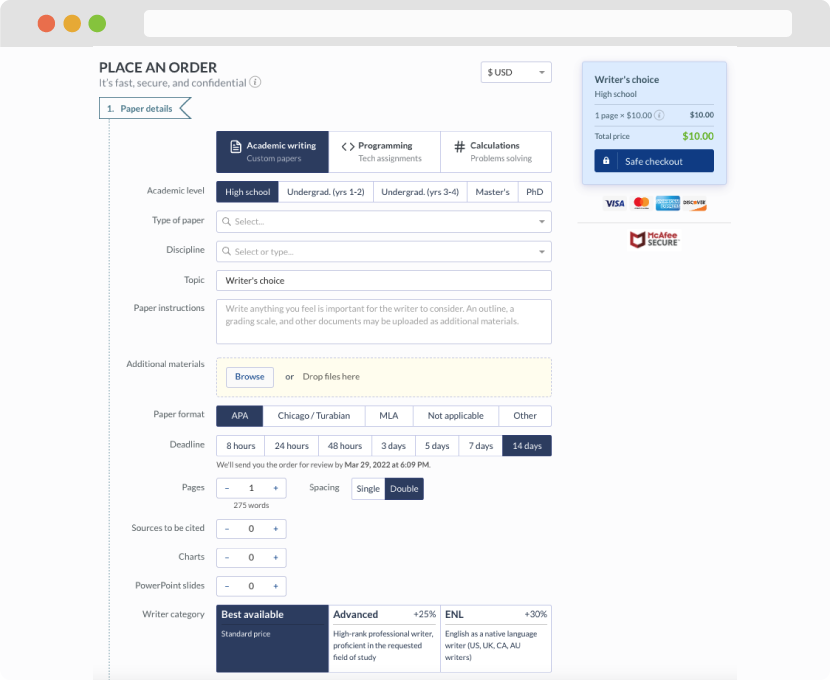
First, you will need to complete an order form. It's not difficult but, if anything is unclear, you may always chat with us so that we can guide you through it. On the order form, you will need to include some basic information concerning your order: subject, topic, number of pages, etc. We also encourage our clients to upload any relevant information or sources that will help.
Complete the order form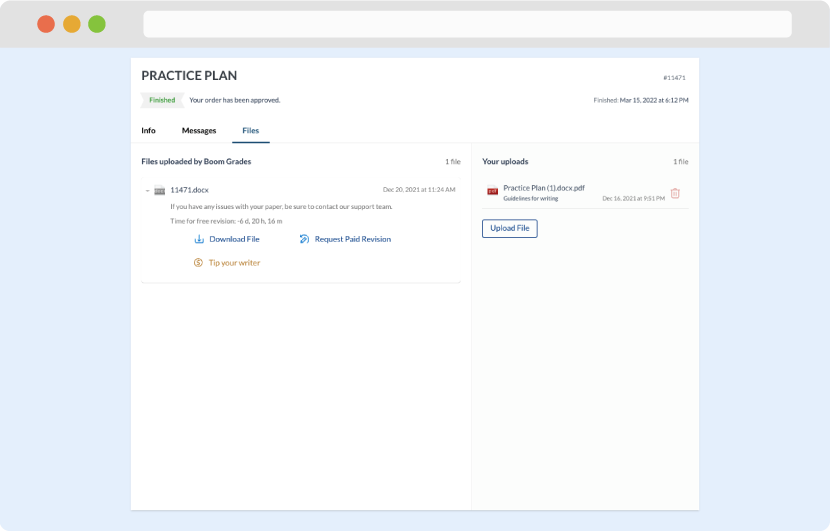
Once we have all the information and instructions that we need, we select the most suitable writer for your assignment. While everything seems to be clear, the writer, who has complete knowledge of the subject, may need clarification from you. It is at that point that you would receive a call or email from us.
Writer’s assignment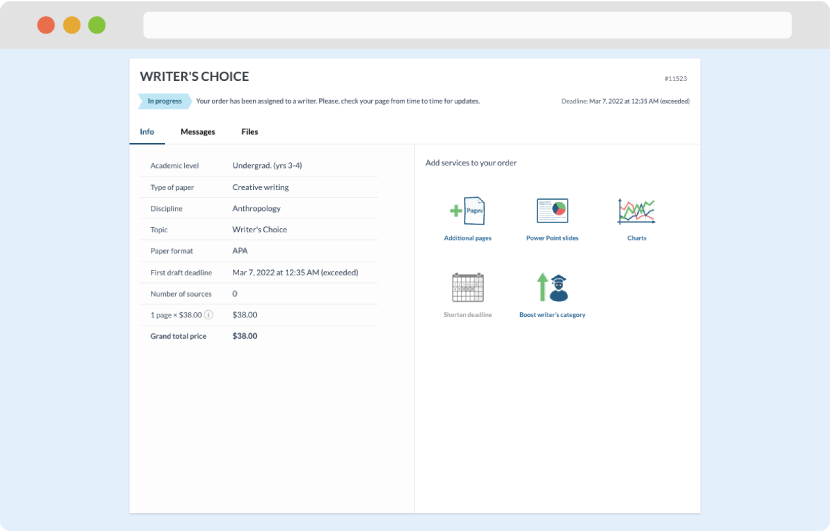
As soon as the writer has finished, it will be delivered both to the website and to your email address so that you will not miss it. If your deadline is close at hand, we will place a call to you to make sure that you receive the paper on time.
Completing the order and download