1Research Methods and Instrument Development
Maya Young
Norfolk State University
Social Work Research (SWK 333-90)
Dr. CHUNG
10/21/2022
2
Research Methods and Instrument Development
Research methods are the procedures used by researchers to gather information and to
have it analyzed for the purpose of drawing inferences. When the researcher is planning their
methods, they must determine exactly how they intend to gather information. This is usually
informed by the type of data in question (Reddy, 2020). There are three major data dichotomies
and they include quantitative vs. qualitative, secondary vs. primary, and experimental vs.
descriptive. How data is to be gathered and analyzed helps the researcher know the best sampling
method and the tools to use while interacting with their respondents (Dodgson & Trotman,
2022).
Sample Selection
The most appropriate sample selection method is the systematic random sampling. This is
an approach that is based on probability, and the participants are chosen from the larger
population upon commencing at a particular random point. The selection is done over fixed and
periodic intervals; and these are determined by dividing the size of the population by the targeted
sample size (Mitchell & Rich, 2021). Although the population from which the sample is drawn
tends to be preselected (for instance, all adolescent sex offenders within a certain jurisdiction),
the process is still deemed to be random. Besides, the researcher picks the starting point by
chance (Punziano & Paoli, 2021).
Benefits of Using Systematic Random Sampling
The method is particularly desired where the researcher is keen on averting what is
referred to as ‘clustered selection’. This is where the population being studied is further
subdivided, and a sample is drawn by picking equal number of participants from each of the new
categories (Dodgson & Trotman, 2022). Taking such a route results into a biased sample, and
3
that is because the researcher would have forced their opinions about the population. Such
judgements may not be consistent with the reality, and hence the inferences would also be
prejudiced. Clustered selection does also magnify the sampling error. This means that the
findings and conclusions based on such a sample could be inaccurate (Mitchell & Rich, 2021).
Systematic random sampling helps in mitigating the risk of contaminating the data. This
refers to the scenario where the individuals in one of the groups used in the trial get the
intervention that was actually meant for another. Supposing the test was meant to determine the
effectiveness of a certain treatment, it would most likely reduce the real difference between the
two groups. Therefore, the intervention may erroneously be deemed to be ineffective (Punziano
& Paoli, 2021).
Drawbacks of Using Systematic Random Sampling
Nonetheless, there are a few issues which the researcher utilizing the systematic random
sampling ought to be mindful about. They must appreciate the possibility that certain patterns
could either be under- or over-represented. This would happen if by any chance the researcher
picks multiple subjects with similar characteristics (Reddy, 2020). It could lead to the
implication that the entire population has those features. In spite of this drawback, systematic
random sampling is still the most appropriate method. Besides, every sampling techniques has
pros and cons. The suitability of any of them is determined by the prevailing circumstances
(Dodgson & Trotman, 2022).
Data Collection Method
Personal interviews are suitable because they have a relatively high response rate.
Moreover, the researcher has the leeway to ask all sorts of questions, and can even clarify an
issue that was misunderstood. That is because of the fact that the two parties involved exchange
4
information via a series of queries and answers. Had the questions been mailed, it would become
difficult to and time consuming to seeking clarification. In essence, therefore, the information
gathered using personal interviews is more conclusive than those attained using a majority of the
other approaches (Reddy, 2020).
Strengths of Personal Interviews
In addition to the data that is gathered from the participants’ responses, one is also in a
position to gain insights with regards to their behaviors and thoughts. Besides, the information
being sought is primarily about experiences and concepts, and not numerical values. Even if
some values will be required, the researcher can acquire them from other sources. They do not
necessarily have to talk to their respondents about that (Dodgson & Trotman, 2022).
Personal interviews are just one approach among seven interviewing methods available.
It suits researchers who are completing studies in a variety of fields. Often times, it is selected in
the place of focus groups, unstructured interview, structured interview, semi-structured
interview, online interview, and phone interview (Reddy, 2020). The researcher has way more
control over how the data gathering process progresses when they use personal interview than
when any other method is used. Supposing one was to use online interview, they may not tell
who the respondent really is. Those credibility challenges are addressed by having the researcher
meet their subjects in person (Punziano & Paoli, 2021).
Drawbacks of Personal Interviews
Personal interviews tend to be more expensive and time intensive than the use of
telephones, mailing, and online-based information gathering. The cost is among the main reasons
why some researchers avoid them. There is also the possibility of influencing the respondents. In
some cases, though, the researcher may engage other professionals to complete this process for
5
them. However, they must have the relevant academic qualification and experience. It is
imperative for one to communicate their intentions to their supervisor(s) so that they can be
guided on how to engage other parties ethically and within the rules of the institution they are
affiliated to (Punziano & Paoli, 2021).
Instrument to be Used
An interview serves the purpose of a method as well as that of a tool. Nonetheless, one
may have a list of questions they had pre-prepared, and they can then expound on that once the
interviews start. If that is the case, the tool could be regarded to be a questionnaire.
Questionnaires contain sets of questions and other prompts which are geared towards facilitating
information gathering while interacting with a respondent (Reddy, 2020).
Typically, questionnaires have both open-ended, and closed-ended questions. The former
is a long-form of questions, while the latter is relatively shorter. The goal of open-ended
questions (which are usually the majority) is to gather qualitative information. Closed-ended aid
in the collection of quantitative data that can then be analyzed using a statistical tool. By using
survey questionnaires, the researcher has the opportunity to quicken their work (Mitchell & Rich,
2021). See the appendix for closed and open-ended questions.
It is also worth noting that a lot more can be drawn from the respondents’ answers. The
researcher may do that if they apply logic, and may even ask follow-up questions on the basis of
the ideas they formulate as the interaction progresses. In addition to the strengths which have
been identified, questionnaires should be used in this case because they are practical and scalable
(Dodgson & Trotman, 2022).
The information gathered using questionnaires is relatively easy to analyze. The aspects
of validity and reliability are taken into account, and hence if the rest of the processes are
6
properly planned and executed, questionnaires become a huge benefit to the individual
completing the research work. Using them as a guide during a personal interview rather than
having them mailed eliminates the challenge of unconscientious responses (Punziano & Paoli,
2021).
Conclusion
There are numerous sampling methods, but systematic random sampling has been chosen
in this case as it enhances the validity and reliability of the information being sought. For
instance, it is relatively random as compared to many other approaches, and hence can led to a
sample that is truly representative. Interviews are preferred due to the way they help one gather
in-depth information. Clarification can be sought in time, and hence avert a scenario where the
analysis commences on the basis of unclear details. Additionally, interacting with the
respondents at a personal level helps the researcher get the hint about their beliefs, thought
patterns, and behavior.
7
References
Dodgson, M. K., & Trotman, A. J. (2022). Lessons learned: Challenges when conducting
interview-based research in auditing and methods of coping. Auditing: A Journal of
Practice & Theory, 41(1), 101–113. https://doi.org/10.2308/AJPT-19-098.
Mitchell, A., & Rich, M. (2021). Teaching research methods and the supervision of
undergraduate projects: Seeking practical improvements to a complex process. Electronic
Journal of Business Research Methods, 19(2), 104–116.
https://doi.org/10.34190/ejbrm.19.2.2513.
Punziano, G., & Paoli, D. A. (2021). Handbook of research on advanced research methodologies
for a digital society. IGI Global
Reddy, C. D. (2020). Teaching research methodology: Everything’s a case. Electronic Journal of
Business Research Methods, 18(2), 178–188. https://doi.org/10.34190/JBRM.18.2.009.
8
Appendix
Closed Questions
I.
How hard (or easy) has it been for you cope since you started getting the treatment? (with
1 being very hard, and 5 very easy)
1.
2.
3.
4.
5.
II.
How disinterested (or interested) are you to continue taking the treatment? (with 1 being
very disinterested, and 5 very interested)
1.
2.
3.
4.
5.
III.
How likely are you to recommend the same treatment for people suffering from your
condition? (with 1 being very unlikely, and 5 very likely)
1.
2.
3.
4.
5.
IV.
In a scale of 1 to 5 (with 1 being very likely, and 5 very unlikely), what is the probability
that you may relapse at some point in the future?
1.
2.
3.
4.
5.
V.
If this treatment is not mandated, how likely are you to continue taking it? (with 1 being
very likely, and 5 very unlikely)
1.
2.
3.
4.
5.
1.
2.
3.
4.
5.
Open-Ended Questions
Would you say that something else (other than the fact that you found the victim to be
vulnerable) contributed to your offense? Please explain.
In your view, are the contributing factors social-environmental, biological, or based on
your childhood experiences? Please explain.
Would you like the society to perceive you as someone who has reformed? Is so, how
would you define ‘reform’, and why should it matter to the members of the community
where you live?
Why do you think this particular treatment is good or bad for people in a similar situation
as yours?
What would you do differently if the circumstances that led to your conviction were
replayed?
97%
9:54 AM Thu Oct 20
learn-us-east-1-prod-fleet02-xythos.content.blackboardcdn.com
BUS 270
Dr. V. Reddy Dondeti, Professor
School of Business, Norfolk State University
Business Statistics
1. The Uniform Distribution is symmetric. (True/False)
Unit#3Quiz
2. In the Uniform Distribution, the relative frequencies of all classes are equal. (True/False)
3. In the Normal Distribution, the relative frequencies of all classes are equal. (True/False)
4. In the Uniform Distribution, the classes in the middle have larger relative frequencies than
the classes at the ends. (True/False)
5. In the Normal Distribution, the classes in the middle have larger relative frequencies than the
classes at the ends. (True/False)
6. In the Normal Distribution, the classes in the middle have smaller relative frequencies than
the classes at the ends. (True/False)
7. In the Normal Distribution, the relative frequencies of classes taper off sharply from the
middle to either end of the curve. (True/False)
8. In the Exponential Distribution, the relative frequencies of all classes are equal. (True/False)
9. In the Exponential Distribution, the relative frequencies of classes taper off to the right.
(True/False)
10. The Normal Distribution is symmetric (True/False)
11. In the Normal Distribution. the left half is a mirror image of the right half. (True/False)
12. The total area under the Normal Curve is equal to 1. (True/False)
13. The area of the left half under the Bell Curve is 0.50. (True/False)
14. The area of the right half under the Bell Curve is 0.50. (True/False)
15. The Mean of the Standard Normal Distribution is 0. (True/False)
16. The Variance of the Standard Normal Distribution is 1. (True/False)
17. The Standard Deviation of the Standard Normal Distribution is 1. (True/False)
18. In theory, the Normal Curve (or Bell Curve) extends from -00 to +∞o. (True/False)
19. The area under the Standard Normal Curve from to 1.96 is equal to 0.475. Then, what is
the area between -1.96 and 1.96? P(-1.96 ≤ Z ≤ 1.96) = ?
(a) 1.00 (b) 0.95 (c) 0.93
(d) 0.92 (e) 0.90
20. What is the area under the Standard Normal Curve from 0 to ∞?
(a) 0.4
(b) 0.5 (c) 0.8 (d) 0.3 (e) 0.2
21. What is the area under the Standard Normal Curve from – to 0?
(a) 0.4 (b) 0.5 (c) 0.8 (d) 0.3 (e) 0.2
22. Through a process of standardization or transformation or scaling, any given variable such as
length or weight, usually denoted by X, that follows Normal Distribution can be reduced to the
Standard Normal Distribution. (True/False)
23. In the Normal Distribution, probability, proportion, relative frequency or area under the
curve pertaining to a class interval are equivalent. (True/False)
24. The middle area between -Z and Z under the Standard Normal Curve is not in any way
related to the Confidence Level (True/False)
25. The level of significance is related to neither the tail area between – and -Z on the left side
of the midpoint 0.00 nor the tail area between Z and +∞ on the right side of the midpoint 0.00 of
the Standard Normal Curve. (True/False)9:55 AM Thu Oct 20
<
-prod-fleet02-xythos.content.blackboardcdn.com
Apple Bing Google Yahoo
Valant ✓ Checkpoint N Students NSU
Blackboard...
Content
X
learn-us-eas... board
(1) P(0 ≤ Z ≤ 1.09) =
=
(2) P(-2.07 ≤ Z ≤ 0) =
Dr. V. Reddy Dondeti, Professor
School of Business, Norfolk State University
BUS-270 Business Statistics Assignment #3 - Part A
(a) 0.3554 (b) 0.4713 (c) 0.3621 (d) None of the above
(a) 0.4808
(c) 0.4662 (d) None of the above
Problem I. Find P(0.43 ≤ Z ≤ 2.87). Questions 3,4 and 5 are based on problem I.
(3) A₁ = (a) 0.1364
(b) 0.3428
(b) 0.1664 (c) 0.2316
0.4373 (c) 0.4878
(4) A₂ = (a) 0.4979
(5) AA2A1
(b)
=
(a) 0.3514, (b) 0.3315, (c) 0.2057
(d) None of the above
(d) None of the above
(6) A₁ =
(d) None of the above
Problem II. Find P( - 2.30 ≤ Z ≤ 1.74). Questions 6, 7 and 8 are based on problem II.
(a) 0.4893 (b) 0.4788 (c) 0.4231 (d) None of the above
(7) A₂ = (a) 0.3537
(8) AA2 + A₁ =
(9) P(-2.98≤ Z ≤
(b) 0.4254 (c) 0.4591
(a) 0.9484 (b) 0.9039, (c)
0.53) =
(a) A₁= 0.4986, A2=0.2019, A= 0.2967 (b)
(c) A₁ 0.4645, A2=0.2019, A= 0.2626
(d) None of the above
0.7768 (d) None of the above
A₁= 0.4986, A2=0.1254, A=0.3732
(d) None of the above
Problem III. Find P( − ∞ ≤ Z ≤ - 0.08) Questions 10, 11 and 12 are based on problem III.
(10) A₁ = (a) 0.01
(11) A₂ = (a) 0.0319
(b) 0.95 (c) 0.5
(b) 0.08
(c) 0.92
(b)
0.5319
(12) AA₁A₂ = = (a) 0.4681
=
(13) P(Z≥ 0.47) = P(0.47
Essay Writing Service Features
Our Experience
No matter how complex your assignment is, we can find the right professional for your specific task. Achiever Papers is an essay writing company that hires only the smartest minds to help you with your projects. Our expertise allows us to provide students with high-quality academic writing, editing & proofreading services.
Free Features
Free revision policy
$10Free bibliography & reference
$8Free title page
$8Free formatting
$8How Our Dissertation Writing Service Works
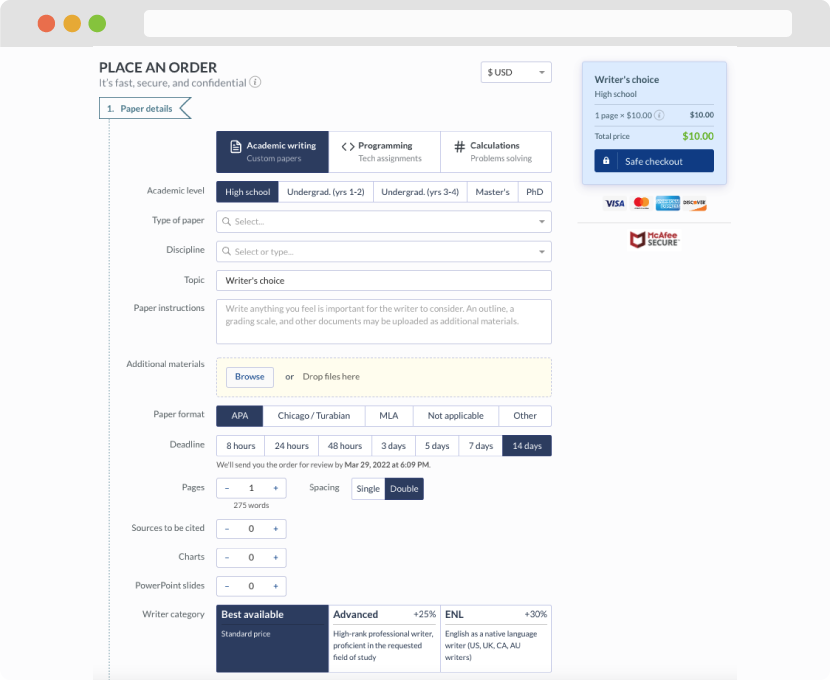
First, you will need to complete an order form. It's not difficult but, if anything is unclear, you may always chat with us so that we can guide you through it. On the order form, you will need to include some basic information concerning your order: subject, topic, number of pages, etc. We also encourage our clients to upload any relevant information or sources that will help.
Complete the order form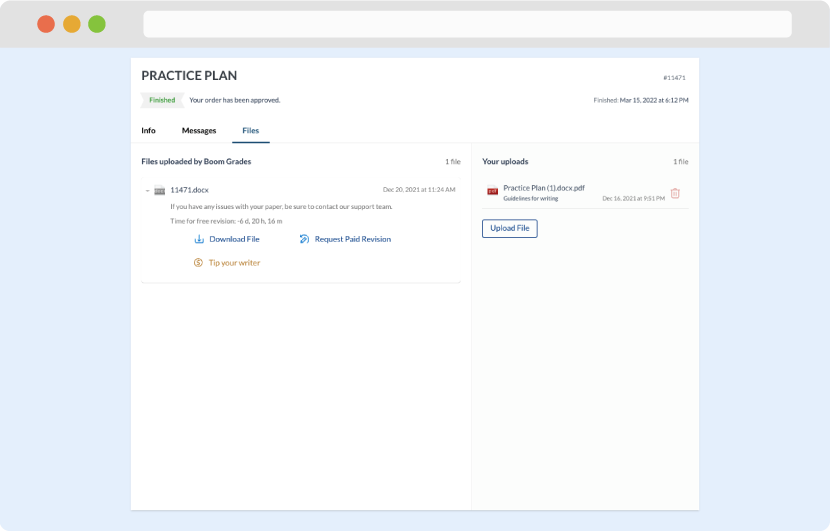
Once we have all the information and instructions that we need, we select the most suitable writer for your assignment. While everything seems to be clear, the writer, who has complete knowledge of the subject, may need clarification from you. It is at that point that you would receive a call or email from us.
Writer’s assignment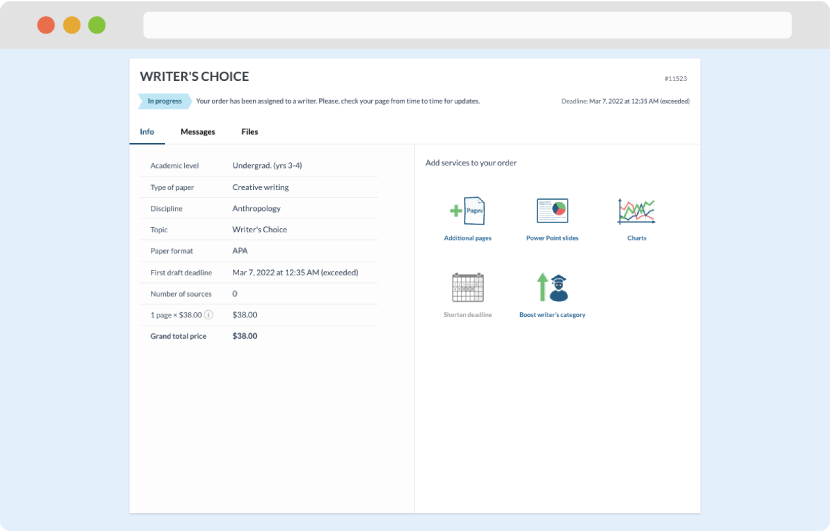
As soon as the writer has finished, it will be delivered both to the website and to your email address so that you will not miss it. If your deadline is close at hand, we will place a call to you to make sure that you receive the paper on time.
Completing the order and download