PSYC 2317
Mark W. Tengler, M.S.
Assignment #11
Single Sample t-Test
11.1
What factor determines whether you should use a z-test or a t-test statistic for a
hypothesis test?
(Note: For problems 11.2 – 11.4 below, be sure and show a full diagram of the research design
as shown in the Formula Sheet and chart attached to this assignment packet. Without using
Excel or Chegg, show all steps and calculations you made for each test following the process
outlined in the t-test formula sheet handout. What statistical decision do you make in each
case? Finally report your results professionally in APA format as found in last step of the
formula sheet attached to this assignment packet).
11.2
A sample is selected from a population mean of µ = 31.5. A treatment is administered
to the individuals in the sample and, after treatment, the sample mean found to be M
= 33.2 with a sample variance of s2 = 12.
a.
If the sample consists of n = 16 individuals, are the data sufficient to conclude
that there is a significant treatment effect using a two-tailed test with α = .05?
b.
If the sample consists of n = 36 individuals, are the data sufficient to conclude
that there is a significant treatment effect using a two-tailed test with α = .05?
11.3
Ackerman & Goldsmith (2011) found that students who studied text from printed
hard copy had better test scores than students who studied text presented on a
screen. In a related study, a professor noticed that several students in a large class
had purchased the eBook version of the course textbook. For the final exam, the
overall average for the entire class was µ = 83, but the n = 10 students who
purchased the eBook had a mean of M = 78 with a standard deviation of s = 8. Do
these data indicate a significant decrease in test scores on the final exam due to the
use of an eBook? Use a one-tailed test with α = .05.
11.4
Oishi & Shigehiro (2010) report that people who move from home to home
frequently as children tend to have lower than average levels of well-being as adults.
To further examine this relationship, a psychologist obtains a sample of n = 12 young
adults who each experienced 5 or more different homes before they were 16 years
old. These participants were given a standardized well-being questionnaire for which
the general population has an average score of µ = 39. The well-being scores for this
sample are as follows: 22, 37, 41, 35, 43, 37, 33, 34, 36, 38, 32, 38. On the basis of
this sample, is well-being for frequent movers significantly different from
the well-being of the general population? Test with alpha α = .05. Is this a onetailed or two-tailed test?
Single Sample t-test
I.
Assumptions for t-test
A.
Populations
1.
the population from which the sample is selected is normal
B.
One random sample (with replacement)
C.
Data values
1.
Sample values known (mean, standard deviation)
2.
Population values (mean, standard deviation) not known
II.
Diagramming your research (shows the whole logic and process of hypothesis testing)
a.
Draw a picture of your research design (see diagramming your research handout).
b.
There are always two explanations (i.e. hypotheses) of your research results, the
wording of which depends on whether the research question is directional (one-tailed)
or non-directional (two-tailed). State them as logical opposites.
c.
For statistical testing, ignore the alternative hypothesis and focus on the null hypothesis,
since the null hypothesis claims that the research results happened by chance through
sampling error.
d.
Assuming that the null is true (i.e. that the research results occurred by chance through
sampling error) allows one to do a probability calculation (i.e. all statistical tests are
nothing more than calculating the probability of getting your research results by chance
through sampling error).
e.
Observe that there are two outcomes which may occur from the results of the
probability calculation (high or low probability of getting your research results by
chance, depending on the alpha (α) level).
f.
Each outcome will lead to a decision about the null hypothesis, whether the null is
probably true (i.e. we then accept the null to be true) or probably not true (i.e. we then
reject the null as false).
III.
Hypotheses (i.e. the two explanations of your research results)
A.
Two-tailed (non-directional research question)
1.
Alternative hypothesis (H1): The independent variable (i.e. the treatment) does
make a difference in performance.
2.
Null hypothesis (H0): The independent variable (i.e. the treatment) does not
make a difference in performance.
B.
One-tailed (directional research question)
1.
Alternative hypothesis (H1): The treatment has an increased (right tail) or a
decreased (left tail) effect on performance.
2.
Null hypothesis (H0): The treatment has an opposite effect than expected or no
change in performance.
IV.
Determine critical regions (i.e. the z score boundary between the high or low probability of
getting your research results by chance) using table A-23
A.
Significance level (should be given or decided prior to the research; also called the
1
B.
C.
D.
V.
confidence, alpha, or p level)
1.
α or p = .05, .01, or .001
One- or two-tailed test
1.
One-tailed: use the first row across the top
2.
Two-tailed: use the second row across the top
Degrees of freedom
1.
df = n – 1
With degrees of freedom & one- or two-tailed α value, find the critical t value
1.
If two-tailed, then critical t value is ± t value
2.
If one-tailed, then determine if critical t value is +t (right tail; expecting an
increase) or -t (left tail; expecting a decrease)
Calculate t-test statistic
A.
General statistical test formula
t=
observed sample mean – hypothesized populational mean
standard error
B.
Calculations
1.
Compute variance
s2 =
2.
∑𝑥 2 −
VI.
𝑛−1
𝑆𝑆
𝑑𝑓
√𝑠
2
𝑛
Compute t-test statistic (i.e. calculates the probability of getting your research
results by chance through sampling error)
t=
C.
or
Compute standard error (average distance between sample & pop means)
Note: (standard error is simply an estimate of the average sampling error which
may occur by chance, since a sample can never give a totally accurate picture of
a population
sM =
3.
(∑𝑥)2
𝑛
𝑀− µ
𝑠𝑀
Compare the calculated t-score to the critical t-score & make a decision about the null
hypothesis
1.
Reject the null (as false) and accept the alternative
or
2.
Accept null (as true)
Reporting the results of a Single Sample t test
“The treatment had a significant effect on (M = 25, SD = 4.22); t(18) = +3.00, p < .05, two-tailed.”
2
non-treatment
Single Sample t test
Diagram Example
Population
µ=?
σ = unknown
Step 3: Using Part IV of
formula sheet, determine the
critical value(s)
Step 1: Diagram your study
(noting the data you are given)
2 explanations of your data
(using directional or non-directional language
depending on the research question)
treatment
high
H1: IV had an effect
n=?
M=?
s=?
SS = ?
single sample
t test
H0: IV had no effect (all results are
due to chance primarily through
sampling error)
Prob.
calcul
ation
2 outcomes
High Prob.
(easy)
α = .05
Low Prob.
(hard)
2 decisions
Accept H0
(due to chance)
Reject H0 &
Accept H1
(due to real effect)
IV
population
before tx
sample after
tx
Step 2: Create a table of
calculations for each of the terms
which you will need to solve the
formulas (not needed in this problem)
The independent variable is being
manipulated with two treatments
(hint: with an abstract problem like this,
sometimes it helps to put in a real
treatment, such as IV Pain Relievers with
tx Ibuprofen and tx non-treatment)
x
x2
(data for sample)
__
∑=
__
∑=
∑(x)2=
Step 4: Calculate the t statistic
1.
s2 =
2.
sm =
3. t =
SS
df
𝑀𝑀 - µ
sm
s2
n
Step 5: Compare critical t to
the calculated t & make a
decision about the H0
hypothesis
Step 6: Report results
professionally (see last step of
formula sheet)
Essay Writing Service Features
Our Experience
No matter how complex your assignment is, we can find the right professional for your specific task. Achiever Papers is an essay writing company that hires only the smartest minds to help you with your projects. Our expertise allows us to provide students with high-quality academic writing, editing & proofreading services.
Free Features
Free revision policy
$10Free bibliography & reference
$8Free title page
$8Free formatting
$8How Our Dissertation Writing Service Works
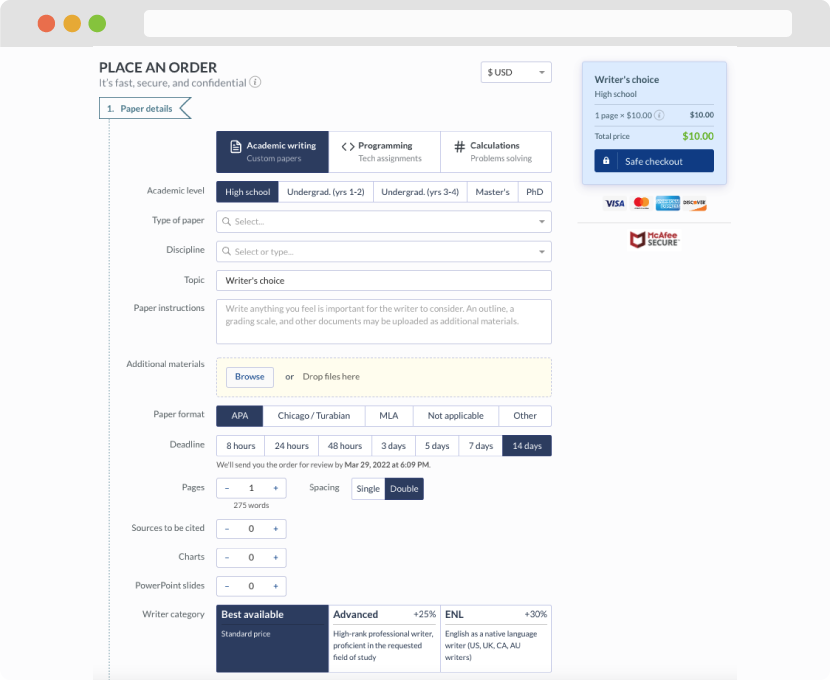
First, you will need to complete an order form. It's not difficult but, if anything is unclear, you may always chat with us so that we can guide you through it. On the order form, you will need to include some basic information concerning your order: subject, topic, number of pages, etc. We also encourage our clients to upload any relevant information or sources that will help.
Complete the order form
Once we have all the information and instructions that we need, we select the most suitable writer for your assignment. While everything seems to be clear, the writer, who has complete knowledge of the subject, may need clarification from you. It is at that point that you would receive a call or email from us.
Writer’s assignment
As soon as the writer has finished, it will be delivered both to the website and to your email address so that you will not miss it. If your deadline is close at hand, we will place a call to you to make sure that you receive the paper on time.
Completing the order and download