STA2023 Application: Sample Data, Statistics, and the Empirical RuleThe completed application should be submitted to the Assignments link in Falcon
Online.
Purpose: The purpose of this assignment is to organize a random sample of data values and
create statistics, tables, and a graph based on the data. Then the sample data will be
compared to the Empirical Rule. The information will then be analyzed in a written summary.
Part 1: Random Data, Statistics, and the Empirical Rule
Methods: Use Excel (or similar software) to create the tables and graph. Then copy the items
and paste them into a Word document. The tables should be formatted vertically, have
borders, and be given the labels and titles stated in the assignment. The proper symbols
should be used. Do not submit this assignment as an Excel file. The completed assignment
should be a Word (or .pdf) document.
1. The data values and relevant information are posted in the course website. Use the data set
(P, Q, R, S, or T) assigned to you by your instructor to complete this application.
For the purpose of this application, treat the data set as if it represented a certain random
variable and was a valid random sample gathered by a researcher from a normally distributed
population. The sample data was actually found with an online Gaussian random number
generator that creates normally distributed data values. The random number generator
simulates the results of a researcher finding those values through observation or
experimentation.
2. Use technology (Excel, graphing calculator, etc.) to sort the sample data values from low to
high. Use Excel or similar software to put the data into a table with about 5 or 6 columns.
Label this “Table 1: Sorted Set of Sample Data.”
3. Using 5 to 10 class intervals, organize the sample data as a frequency distribution in a table.
The intervals of the frequency distribution should be rounded to the tenths so that they match
the data. Label this “Table 2: Frequency Distribution.”
4. Use Excel (or similar software) to construct a frequency histogram to illustrate the data.
Give the axes the proper titles. Label this “Graph 1: Histogram.”
5. Use Table 2, the frequency distribution, to find the midpoints of each class interval. Create
a new frequency distribution with the midpoints in the left column and the frequencies in the
right column. Label this “Table 3: Frequency Distribution with Midpoints.”
6. Use technology to find the mean, median, standard deviation, and variance of the sample
data organized in Table 3 (from step 5 above). Put these values into a table with the proper
symbol in the left column and the value of the statistic in the right column. Also, from the
original data set, put the values of the range and sample size in the table. The median and
range do not generally have symbols so the terms “Median” and “Range” can be used in the left
STA2023 Application (2017)
1
column. Identify the modal class (the one with the highest frequency). Put the terms “Modal
Class” in the left column and the class interval in the right column. The statistics should be
rounded properly (one more decimal place than the data). Label this “Table 4: Summary
Statistics”
7. Use the sample mean and standard deviation to find the values related to the Empirical
Rule.
The Empirical Rule: For a set of data whose distribution is approximately normal,
• about 68% of the data are within one standard deviation of the mean.
• about 95% of the data are within two standard deviations of the mean.
• about 99.7% of the data are within three standard deviations of the mean.
Use the value of n and the percents listed above to find how many data values should be within
each category. Then use the sample mean and standard deviation to find the lower and upper
cut-off values in each category. Then use the sorted list of data to determine how many values
are actually in each category. Put the values into a table as shown in the example and label it
“Table 5: The Empirical Rule.”
Part 2: Written Introduction and Summary
1. Write an introduction to this application. Discuss the random variable and the source of the
sample data. Refer to the textbook or class notes to describe the basic components of the
application and the statistical concepts that are applied. The introduction should be at least 50
words and be written with proper grammar and spelling.
2. Write a summary of the application, considering the following topics. The summary should
be at least 150 words and be written with proper grammar and spelling. Refer to the tables
and graph (by label and number) throughout the summary. Use the proper statistical terms
and symbols in the summary. Write about the concepts in the application rather than the steps
followed. Do not number the parts or steps in the application except for the proper numbering
of the tables and graph.
• Discuss the difference between population and sample values
• Discuss how the frequency distribution was created, specifically referring to the intervals
and class width.
• Describe the features of the histogram, including the axes and the shape of the
distribution, especially whether it meets the criteria of an approximately normal
distribution
• Discuss measures of center and variation as related to the sample data; given the values
used in the random number generator, compare the sample values to those of the
population
• Discuss the Empirical Rule and compare the actual number of values within each
category of the Empirical Rule to the number that should be there
• Discuss how the Empirical Rule is related to the criteria for significantly low or high
values.
• Discuss characteristics of the sample data such as significantly low/high values and
skewness, providing support and examples. Use both the histogram and measures of
center to identify whether there is skewness.
STA2023 Application (2017)
2
Part 3: Format Requirements
• Include a title page with your name, STA2023 Application 1, the word count for the
introduction, the word count for the summary, and which data set is used.
• The introduction and summary should be written in paragraphs that are typed and
double-spaced, with 1-inch margins and a readable font type and font size. The
preferred font size could be 12 Times New Roman.
• The introduction by itself should be at least 50 words.
• The summary should be at least 150 words.
• The introduction and summary should be college-level writing with proper grammar and
spelling. Do not use first or second person (I, you, etc.).
• Do not write about the parts of the assignment or the use of a calculator or excel to
complete steps in the application. Write about the concepts used in the application.
• Throughout the introduction, tables, graph, and summary, proper statistical symbols and
terms should be used.
• The tables should be formatted vertically, have 2 columns (unless specified otherwise),
have borders, and be given the labels and titles stated in the assignment.
• The title page, introduction, tables, graphs, and summary should be a single document
(.doc, .docx, or .pdf) which is submitted to the Assignments link in Falcon Online by the
due date.
• Assemble the application in the following order to create a single document.
o Title page
o Introduction
o Tables and Graph
o Summary
Part 4: Grading: The application is worth up to 30 points, based on the following criteria.
• The statistical content (Part 1) is worth up to 10 points, based on completion of all
the listed requirements.
• The introduction and written summary (Part 2) are worth up to 10 points, based on
completion of all the listed requirements.
• The format (Part 3) of the complete document submitted to the Assignments link is
worth up to 10 points, based on completion of all the listed requirements.
Rubric/allocation of 10 points:
• 0 points for completing none of the requirements
• 2 points for attempting the requirements
• 4 points for completing some of the requirements
• 8 points for completing most of the requirements
• 10 points for completing all of the requirements
STA2023 Application (2017)
3
Template for table 5
Sample size: n=48
Category of
Empirical Rule
68%
95%
99.70%
number of data
values which
should be within
cut off values
33
46
48
Table 5: The Empirical Rule
lower cut-off
𝑥 – s = 30.31
𝑥 – 2s = 26.54
𝑥 – 3s = 22.77
upper cut-off
𝑥 + s = 37.85
𝑥 + 2s = 41.26
𝑥 + 3s = 45.39
number of data
values which
actually are
within cut-off
values
30
45
48
Data
Set R
31.0
32.8
34.7
34.9
30.8
38.3
31.6
31.1
Mu=31.2
34.9
32.0
33.3
33.5
31.3
28.2
29.3
34.0
31.4
26.4
39.5
26.9
33.8
39.0
29.2
29.3
sd=4.5
27.4
32.3
32.5
38.4
31.6
29.1
25.8
28.3
37.6
33.9
29.1
17.9
33.7
41.1
38.6
n=46
38.2
21.4
28.0
28.9
38.3
23.6
27.2
STA2023 Example for Application: Sample Data, Statistics, and the Empirical
Rule
Do not number these items in your application. Create a single document with these items,
numbering the tables and graph as stated in the assignment.
Item 1: Title Page
Item 2: Introduction
Item 3: Tables and Graph
25.7
26.7
27.2
28.4
29.2
29.7
30.0
30.6
30.7
30.7
31.0
31.1
31.5
31.8
32.0
32.2
32.5
32.6
33.1
33.2
33.3
33.3
33.4
33.4
33.5
34.2
34.3
34.9
35.2
35.5
35.7
35.8
Table 1: Sorted Set of Sample Data
Data Values
25.0-26.9
27.0-28.9
29.0-30.9
31.0-32.9
33.0-34.9
35.0-36.9
37.0-38.9
39.0-40.9
41.0-42.9
Frequency
2
2
6
8
10
9
6
4
1
Table 2: Frequency Distribution
36.0
36.2
36.2
36.5
36.8
37.0
37.4
37.7
38.5
38.6
38.6
39.4
39.6
40.4
40.8
42.6
Histogram
12
10
Frequency
8
6
4
2
0
25.0-26.9
27.0-28.9
29.0-30.9
31.0-32.9
33.0-34.9
Data Values
Graph 1: Histogram
Data Values
25.95
27.95
29.95
31.95
33.95
35.95
37.95
39.95
41.95
Frequency
2
2
6
8
10
9
6
4
1
Table 3: Frequency Distribution with Midpoints
35.0-36.9
37.0-38.9
39.0-40.9
41.0-42.9
Statistic
Value
34.08
𝑥
Median
33.95
s
3.77
2
s
14.20
n
48
Range
16.9
Modal Class
33.0-34.9
Table 4: Summary Statistics
Sample size: n=48
Category of
Empirical Rule
68%
95%
99.70%
number of data
values which
should be within
cut off values
33
46
48
Table 5: The Empirical Rule
Item 4: Summary
lower cut-off
𝑥 – s = 30.31
𝑥 – 2s = 26.54
𝑥 – 3s = 22.77
upper cut-off
𝑥 + s = 37.85
𝑥 + 2s = 41.26
𝑥 + 3s = 45.39
number of data
values which
actually are
within cut-off
values
33
46
48
Essay Writing Service Features
Our Experience
No matter how complex your assignment is, we can find the right professional for your specific task. Achiever Papers is an essay writing company that hires only the smartest minds to help you with your projects. Our expertise allows us to provide students with high-quality academic writing, editing & proofreading services.
Free Features
Free revision policy
$10Free bibliography & reference
$8Free title page
$8Free formatting
$8How Our Dissertation Writing Service Works
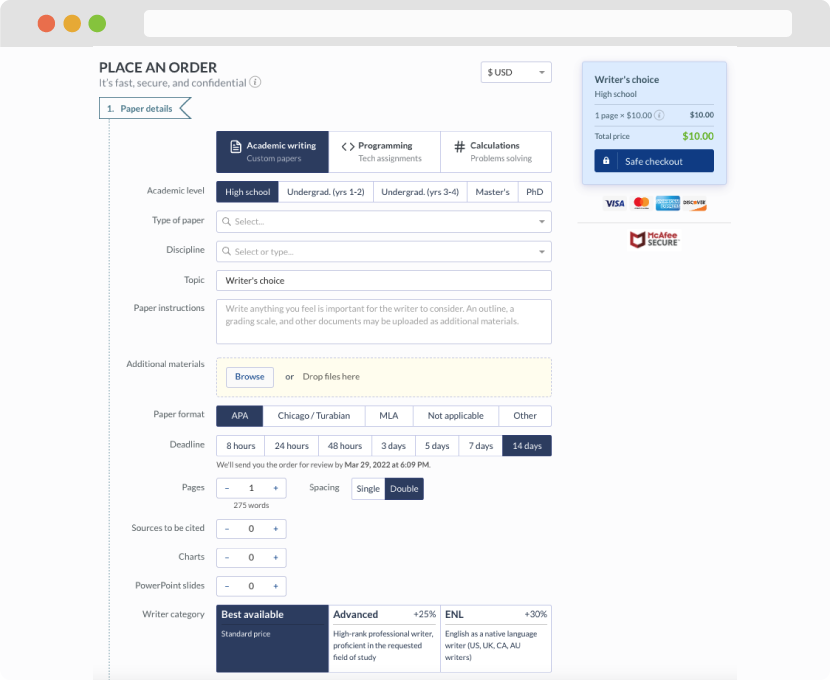
First, you will need to complete an order form. It's not difficult but, if anything is unclear, you may always chat with us so that we can guide you through it. On the order form, you will need to include some basic information concerning your order: subject, topic, number of pages, etc. We also encourage our clients to upload any relevant information or sources that will help.
Complete the order form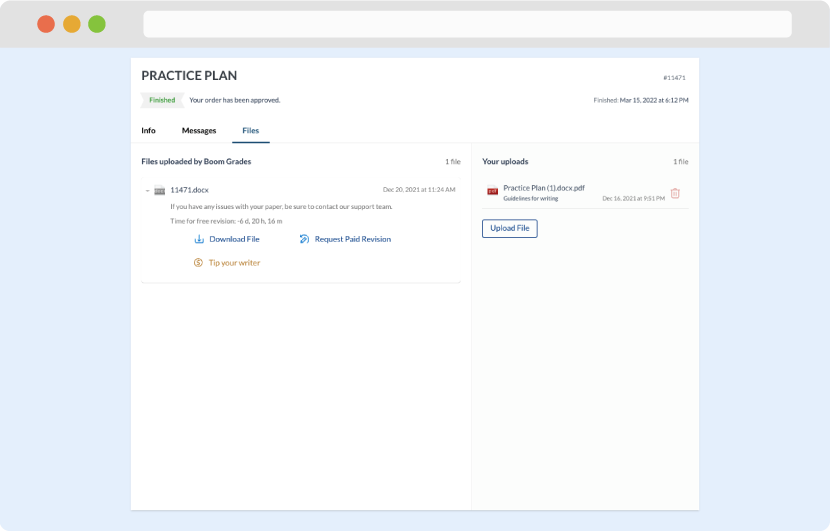
Once we have all the information and instructions that we need, we select the most suitable writer for your assignment. While everything seems to be clear, the writer, who has complete knowledge of the subject, may need clarification from you. It is at that point that you would receive a call or email from us.
Writer’s assignment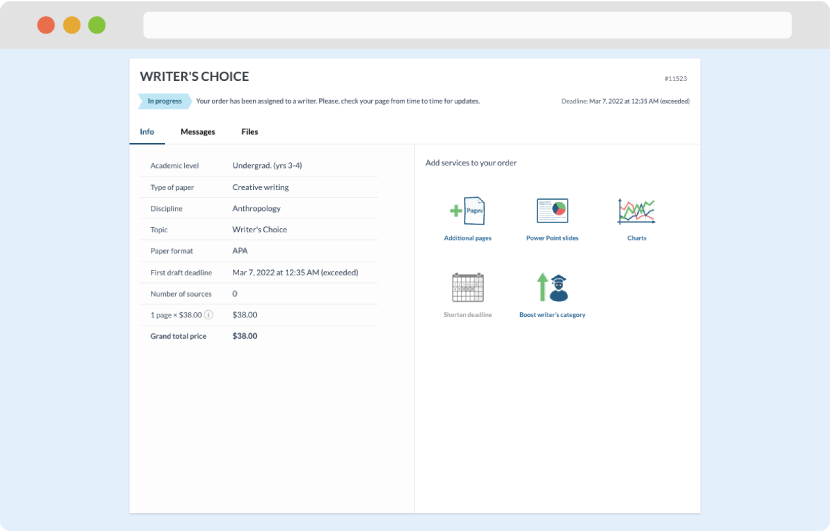
As soon as the writer has finished, it will be delivered both to the website and to your email address so that you will not miss it. If your deadline is close at hand, we will place a call to you to make sure that you receive the paper on time.
Completing the order and download