Part 1 DiscussionQuestion 1
Measures of variability include the range, the variance, and the standard deviation, and define
how far away the data points tend to fall from the center.
Write a 250- to 300-word response to the following:
•
How do you choose which measure of variability to use and what considerations may
have an impact on your decision?
Include your own experience as well as 2 citations that align with or contradict your comments
as sourced from peer-reviewed academic journals, industry publications, books, and/or other
sources. Cite your sources according to APA guidelines. If you found information that
contradicts your experience, explain why you agree or disagree with the information.
Question 2
Measures of variation provide us with information about how a set of scores are distributed.
Refer to the data you collected in Week 1 or other dataset practice, running measures of
variability for each of your variables.
Write a 250- to 300-word response to the following:
•
•
What specific considerations did you use to determine which test to run?
Why are measures of variability important when interpreting your data?
Include your own experience as well as 2 citations that align with or contradict your comments
as sourced from peer-reviewed academic journals, industry publications, books, and/or other
sources. Cite your sources using APA formatting. If you found information that contradicts your
experience, explain why you agree or disagree with the information.
Part 2 Student Response
Student response 1: Review the classmates’ posts and respond to at least one in a
minimum of 150 words. Explain why you agree or disagree. Then, share an example from
your professional experience to support your assertions.
There is a total of five measures of variation namely the IQV, the range, the IQR, the variance,
and the standard deviation. Each of these measures can represent the degree of variability in a
distribution. When making a decision on which measure of variability needs to be used, it is
evident that there is no simple answer to this (Frost, 2018). However, in most cases, we tend to
use only one measure of variation, and as a result, the choice of the appropriate one involves
various considerations.
One key consideration is the choice of the variable’s level of measurement. It is required that
the use of any measure of the data has to be aligned with the level of measurement. For
instance, when working on a nominal level of measurement, IQV is used in determining
variability in the distribution. On the other hand, the ordinal level of measurement is
considered based on the research objective (Frankfort-Nachmias et al, 2019). For instance, if the
research objective is measuring the variability and ignoring the rank order, then QV will be
used. Secondly, if the objective is to determine the variability in distribution, then variance and
standard deviation are used. Thirdly, the research objective is to measure the range of rankordered categories that include the middle 50% of observations, then Range and IQR are used.
Lastly, the Interval-ratio level of measurement is considered based on the shape of the
distribution. For instance, if the shape is symmetrical and the research objective is to rough the
assessment of the variability, then Range and IQR are used whereas if the objective is to
determine variability in distribution, then variance and the standard deviation are used. On the
other hand, if the shape of the distribution is asymmetrical and the main objective is to
determine variability in a seriously skewed distribution, then range and IQR are considered.
References
Frankfort-Nachmias, C., Leon-Guerrero, A., & Davis, G. (2019). Social statistics for a diverse
society (9th ed.). SAGE Publications.
Frost, J. (2018, March 2). Measures of Variability: Range, Interquartile Range, Variance, and
Standard Deviation – Statistics By Jim. Statistics by Jim.
Measures of Variability: Range, Interquartile Range, Variance, and Standard Deviation
Student response 1: Review the classmates’ posts and respond to at least one in a
minimum of 150 words. Explain why you agree or disagree. Then, share an example from
your professional experience to support your assertions.
What specific considerations did you use to determine which test to run?
Choosing a test can be a difficult process for researchers. In order to determine the best tests
to run, the researcher must consider certain factors such as the type of research design, the
scientific question, type of data and number of participants. Before recording the data and
selecting then test, the research question must be and the null hypothesis must be conveyed.
The three main criteria for selecting the test are the number of variables, levels of
measurement and the type of design. When choosing a test, it is important to determine the
number of variables that need to be analyzed. A single set of tests used on a single variable
referred to as descriptive statistics, second set is used to identify the relationship between two
variables and the third is used to model multivariable relationships (Parab & Bhalero, 2010).
Why are measures of variability important when interpreting your data?
In research study, measures of variability are important when interpreting data. Researchers
will use the mean to better analyze and review the center of the population. Understanding
variability helps the researcher to have a better understating of events that might affect the
data sets, Distributions that have lower variability often have more constant datasets. However
higher variability results in the likelihood of extreme values in the data sets. The fact is that
extreme values can result in possible issues with the data and while some amount of variation
is usually unavoidable, if there is too much inconsistency, then there can be problems with the
research (Frost, 2022).
References
Frost, J. (2022). Measures of Variability: Range, Interquartile Range, Variance, and Standard
Deviation. https://statisticsbyjim.com/basics/variability-range-interquartile-variance-standarddeviation/
Parab, S., & Bhalerao, S. (2010). Choosing statistical test. International journal of Ayurveda
research, 1(3), 187–191. https://doi.org/10.4103/0974-7788.72494
Essay Writing Service Features
Our Experience
No matter how complex your assignment is, we can find the right professional for your specific task. Achiever Papers is an essay writing company that hires only the smartest minds to help you with your projects. Our expertise allows us to provide students with high-quality academic writing, editing & proofreading services.
Free Features
Free revision policy
$10Free bibliography & reference
$8Free title page
$8Free formatting
$8How Our Dissertation Writing Service Works
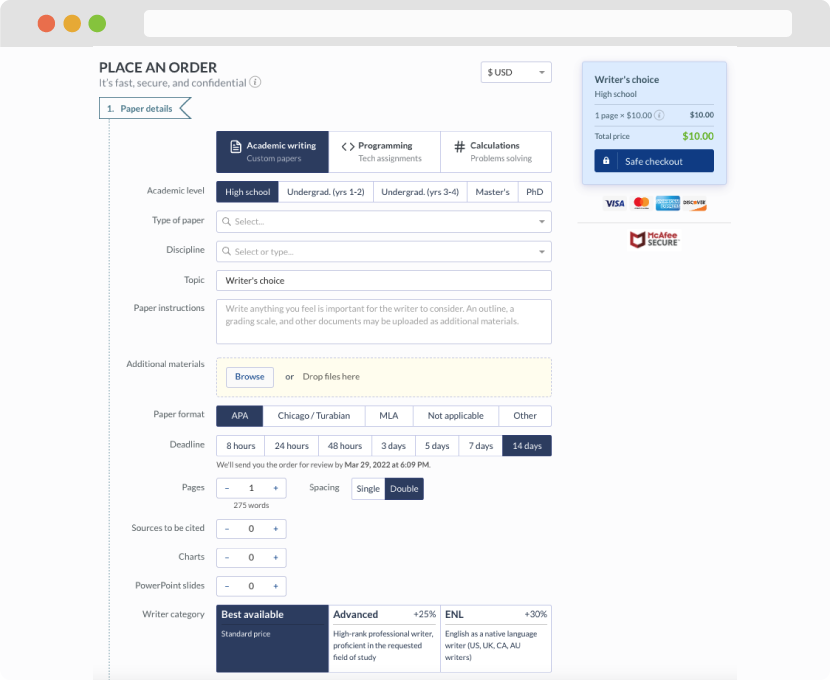
First, you will need to complete an order form. It's not difficult but, if anything is unclear, you may always chat with us so that we can guide you through it. On the order form, you will need to include some basic information concerning your order: subject, topic, number of pages, etc. We also encourage our clients to upload any relevant information or sources that will help.
Complete the order form
Once we have all the information and instructions that we need, we select the most suitable writer for your assignment. While everything seems to be clear, the writer, who has complete knowledge of the subject, may need clarification from you. It is at that point that you would receive a call or email from us.
Writer’s assignment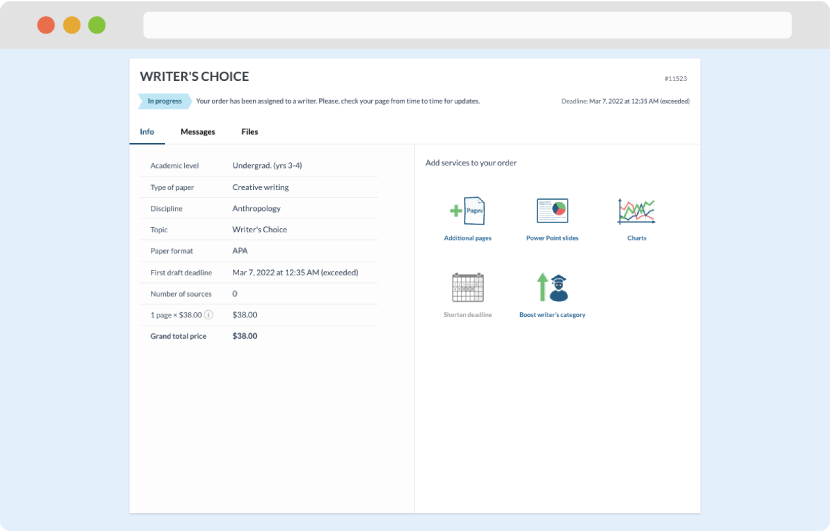
As soon as the writer has finished, it will be delivered both to the website and to your email address so that you will not miss it. If your deadline is close at hand, we will place a call to you to make sure that you receive the paper on time.
Completing the order and download