Respond to your colleagues by comparing the differential diagnostic features of the disorder you were assigned to the diagnostic features of the disorder your colleagues were assigned.
NOTE( Disorder assigned to me: Anxiety Disorder)
Main Post
Adjustment Disorder versus Anxiety Disorder
Adjustment disorder is the development of emotional symptoms in response to an identifiable stressor occurring within 3 months of the onset of the stressor. The distress from an adjustment disorder is out of proportion to the severity and intensity of the stressor. The adjustment disorder can have specifiers such as “with depressed mood,” “with anxiety,” and “with mixed anxiety and depressed mood,” “with disturbance of conduct,” and “with mixed disturbance of emotions and conduct.” Adjustment disorders are classified as a “Trauma and Stressor-related disorder” in the DSM (American Psychiatric Association [APA], 2013) and resolve within 3 months of removing the stressor. Treatment is usually made up of brief psychotherapy (Gabbard, 2014).
Generalized Anxiety Disorder (GAD) is not born out of one identified stressor (though stressors can worsen signs and symptoms) but is excessive anxiety and worry about a number of situations and events and require 3 or more of the following symptoms: restlessness/feeling “keyed up”, easily fatigued, difficulty concentrating, irritability and muscle tension, and sleep disturbances. The anxiety symptoms have been going on for at least 6 months and is causing clinically significant distress in functioning (APA, 2013).
Adjustment disorder can be seen as a disorder of exclusion; if symptoms do not meet criteria for another psychiatric disorder, and there is a an identified precipitant of symptoms occurring within 3 months, adjustment disorder may be the most logical diagnosis. Adjustment disorder does not have a “checklist” of symptoms to make an objective determination of distress or dysfunction (Gabbard, 2014).
When I worked on the psychiatric unit in the Navy, we saw a lot of young sailors with adjustment disorder. Entering the military was enough of a stressor that they were displaying some conduct or emotional issues that prevented them from doing their job well. Many times, they wanted a service discharge but more often our psychiatrists returned them to work with therapy and medication. If they were admitted to the hospital 3 times within a year, they would be administratively discharged.
Diagnostic Criteria for OCD
Obsessive-Compulsive Disorder (OCD) is characterized by recurrent intrusive thoughts, images, or urges (obsessions) that typically cause intense anxiety; to alleviate anxiety and function in the world, clients with OCD must perform repetitive mental or behavioral actions (compulsions) related to their obsession according to rigidly defined rules.OCD typically starts in childhood or adolescence, persists throughout a person’s life, and can produce substantial impairment in functioning (Sadock et al., 2017). Among adults in the United States, prevalence rates are 2.3 percent, with females affected slightly more than males in adulthood, while males have higher rates that begin in childhood (Ruscio et al., 2010). Seventy-six perfect of adults with OCD have another anxiety disorder, 63 percent have a mood disorder (commonly depression), and 23 to 32 percent have a co-morbid obsessive-compulsive personality disorder (Kessler et al., 2005).
Psychotherapy and Psychopharmacological Treatment
For the OCD patient, I would definitely begin to measure OCD symptoms with the Yale-Brown Obsessive Compulsive Scale. There is a self-report scale that clinicians can use which shows good convergent validity as compared to the interview, as well as internal consistency and test-retest reliability. As providers get busier and busier, using a self-report to track efficacy of treatment becomes essential (Steketee et al., 1996).
Therapy is the mainstay of treatment for patients with OCD. CBT may be more effective than SSRI’s or Clomipramine; though many providers use therapy and medication in combination, there is no evidence to show superiority of combination treatment over the most effective psychotherapies (Ming, 2016). The most common type of therapy uses exposure and response prevention (ERP). This treatment leads to the habituation of anxiety related to obsessions so that rituals are no longer necessary to reduce anxiety. Psychoeducation is also important as anxiety may increase during exposure as the client needs to know that the short term “pain” will produce long term “gains” (Gabbard, 2014).
If CBT/ERP is not available, or the patients symptoms are severe enough to warrant medication, SSRI’s are first-line; all of the SSRI’s (except Lexapro and Celexa) have been approved for the treatment of OCD (Soomro et al., 2008). Clomipramine, a tricyclic antidepressant, is a second line option due to it’s increase side effect profile (Stahl, 2018). In general, SSRI’s and Clomipramine leads to improvement in 40-60% of patients with OCD (Pigott, 1999).
References
American Psychiatric Association. (2013). Diagnostic and statistical manual of mental disorders (5th ed.). APA Publishing.
Gabbard, G.O. (2014). Gabbard’s treatment of psychiatric disorders (5th ed.). American Psychiatric Publications.
Kessler, R. C., Chiu, W. T., Demler, O., Merikangas, K. R., & Walters, E. E. (2005). Prevalence, severity, and comorbidity of 12-month DSM-IV disorders in the National Comorbidity Survey Replication. Archives of General Psychiatry, 62(6), 617–627.
https://doi.org/10.1001/archpsyc.62.6.617
Ming T. S. (2016). Network meta-analyses and treatment recommendations for obsessive-compulsive disorder. The lancet. Psychiatry, 3(10), 920–921. https://doi.org/10.1016/S2215-0366(16)30281-4
Pigott, T. A., & Seay, S. M. (1999). A review of the efficacy of selective serotonin reuptake inhibitors in obsessive-compulsive disorder. The Journal of clinical psychiatry, 60(2), 101–106. https://doi.org/10.4088/jcp.v60n0206
Ruscio, A. M., Stein, D. J., Chiu, W. T., & Kessler, R. C. (2010). The epidemiology of obsessive-compulsive disorder in the National Comorbidity Survey Replication. Molecular Psychiatry, 15(1), 53–63.
https://doi.org/10.1038/mp.2008.94
Sadock, B., Sadock, V., and Ruiz, P. (2017). Kaplan & Sadock’s synopsis of psychiatry (11th ed.). Wolters Kluwer.
Stahl, S. M. (2018). The prescriber’s guide (5th ed.). Cambridge University Press.
Soomro, G. M., Altman, D., Rajagopal, S., & Oakley-Browne, M. (2008). Selective serotonin re-uptake inhibitors (SSRIs) versus placebo for obsessive compulsive disorder (OCD). The Cochrane database of systematic reviews, 2008(1), CD001765. https://doi.org/10.1002/14651858.CD001765.pub3
Steketee, G., Frost, R., & Bogart, K. (1996). The Yale-Brown Obsessive Compulsive Scale: interview versus self-report. Behavior Research and Therapy, 34(8), 675–684.
https://doi.org/10.1016/0005-7967(96)00036-8
Essay Writing Service Features
Our Experience
No matter how complex your assignment is, we can find the right professional for your specific task. Achiever Papers is an essay writing company that hires only the smartest minds to help you with your projects. Our expertise allows us to provide students with high-quality academic writing, editing & proofreading services.
Free Features
Free revision policy
$10Free bibliography & reference
$8Free title page
$8Free formatting
$8How Our Dissertation Writing Service Works
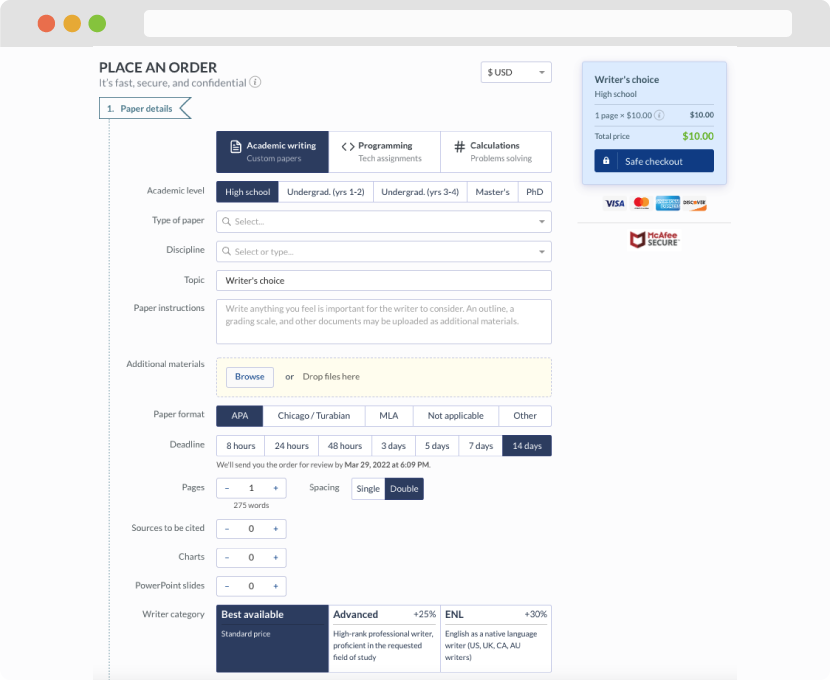
First, you will need to complete an order form. It's not difficult but, if anything is unclear, you may always chat with us so that we can guide you through it. On the order form, you will need to include some basic information concerning your order: subject, topic, number of pages, etc. We also encourage our clients to upload any relevant information or sources that will help.
Complete the order form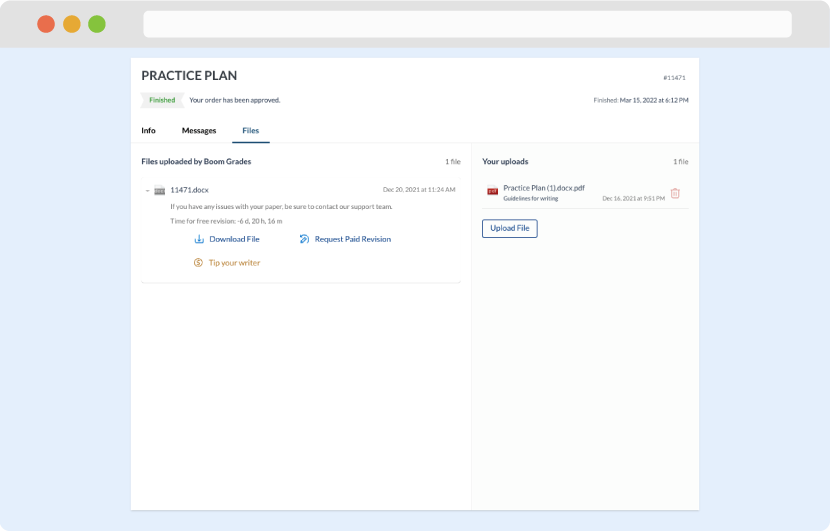
Once we have all the information and instructions that we need, we select the most suitable writer for your assignment. While everything seems to be clear, the writer, who has complete knowledge of the subject, may need clarification from you. It is at that point that you would receive a call or email from us.
Writer’s assignment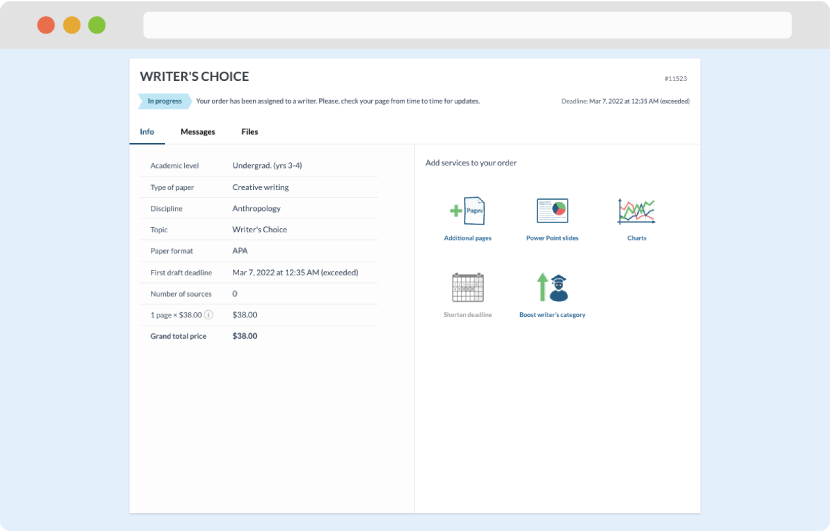
As soon as the writer has finished, it will be delivered both to the website and to your email address so that you will not miss it. If your deadline is close at hand, we will place a call to you to make sure that you receive the paper on time.
Completing the order and download