I kindly need a summary of each presentation attached with the conclusion.
VILNIUS TECH
PRESENTATION ON:
Replacement Decisions
BY
KINGSLEY JOHN
12. Replacement Decisions
The decision to replace an existing product with a new one is usually based on a
comparison of the cost of the new product with the cost of continuing to use the existing
product.
In order to make a replacement decision, a company must first determine the expected
life of the existing product and the expected life of the new product.
The company must also determine the cost of the new product and the cost of
continuing to use the existing product.
The company must then decide whether the savings from using the new product justify
the cost of replacing the existing product.
If the company decides to replace the existing product, it must then determine how to
dispose of the existing product.
12.1. Replacement-Analysis Fundamentals
Analyzing the needs of the organization: The
first step in replacement analysis is to
understand the needs of the organization.
This includes understanding the company’s
goals, objectives, and strategies. It also
includes understanding the company’s
current situation, including its financial
situation, its competitive position, and its
overall business environment
Identifying the options: The next step is to
identify the options for replacement. This
includes identifying the possible replacement
options, their costs, and their benefits.
12.1. Replacement-Analysis Fundamentals
cont:
Evaluating the options: The next step is to evaluate the options. This includes considering the
risks and benefits of each option and how well each option meets the needs of the
organization.
Making the decision: The final step is to make the decision. This includes selecting the option
that is best for the organization and making sure that the decision is implemented correctly.
Reviewing the decision: The last step is to review the decision. This includes monitoring the
results of the decision and making sure that the organization is still meeting its goals and
objectives.
12.1.1. Basic Concepts and
Terminology
Replacement: The act of replacing one item with another. In business, replacement
decisions are made when an item is no longer able to perform its function adequately
and a new item is needed to take its place.
Life Cycle: The life cycle of an item is the amount of time that the item can be used
before it needs to be replaced.
Cost: The cost of an item includes the purchase price, the shipping and handling
charges, the installation charges, and the costs of any repairs or maintenance that may
be required.
Value: The value of an item is the amount of money that the item will save over its life
cycle.
Replacement Interval: The replacement interval is the amount of time between the
purchase of an item and the time when it needs to be replaced.
12.1.2. Approaches for Comparing
Defender and Challenger
Replacement analysis: This approach involves estimating the cash flows that are expected to occur if
the existing asset is replaced with a new one. The decision rule is to replace the existing asset if the net
present value of the cash flows from the new asset is greater than the net present value of the cash
flows from the existing asset.
Life cycle costing: This approach estimates all of the costs that are associated with an asset over its
entire life cycle. These costs include the initial purchase price, installation costs, operating costs, and
maintenance costs. The decision rule is to replace the existing asset if the total life cycle costs of the
new asset are less than the total life cycle costs of the existing asset.
Present value of money: This approach takes into account the time value of money when making
replacement decisions. The decision rule is to replace the existing asset if the present value of the cash
flows from the new asset is greater than the present value of the cash flows from the existing asset.
Depreciation: This approach estimates the amount of depreciation that has already been incurred on
the existing asset. The decision rule is to replace the existing asset if the present value of the cash flows
from the new asset is greater than the present value of the cash flows from the existing asset, less the
amount of depreciation that has already been incurred.
Opportunity cost: This approach considers the opportunity cost of capital when making replacement
decisions. The decision rule is to replace the existing asset if the present value of the cash flows from the
new asset is greater than the present value of the cash flows from the existing asset, less the opportunity
cost of capital.
12.2. Economic Service Life
Price: The price of the item being replaced, as well as the
price of the potential replacement, will factor into the
decision.
Function: The item being replaced may no longer be fulfilling
its intended function. For example, a car that can no longer
drive may be replaced with a new car.
Quality: The item being replaced may no longer be of the
same quality as it was when it was first purchased. For
example, a piece of clothing that has been worn and washed
many times may be replaced with a new piece of clothing.
aesthetics: The item being replaced may no longer be
aesthetically pleasing. For example, a piece of furniture that is
scratched and dented may be replaced with a new piece of
furniture.
sentimental value: The item being replaced may have
sentimental value. For example, a family heirloom may be
replaced with a new item.
12.3. Replacement Analysis When the
Required Service Period Is Long
One method is to find the minimum cost of
ownership. This involves looking at the total cost of
ownership of each replacement option, including
the purchase price, installation costs, and
maintenance costs. The option with the lowest
cost of ownership is typically the best option.
Another method is to find the option with the
lowest life-cycle costs. This approach takes into
account all the costs associated with each
replacement option over the expected life of the
asset, including the purchase price, installation
costs, maintenance costs, and disposal costs. The
option with the lowest life-cycle costs is typically
the best option.
12.3. Replacement Analysis When the
Required Service Period Is Long
A third method is to find the option with the lowest present value of costs. This approach
discounts all the future costs associated with each replacement option at a rate that
reflects the time value of money. The option with the lowest present value of costs is
typically the best option.
A fourth method is to find the option with the shortest payback period. This approach
looks at the net present value of the cash flows associated with each replacement
option. The option with the shortest payback period is typically the best option.
A fifth method is to find the option with the highest net present value. This approach also
looks at the net present value of the cash flows associated with each replacement
option. The option with the highest net present value is typically the best option.
12.3.1. Required Assumptions and
Decision Frameworks
The first assumption is that the decision-maker is risk-neutral. This
means that the decision-maker is indifferent between taking a
risky investment and a risk-free investment.
The second assumption is that the decision-maker has access to
perfect information. This means that the decision-maker knows all
relevant information about the investment options available to
them.
The third assumption is that the decision-maker can choose any
investment option. This means that the decision-maker is not
constrained by any factors such as budget or time.
The fourth assumption is that the decision-maker can commit to
their investment decision. This means that the decision-maker will
not change their mind after making their investment decision.
The fifth assumption is that the decision-maker can reinvest the
proceeds from their investment. This means that the decisionmaker can reinvest the money they make from their investment
back into the investment.
12.3.2. Handling Unequal Service Life
Problems in Replacement Analysis
One common handling unequal service life problem is using a weighted average
instead of a straight average. This means that items with a shorter service life are
given a higher weight, or importance, than items with a longer service life.
Another common handling unequal service life problem is using a geometric mean
instead of an arithmetic mean. This approach is based on the idea that each
successive replacement doubles the service life of the item, so it gives a more
accurate representation of the average service life.
12.3.2. Handling Unequal Service Life
Problems in Replacement Analysis. Cont:
A third handling unequal service life problem is to use a rolling average. This means
that you calculate the average service life of an item based on its most recent
replacements. This is useful for items that have a history of shortening service life over
time. A fourth handling unequal service life problem is to use a minimum service life.
This means that you only consider replacements that have a service life that is equal
to or greater than the minimum service life. This is useful for items that you want to
guarantee a certain level of performance for.
A fifth handling unequal service life problem is to use a maximum service life. This
means that you only consider replacements that have a service life that is equal to
or less than the maximum service life. This is useful for items that you want to replace
before they reach the end of their service life.
12.3.3. Replacement Strategies under the
Infinite Planning Horizon
The do-nothing strategy: Under this strategy, the firm does not replace the existing equipment
and continues to use it until it fails. This strategy is optimal when the cost of replacing the
equipment is greater than the cost of continuing to use the existing equipment.
The replacement-at-failure strategy: Under this strategy, the firm waits until the existing
equipment fails and then replaces it with new equipment. This strategy is optimal when the
cost of replacing the equipment is less than the cost of continuing to use the existing
equipment.
The replacement-at-a- predetermined time strategy: Under this strategy, the firm replaces the
existing equipment at a predetermined time, regardless of whether it has failed or not.
This strategy is optimal when the cost of replacing the equipment is less than the cost of
continuing to use the existing equipment and the cost of replacing the equipment is less than
the cost of waiting for it to fail.
12.3.3. Replacement Strategies under
the Infinite Planning Horizon: cont:
The replacement-at- an-optimal-time strategy: Under this
strategy, the firm replaces the existing equipment at the
time that is optimal for the firm, taking into account the
costs of replacing the equipment and the cost of
continuing to use the existing equipment.
The replacement-at-a- predetermined-time- with-asafety-margin strategy: Under this strategy, the firm
replaces the existing equipment at a predetermined
time, regardless of whether it has failed or not, and
includes a safety margin in the decision.
This strategy is optimal when the cost of replacing the
equipment is less than the cost of continuing to use the
existing equipment and the cost of replacing the
equipment is less than the cost of waiting for it to fail,
and when there is a possibility that the equipment will fail
before the predetermined time.
12.4. Replacement Analysis with Tax
Considerations
Capital Gains Tax: If you sell an asset for more than you paid for it, you may be subject to
capital gains tax. This could potentially impact your decision to replace an asset or not.
Depreciation: An asset that is being replaced may have depreciation deductions
associated with it. These deductions can impact your tax liability and should be considered
when making a replacement decision.
Tax-exempt Investments: If you are considering replacing an asset with a tax-exempt
investment, you need to be aware of the potential impact on your overall tax liability.
Basis: The basis of an asset is important to keep in mind for tax purposes. When an asset is
replaced, the basis of the new asset may be different than the old one. This could impact
your taxes in the future.
Timing: The timing of when you replace an asset can also have tax implications. For
example, if you replace an asset in the middle of the year, you may only be able to deduct
a portion of the costs associated with the replacement in that tax year.
Conclusion
The decision to replace an existing product with a new one is usually based on a
comparison of the cost of the new product with the cost of continuing to use the existing
product.
To make a replacement decision, a company must first determine the expected life of the
existing product and the expected life of the new product.
The company must also determine the cost of the new product and the cost of continuing
to use the existing product.
The company must then decide whether the savings from using the new product justify the
cost of replacing the existing product.
If the company decides to replace the existing product, it must then determine how to
dispose of the existing product.
References
Leu, S. S., & Ying, T. M. (2020). Replacement and maintenance decision analysis for
hydraulic machinery facilities at reservoirs under imperfect maintenance. Energies,
13(10), 2507.
Leu, S. S., & Ying, T. M. (2020). Replacement and maintenance decision analysis for
hydraulic machinery facilities at reservoirs under imperfect maintenance. Energies,
13(10), 2507.
van den Boomen, M., Leontaris, G., & Wolfert, A. R. M. (2019). Replacement
optimization of ageing infrastructure under differential inflation. Construction
Management and Economics, 37(11), 659-674.
• FACULTY OF MECHANICS
• DEPARTMENT OF MECHANICAL ENGINEERING
FOUNDATIONS
OF
ENGINEERING
ECONOMY
• LECTURER: YEGANEH ARABLOUSABET
•
PREPARED BY:
•
KINGSLEY JOHN
OUTLINE
• Description and role
• Cash flows
• Study approach
• Economic equivalence
• Ethics and economics
• Simple and compound interest
• Rate of interest
• MARR and opportunity cost
• Terminology and symbols
• Spreadsheet functions
DESCRIPTION AND ROLE
• What is engineering economics?
• Formulation, approximation, and evaluation of anticipated economic
results of decisions made to realize a specified purpose.
• Engineers design, analyze, and synthesize.
• They should apply economic analysis when making capital
investment decisions.
• Usually, engineers have to select and execute from various
alternatives.
• The application of proper economic analysis is key to this.
DESCRIPTION AND ROLE
• Time value of money (TVM)
• The concept that money makes money over time.
• Investments are expected to yield returns.
• Example: If Peter invests in a construction project today, he anticipates having
more money than the invested capital in the future.
• Conclusion: Engineers should comprehend cost estimation, economic
equivalence, and time value of money.
STUDY APPROACH
• Engineering economic study involves:
• Identification of problem
• Objective definition
• Approximation of cash flow
• Financial analysis
• Decision making
STUDY APPROACH
• Problem identification and objective definition
• Example: A manufacturing plant must be closed due to several health and
safety concerns.
• Objective: Adhere to OSHA health and safety standards.
• Alternatives
• Descriptions of feasible solutions to the problem.
• Cash flows
• Risk and sensitivity analysis used to improve the prediction of cash flows.
STUDY APPROACH
• Financial analysis
• Cash flow estimation, TVM, and selected measure of worth
• Consider the impact of taxes and inflation
• Decision making
• Select the best alternative based on a measure of worth.
• Example: If investment A has an annual ROR of 8% and investment B has an
annual ROR of 12%, then investment B is better economically.
• Conclusion: Select the investment with the highest net income or
lowest overall cost.
PROFESSIONAL ETHICS AND ECONOMIC
DECISIONS
• Ethics and morals are commonly used interchangeably.
• Ethics – Standards that guide decision-making and actions of organizations
and individuals.
• Morals – Underlying tenets that form one’s conduct and character when
differentiating right from wrong.
• Common or universal morals: Fundamental beliefs
• Examples: Do not steal, murder, or lie.
• Personal or individual morals: Beliefs held and maintained by an individual.
PROFESSIONAL ETHICS AND ECONOMIC
DECISIONS
• Professional/engineering ethics – Formal codes and standards that guide
professionals when making decisions and when completing tasks.
• Code of Ethics for Engineers:
• Provides positive stimulus for ethical conduct.
• Published by NSPE.
• Example from the code: When fulfilling their duties, engineers should ensure the
health, safety, and welfare of the public.
• Conclusion: Translation from common morals to individual morals and
engineering ethics can change depending on the culture.
INTEREST RATE AND ROR
A) Interest Rate
• Interest
• Fee one pays for the privilege of borrowing money
• Amount current owed – principal
• Interest rate – The price paid for using someone else’s money, over a specific
period expressed as % of the principal.
• 𝐼𝑛𝑡𝑒𝑟𝑒𝑠𝑡 𝑟𝑎𝑡𝑒 % = (𝐼𝑛𝑡𝑒𝑟𝑒𝑠𝑡 𝑎𝑐𝑐𝑟𝑢𝑒𝑑 𝑝𝑒𝑟 𝑡𝑖𝑚𝑒 𝑢𝑛𝑖𝑡)/(𝑝𝑟𝑖𝑛𝑐𝑖𝑝𝑎𝑙)*100
• Example: Mary borrowed $5,000 from Paul, promising to pay a total of $5,600 in 1 yr.
• Interest Rate = [($5,600-5,000)/$5,000]*100 = 12%.
B) RATE OF RETURN
• ROR– Interest gained over a specified time indicated as a % of the
principal
• 𝑅𝑂𝑅% = (𝐼𝑛𝑡𝑒𝑟𝑒𝑠𝑡 𝑒𝑎𝑟𝑛𝑒𝑑 𝑝𝑒𝑟 𝑡𝑖𝑚𝑒 𝑢𝑛𝑖𝑡/𝑝𝑟𝑖𝑛𝑐𝑖𝑝𝑎𝑙)*100%.
• Conclusion
• ROR is the lender’s outlook
• Interest rate is the borrower’s outlook.
TERMINOLOGY AND SYMBOLS
• Commonly used symbols are:
• P – The value you give to money at the present time.
• F- The value that an amount today will be worth at a certain point in the
future
• A-series of equivalent payments that occur at an equal period of time.
• n – number of interest periods.
• i – interest rate within a specified period of time, expressed as %
• t – time, expressed in periods (days, months, years)
TERMINOLOGY AND SYMBOLS
EXAMPLE
• Fiona borrowed $7,000 to purchase a car. She can pay back the loan in 2
ways:
• 5 equal annually paid installments with an interest rate of 8% p.a.
• One full payment in 4 years based on an interest rate10% per year.
• From the above example, the following symbols can be deduced.
a. P = $7,000,
i=8% per annum
n = 5 years
b. P = $7,000,
i=10% per annum
n = 4 years
• Conclusion: Generally, all problems in engineering economics mostly
involve the symbols P, A, F, n, and i,
CASH FLOWS: ESTIMATION AND
DIAGRAMMING
• Cash flows terminology
• Cash inflows- Refers to the receipts, incomes, savings, and sales that accrue
from a project or business ( symbolized by a +)
• Cash outflows- denotes the disbursements, costs, taxes, and expenses
incurred by projects and businesses(indicated by a -)
• Net cash flow= cash inflows- cash outflows (NCF=R-D)
• Cash flow diagram is used to graphically representant cash flows.
CASH FLOWS: ESTIMATION AND DIAGRAMING
CONT’
• Example: An engineer deposits a certain amount P now and is allowed to
withdraw a uniform yearly amount A1, of $ 2000 for the next 5 years,
beginning a year after she makes the deposit. After the 5 years have elapsed,
she is allowed to withdraw an annual amount, A2 of $3,000 for 3 consecutive
years. Show the cash flow diagram based on an interest rate of 8.5% p.a.
ECONOMIC EQUIVALENCE
• Economic equivalence is a concept that combines i and TVM to
compute varying amounts of money at varying periods with the same
economic value.
• Examples of the many types of equivalency used comprise length,
pressure, and speed.
• Length; 12 inch= 1 foot, and 39.370 inches= 1 meter
• 1,000m= 1 km, and 1 km= 0.621 miles
ECONOMIC EQUIVALENCE CONT’
• Pressure
• Speed
• Example;
• Example;
• 1 atmosphere= 1 Newton
• 1 mile=1.609 km
• 1 Newtons/Square Meter =
103 Pascal= 1 Kilopascal
• 1 hr= 60 mins
• 110kmh=68.365mph= 1.139
miles per minute
ECONOMIC EQUIVALENCE CONT’
• Conclusion
In the above example, it can be concluded that various have been applied to
develop equivalent statements on speed.
SIMPLE AND COMPOUND INTEREST
SIMPLE INTEREST
COMPOUND INTEREST
• Computed using the principal
only while disregarding the
interest accrued in between.
• iIterest that’s paid on what
you deposit in the bank +
interest on your interest.
• Simple interest=
principal(number of
periods)(rate of interest)
• Compound interest
=(principal + all accrued
interest(rate of interest)
SIMPLE AND COMPOUND INTEREST CONT’
SIMPLE INTEREST
COMPOUND INTEREST
• Example;
• Example;
Mokah Stores lent an engineering firm
company $100,000 to replace some
equipment.The firm was required to
pay back the loan in 3years at a 10%
interest rate. How much will the firm
pay back after the three yrs?
• If the engineering company borrows
the $100,000 with 10% compound
interest for 3 years.
Conclusion; interest p.a= $100,
000(3)(0.10)= $30,000
• Year 2= $100,000(1.10)2=$121,000
Total amount payable= -$130,000
• Total dues payable= $133,100
• The solution would be;
• Year 1= $100,000(1.10)1= $110,000
• Year3= $100,00-(1.10)3= $133,100
MINIMUM ATTRACTIVE RATE OF RETURN (MARR)
• MARR Terminology
• MARR; a reasonable rate of return applied to evaluate and select the best
alternative.
• Also known as the hurdle rate, benchmark rate, and cut-off rate.
• MARR value is applied when making capital investment decisions.
• Cost of capital – Money in interest form used to raise capital.
• It is raised through different means including equity financing and debt financing.
MARR CONT’
Conclusion
• Combination of debt financing and
equity financing results in WACC
• For any organization, the MARR used to
accept or reject an investment decision
is always to equal or higher than
WACC.
• The anticipated ROR on an unfunded
project is known as opportunity cost.
SPREADSHEET FUNCTIONS
• Seven excel functions can be used to perform fundamental engineering
economy calculations.
• The functions are listed in the caption below;
SPREADSHEET FUNCTIONS CONT’
• Example; the example below shows use of spreadsheets to develop
relationships and calculate the interest and cash flows;
• Conclusion; spreadsheet functions can be used to establish associations
and hence calculate interest and cash flows
QUESTIONS FOR DISCUSSION
• What is engineering economic analysis?
• Give various examples of standards outlined in the Code of Ethics for
Engineers
• Explain what the symbols PV, PW, DCF, NPV, and CC stand for.
• Discuss what end-of-period convention means.
• Provide examples of equity and debt financing.
• How can spreadsheets be used to perform sensitivity analysis?
Essay Writing Service Features
Our Experience
No matter how complex your assignment is, we can find the right professional for your specific task. Achiever Papers is an essay writing company that hires only the smartest minds to help you with your projects. Our expertise allows us to provide students with high-quality academic writing, editing & proofreading services.
Free Features
Free revision policy
$10Free bibliography & reference
$8Free title page
$8Free formatting
$8How Our Dissertation Writing Service Works
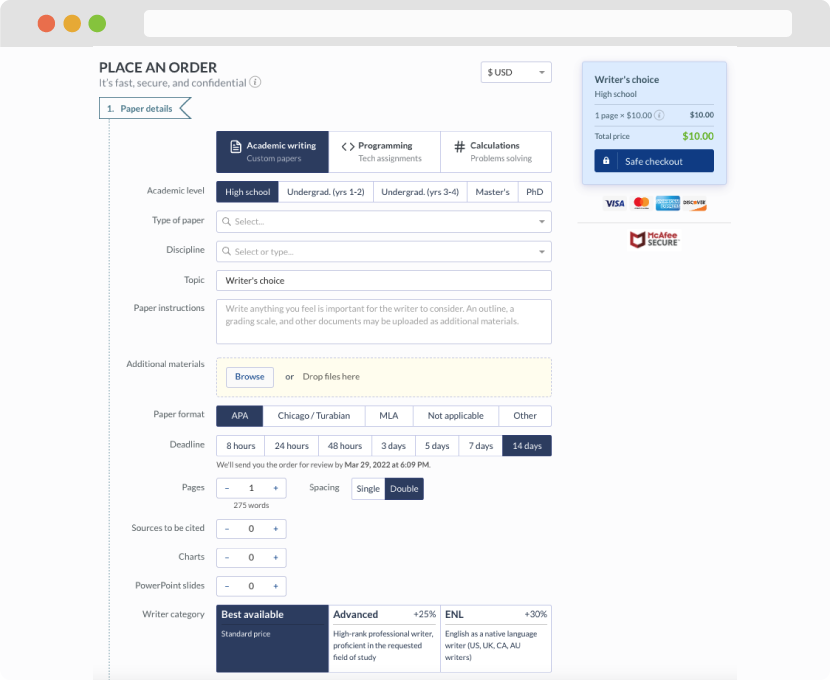
First, you will need to complete an order form. It's not difficult but, if anything is unclear, you may always chat with us so that we can guide you through it. On the order form, you will need to include some basic information concerning your order: subject, topic, number of pages, etc. We also encourage our clients to upload any relevant information or sources that will help.
Complete the order form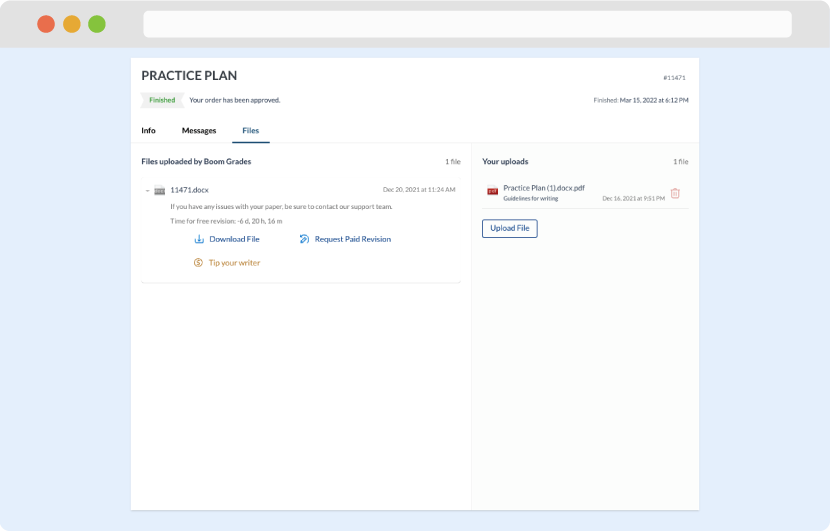
Once we have all the information and instructions that we need, we select the most suitable writer for your assignment. While everything seems to be clear, the writer, who has complete knowledge of the subject, may need clarification from you. It is at that point that you would receive a call or email from us.
Writer’s assignment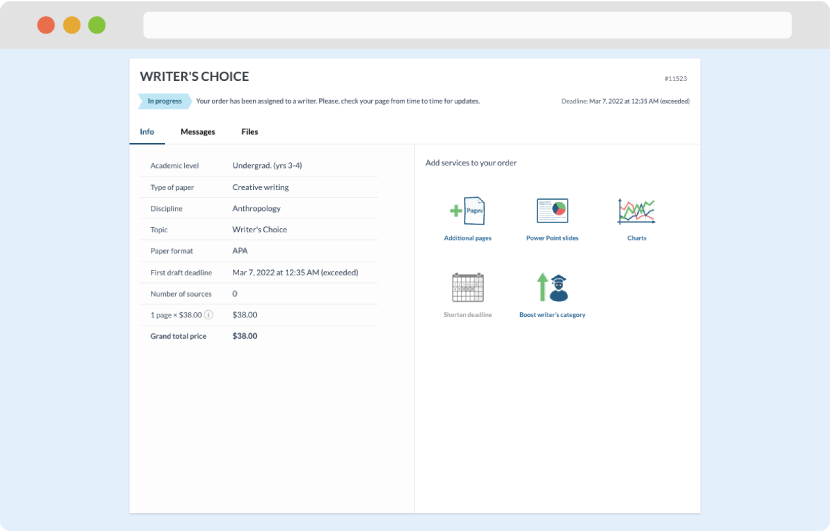
As soon as the writer has finished, it will be delivered both to the website and to your email address so that you will not miss it. If your deadline is close at hand, we will place a call to you to make sure that you receive the paper on time.
Completing the order and download