Market research is an essential part of making informed business decisions. Whether you are launching a new product, entering a new market, evaluating competitors, or identifying customer needs, market research helps you replace assumptions with evidence.
However, collecting information is only one part of the process. To make your findings useful, you must organize the data, analyze the results, and present your conclusions in a clear, structured report.
Learning how to write a market research report can help entrepreneurs, business owners, marketing professionals, consultants, and university students develop valuable analytical skills.
This guide explains how to conduct market research, structure a professional report, analyze your findings, and turn the results into actionable recommendations.
A market research report is a structured document that presents information about a particular market, its customers, competitors, industry trends, and potential business opportunities.
The report uses information collected from reliable sources to answer specific business questions. These might include:
Is there sufficient demand for a new product?
Who are the potential customers?
How much are customers willing to pay?
Which competitors dominate the market?
What challenges might a new business face?
Which marketing channels are most likely to reach the target audience?
For example, a company planning to introduce a new energy drink might research consumer preferences, competitor prices, distribution channels, purchasing habits, and market growth.
The resulting report would help management determine whether to launch the product, how to price it, and which customers to target.
A well-prepared market research report helps businesses make decisions based on evidence rather than guesswork.
Its main benefits include:
1. Identifying business opportunities
Research can reveal unmet customer needs, underserved customer groups, and emerging market trends.
2. Understanding customer behavior
Businesses can learn what customers value, how they make purchasing decisions, and what influences their brand preferences.
3. Evaluating competitors
Analyzing competing businesses helps identify their strengths, weaknesses, pricing strategies, and market positioning.
4. Reducing business risks
Market research helps businesses identify potential obstacles before committing substantial resources to a new product or market.
5. Supporting strategic planning
Research findings provide a foundation for decisions about pricing, product development, advertising, distribution, and expansion.

Before collecting information, determine exactly what you want the research to establish.
A report without a clear objective can easily become a collection of unrelated facts that offers little practical value.
Start by identifying the business problem or opportunity you want to investigate. Then develop specific research questions that will guide your work.
For example, suppose a small company wants to introduce an affordable skincare product for young adults.
Its research objective might be:
“To evaluate the demand for affordable skincare products among consumers aged 18–30 and identify the most promising pricing, product, and marketing strategies.”
The research questions could include:
What skincare products do consumers in this age group currently purchase?
Which product features influence their buying decisions?
How much are they willing to spend?
Which brands are their main alternatives?
Where do they prefer to purchase skincare products?
Practical tip: Write your research objective in one or two sentences. Every section of the report should contribute to answering it.
The next step is to establish which customers, businesses, or market segments the research will examine.
A target market can be defined using several characteristics.
|
Segmentation method |
What it examines |
Example |
|---|---|---|
|
Demographic |
Age, income, occupation, education |
Working adults aged 25–40 |
|
Geographic |
Country, city, region, or neighborhood |
Consumers in Nairobi |
|
Psychographic |
Values, interests, attitudes, and lifestyles |
Environmentally conscious shoppers |
|
Behavioral |
Purchasing habits, usage, and brand loyalty |
Customers who buy skincare products monthly |
|
Firmographic |
Business size, industry, and location |
Small retailers in East Africa |
Your choice depends on the research objective.
For example, a company selling accounting software to small businesses would focus on business characteristics rather than individual consumers’ lifestyles.
A clearly defined target market also helps you select appropriate data sources and avoid drawing conclusions about customers who are unlikely to purchase the product.
A market research report should use reliable information that directly addresses the research questions.
There are two main categories of research data.
Primary research involves collecting new information directly from potential customers, competitors, or other relevant participants.
Common methods include:
Surveys: Collect structured responses from a group of people.
Interviews: Obtain detailed insights into customer experiences and preferences.
Focus groups: Explore opinions through guided group discussions.
Observations: Examine how people behave in real-world or digital environments.
Experiments: Test how changes in price, product features, or marketing messages affect behavior.
For example, a business researching demand for a new food delivery service could survey 200 potential customers about their ordering habits, preferred delivery times, and willingness to pay.
Primary research provides information tailored to the research question, although it can require time, money, and careful planning.
Secondary research uses information that has already been collected and published by other organizations.
Useful sources include:
National statistics agencies and government reports.
Industry associations and trade publications.
Company annual reports and financial statements.
Academic journals and university research.
Competitor websites and published price lists.
Reputable market research publications.
Public customer reviews and industry surveys.
For example, a business investigating the Kenyan mobile money market might consult Central Bank of Kenya publications, Communications Authority of Kenya reports, company disclosures, and relevant industry studies.
Secondary research is often a cost-effective starting point, but you should verify publication dates, methodologies, and the credibility of the sources.
Important: Distinguish between facts, estimates, and assumptions. Do not present an unverified market-size figure as an established fact.
After collecting your information, analyze it to identify patterns, opportunities, threats, and implications for the business.
Simply listing statistics does not constitute meaningful market analysis.
Consider examining the following areas.
Market size and growth
Estimate the number of potential customers, total market revenue, historical growth, and future demand where reliable data is available.
Customer needs and preferences
Identify the most important customer problems, purchasing motivations, preferred features, and price expectations.
Competitor analysis
Compare major competitors based on their products, prices, target customers, distribution methods, reputation, and competitive advantages.
A competitor analysis table can make these comparisons easier to understand.
|
Factor |
Your business |
Competitor A |
Competitor B |
|---|---|---|---|
|
Price |
Planned price |
Published price |
Published price |
|
Target customers |
Intended segment |
Main segment |
Main segment |
|
Main advantage |
Proposed benefit |
Verified strength |
Verified strength |
|
Distribution |
Planned channels |
Observed channels |
Observed channels |
|
Potential weakness |
To be validated |
Evidence-based finding |
Evidence-based finding |
Use current, verifiable information wherever possible. Do not invent competitor weaknesses simply to make your business appear more attractive.
Industry trends
Investigate changes in technology, regulations, customer preferences, distribution, and economic conditions that could affect demand.
You can also use analytical frameworks such as SWOT analysis, which examines strengths, weaknesses, opportunities, and threats, or Porter’s Five Forces, which evaluates competitive pressures within an industry.
Choose frameworks that genuinely help answer your research questions instead of including them merely to make the report appear sophisticated.
Once you have analyzed the data, group the findings into logical themes.
For example, a report investigating the market for an online tutoring service might organize its findings into:
Market demand and growth.
Customer demographics and needs.
Competitor pricing and service offerings.
Preferred learning platforms.
Customer acquisition opportunities.
Barriers to entry and business risks.
Use charts, tables, and graphs when they make comparisons or trends easier to understand.

When presenting numerical findings, include the relevant units, time periods, sample sizes, and sources.
For example, reporting that 62% of respondents prefer online consultations is more informative when you also state how many people participated in the survey and how they were selected.
If your survey included 100 respondents, you could write:
“Among the 100 survey respondents, 62% expressed a preference for online consultations. Because the sample was limited to participants recruited through social media, the finding may not represent the wider target market.”
This approach communicates the result without overstating its significance.
A professional market research report generally contains the following sections.
Include the report title, company or client name, author, and date of preparation.
Choose a title that clearly communicates the subject of the research.
Example: Market Research Report: Demand for Affordable Skincare Products Among Young Adults in Kenya.
The executive summary provides a concise overview of the entire report.
It should highlight:
The research objective.
The methods used.
The most important findings.
The main opportunities and risks.
The principal recommendations.
Although it appears at the beginning, it is usually easiest to write this section after completing the rest of the report.
A decision-maker should be able to understand the report’s main conclusions without reading every page.
Explain the background to the research, the business problem, the purpose of the study, and the specific questions being investigated.
You should also clarify the scope of the research, including the market, geographical area, customer segment, and period covered.
Describe how the information was collected and analyzed.
Include the following where relevant:
Primary and secondary data sources.
Survey or interview methods.
Sample size and participant selection.
Research period.
Analytical techniques.
Limitations that could affect the findings.
A transparent methodology helps readers assess the reliability of the report.
Describe the industry, its current condition, market size, growth patterns, and significant trends.
Use credible evidence to support claims about market performance. Where precise figures are unavailable, explain the uncertainty instead of presenting unsupported estimates.
Describe the potential customers, their needs, purchasing habits, preferences, and price sensitivity.
Customer personas can be useful when they are grounded in research rather than invented assumptions.
Identify the main competitors and compare their products, prices, positioning, strengths, weaknesses, and distribution strategies.
Explain what the comparison means for the business being researched.
Present the most important research results and interpret their implications.
For instance, discovering that customers prefer a low-priced product is only the beginning. You should also consider whether the proposed price would cover production, distribution, marketing, and operating costs.
Summarize what the evidence indicates and recommend practical next steps.
Recommendations should be specific, realistic, and directly connected to the findings.
For example:
“Conduct a four-week pilot campaign targeting young adults in Nairobi before committing to a large inventory purchase. Measure customer acquisition cost, conversion rate, repeat purchases, and gross margin.”
This is more useful than simply recommending that the business should increase its marketing efforts.
List the sources used in the report using a consistent referencing style.
Appendices can contain survey questionnaires, detailed tables, interview guides, supplementary calculations, and other supporting materials.
The most valuable market research reports help readers decide what to do next.
Each recommendation should explain the proposed action, the evidence supporting it, and the expected business benefit.
A practical way to structure recommendations is to use the following table.
|
Research finding |
Recommended action |
Success measure |
|---|---|---|
|
Customers are highly price-sensitive |
Test two or three price points |
Conversion rate and gross margin |
|
Competitors have limited evening availability |
Test an evening service option |
Evening bookings and revenue |
|
Customers discover products through social media |
Run a small targeted campaign |
Cost per qualified lead |
|
Buyers are concerned about product quality |
Introduce clear quality guarantees |
Conversion and complaint rates |
Where possible, assign responsibility, deadlines, and measurable targets to each recommendation.
Avoid making promises that the research cannot support. For example, a survey indicating purchase interest does not guarantee that customers will actually buy the product.
Before submitting or presenting your report, review it for accuracy, clarity, consistency, and usefulness.
Use this checklist:
If the report will support a significant investment, consider validating important assumptions through additional research or a small-scale market test.
The following fictional example demonstrates how research findings can be presented in a concise business report.
Illustrative example only — the figures below are hypothetical, not actual market research results.
1. Executive summary
The study examines the potential demand for affordable online tutoring services among secondary school students in Nairobi. The objective is to assess customer needs, pricing preferences, and competitive opportunities.
2. Research methodology
The proposed research uses an online questionnaire, interviews with parents, and a review of publicly available competitor information. The hypothetical results below are included solely to demonstrate report writing.
3. Illustrative findings
65% of the hypothetical respondents express interest in online tutoring.
Mathematics and chemistry emerge as the most requested subjects.
Respondents identify affordability and tutor reliability as important purchasing considerations.
Parents express interest in receiving regular progress updates.
4. Competitor analysis
Existing providers would be compared on hourly fees, tutor qualifications, lesson formats, scheduling flexibility, and parental communication. Actual competitor data would need to be collected before drawing conclusions.
5. Recommendations
Test a small tutoring pilot focused on mathematics and chemistry.
Compare customer response to individual lessons and discounted lesson packages.
Introduce structured progress updates for parents.
Evaluate conversion rates, customer retention, and profitability before expanding.
6. Conclusion
The proposed service could be worth testing if actual research confirms sufficient demand at prices that support sustainable operating margins. A limited pilot would help validate the assumptions before a larger investment.
This example illustrates the difference between presenting information and interpreting it. A useful report connects customer needs, competitive conditions, and commercial feasibility to a practical business decision.
Even a well-formatted report can be unreliable if the underlying research is weak.
Relying on outdated information: Market conditions change. Check when each source was published and whether the information remains relevant.
Confusing a large market with a profitable opportunity: A large market does not automatically mean that a new business can attract customers profitably. Consider competition, operating costs, customer acquisition expenses, and realistic market share.
Using an unrepresentative sample: A survey of friends, existing customers, or social media followers may not represent the entire target market.
Collecting information without a clear objective: Every research activity should contribute to answering a defined question.
Presenting opinions as facts: Separate verified information, respondents’ opinions, analytical estimates, and assumptions.
Ignoring contradictory findings: Evidence that challenges your preferred business idea is just as important as evidence that supports it.
Making vague recommendations: Replace statements such as “improve customer service” with specific actions, responsible parties, timelines, and measurable outcomes.
Overusing charts and statistics: Include only the data that helps readers understand the market or make a decision.
Several digital tools can make research faster and more organized.
 Google Trends
Explore how search interest changes over time and compare interest in related search terms.
 Google Forms
Create questionnaires, collect responses, and organize survey results.
 Google Sheets
Organize research data, calculate percentages, compare competitors, and create charts.
 Similarweb
Investigate competitor websites and explore estimated traffic and digital market positioning. Some features require a paid plan.
AI tools can also help generate research questions, organize notes, summarize long reports, and identify themes in collected information. However, any AI-generated statistics, citations, competitor details, or market-size estimates should be independently verified before inclusion in a final report.
Writing an effective market research report involves more than collecting statistics or summarizing industry trends. It requires a clear research objective, reliable data, thoughtful analysis, and recommendations that readers can put into practice.
The best reports answer three fundamental questions:
What is happening in the market?
What do the findings mean for the business?
What should the business do next?
By following a structured research process and supporting your conclusions with credible evidence, you can produce reports that help businesses understand customers, evaluate opportunities, manage risks, and make better strategic decisions.
Essay Writing Service Features
Our Experience
No matter how complex your assignment is, we can find the right professional for your specific task. Achiever Papers is an essay writing company that hires only the smartest minds to help you with your projects. Our expertise allows us to provide students with high-quality academic writing, editing & proofreading services.
Free Features
Free revision policy
$10Free bibliography & reference
$8Free title page
$8Free formatting
$8How Our Dissertation Writing Service Works
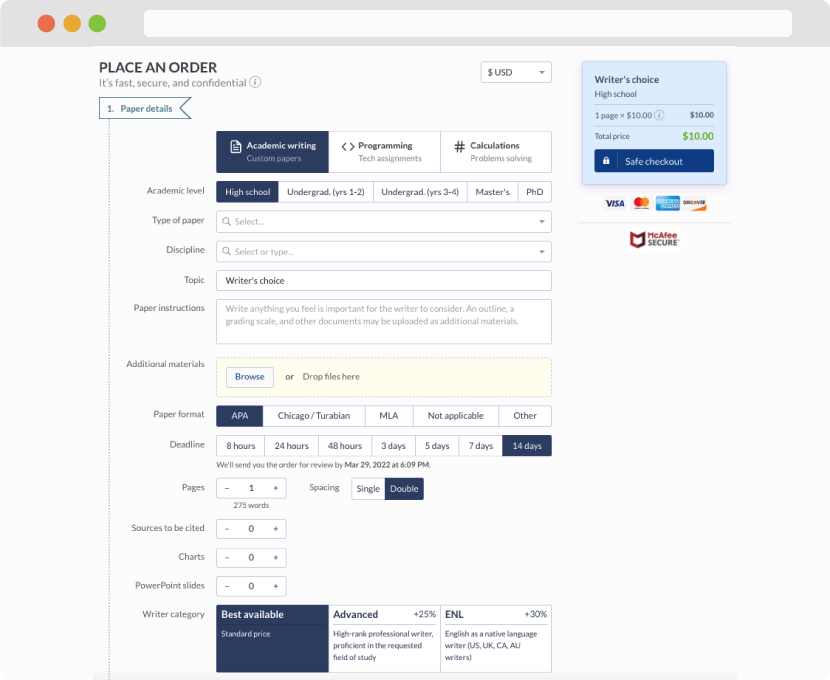
First, you will need to complete an order form. It's not difficult but, if anything is unclear, you may always chat with us so that we can guide you through it. On the order form, you will need to include some basic information concerning your order: subject, topic, number of pages, etc. We also encourage our clients to upload any relevant information or sources that will help.
Complete the order form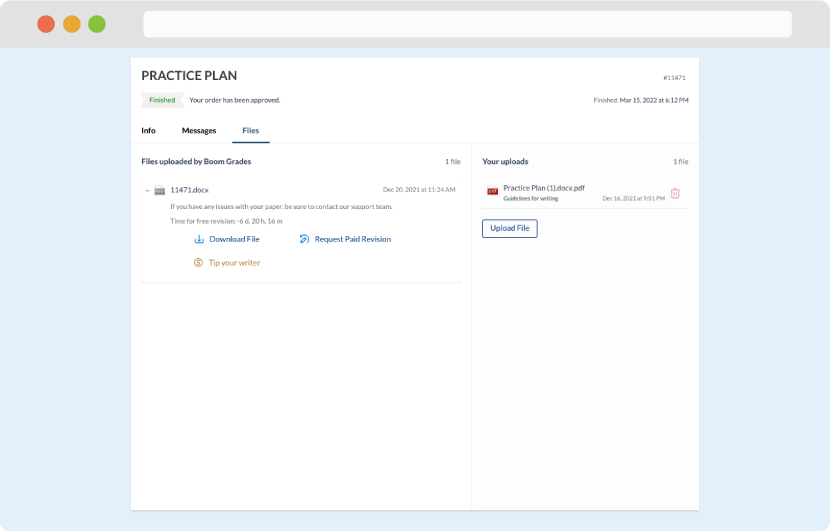
Once we have all the information and instructions that we need, we select the most suitable writer for your assignment. While everything seems to be clear, the writer, who has complete knowledge of the subject, may need clarification from you. It is at that point that you would receive a call or email from us.
Writer’s assignment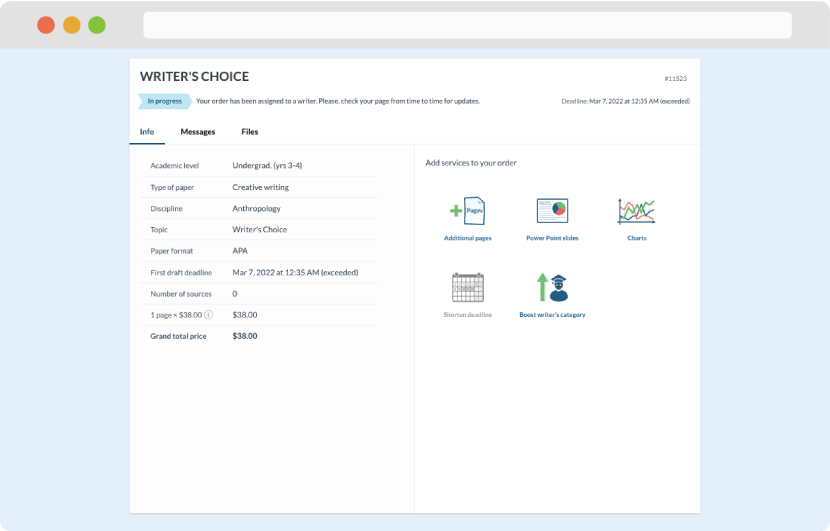
As soon as the writer has finished, it will be delivered both to the website and to your email address so that you will not miss it. If your deadline is close at hand, we will place a call to you to make sure that you receive the paper on time.
Completing the order and download