Major Incident And Crisis Management
Research Title :Singapore Night Festival
Major Incident And Crisis Management
Research Title :Singapore Night Festival
A. Indroduction;
Singapore Night Festival draws out the most amazing aspect the city with its legacy
locales enhanced with bright lights. The Night Festival happens on two ends of the week each August.
B. Design Brieffor Art Skinson Monument; 1. Projection Surfaces.
2. Projection Experience.
3. Scope of Work for Artist 4. Project Budget .
Bras Basah Bugis is a workmanship area in Singapore’s urban focus that becomes animated during the Night Celebration. Watch global craftsmen playing out their unique chips away at the roads. A few territories become just a walker zone to permit the celebration to happen.
C. Sources Utilized
The SNF (Singapore Night Celebration) has an alternate topic consistently, as indicated by which the craftsmen are picked and enhancements are chosen. It’s an occasion not to miss in case you’re in the city during August. When: Two ends of the week, each August
ANNEXES ;
• Extension A – Light to Night 2021 Celebration Subject
• Addition B – Venture Course of events
References;
•
https://www.nas.gov.sg/archivesonline/data/pdfdoc/20130829001/singapo
re_night_festival_2013_-_factsheet
.
•
https://www.nightfestival.gov.sg/-/media/snf2018/media/5bfactsheet5d-
singapore-night-festival-2018–night-lights-and-performance-
highlights
•
https://www.nhb.gov.sg/brasbasahbugis/-
/media/bbb/images/programmes/open-call-for-night-lights-2018_final
1
Beacon International College
Major Incident and Crisis Management (HLT5052)
Level 5.
COURSE OUTLINE AND ASSESSMENT BRIEF
Module:
Major Incident and Crisis Management
Tutor: Mohan Balagopal (mohan@beacon.edu.sg)
Assessment type: Individual written assignment (100% weighting)
Aims: This module will provide students with a significant understanding of Major
Incident and Crisis Management planning in an event context and how this
translates into a practical operational time sensitive plan involving the various key
stakeholders. Students will be able to identify the range of stakeholders involved in
such processes and the strategies and operational practices they are required to
implement in relation to major incidents and crises.
Learning outcomes: By the end of the module, students will be able to: –
1. Clarify what a major incident is and a typical sequence of events surrounding major incidents
2. Assess the practical benefits of Major Incident and Crisis Management
3. Discuss the roles and responsibilities of the range of stakeholders involved in major incident and crisis
management and understand the content of a Major Incident and Crisis Management plan
4. Research and develop an operational Major Incident and Crisis Management plan
5. Apply the content of an effective time sensitive Major Incident and Crisis Management plan to an event
scenario
Indicative content
Major incidents at events, exploring their effects and impacts
Event planning pre and post and damage limitation
Corporate identity and protection in crisis
Media – Management, operations and responsibilities
UK and European Health and Safety Legislation and regulations
Duty of Care and the social responsibility of the event and the management team
Stakeholder liaison, management, interactions and responsibilities
Table top planning, design, operation, planning and responsibilities
Management issues within the event sector
Major Incident and Crisis Management practical workshops & role play
Major Incident and Crisis Management plan and other supporting documentation
Environmental and sustainability issues in relation to Major Incident and Crisis Management
Required reading
‒ Bernstein, D. (2011) Manager’s guide to Crisis Management. London: McGraw-Hill Education
Publishing.
‒ Crandall, W. (2013) Crisis management (2nd Edition). London: Sage.
‒ Fernandez, L; Merzer, M. (2003) Jane’s Crisis Communications Handbook. Surrey: Janes information
group. (Available as an E Book)
mailto:mohan@beacon.edu.sg
https://www.google.co.uk/search?client=safari&rls=en&q=%E2%80%A2+Bernstein,+DA.+(2011)+Manager’s+guide+to+Crisis+Management+London+Silvers,+R.+(2008)+Risk+Management+for+Meetings+and+Events.+Oxford+(UK)+:+Elsevier+Butterworth-Heinemann+Publishing&spell=1&sa=X&ved=0ahUKEwjhsd-plpDKAhUDRhQKHVSKAr4QBQgaKAA
2
‒ Fagel, M. (2013) Crisis Management and Emergency Planning: Preparing for Today’s Challenges.
Abingdon: CRC Press.
‒ Silvers, R. (2008) Risk Management for Meetings and Events. Oxford (UK) : Elsevier Butterworth-
Heinemann Publishing
The following journals/trade publications contain papers relevant to this module:
International Journal of Event Management Research
Disaster Recovery Institute Singapore – https://www.dri-singapore.org/home.php
Audience
Access All Areas
Economist
Event
Main Event
Stand Out
Total Production International
Lecture Program
Lecture 1 Welcome and introductions
Importance of a Major Incident and Crisis Management plan why have one?
Characteristics of a Disaster.
Lecture 2 Major Incident and Crisis Management plan and other supporting documentation: the time line
being proactive rather than reactive.
Case studies and tutorials
Lecture 3 Major incident management: exploring their effects and impacts, the management issues, the
impacts on the event sector
Case studies and tutorials
Lecture 4 The team, who will manage the situation: Stakeholder liaison, management, interactions and
responsibilities “The Duty of care “.
Case studies and tutorials
Lecture 5 Media management the release of information.
Briefing for the press conference, operations and responsibilities, protecting corporate identity
and limiting negative critique, dealing with the management, operations and responsibilities
Case studies and tutorials
Lecture 6 The control room: logging of vital data, appraising the situation, bronze, silver and gold
command.
Case studies and tutorials
Lecture 7 Security planning, what they do and how they can help? Looking at the importance of your
security team to support your event to prevent Major incidents occurring
Case studies and tutorials
3
Assessment 1 – Individual written assignment (100%)
Submission deadlines:
Draft submission in week 4 on 28 January 2021 by 1800hrs in Turnitin via Moodle
Final submission in week 9 on 11 March 2021 by 1800hrs in Turnitin via Moodle
You need to produce your own crisis plan for an event of over 2,500 people – 2,000-word limit individual
assignment
Your plan must be based on a “real” event that will take place in or around Singapore in 2021. You must
submit via email to your lecturer your selected event by week 2 for approval or you will not be able to
continue with your assessment. Your crisis plan needs to include evidence of your own research into existing
events in Singapore along with crisis and risk management theory.
There are a number of aspects relating to this assignment that need to be considered and these are detailed in
the marking schedule below.
Firstly, you need to identify the event, define what a Major Incident / Crisis is and consider the range of
potential major incidents and crisis which could occur at your chosen event. You are then required to select
one of the areas below and discuss how a major incident and crisis management plan would be used to help
manage your chosen situation.
To give your report focus you should choose one of the four areas listed below to discuss the recommended
considerations and procedures in managing your selected situation:
1. Natural disaster, fire, high winds, rain, flooding.
2. Terrorist attack.
3. Crowd disorder, violence, missing persons.
4. Structural collapse.
Once you have selected one of the issues above explain how your plan will be used to manage the chosen
incidents. Relate this to your event and your crisis plan.
When the situation happens, how will you communicate with the public and the press? Think of what you
might say to and how you might manage the public, the press and the emergency services. This can include
pre- scripted responses and other such associated responses.
In terms of referencing please also use Health and Safety legislation and regulations to guide your work, and
where possible give an example of a real case study within the crisis plan section.
There will be progress feedback session to see how you are progressing with your work via consultation and
draft submissions.
Additional Submission Guidelines
Students must follow submission guidelines as indicated in the Student Submission Guidelines document
uploaded in Moodle.
4
Marking guide: Individual written assignment
Criteria Comments Marks
Draft submission
Draft submitted on time and correctly
/10
Introduction
Outline of the event and key event details e.g.
capacity, venue and location, audience profile,
entertainer profile, timing, etc.
/10
Major Incidents
Discuss the range of likely major incidents which
could occur at your chosen event and give a brief
precis of their likely impacts and how major
incident plans can benefit event organisers.
/20
Detailed plan and Recommendations
From the range of potential major incidents select
one and discuss how would you apply a crisis
management plan to manage and mitigate the
impacts of your chosen scenario?
1. Outline the typical sequence of events
along with a time sensitive Major Incident
and Crisis Management plan.
2. Produce a communication and control
plan including communication chart –
relating to your chosen scenario.
3. Discuss the roles and responsibilities of
the range of stakeholders involved in the
major incident and crisis management
including categories of staff and blue light
services.
4. Identify and discuss the location of the
control centre, equipment required and
crisis kit.
5. Discuss the evacuation procedure –
Contingency plans.
Consider what would be required in terms of
communicating with different stakeholders e.g.
public information, staff briefing and press/media
briefing information i.e. messages, materials and
how these would be disseminated.
/50
Referencing
Strict application of Harvard Referencing System
Demonstrated depth of reading and research
Minimum 10 ACADEMIC references
/10
TOTAL /100
Overall comments
5
Marking Criteria
90-100% A quite exceptional and outstanding answer, providing insights which would not be available
publicly, and would, with some editing, be publishable. In addition to the features of the next section, this
range is distinguished by superior organization, economic use of language and totally comprehensive, given
the conditions of the exercise.
80-89% An answer which demonstrates an excellent understanding of the question and of the complexity of
the issues involved. There is a sound basis of relevant factual knowledge and/or the theoretical issues
involved. Most of the important issues are dealt with in a detailed, specific and systematic way. There is
either some measure of original thinking in the answer or an accurate and comprehensive account is given in
a way which demonstrates understanding, for example by structuring the material such that it could not have
been based just on reproduction of lecture notes and programme material. Evidence of creativity, critical
approach, and wide reading beyond the core subject matter.
70-79% As above but a slightly less consistently excellent level. Alternatively, this range of mark may be
given for an answer which, while not having original insights, gives comprehensive and accurate coverage of
the issues at a high level throughout the answer, without significant omissions or errors.
60-69% An answer which demonstrates a clear understanding of the question and grasp of the complexity of
the issues involved. There is a sound basis of relevant factual knowledge and/or of theoretical issues
involved, with few significant errors. The issues involved are dealt with in a systematic way. Some of the
issues may be limited in critical approach but organized to display a comprehensive understanding and
factual information essentially complete.
50-59% An answer which demonstrates an understanding of the major or basic issues in the question. There
is a basis of factual knowledge and/or of relevant theoretical issues. Although some errors may be present,
the overall framework of the answer is sensible and accurate. Most of all the issues may be dealt with at the
level of obviously available programme material given to the student. The answer shows planning in its
construction, with a clear train of thought or development of argument present. Average competent
performance, well presented, demonstrating understanding of most of the essential issues.
40-49% An answer which demonstrates a limited understanding of the major or basic issues in the question.
There is some relevant factual knowledge and/or awareness of theoretical issues, but it is patchy. A few
significant errors may be present. The answer is not well planned, with little development of argument, and
often much irrelevant material is present. Lacks clarity of expression. The lower range (40-45) would
include an answer where relevant factual knowledge and/or awareness of theoretical issues is poor and
confused, but not absent. Many significant errors may be present. The answer is poorly planned, with little
clear train of thought or development of argument, and much of the answer may be irrelevant.
38-39% An answer which fails to demonstrate any appreciable understanding of the major issues or basic
issues of the question. Relevant factual knowledge and/or awareness of theoretical issues, if present at all, is
very poor and confused and very limited. Many significant errors may be present. Much or all of the answer
may be irrelevant. Poorly organized and very limited in scope.
30-37% Attempts an answer, but relevant factual knowledge and/or awareness of theoretical issues is very
poor and confused, and very limited with many significant errors.
10-29% Not clear that an answer is properly attempted. Only a few minor points made at all relevant to the
answer and these may be superficial. Most material is irrelevant or incorrect.
1-9% An answer that is so short or irrelevant that only a few marks are justified. For example, one or two
points may be made which show some peripheral awareness of certain possibly relevant issues.
6
Graduate Attributes
It is School policy that Graduate Skills should be embedded into module delivery and assessment. The
interactive nature of the seminars fulfils most of the requirements by encouraging discussion, organization and
communication, and group discussion. By examining the assessment criteria, you will note that Graduate Skills
are also contained within them. More specifically, the following Skills are included in the module overall:
Problem Solving and Analytical Ability
Inter-Personal Skills and Networking
Global Citizenship (Diversity and Sustainability)
Flexibility and Adaptability (Life-Long learning)
Effective Communication
Creativity and Innovation
Essay Writing Service Features
Our Experience
No matter how complex your assignment is, we can find the right professional for your specific task. Achiever Papers is an essay writing company that hires only the smartest minds to help you with your projects. Our expertise allows us to provide students with high-quality academic writing, editing & proofreading services.
Free Features
Free revision policy
$10Free bibliography & reference
$8Free title page
$8Free formatting
$8How Our Dissertation Writing Service Works
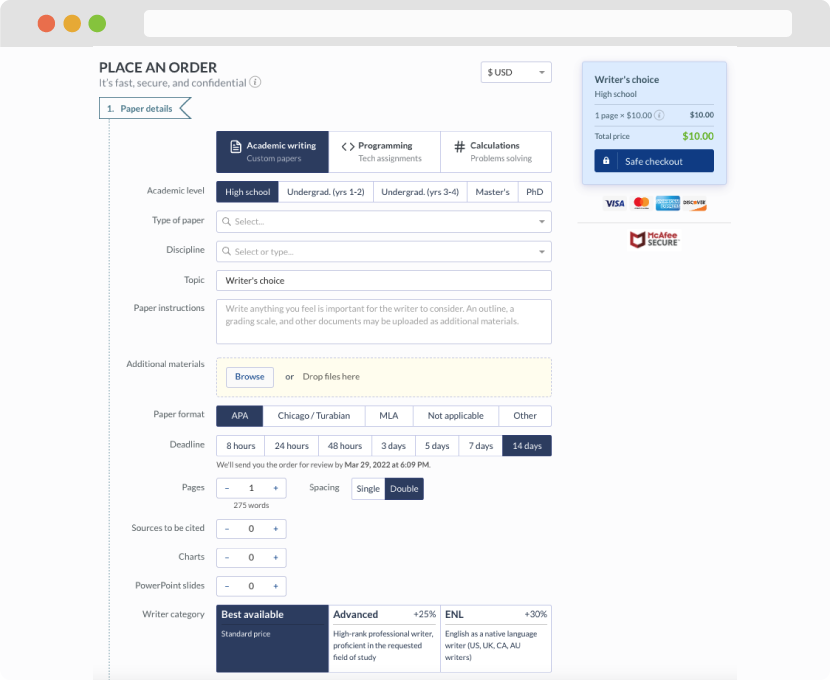
First, you will need to complete an order form. It's not difficult but, if anything is unclear, you may always chat with us so that we can guide you through it. On the order form, you will need to include some basic information concerning your order: subject, topic, number of pages, etc. We also encourage our clients to upload any relevant information or sources that will help.
Complete the order form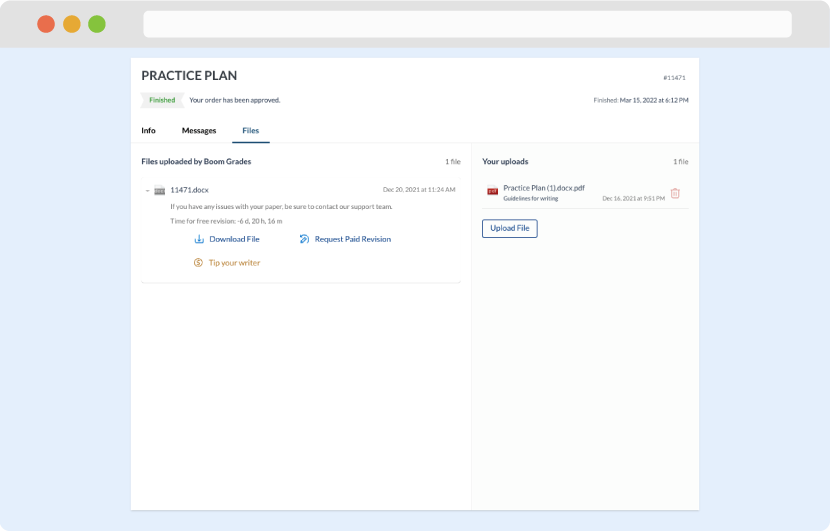
Once we have all the information and instructions that we need, we select the most suitable writer for your assignment. While everything seems to be clear, the writer, who has complete knowledge of the subject, may need clarification from you. It is at that point that you would receive a call or email from us.
Writer’s assignment
As soon as the writer has finished, it will be delivered both to the website and to your email address so that you will not miss it. If your deadline is close at hand, we will place a call to you to make sure that you receive the paper on time.
Completing the order and download