Read the article linked here explaining PICOT:
https://www.ebsco.com/sites/g/files/nabnos191/files/acquiadam-assets/7-Steps-to-the-Perfect-PICO-Search-White-Paper_0
After reading the article, complete the worksheet (found in the John’s Hopkins Evidence-Based Practice tab). It is okay to revise your topic if need be while going through the worksheet.
The worksheet must be completed
Must follow directions and answer questions.
Plagiarism receipt
APA format
1. What is the problem?
3.
4.
(Check all that apply)
· Safety and risk-management concerns
· Quality concerns (efficiency, effectiveness, timeliness, equity, patient-centeredness)
· Unsatisfactory patient, staff, or organizational outcomes
· Variations in practice within the setting
· Variations in practice compared to community standard
· Current practice that has not been validated
· Financial concerns
5. What are the PICO components?
P – (Patient, population, or problem)
I – (Intervention)
C – (Comparison with other interventions, if foreground question)
O – (Outcomes are qualitative or quantitative measures to determine the success of change)
6.
❑ Background ❑ Foreground
Johns Hopkins Nursing Evidence-Based Practice
Appendix B: Question Development Tool
Johns Hopkins Nursing Evidence-Based Practice
© 2017 The Johns Hopkins Hospital/ Johns Hopkins University School of Nursing
7.
8.
(Check all that apply)
· Publications (e.g., EBSCOHost, PubMed, CINAHL, Embase)
· Standards (regulatory, professional, community)
· Guidelines
· Organizational data (e.g., QI, financial data, local clinical expertise, patient/family preferences)
· Position statements
9.
(Revisions in the EBP question may not be evident until after the initial evidence review; the revision can be in the background question or a change from the background to a foreground question)
What will we measure?
(structure, process, outcome measure)
How will we measure it?
(metrics are expressed as rate or percent)
How often will we measure it?
(frequency)
Where will we obtain the data?
Who will collect the data?
To whom will we report the data?
Directions for Use of the Question Development Tool
This form is used to develop an answerable EBP question and to guide the team in the evidence search process. The question, search terms, search strategy, and sources of evidence can be revised as the EBP team refines the EBP question.
Indicate why the project was undertaken. What led the team to seek evidence? Ensure that the problem statement defines the actual problem and does not include a solution. Whenever possible, quantify the extent of the problem. Validate the final problem description with practicing staff. It is important for the inter-professional team to take the time together to reflect, gather information, observe current practice, listen to clinicians, visualize how the process can be different or improved, and probe the problem description in order to develop a shared understanding of the problem.
What is the current practice?
Define the current practice as it relates to the problem. Think about current policies and procedures. Observe practices. What do you see?
How was the problem identified?
Check all the statements that apply.
P (patient, population, problem) e.g., age, sex, setting, ethnicity, condition, disease,
type of patient, or population
I (intervention) e.g., treatment, medication, education, diagnostic test, or best practice(s)
C (comparison with other interventions or current practice for foreground questions; is not applicable for background questions, which identify best practice)
O (outcomes) stated in measurable terms; may be a structure, a process, or an outcome measure based on the desired change (e.g., decrease in falls, decrease in length of stay, increase in patient satisfaction)
Initial EBP question
A starting question (usually a background question) that is often refined and adjusted as the team searches through the literature:
· Background questions are broad and are used when the team has little knowledge, experience, or expertise in the area of interest. Background questions are often used to identify best practices.
· Foreground questions are focused, with specific comparisons of two or more ideas or interventions. Foreground questions provide specific bodies of evidence related to the EBP question. Foreground questions often flow from an initial background question and literature review.
List possible search terms, databases to search, and search strategies.
Using PICO components and the initial EBP question, list search terms. Terms can be added or adjusted throughout the evidence search. Document the search terms, search strategy, and databases queried in sufficient detail for replication.
What evidence must be gathered?
Check the types of evidence the team will gather based on the PICO and initial EBP question.
Revised EBP question
Often, the question that you start with may not be the final EBP question. Back- ground questions can be refined or changed to a foreground question based on the evidence review. Foreground questions are focused questions that include specific comparisons and produce a narrower range of evidence.
Measurement plan
Measures can be added or changed as the review of the literature is completed and the translation planning begins:
· A measure is an amount or a degree of something, such as number of falls with injury. Each measure must be converted to a metric, which is calculated before and after implementing the change.
· Metrics let you know whether the change was successful. They have a numerator and a denominator and are typically expressed as rates or percent. For example, a metric for the measure falls-with-injury would be the number of falls with injury (numerator) divided by 1,000 patient days (denominator). Other examples of metrics include the number of direct care RNs (numerator) on a unit divided by the total number of direct care staff (denominator); the number of medication errors divided by 1,000 orders.
Essay Writing Service Features
Our Experience
No matter how complex your assignment is, we can find the right professional for your specific task. Achiever Papers is an essay writing company that hires only the smartest minds to help you with your projects. Our expertise allows us to provide students with high-quality academic writing, editing & proofreading services.
Free Features
Free revision policy
$10Free bibliography & reference
$8Free title page
$8Free formatting
$8How Our Dissertation Writing Service Works
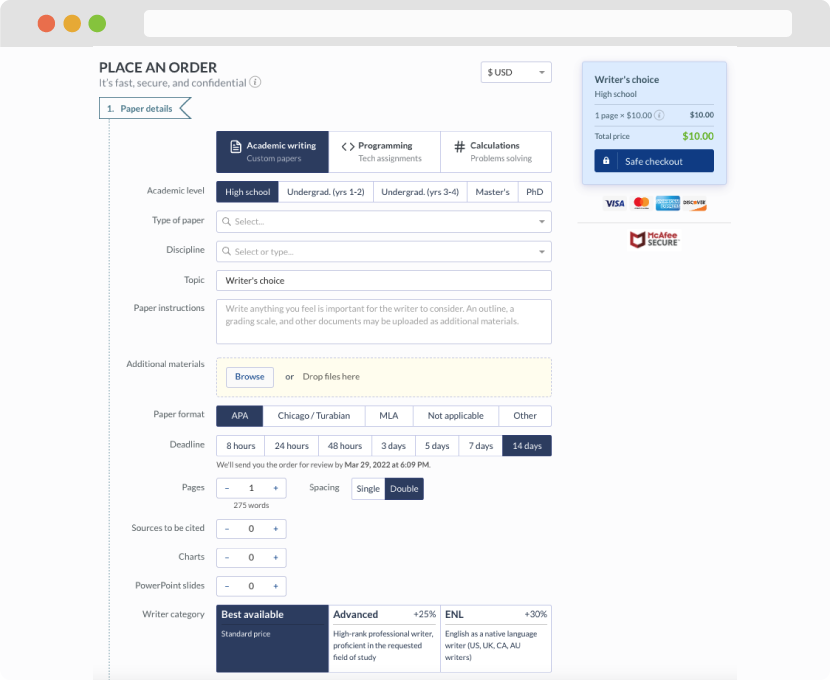
First, you will need to complete an order form. It's not difficult but, if anything is unclear, you may always chat with us so that we can guide you through it. On the order form, you will need to include some basic information concerning your order: subject, topic, number of pages, etc. We also encourage our clients to upload any relevant information or sources that will help.
Complete the order form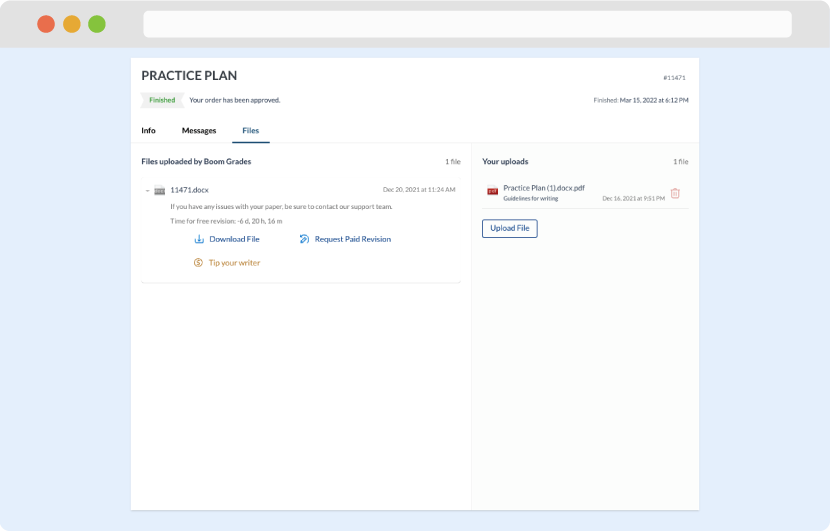
Once we have all the information and instructions that we need, we select the most suitable writer for your assignment. While everything seems to be clear, the writer, who has complete knowledge of the subject, may need clarification from you. It is at that point that you would receive a call or email from us.
Writer’s assignment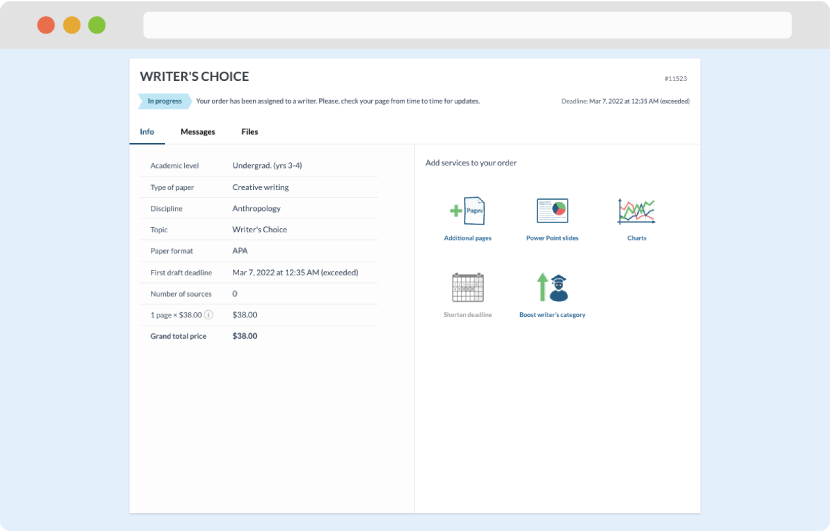
As soon as the writer has finished, it will be delivered both to the website and to your email address so that you will not miss it. If your deadline is close at hand, we will place a call to you to make sure that you receive the paper on time.
Completing the order and download