Pre-Experince Questions
1. Why is cellular respiration necessary for living organisms?
2. Why is fermentation less effective than respiration?
3. What is the purpose of glycolysis?
4. How many ATP molecules are produced in aerobic respiration, fermentation, and glycolysis?
Experiment 1: Fermentation by Yeast
Yeast cells produce ethanol, C2H6O, and carbon dioxide, CO2, during alcoholic
fermentation. In this experiment, you will measure the production of CO 2 to
determine the rate of fermentation in the presence of different carbohydrates with
fermentation tubes.
Materials
(4) 250 mL Beakers
15 mL 1% Glucose Solution
(1) 100 mL Graduated Cylinder
Measuring Spoon
1 g. Packets of Equal®, Splenda®,
and Sugar
Permanent Marker
3 Pipettes
5 Fermentation Tubes (two test
tubes that fit into each other – 5
plastic and 5 glass; see Figure 4).
Ruler
15 mL 1% Sucrose (Sugar)
Solution, C12H22O11
Test Tube Rack
1 Yeast Packet
*Stopwatch
*Warm Water
*You Must Provide
Note: Regular table sugar is sucrose (a disaccharide), which is made up of
glucose and fructose. Glucose is a monosaccharide.
©eScience Labs, 2016
Figure 4: Fermentation tubes. Note how the smaller, plastic test tube is
inverted into the larger test tube. You will create five fermentation tubes in
this experiment.
Procedure
1. In this experiment, you will mix yeast with sugar, Equal®, and Splenda®.
Before you begin, develop a hypothesis predicting what will happen when
the sugar/sweeteners are mixed with yeast. Will fermentation occur? Why
or why not? Record your hypothesis in the Post-Lab Questions section.
2. Use the permanent marker to label three 250 mL beakers as Equal ®,
Splenda®, and Sugar.
3. Empty the Equal®, Splenda®, and Sugar packets into the corresponding
beakers.
4. Fill the Equal® and Splenda® beakers to the 100 mL mark with tap water.
5. Fill the Sugar beaker to the 200 mL mark with tap water.
6. Mix each beaker thoroughly by pipetting the solution up and down several
times. Each beaker now contains a 1% solution. Set these aside for later
use.
7. Completely fill one of the smaller tubes with tap water and invert the larger
tube over it. Push the small tube up (into the larger tube) until the top
©eScience Labs, 2016
connects with the bottom of the inverted tube. Invert the fermentation tube
(Figure 4) so that the larger tube is upright (there should be a small bubble
at the top of the internal tube).
Note: Repeat Step 7 several times as practice. Strive for the smallest
bubble possible. When you feel comfortable with this technique, empty the
test tube(s) and proceed to Step 8.
CAUTION: Do not try to force the plastic test tube into the glass
test tube. This might cause your glass test tube to break, causing you
injury. If your plastic test tubes do not fit easily, please call eScience
Labs for replacement glass tubes. If you are able to set up at least two
fermentation tubes, continue with the experiment, but know that you will
have to perform steps 12-15 in multiple steps.
8. Use the permanent marker to label the fourth 250 mL beaker as Yeast.
9. Fill this beaker with 175 mL of warm tap water. It should be between 30 –
40 oC (warm to the touch)
10. Open the yeast package, and use the measuring spoon to measure and
pour 1 tsp. yeast into the beaker. Pipette the solution up and down until all
of the yeast is mixed homogenously into solution.
Note: Make sure the yeast solution remains homogenous before each test
tube is filled in the proceeding steps. The yeast density is fairly high, and
the yeast may settle to the bottom of the beaker if it rests for an extended
period of time.
11. Use the permanent marker to label the big and small test tubes as 1, 2, 3,
4, and 5.
12. Use the 100 mL graduated cylinder to measure and pour 15 mL of the
following solutions into the corresponding small test tubes:
Tube 1: 1% Glucose Solution
Tube 2: 1% Sucrose Solution
Tube 3: 1% Equal® Solution
Tube 4: 1% Splenda® Solution
Tube 5: 1% Sugar Solution
©eScience Labs, 2016
Note: Rinse the graduated cylinder between each measurement.
13. Fill the remaining volume in each small tube to the top with the yeast
solution.
14. Slide the corresponding larger tube over the small tube and invert it as
practiced in Step 7. This will mix the yeast and sugar/sweetener solutions.
15. Place the fermentation tubes in the test tube rack, and use a ruler
measure the initial air space in the rounded bottom of the internal tube.
Record these values in the Table 1.
16. Allow the test tubes to sit in a warm place (approximately 30 °C) for two
hours. Placement suggestions include: a sunny windowsill, atop (not in!) a
warm oven heated to approximately 85 °C (185 °F on an oven setting), or
under a very bright (warm) light.
17. At the end of the fermentation period, use your ruler to measure the final
gas height (total air space) in the tube. Record this data in Table 1.
Table 1: Yeast Fermentation Data
Tube
Initial Gas Height (mm)
Final Gas Height (mm)
Net Change
Post-Lab Questions
1. Include your hypothesis from Step 1 here. Be sure to include at least one piece
of scientific reasoning in your hypothesis to support your predictions.
2. Did you notice a difference in the rate of fermentation between the various
sugars? Did the artificial sugar provide a good starting material for fermentation?
©eScience Labs, 2016
3. Was anaerobic fermentation occurring? How do you know (use scientific
reasoning).
4. If you observed fermentation, identify the gas that was produced. Suggest two
methods you could use for positively identifying this gas.
5. Hypothesize why some of the sugar or sweetener solutions were not
metabolized, while others were. Research the chemical formula of Equal® and
Splenda® and explain how it would affect yeast fermentation.
6. How do the results of this experiment relate to the role yeast plays in baking?
7. What would you expect to see if the yeast cell metabolism slowed down? How
could this be done?
8. Indicate sources of error and suggest improvement (for example, what types of
controls could be added?).
©eScience Labs, 2016
Essay Writing Service Features
Our Experience
No matter how complex your assignment is, we can find the right professional for your specific task. Achiever Papers is an essay writing company that hires only the smartest minds to help you with your projects. Our expertise allows us to provide students with high-quality academic writing, editing & proofreading services.
Free Features
Free revision policy
$10Free bibliography & reference
$8Free title page
$8Free formatting
$8How Our Dissertation Writing Service Works
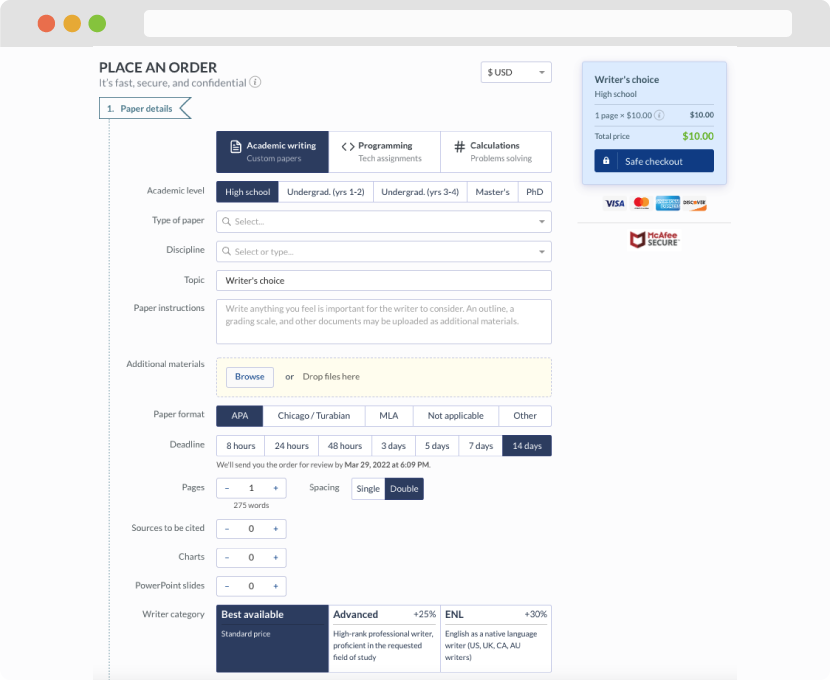
First, you will need to complete an order form. It's not difficult but, if anything is unclear, you may always chat with us so that we can guide you through it. On the order form, you will need to include some basic information concerning your order: subject, topic, number of pages, etc. We also encourage our clients to upload any relevant information or sources that will help.
Complete the order form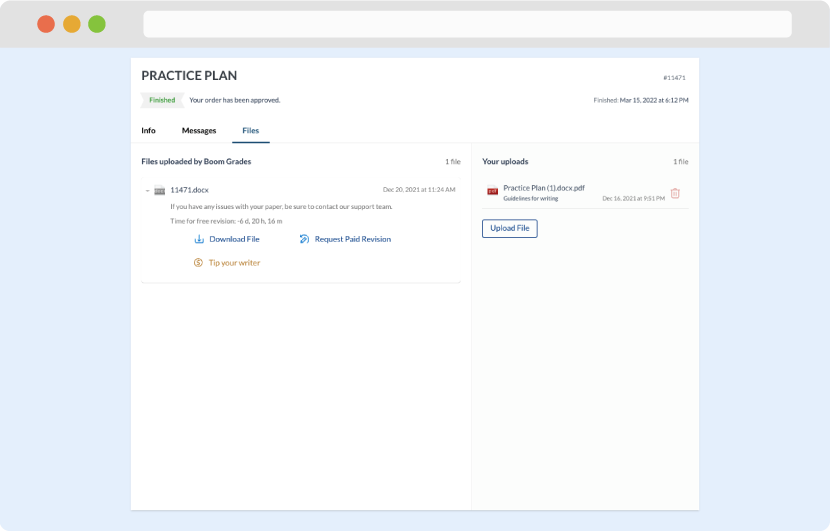
Once we have all the information and instructions that we need, we select the most suitable writer for your assignment. While everything seems to be clear, the writer, who has complete knowledge of the subject, may need clarification from you. It is at that point that you would receive a call or email from us.
Writer’s assignment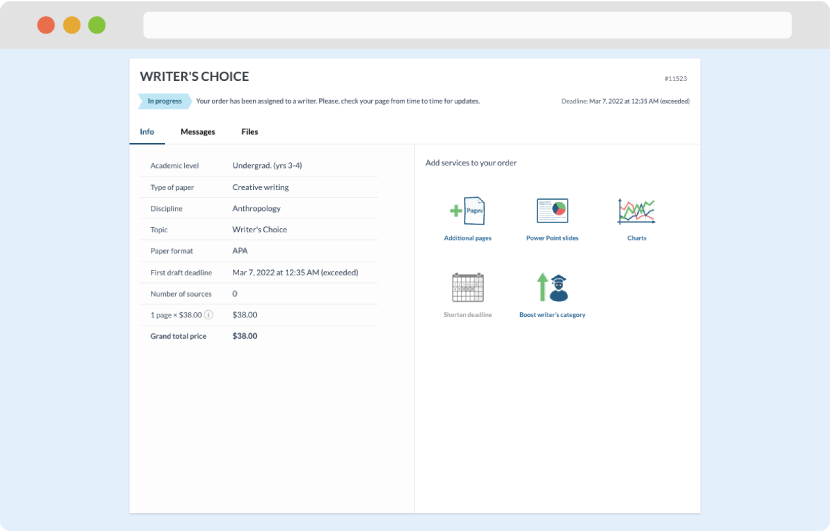
As soon as the writer has finished, it will be delivered both to the website and to your email address so that you will not miss it. If your deadline is close at hand, we will place a call to you to make sure that you receive the paper on time.
Completing the order and download