The
Open Source Sample Alert
provides examples of potential indicators of terrorist activity. Discuss signs that professionals in surveillance roles can look for in order to predict and prevent a terrorist attack. In addition, identify any legal parameters that may limit surveillance abilities. Cite at least one case in which counterterrorism professionals detected terroristic preparation and prevented an attack.
For additional details, please refer to the
Module One Short Paper Guidelines and Rubric
document.
Website: The USA PATRIOT Act: Preserving Life and Liberty
This act provides a deep understanding of the latitude given to law enforcement professionals and operational considerations that need to be factored in when developing a case or conducting an investigation.
This resource supports the short paper in this module.
Counterterrorism is a specific and unique form of law enforcement and security. With increased occurrences of domestic and international terrorism related cases, the need to explore all the elements that influence counterterrorism measures is paramount. Counterterrorism approaches are constantly evolving with terroristic techniques, as are the laws and policies that govern the global response to terrorism.
In order to understand this specialty, one must explore terrorism as a whole. Terrorism can come in many forms, including international, domestic, and cyber. Regardless of the type, terrorism poses a major threat to human life, property, and prosperity. Where a violent act attempts to harm the direct targets, violent acts of terrorism have larger political or societal implications. There are many factors to be considered when trying to combat terrorism, such as the means and techniques being utilized, the motives, the target, and the ultimate goal. What is the venue and demographic of the terrorist? Does the terrorist have health-related issues or motivations that go beyond their immediate surroundings? Lastly, what support structure does the terrorist have to assist in carrying out their mission? These are only a few of the many questions that counterterrorism professionals seek to answer in order to determine terrorists’ motivations, strengths, and weaknesses. Understanding the complexity of these considerations is the first step in understanding counterterrorism.
Field operators and surveillance professionals must be aware of the steps a terrorist takes to prepare for an attack. These steps can often begin with pre-operational research, which can include taking notes and pictures of a target location, probing a site to see what security reaction time is, and using social media to obtain additional information. A current trend that terrorists use to conduct pre-operational research is the use of individuals who would not cause alarm to scope out a target. For example, an elderly individual or mother with a child in a stroller can easily obtain information without drawing attention to themselves. Security personnel who are not trained in counterterrorism may not detect these people as suspicious, but counterterrorism professionals know that anyone can be part of a terrorism plot. They seek the indicators of terrorist planning in addition to the individuals behind the plan.
The last part of the planning phase consists of obtaining the materials for a terrorist’s mode of attack. Counterterrorism professionals observe the plan unfold and track the terrorists’ activities until there is enough evidence collected to apprehend and charge the terrorist. In addition to surveillance, professionals use various approaches to obtain actionable information to charge a criminal. For example, an outreach approach can be implemented where agents visit local beauty salons and hardware stores to inform employees of suspicious purchases they should be aware of and provide them with a direct channel for reporting the activity. This increases the likelihood of obtaining current and actionable information and provides intelligence to follow up in relation to case development. Intelligence techniques and methodology will be explored further in Module Two.
Essay Writing Service Features
Our Experience
No matter how complex your assignment is, we can find the right professional for your specific task. Achiever Papers is an essay writing company that hires only the smartest minds to help you with your projects. Our expertise allows us to provide students with high-quality academic writing, editing & proofreading services.
Free Features
Free revision policy
$10Free bibliography & reference
$8Free title page
$8Free formatting
$8How Our Dissertation Writing Service Works
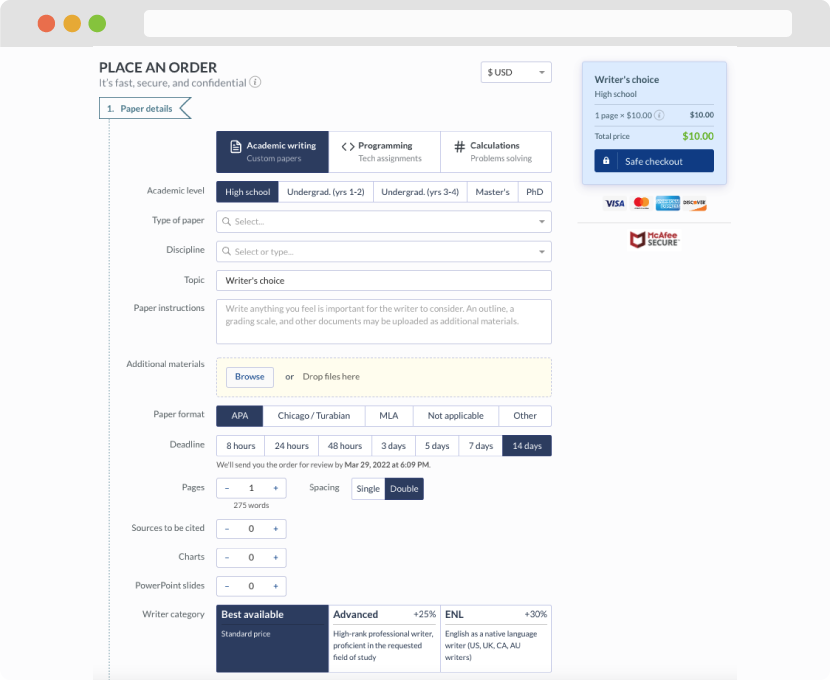
First, you will need to complete an order form. It's not difficult but, if anything is unclear, you may always chat with us so that we can guide you through it. On the order form, you will need to include some basic information concerning your order: subject, topic, number of pages, etc. We also encourage our clients to upload any relevant information or sources that will help.
Complete the order form
Once we have all the information and instructions that we need, we select the most suitable writer for your assignment. While everything seems to be clear, the writer, who has complete knowledge of the subject, may need clarification from you. It is at that point that you would receive a call or email from us.
Writer’s assignment
As soon as the writer has finished, it will be delivered both to the website and to your email address so that you will not miss it. If your deadline is close at hand, we will place a call to you to make sure that you receive the paper on time.
Completing the order and download