S
w
ACME HARDWARE
Alister K. Mason, Partner, Deloitte Haskins and Sells, Toronto, and Professor Claude Lanfranconi prepared this
case solely to provide material for class discussion. The authors do not intend to illustrate either effective or
ineffective handling of a managerial situation. The authors may have disguised certain names and other
identifying information to protect confidentiality.
Ivey Management Services prohibits any form of reproduction, storage or transmittal without its written
permission. This material is not covered under authorization from CanCopy or any reproduction rights
organization. To order copies or request permission to reproduce materials, contact Ivey Publishing, Ivey
Management Services, c/o Richard Ivey School of Business, The University of Western Ontario, London,
Ontario, Canada, N6A 3K7; phone (519) 661-3208; fax (519) 661-3882; e-mail cases@ivey.uwo.ca.
Copyright © 2009, Ivey Management Services
Version: (A) 2009-01-16
INTRODUCTION
John Smith, C.A., was recently assigned the responsibility for the audit of Acme
Hardware, a new client. He was wondering what action, if any, he should take
about the way certain stores of Acme Hardware were accounting for inventory and
advertising costs. As a result of his pre-audit review of the previous auditor’s files,
he had identified a situation where there was a probability that certain store
managers, motivated by the company’s management and control system, were
taking advantage of discretionary accounting alternatives available to them. Any
complete investigation would be disruptive and expensive and had to be
considered in light of the fact that the impact of their actions on the company’s
financial statements might be immaterial.
THE COMPANY
Acme Hardware was a rapidly expanding chain of hardware stores which operated
in southern Ontario. All stores were company-owned; there were no franchises.
By the beginning of the 2007/08 fiscal year, Acme had 14 stores, four of which
had been opened up in the previous five years. Total sales in 2006/07 were $307
million (up from $214 million in 2002/2003), resulting in net income — after
corporate expenses and income taxes — of $12 million ($6.50 million in
2002/2003). Total assets as at March 31, 2007 were $174 million.
Authorized for use only in the course Financial Management/Capstone at Centennial College taught by S. Lamarre from 12/9/2022 to 4/23/2023.
Use outside these parameters is a copyright violation.
9A89B001
Acme’s success was attributed to several factors, but the most important was
usually considered to be the generous bonuses ($50,000), which were payable to
the store manager when the budgeted net income for the year was met. Budgets
were set by head office, after negotiations with store management. Net income was
computed in accordance with accounting policies laid down by head office, and in
the event of disagreement, Acme’s auditors, who also reviewed each store’s
records, were to act as arbitrators. The predecessor audit firm had not been
required to arbitrate any disagreements about the income computations in the
preceding five-year period.
PREPARATION FOR THE AUDIT
Acme had recently engaged a new firm of auditors, Cooperhouse and Sells, and
John Smith was the partner assigned to the engagement. In planning the work to be
performed for the first year — the year ended March 31, 2008 — he reviewed the
predecessor audit firm’s working paper files. John found that the above-mentioned
bonus arrangement had been identified by that firm as a potential “audit risk”1 with
regard to the pressure on store managers to achieve budgets.
John reviewed the budget and actual net income figures for the previous five years,
to see how frequently the budgets had been met, and hence the bonuses paid. He
noted that, for 10 stores he examined, because they had been in operation for some
time, and therefore had an established pattern of operations, bonuses had been paid
on 23 occasions (out of a maximum of 50). He also noted that, when a budget was
met, the tendency seemed to be for it to be met by a narrow margin, but, when
missed, by a much wider margin.
ANALYSIS OF INCENTIVE SYSTEM
To examine this issue more closely, John prepared a table setting out the budget
and actual net income figures for the 10 stores over the five-year period (see Table
1). He separated the 10 stores into two groups:
1. Three stores (North York, Hamilton, and Waterloo) in which:
(a) budgets were met four times out of a possible 15 (27 per cent);
(b) the margins by which the budgets were met were $100,000, $30,000,
$90,000 and $60,000 (average $70,000); and,
(c) on the 11 occasions when the budgets were not met, the margins ranged
from $50,000 down to $10,000 (average $28,000).
1
“Audit risk” is the risk that the audit firm would fail to express a reservation in its opinion on Acme’s
financial statements if they were materially misstated. Such material misstatement would not have been
prevented or detected by Acme’s internal controls, and would not have been detected by the audit firm.
9A89B001
Authorized for use only in the course Financial Management/Capstone at Centennial College taught by S. Lamarre from 12/9/2022 to 4/23/2023.
Use outside these parameters is a copyright violation.
Page 2
2.
9A89B001
The other seven stores, for which:
(a) budgets were met 19 times out of a possible 35 (54 per cent);
(b) the margins by which the budgets were met ranged from $20,000 to
$50,000 (average $33,000); and,
(c) on the 16 occasions when the budgets were not met, the margins ranged
from $70,000 to $180,000 (average $112,000).
John concluded that there was a strong probability that the managers of seven
stores were manipulating net income computations. Based on his experience, John
thought that the most likely way of doing so would be by advancing or deferring
— from one period to the next — the recognition of income and/or expenses. For
example:
1. By deferring the recognition of income or advancing the recognition of
expenses, it would be easier to meet the budget in the next period. Managers
would be tempted to do this when it was apparent — say by the 10th or the
11th month of the fiscal year — that (a) the current year’s budget could not be
met, or (b) the budget had already been met.
2. By advancing the recognition of income or deferring the recognition of
expenses, it would be easier to meet the budget in the current period. This
would be particularly tempting when, without action of this kind, the budget
would probably be missed by a fairly narrow margin.
John reviewed the monthly income statements for the individual stores, all of
which followed a standard format (prescribed by head office), based on the income
and expense accounts in the general ledger. He concluded that the two most likely
areas for manipulation were:
1. Inventories
These were valued at the lower of cost (determined on a FIFO first in first out
basis) and net realizable value. The write-down to net realizable value was largely
a matter of judgment, particularly in respect of seasonal merchandise, e.g., garden
supplies, and products for which expected new models might make the present
ones obsolete, e.g., power mowers.
2. Advertising Expenses
Company policy required the costs of local advertising to be expensed in the
period the campaign was run. However, store managers had discretion when a
campaign should be run, and it would be quite possible to advance a campaign
scheduled for the first week of April to the last week of March. (Experience had
Authorized for use only in the course Financial Management/Capstone at Centennial College taught by S. Lamarre from 12/9/2022 to 4/23/2023.
Use outside these parameters is a copyright violation.
Page 3
Page 4
9A89B001
CONCLUSION
John was very familiar with these types of incentive schemes because of their use
by many of his other clients. He was also aware that senior management
recognized that any management control system had flaws. However, these
systems motivated their operating managers to maintain a focus on net income
and, in the process, to maximize revenues and minimize costs.
John also recognized that, unless several stores manipulated their results in the
same direction in any year, the impact on the corporate financial statements would
probably not be material. He now had to decide what, if any, action was necessary.
Authorized for use only in the course Financial Management/Capstone at Centennial College taught by S. Lamarre from 12/9/2022 to 4/23/2023.
Use outside these parameters is a copyright violation.
shown that some advertising campaigns result in increased sales over the next few
weeks, rather than only in the period in which the advertisements are run.)
9A89B001
Table 1
BUDGET/ACTUAL NET INCOME FIGURES FOR 10 STORES
(all figures in $000)
Oshawa
Scarborough
Markham
North York
Mississauga
Hamilton
St. Catharines
Guelph
Waterloo
London
2002/2003
Income
Budget Actual
2003/2004
Income
Budget Actual
2004/2005
Income
Budget Actual
2005/2006
Income
Budget Actual
2006/2007
Income
Budget Actual
$1250
1800
760
2020
1680
1360
940
850
1480
1890
$1360
1950
840
2120
1750
1420
980
880
1540
1950
$1320
2120
1020
2200
1850
1480
1050
950
1630
1980
$1400
2280
1200
2350
1970
1580
1100
1010
1720
2050
$1450
2360
1380
2500
2020
1680
1140
1040
1850
2090
*Bonus paid to store management.
$1290*
1730
650
1980
1710*
1390*
850
760
1460
1920*
$1180
1980*
880*
2080
1650
1370
1000*
920*
1600*
1840
$1350*
2170*
860
2180
1890*
1460
960
980*
1600
2010*
$1320
2160
1250*
2450*
1860
1670*
1120*
920
1700
1950
$1470*
2400*
1210
2470
2050*
1650
1020
1060*
1840
2130*
Authorized for use only in the course Financial Management/Capstone at Centennial College taught by S. Lamarre from 12/9/2022 to 4/23/2023.
Use outside these parameters is a copyright violation.
Page 5
Essay Writing Service Features
Our Experience
No matter how complex your assignment is, we can find the right professional for your specific task. Achiever Papers is an essay writing company that hires only the smartest minds to help you with your projects. Our expertise allows us to provide students with high-quality academic writing, editing & proofreading services.
Free Features
Free revision policy
$10Free bibliography & reference
$8Free title page
$8Free formatting
$8How Our Dissertation Writing Service Works
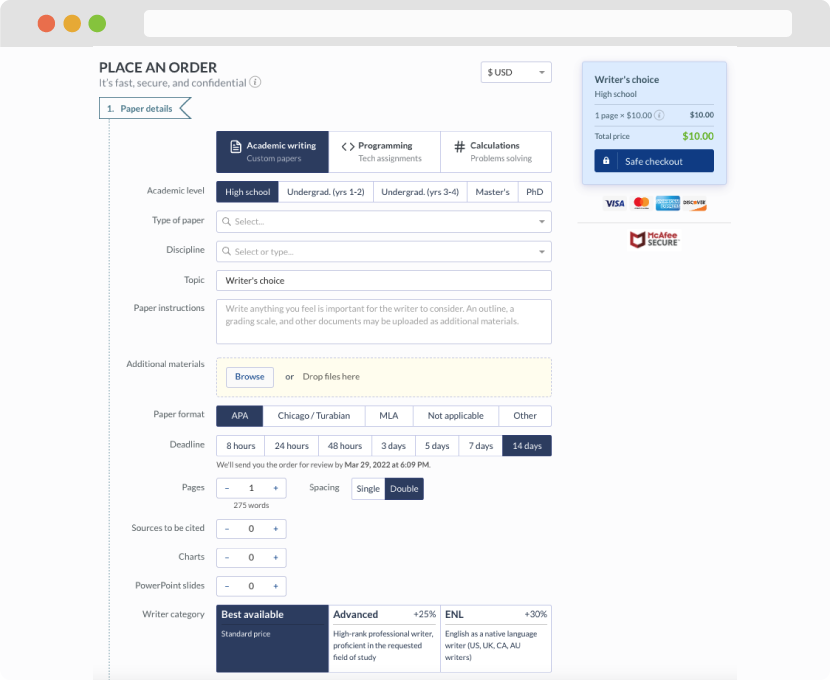
First, you will need to complete an order form. It's not difficult but, if anything is unclear, you may always chat with us so that we can guide you through it. On the order form, you will need to include some basic information concerning your order: subject, topic, number of pages, etc. We also encourage our clients to upload any relevant information or sources that will help.
Complete the order form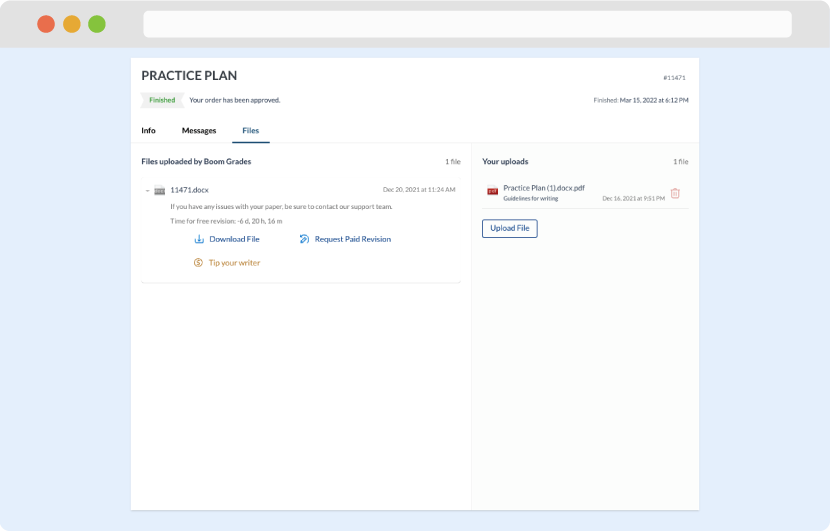
Once we have all the information and instructions that we need, we select the most suitable writer for your assignment. While everything seems to be clear, the writer, who has complete knowledge of the subject, may need clarification from you. It is at that point that you would receive a call or email from us.
Writer’s assignment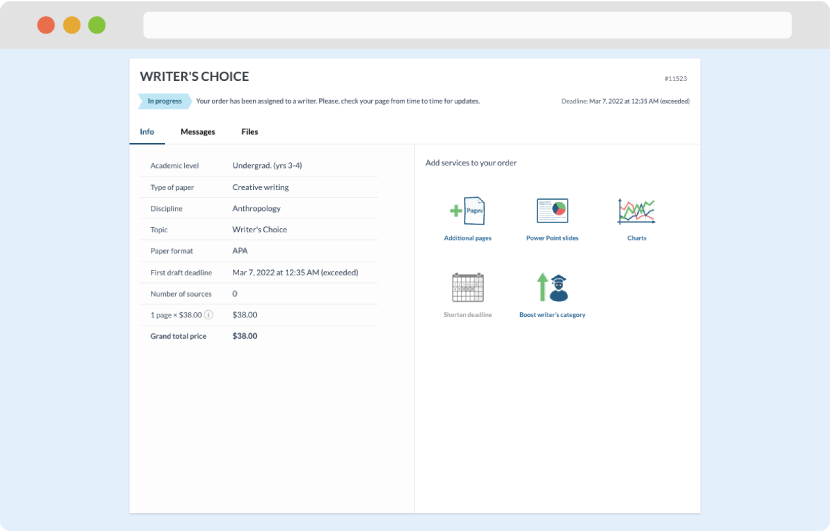
As soon as the writer has finished, it will be delivered both to the website and to your email address so that you will not miss it. If your deadline is close at hand, we will place a call to you to make sure that you receive the paper on time.
Completing the order and download