The purpose of this Discussion topic is to not only introduce you to the concepts of Chemical Bonding, but to also ensure that you understand the proper use of resource material in order to avoid Plagiarism. In this class you will be exposed to new concepts and terms, which means you will need to use books and websites to formulate your answers. According to Park University:
“Plagiarism involves the use of quotations without quotation marks, the use of quotations without indication of the source, the use of another’s idea without acknowledging the source, the submission of a paper, laboratory report, project, or class assignment (any portion of such) prepared by another person, or incorrect paraphrasing.”
Park University. 2013. 2013-2014 Undergraduate Catalog. P 95
http://www.park.edu/catalogs/Links to an external site.
You can download a “Required Reference Formatting” Guide from
here
to give you some help on knowing how I like you to reference discussion assignments and homework responses.
Based on the above information and the course policies outlined in our Syllabus, review the information below and address the questions asked. You will need to read the material carefully and compare it to the source from which it was derived.
According to our book, a chemical bond is an attraction between two atoms resulting from the sharing of outer-shell electrons or the presence of opposite charges on the atoms. The bonded atoms gain complete outer electron shells. There are three main types of chemical bonds, ionic, covalent and hydrogen.
An ionic bond is “a type of chemical bond formed through an electrostatic attraction between two oppositely charged ions. Ionic bonds are formed due to the attraction between an atom that has lost one or more electron (known as a cation) and an atom that has gained one or more electrons (known as an anion). Usually, the cation is a metal atom and the anion is a nonmetal atom.” (Wikipedia)
A covalent bond is a bond that consists of the use of the same electron pairs between atoms. The balance of repulsive and attractive forces among atoms when they both use these electrons is called covalent bonding. For several molecules, these shared electrons permit each atom to get a full outer shell, related to a constant electron configuration. (Wikipedia)
Hydrogen bonds can form when electrons in a covalent bond are unequally shared (= polar covalent bond), such as in a molecule of water. In this case, the oxygen atom holds on to the electrons more than the hydrogen atoms, causing the oxygen atom to become slightly negatively charged and the hydrogen atoms to be slightly positively charge. This results in the attraction between a hydrogen atom in one water molecule and an oxygen atom in a neighboring water molecule; this attraction is called a hydrogen bond (Simon, Dickey and Reece 2013, p 28).
Simon, E.J., J.L. Dickey and J.B. Reece. 2013. Campbell Essential Biology, 5th Edition. Pearson: Boston.
Ionic bond. (2013, June 13). In Wikipedia, The Free Encyclopedia. Retrieved 15:23, July 29, 2013, from
http://en.wikipedia.org/w/index.php?title=Ionic_bond&oldid=559668980 (Links to an external site.)
http://en.wikipedia.org/wiki/Covalent_bond (Links to an external site.)
Required Reference Format
for
Discussion Postings, Homework Questions, & any
Other Submitted Written Work
Types of References
· Parenthetical or in-text references to quoted material or paraphrased material. These usually include the author’s last name and the date of publication (scientific style) and follow either
quoted material or information you have paraphrased
from that source. Example:
Bowers (2007) required us to use parenthetical references in our Homework and Experiment write-ups, but not in our Discussion postings.
· Bibliographic or your list of references (works cited). This list should include all of the sources you have cited in the body of your posting or paper. The elements of your full reference vary slightly among documentation styles. Example:
Sanders, C. 2009. Reference Formats. BI210.
In BI101, you are required to include BOTH types of references in your homework and discussion assignments. This is also the case if you were writing a research paper. I require complete references using your discipline’s preferred style.
Reference Formats (Documentation Styles)
There are several different reference formats, such as MLA, APA and CSE. They are all very similar, contain many of the same elements, but differ primarily in the order the elements are presented. In this course you may use your discipline’s preferred style. IF you were writing a research paper, I would require complete references using CSE style. The elements of your references should commonly include the author(s), year, title of the article or book, and the website address when appropriate. If you cite your textbook (this is required if you use it), be sure to include page numbers! Below are some examples:
|
Parenthetical |
Bibliographic |
||
|
Doe 1989 |
Doe, J. 1989. Historical Perspectives on Wars in the US. p 210. |
||
|
Goodall 2003 |
Goodall, J. 2003. Infant chimpanzee behaviors. Animal Behavior 23: 35-315. |
||
|
Johnson and Losos 2008 |
Johnson, G and J. Losos. 2008. Essentials of the Living World (2th ed). pp 213-214. |
Many references that you find online will be missing certain reference format elements, such as author or year. Try to find references that have both, if possible, but if not, then you will just need to indicate either “Anonymous” for those with no author and “No date” for those with no date. All of your .edu sites will have an author, you just have to go back to the main page to find them. Here are some specific examples (You should pay special attention to the last one):
|
MBG 2006 |
Missouri Botanical Garden [MBG]. 2005. What’s it Like Where You Live. http://www.mbgnet.net/ Accessed 10/05/2009. |
|
Scholbe 2001 |
Scholbe, G. 2001 June-July. Essential Fatty Acids. HolisticBird. http://www.holisticbirds.com/HBN01/june/pages/efa2.htm Accessed 10/05/2009. |
|
UIC 2006 |
Uranium Information Centre Ltd [UIC]. February 2006. Radioisotopes in medicine. http://www.uic.com.au/nip26.htm Accessed 10/15/2009. |
|
Kaltenbach 1999 |
Kaltenbach, Chris. Will TV sci-fi shows keep on trekking? genre needs fresh blood. The Arizona Republic, D8, July 26, 1999 (Accessed August 11, 1999). Lexis-Nexis Academic Universe, http://web.lexis-nexis.com/universe. Accessed 10/05/2009. |
Essay Writing Service Features
Our Experience
No matter how complex your assignment is, we can find the right professional for your specific task. Achiever Papers is an essay writing company that hires only the smartest minds to help you with your projects. Our expertise allows us to provide students with high-quality academic writing, editing & proofreading services.
Free Features
Free revision policy
$10Free bibliography & reference
$8Free title page
$8Free formatting
$8How Our Dissertation Writing Service Works
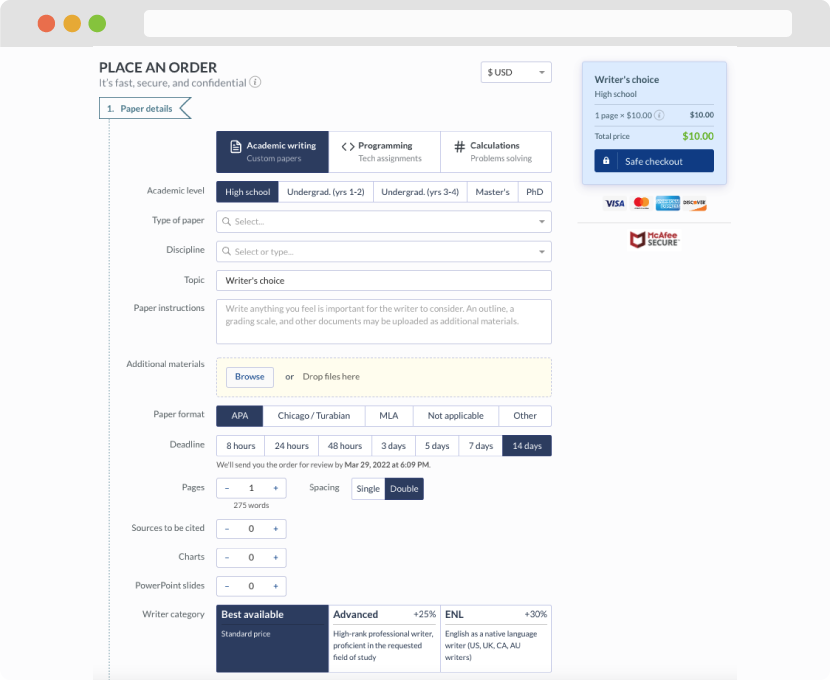
First, you will need to complete an order form. It's not difficult but, if anything is unclear, you may always chat with us so that we can guide you through it. On the order form, you will need to include some basic information concerning your order: subject, topic, number of pages, etc. We also encourage our clients to upload any relevant information or sources that will help.
Complete the order form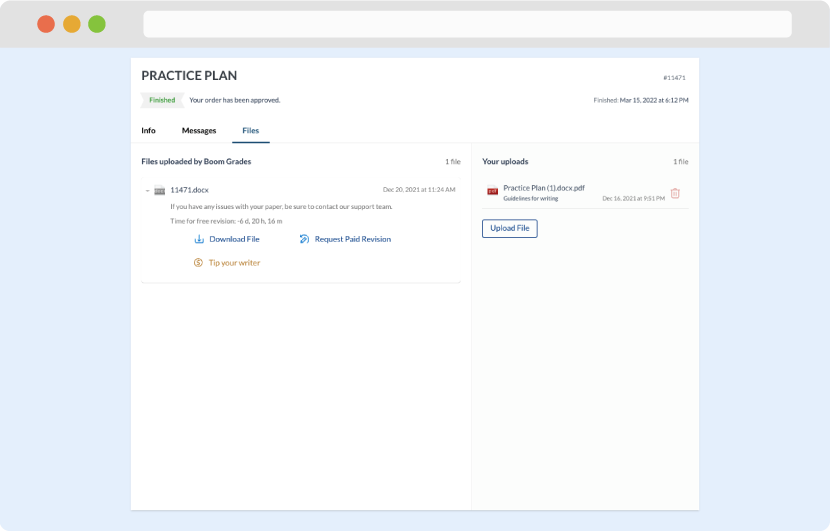
Once we have all the information and instructions that we need, we select the most suitable writer for your assignment. While everything seems to be clear, the writer, who has complete knowledge of the subject, may need clarification from you. It is at that point that you would receive a call or email from us.
Writer’s assignment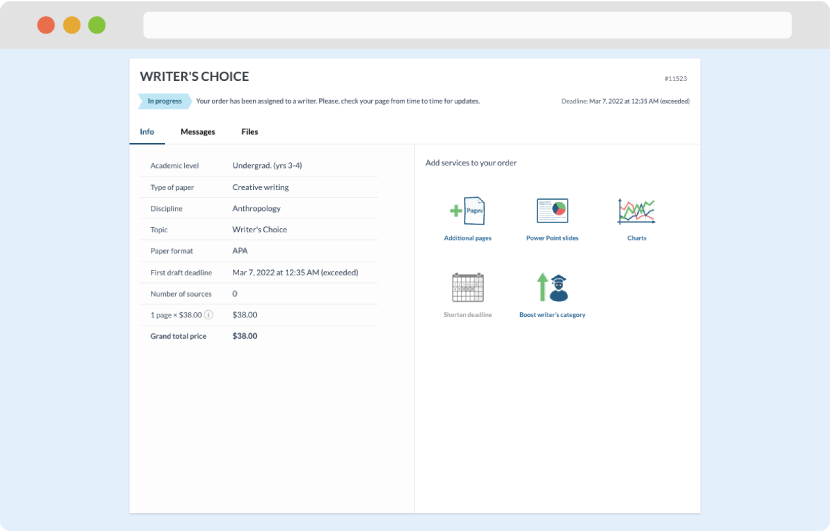
As soon as the writer has finished, it will be delivered both to the website and to your email address so that you will not miss it. If your deadline is close at hand, we will place a call to you to make sure that you receive the paper on time.
Completing the order and download