i need an original Math IA without plagiarism,with a scatter plot and box and whisker
STRUCTURE OF A MATHAMATICAL INVESTIGATION
1) Introduction
a. Tell in general what the paper will be about.
b. Define the problem and your variables.
2) Observations (Data Collection)
a. Gather data using a clear mathematical strategy. You may have to do calculations to get
b. your data. Your systematic choice of values to calculate will demonstrate your strategy.
Organize your data – usually in a table or some sort of list or other organized way.
c. Process and display the data, preferably using more than one form of mathematical representation
(graph, diagram, equation). Label this diagram or graph in detail!
3) Analysis
a. Tell the reader your steps /thinking. Describe with appropriate terminology and notation. b.
Show the reader your steps/thinking. Use graphs, tables, diagrams and other visuals.
4) Interpretation (General Statement)
Write your general statement using correct mathematical terminology and notation.
5) Validity (Testing the general statement)
a. Test the general statement in a variety of ways. For instance, if your general statement is an equation,
you should substitute different kinds of numbers (0, positive numbers, negative numbers, decimals or
fractions >1 or =1, irrational numbers like n) into the independent variable.
b. Adjust your general statement if necessary and describe what you are changing and why.
C. If you do not change your general statement, state why it does not need to be changed.
6) Evidence Justification/Proof
a. Provide evidence throughout the paper; not just in one place. All examples should be placed with your
text as you describe things to make it easier for the reader to understand
b. You can justify things in many ways – using examples or non-examples, by showing diagrams, or
demonstrating patterns in tables of values.
7) Scope and Limitations
a. If you found that some values don’t work (limitations) for your general statement, detail these.
Perhaps only whole number values make sense, or negative numbers do not.
b. Scope is written with limitations in mind. For example: (n: n€2, 0 < n < 30)
8) Reflection and Conclusion
Write about what you learned, other possible related problems that could be explored, or reflect on the
correctness of your findings or the accuracy and precision used, or the impact of technology in your task.
Suggest realistic improvements. Then "wrap it up."
9) Mathematical Terminology and Notation and Mathematical Communication
a. Check for appropriate math terminology (words).
b. Check for appropriate math notation (symbols).
c. Check for logical organization (introduction, conclusion). Check for coherence (logical development,
easy to follow). Diagrams should be part of the paper, not at the end.
STRUCTURE OF A MATHMATICAL MODEL
Introduction
1.) Tell in general what the paper will be about. Define the problem and your variables.
2) Observations (Data Collection and Preparation for Analysis)
a. Gather data using a clear mathematical strategy. You may have to do calculations to get your data.
Your systematic choice of values to calculate will demonstrate your strategy.
b. Organize your data - usually in a table or some sort of list.
c. Process and display the data, preferably using more than one form of mathematical representation
(graph, diagram, equation). Label this diagram or graph in detail, and define the variables and
parameters in your equation.
3) Analysis
a. Identify trends in the data (increasing or decreasing, how does it increase or decrease, end behavior,
intercepts, asymptotes, maximum or minimum values, etc.)
b. Discuss possible function model types (quadratic, exponential, logarithmic, trigonometric, rational,
piecewise, etc.) that might fit the data.
c. choose a function model type and state why this fits best.
d. Tell the reader your steps/thinking. Describe with appropriate terminology and notation.
e. Show the reader your steps/thinking. Use graphs, tables, diagrams and other visuals.
4) Interpretation (Equation of the Function Model)
a. Create a model analytically using your knowledge of parameters in the function type, using
transformations, or using technology. Give the domain and range of this function.
b. Write the equation of the function model using correct math terminology /notation.
5) Goodness of Fit (Testing the Function Model)
a. Show your function model on a graph with the data. Compare the model to the data, and comment
on how well the model fits the data. Comment in context wherever possible.
b. Compare the model to another model found with regression or another technological tool.
6) Applications, Modifications and Limitations
a. Modify your function model if necessary and describe what you are changing and why.
b. If you do not modify your function model, state why it does not need to be changed.
Apply the model to a different, yet related situation. Comment in context on how well the function
models this situation. Explain modifications that would need to be made.
d. Scope is written with limitations in mind. For example: (n: nE2, 0 < n < 30]
7) Evidence Justification/Proof)
a. Provide evidence throughout the paper, not just in one place. All examples should be placed with your
text as you describe things to make it easier for the reader to understand.
b. You can justify things in many ways - using examples or non-examples, by showing diagrams, by doing
new calculations, or demonstrating patterns in tables of values.
8) Reflection and Conclusion
Write about what you learned, other possible related problems that could be explored, or reflect on the
correctness of your findings or the accuracy and precision used, or the impact of technology in your task.
Suggest realistic improvements. Then "wrap it up."
9) Mathematical Terminology and Notation and Mathematical Communication a.
Check for appropriate math terminology (words) and math notation (symbols). b.
Check for logical organization (introduction, conclusion). Check for coherence (logical development, easy
to follow). Diagrams should be part of the paper; not at the end.
gender
female
Male
female
Male
Male
Male
female
Male
female
female
Male
female
female
female
female
female
female
female
female
female
female
female
Male
Male
Male
female
Male
female
female
female
female
female
female
female
during the past two
weeks how often have
you felt sad or
depressed on a scale of
1-5?
on a scale of 1-5 how
would you rate your
mental health?
4
2
1
5
3
3
1
5
1
4
1
5
4
3
1
5
3
3
2
4
4
3
4
3
4
2
4
2
5
5
2
3
2
3
3
3
3
4
4
2
5
3
2
3
5
1
4
2
3
3
3
3
3
4
1
4
3
2
2
4
2
5
3
4
2
3
1
5
Essay Writing Service Features
Our Experience
No matter how complex your assignment is, we can find the right professional for your specific task. Achiever Papers is an essay writing company that hires only the smartest minds to help you with your projects. Our expertise allows us to provide students with high-quality academic writing, editing & proofreading services.
Free Features
Free revision policy
$10Free bibliography & reference
$8Free title page
$8Free formatting
$8How Our Dissertation Writing Service Works
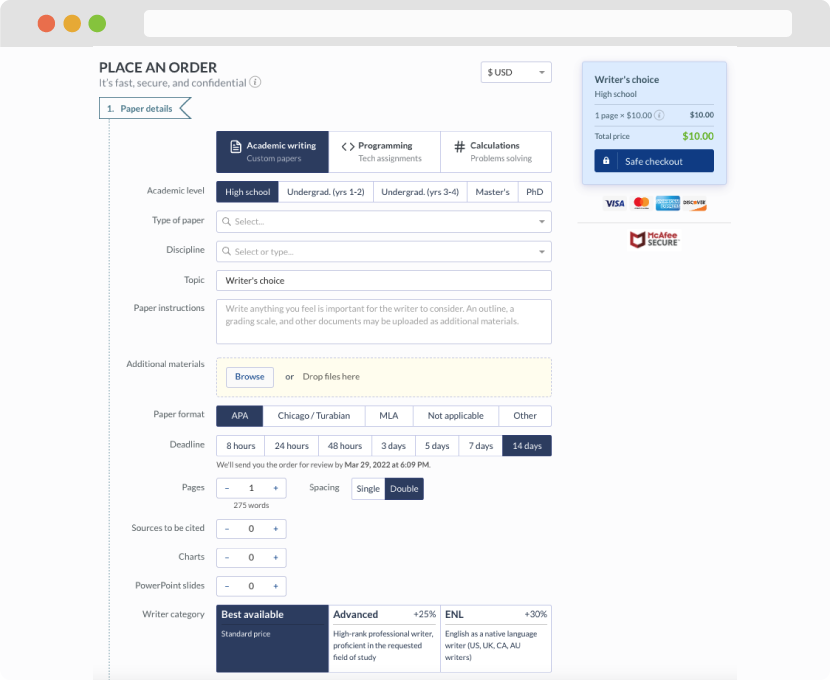
First, you will need to complete an order form. It's not difficult but, if anything is unclear, you may always chat with us so that we can guide you through it. On the order form, you will need to include some basic information concerning your order: subject, topic, number of pages, etc. We also encourage our clients to upload any relevant information or sources that will help.
Complete the order form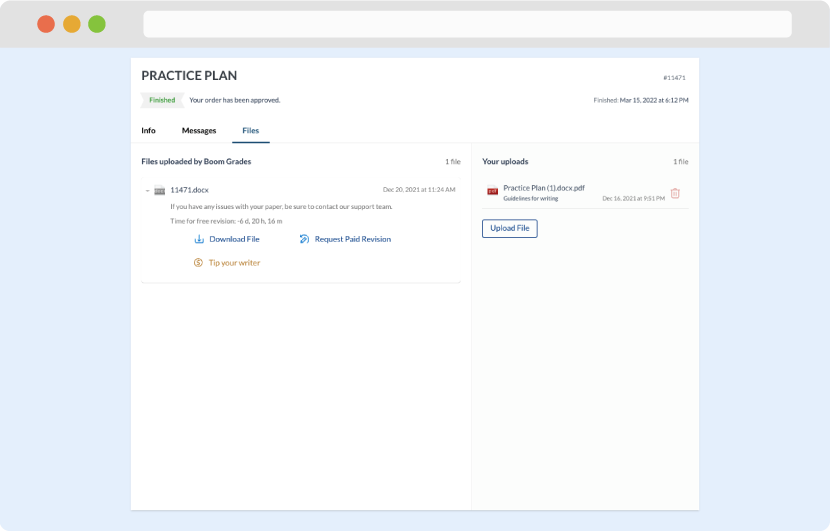
Once we have all the information and instructions that we need, we select the most suitable writer for your assignment. While everything seems to be clear, the writer, who has complete knowledge of the subject, may need clarification from you. It is at that point that you would receive a call or email from us.
Writer’s assignment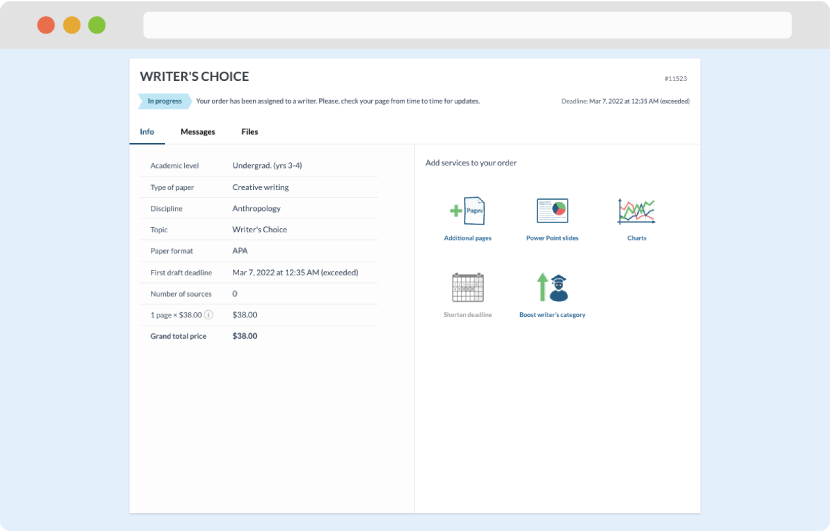
As soon as the writer has finished, it will be delivered both to the website and to your email address so that you will not miss it. If your deadline is close at hand, we will place a call to you to make sure that you receive the paper on time.
Completing the order and download