Choosing the right anthropology research paper topic is an important first step towards writing a strong university paper. Anthropology covers a wide range of subjects, from human evolution and ancient civilizations to cultural identity, language, healthcare, and modern social relationships. With so many possibilities, finding a topic that is both interesting and manageable can be challenging.
If you are looking for anthropology research paper topics for university students, this guide offers 50 ideas organized into six major areas of study. Whether you are preparing an undergraduate essay, a research paper, a coursework assignment, or a dissertation proposal, these topics can help you identify a suitable direction for your research.
Each topic is designed to encourage investigation and analysis rather than simple description. You can adapt the ideas to a particular community, country, historical period, or theoretical perspective to make your research more focused.
Cultural and social anthropology topics
Biological anthropology topics
Archaeology research topics
Linguistic anthropology topics
Medical anthropology topics
Forensic and applied anthropology topics
How to choose the best anthropology research topic
Frequently asked questions
Cultural and social anthropology examines how people develop identities, organize communities, maintain traditions, and respond to social change. These topics are suitable for students interested in human relationships, cultural practices, religion, migration, and contemporary society.


1. The Influence of Globalization on Traditional Cultural Practices: Investigate how international trade, migration, tourism, and digital media influence cultural traditions in a selected community.
2. The Role of Family Structures in Shaping Cultural Identity: Examine how extended families, nuclear families, and kinship networks influence identity and social responsibilities.
3. Religion and Its Influence on Social Behaviour: Explore how religious beliefs and practices influence everyday decisions, community relationships, and social expectations.
4. Gender Roles and Cultural Expectations Across Societies: Analyse how cultural norms shape gender roles and how those expectations change across generations.
5. The Impact of Urbanization on Traditional Communities: Investigate how migration to cities influences family relationships, cultural identity, and community organization.
6. Marriage Customs and Kinship Systems Across Cultures: Compare marriage practices, inheritance, and kinship relationships in two selected cultural settings.
7. The Preservation of Indigenous Knowledge in Modern Society: Explore how indigenous communities preserve traditional knowledge while responding to economic, political, and technological changes.
8. Social Media and the Formation of Cultural Identity: Examine how online communities, digital communication, and social networking platforms influence identity and belonging.
9. Cultural Taboos and Their Role in Maintaining Social Order: Investigate how taboos influence social behaviour, community expectations, and interpersonal relationships.
10. Migration, Cultural Adaptation, and Belonging: Explore how migrants maintain cultural connections while adapting to new social environments.
Biological anthropology studies human evolution, genetics, primate behaviour, biological variation, and human adaptation. These topics are appropriate for students interested in the scientific aspects of anthropology.


12. Human Adaptation to Different Climatic Environments: Investigate how human populations have adapted biologically to environmental conditions, using a clearly defined example.
13. What Primate Behavior Can Tell Us About Human Social Evolution: Explore similarities and differences between human social behavior and the behavior of other primates.
14. Genetic Variation and Human Population History: Analyze how genetic evidence contributes to understanding human migration, ancestry, and population relationships.
15. The Relationship Between Diet and Human Evolution: Examine how changes in diet and food acquisition have influenced human biological and cultural development.
16. Bipedalism and Its Significance in Human Evolution: Investigate the evidence for the development of upright walking and its implications for human anatomy and movement.
17. The Influence of Environment on Human Biological Variation: Explore the relationship between environmental conditions and selected aspects of human biological variation without assuming that social categories correspond neatly to genetic groups.
18. Fossil Evidence and the Reconstruction of Human Ancestry: Examine how researchers interpret fossil evidence to understand human evolutionary history.
Archaeology investigates past human societies through material evidence, including tools, buildings, pottery, burial sites, and other remains. Archaeological research can help explain technological change, trade, settlement patterns, and cultural development.


20. How Archaeological Evidence Helps Reconstruct Ancient Civilizations: Investigate how artefacts, architecture, and settlement remains contribute to knowledge about past societies.
21. The Role of Trade Networks in the Development of Ancient Societies: Analyze how trade influenced economic relationships, technological exchange, and cultural interaction.
22. Burial Practices and Beliefs About Death in Ancient Cultures: Explore what archaeological burial evidence can reveal about social organization and beliefs, while acknowledging interpretive limitations.
23. The Preservation of Archaeological Heritage in Modern Cities: Investigate the challenges of protecting archaeological sites amid urban development and infrastructure expansion.
24. The Development of Early Cities and Complex Societies: Examine how settlement growth, resource management, and political organization contributed to urban development.
25. The Use of Scientific Dating Methods in Archaeology: Compare selected dating methods and assess their usefulness and limitations in establishing the age of archaeological materials.
26. Colonialism, Museum Collections, and the Return of Cultural Artefacts: Explore ethical and political debates concerning the ownership, repatriation, and display of cultural heritage.
Linguistic anthropology explores how language operates within cultural and social settings. It investigates communication, identity, power, multilingualism, and the ways language changes over time.
27. Language and the Construction of Cultural Identity: Investigate how language use contributes to group identity and a sense of belonging.
28. The Causes and Consequences of Language Extinction: Examine the social, economic, and political factors that contribute to language loss and explore community-led preservation efforts.
29. Multilingualism and Identity Among University Students: Explore how students who speak several languages choose languages in different social, academic, and family settings.
30. The Influence of Social Media on Language Change: Investigate how online communication influences vocabulary, expressions, and language practices within a selected group.
31. Language, Power, and Social Inequality: Examine how language expectations can influence access to education, employment, public services, or social status.
32. Code-Switching in Multilingual Communities: Analyze why speakers alternate between languages and how these choices relate to audience, identity, and social context.
33. Language Preservation and Indigenous Communities: Explore the role of education, community initiatives, and digital tools in maintaining endangered languages.
34. Communication Styles and Cultural Differences: Investigate how communication practices vary across cultural contexts and how misunderstandings may arise between groups.
Medical anthropology examines how culture, society, economics, and political systems influence health, illness, healing, and healthcare experiences. It provides a way to investigate health-related issues beyond their purely biological dimensions.


36. Traditional Healing Practices and Modern Healthcare Systems: Investigate how traditional healing practices interact with formal healthcare in a selected community.
37. The Influence of Socioeconomic Inequality on Healthcare Access: Explore how income, education, location, and social conditions shape people’s experiences of healthcare.
38. Cultural Perceptions of Ageing and Elderly Care: Analyze how cultural expectations influence family caregiving, community support, and attitudes towards older adults.
39. Migration and Cultural Barriers to Healthcare: Investigate how language, cultural expectations, and familiarity with healthcare systems influence migrants’ experiences of care.
40. Food Culture, Identity, and Health Practices: Explore how food traditions, social relationships, and beliefs influence dietary practices in a selected community.
41. The Anthropology of Vaccination Beliefs and Practices: Examine how trust, community relationships, historical experiences, and social influences shape attitudes towards vaccination.
42. Public Health Campaigns and Cultural Context: Investigate how cultural values and local communication practices influence the reception of public health messages.
Forensic anthropology applies biological anthropology to questions involving human remains, often in legal investigations. Applied anthropology uses anthropological knowledge and methods to address practical issues in healthcare, development, organizations, and public policy.
43. The Role of Forensic Anthropology in Human Identification: Examine how skeletal evidence contributes to the identification of unknown human remains and what its limitations are.
44. Estimating Age at Death from Human Skeletal Remains: Investigate selected methods used to estimate age and discuss the uncertainty involved in forensic assessments.
45. The Ethical Challenges of Forensic Anthropology: Explore ethical responsibilities when examining human remains, communicating findings, and working with affected families or communities.
46. Anthropology and Humanitarian Investigations of Missing Persons: Examine how anthropological methods can support efforts to identify human remains and document cases of missing persons.
47. The Role of Applied Anthropology in Community Development: Investigate how community-based research can help development organizations understand local needs and social relationships.
48. Digital Anthropology and Human Behavior Online: Explore how people create identities, form communities, and develop social norms in digital spaces.
49. Climate Change and Human Adaptation: Examine how communities understand and respond to environmental change, using an anthropological perspective on livelihoods, knowledge, and social organization.
50. The Anthropology of Work and Changing Employment Practices: Investigate how technology, economic pressures, and changing employment arrangements influence workplace relationships and occupational identity.
Having a list of anthropology research paper ideas is a useful starting point, but the best topic is one that fits your assignment requirements, interests, and available research resources.
The following steps can help you narrow your options. University writing guidance similarly recommends considering assignment requirements, narrowing broad subjects, and confirming that credible scholarly sources are available.1. Identify your area of interest
Start by deciding which aspect of anthropology interests you most. You may prefer cultural practices, human evolution, ancient civilizations, language, healthcare, or forensic investigations.
Choosing a subject that genuinely interests you can make the research process more engaging.
Broad topics often lead to superficial papers because they cover too much material. Narrow your focus by specifying a population, location, period, or issue.
For example:
Broad topic: Globalization and culture.
More focused topic: The influence of social media on cultural identity among university students in Nairobi.
Possible research question: How do university students in Nairobi use social media to express and negotiate cultural identity?
The narrower version gives you a clearer population and issue to investigate.
Before committing to a topic, search your university library, Google Scholar, and relevant scholarly databases. Look for peer-reviewed journal articles, academic books, and credible primary research.
A topic may sound interesting but be difficult to complete if the necessary evidence is inaccessible.
Turn your topic into a question that requires analysis rather than a simple factual answer.
For example, instead of asking what traditional healing is, you could ask how people combine traditional healing practices with formal healthcare in a particular setting.
A focused research question provides direction for your reading, argument, and conclusion.
Different anthropology topics require different methods. Depending on your assignment, you might use a literature review, ethnographic studies, historical records, archaeological evidence, interviews, or observation.
If your research involves interviews or direct observation of people, check your institution’s ethical requirements, consent procedures, and rules for protecting participants’ privacy.
Check the required word count, academic level, citation style, research method, and submission deadline. Your lecturer’s instructions should take priority over general advice.
Once you have selected your topic, organize the paper around a clear research question and central argument.
A typical anthropology research paper includes the following sections:
Introduction: Introduce the research problem, explain its relevance, and state your research question or argument.
Literature review: Summarize and critically evaluate relevant academic research.
Theoretical framework: Explain the anthropological concepts or theories used to interpret the topic, where required.
Methodology: Describe how evidence was collected or selected, if your assignment requires a methods section.
Analysis and discussion: Interpret the evidence, compare perspectives, and develop your argument.
Conclusion: Answer the research question and summarize the main findings and limitations.
References: List the sources cited in the paper using the required citation style.
Not every assignment needs all these sections. Follow your lecturer’s specified structure, particularly for shorter essays and literature reviews.
Even an interesting topic can lead to a weak paper if the research is poorly focused or the evidence is not evaluated carefully.
Avoid these common mistakes:
Choosing a topic that is too broad for the assigned word count.
Describing cultural practices without analyzing their context.
Treating one person’s experience as representative of an entire community.
Relying on unverified online sources instead of relevant academic research.
Ignoring alternative interpretations or contradictory evidence.
Making unsupported generalizations about cultural or biological differences.
Collecting interviews or personal information without following ethical requirements.
Using inconsistent citations or including references that do not support your claims.
Strong anthropology research combines careful evidence evaluation with thoughtful interpretation of human experiences and social contexts.
Choosing a topic is only the beginning of the research process. Students may also need guidance with developing research questions, organizing literature reviews, understanding anthropological theories, evaluating evidence, and structuring academic arguments.
Achiever Papers offers an online platform for students exploring academic writing support. If you are struggling to turn one of these anthropology research paper topics into a focused assignment, visit Achiever Papers to explore the available services.
Before requesting assistance, prepare your assignment brief, marking rubric, academic level, required citation style, and deadline. These details can help clarify the type of support you need.
Need more guidance with your anthropology assignment? Explore our Anthropology Assignment Help page for further information.
Good topics include cultural identity and globalization, language preservation, human evolution, archaeological heritage, healthcare inequality, migration, and digital anthropology. The best choice depends on your course requirements and the evidence available for your research.
Undergraduate students can explore topics such as social media and cultural identity, family structures, language change, food traditions, archaeological dating, or access to healthcare. Selecting a specific population or case study can help keep the project manageable.
The traditional four-field approach in anthropology includes cultural anthropology, biological anthropology, archaeology, and linguistic anthropology. Some university programs organize or emphasize these fields differently, and applied anthropology can connect methods from several areas.
Limit the topic by location, population, time period, social issue, or theoretical approach. Then formulate a research question that identifies what you want to understand or explain.
Yes, these topics can serve as starting points for dissertation ideas. However, a dissertation generally requires a more developed research problem, engagement with existing scholarship, a suitable methodology, and approval from your supervisor.
Start with your university library, Google Scholar, relevant peer-reviewed journals, and academic books. Depending on the topic, useful evidence may also come from archaeological reports, ethnographic studies, historical archives, or credible institutional publications.
You can seek guidance from your lecturer, university writing centre, librarian, or an appropriate academic support service. Support may include refining a research question, organizing an outline, understanding theory, checking citations, and improving a draft.
Essay Writing Service Features
Our Experience
No matter how complex your assignment is, we can find the right professional for your specific task. Achiever Papers is an essay writing company that hires only the smartest minds to help you with your projects. Our expertise allows us to provide students with high-quality academic writing, editing & proofreading services.
Free Features
Free revision policy
$10Free bibliography & reference
$8Free title page
$8Free formatting
$8How Our Dissertation Writing Service Works
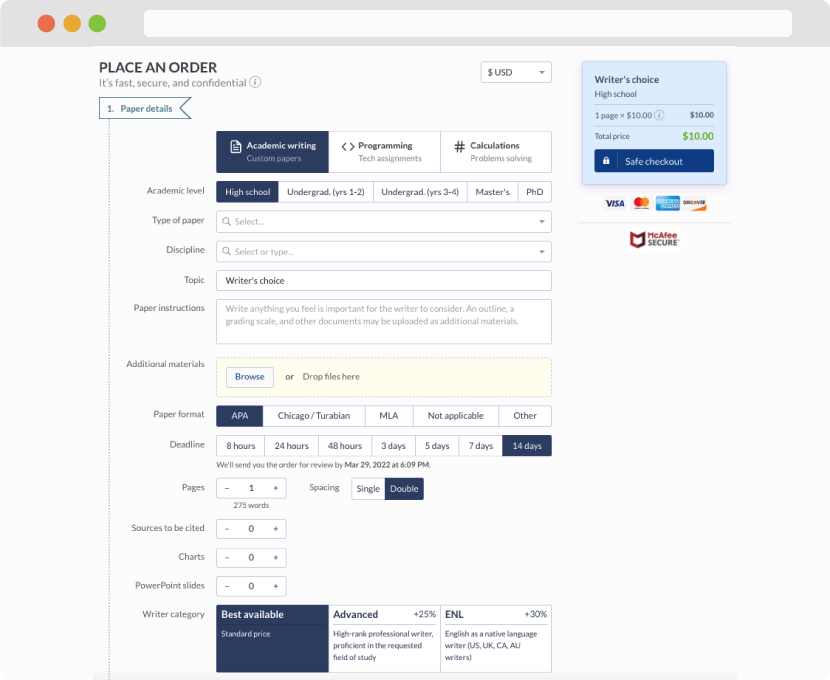
First, you will need to complete an order form. It's not difficult but, if anything is unclear, you may always chat with us so that we can guide you through it. On the order form, you will need to include some basic information concerning your order: subject, topic, number of pages, etc. We also encourage our clients to upload any relevant information or sources that will help.
Complete the order form
Once we have all the information and instructions that we need, we select the most suitable writer for your assignment. While everything seems to be clear, the writer, who has complete knowledge of the subject, may need clarification from you. It is at that point that you would receive a call or email from us.
Writer’s assignment
As soon as the writer has finished, it will be delivered both to the website and to your email address so that you will not miss it. If your deadline is close at hand, we will place a call to you to make sure that you receive the paper on time.
Completing the order and download