need answers for 2 students
Reflection and Discussion Forum Week 1
Reflection and Discussion Forum Week 1Reflect on the assigned readings for Week 1 and then type a two page paper regarding what you thought was the most important concept(s), method(s), term(s), and/or any other thing that you felt was worthy of your understanding. Define and describe what you thought was worthy of your understanding in half a page, and then explain why you felt it was important, how you will use it, and/or how important it is in project planning. After submitting your two page paper as an initial post in the “Reflection and Discussion Forum,” then type at least two peer replies in response to your classmates posts (200 word minimum each).(chapter 1,2 and 3)
·
·
Problem Set #1
1.Everyone has been involved in projects. What is the largest project you have been involved in? (You do not have to have been the project manager, but could have played another role.)
1. Write one sentence that describes the objective of the project.
2. Describe specifically how this project meets the definition of a project used in this textbook. (How is it unique? What were the time constraints? If it is over, how did you know it was over? If it is ongoing, how will you know when it is over?
3. What was your role? Were you the project manager, a volunteer, some other role? If you were not the project manager, who was?
4. Was the project part of a larger portfolio or program of projects?
5. Who else was involved?
6. What was the budget?
7. Did you anticipate any risks at the outset? Did the project experience any outside forces that caused a change in either the objectives or the approach to achieving those objectives
2. In what ways can the following activities be seen as projects? In what ways do they resemble ongoing, routine business activities? Feel free to add assumptions and details to describe how the activity might be a project in one context and routine in another.
1.Reading the chapter before attending a university lecture.
2.Taking the bus to work each day.
3.Piloting an aircraft between Vancouver and Fiji.
4.Teaching a course for the first time; teaching the same course every semester.
5. Go online and search for project life cycle models. Identify at least two that are different from the PMI model, and compare and contrast the phases. Be sure to cite your sources.
Reflection and Discussion Forum Week 1
Reflect on the assigned readings for the week. Identify what you thought was the most important concept(s), method(s), term(s), and/or any other thing that you felt was worthy of your understanding.
Also, provide a graduate-level response to each of the following questions:
This activity/assignment will allow students to systematically understand the general and specific environments of business.
Activity: Select any company of your choice. Identify its strengths and weaknesses. Then analyze the company’s context, customers, competitors, and collaborators.
The assignment is to answer the question provided above in essay form. This is to be in narrative form and should be as thorough as possible. Bullet points should not to be used. The paper should be at least 1.5 – 2 pages in length, Times New Roman 12-pt font, double-spaced, 1 inch margins and utilizing at least one outside scholarly or professional source related to marketing management. The textbook should also be utilized. Do not insert excess line spacing. APA formatting and citation should be used.
The Project Life Cycle
This work is licensed under a
Creative Commons Attribution 3.0
Unported
License
(CC-BY).
Project Management
Chapter 3: The Project Life Cycle
1
Phases of a project
Initiation
Planning
Implementation
Closing
This work is licensed under a
Creative Commons Attribution 3.0
Unported
License (CC-BY).
Project Management
Chapter 3: The Project Life Cycle
Initiation phase
Project sponsor is identified
Scope and deliverables are defined
Relationship to organizational goals is key
Budget is approved
Broad statements are made about risks, approach, timelines
Stakeholders are identified
Project Manager is assigned
At end of phase, approved project charter is the approval to proceed to the planning phase
This work is licensed under a
Creative Commons Attribution 3.0
Unported
License (CC-BY).
Project Management
Chapter 3: The Project Life Cycle
Planning phase
Deliverables are clearly defined
Based on the deliverables, a work breakdown structure or WBS defines the “work packages”
The work packages are used to develop a schedule
Plans are made for management of stakeholders, communication, quality, costs, risks, procurement, resources including human resources
This work is licensed under a
Creative Commons Attribution 3.0
Unported
License (CC-BY).
Project Management
Chapter 3: The Project Life Cycle
Implementation (Execution) Phase
Project team is hired and developed
Procurements take place
Project work is underway
Project must be monitored and changes managed
Communication to stakeholders is an important ongoing activity
This work is licensed under a
Creative Commons Attribution 3.0
Unported
License (CC-BY).
Project Management
Chapter 3: The Project Life Cycle
Closing phase
Reporting
Closing out procurements—final payments
Identify lessons learned
Celebrate
This work is licensed under a
Creative Commons Attribution 3.0
Unported
License (CC-BY).
Project Management
Chapter 3: The Project Life Cycle
Summary
Project Phases
Initiation
Planning
Implementation (Execution)
Closing
This work is licensed under a
Creative Commons Attribution 3.0
Unported
License (CC-BY).
Project Management
Chapter 3: The Project Life Cycle
Questions?
This work is licensed under a
Creative Commons Attribution 3.0
Unported
License (CC-BY).
Project Management
Chapter 3: The Project Life Cycle
8
Project Management
Overview
This work is licensed under a
Creative Commons Attribution 3.0
Unported
License
(CC-BY).
Project Management
Chapter 2: Project Management Overview
1
Purpose of the chapter
Define a project
Define project success
Project constraints
Project management expertise
The project environment
Project management knowledge and skills
This work is licensed under a
Creative Commons Attribution 3.0
Unported
License (CC-BY).
Project Management
Chapter 2: Project Management Overview
Define a project
Define a project:
Unique product or service
Time-limited
Project ends when the objectives are achieved or abandoned
This work is licensed under a
Creative Commons Attribution 3.0
Unported
License (CC-BY).
Project Management
Chapter 2: Project Management Overview
Unique
How can you tell that an activity is unique?
Completely new product or service
Creation of new process
Product or service new to this group of people
This work is licensed under a
Creative Commons Attribution 3.0
Unported
License (CC-BY).
Project Management
Chapter 2: Project Management Overview
Time-limited
May have a start and end date
May be measured as “will be complete when a particular objective is achieved”
If it simply continues forever or to an unspecified end-date it is probably an ongoing business activity
This work is licensed under a
Creative Commons Attribution 3.0
Unported
License (CC-BY).
Project Management
Chapter 2: Project Management Overview
Can tell when it is done
Objective is achieved
Time limit is reached
Objective is abandoned
This work is licensed under a
Creative Commons Attribution 3.0
Unported
License (CC-BY).
Project Management
Chapter 2: Project Management Overview
Project Success
Traditionally: on time, within budget and delivers the promised scope
More effective measure: satisfied customer
This work is licensed under a
Creative Commons Attribution 3.0
Unported
License (CC-BY).
Project Management
Chapter 2: Project Management Overview
Group work
In small groups, try to identify the LARGEST project each of you have been involved with.
You do not have to have been the project manager—if not, what was your role? (team member, volunteer, purchaser, ??)
With the group, make it clear how the project you have identified meets the criteria:
Unique
Temporary
This work is licensed under a
Creative Commons Attribution 3.0
Unported
License (CC-BY).
Project Management
Chapter 2: Project Management Overview
Project constraints
Cost
Scope
Quality
Risk
Resources
Time
This work is licensed under a
Creative Commons Attribution 3.0
Unported
License (CC-BY).
Project Management
Chapter 2: Project Management Overview
Triple constraint
All the constraints can be grouped into these three:
The triad constraints by John M. Kennedy T. (http://commons.wikimedia.org/wiki/File:The_triad_constraints ) used under CC-BY-SA license (https://creativecommons.org/licenses/by-sa/3.0/)
This work is licensed under a
Creative Commons Attribution 3.0
Unported
License (CC-BY).
Project Management
Chapter 2: Project Management Overview
Project Management Expertise
Application knowledge
Industry group
Technical specialty
Managerial area
Understanding the project environment
Cultural, social, political, international, physical
Management knowledge and skills
Interpersonal skills
Communication, influence, leadership, motivation, negotiation and problem solving
This work is licensed under a
Creative Commons Attribution 3.0
Unported
License (CC-BY).
Project Management
Chapter 2: Project Management Overview
Project Management Standards
Standards organizations
PMI
Project Management Institute: http://www.pmi.org/
CAPM, PMP and other professional standards
IPMA
International Project Management Association: http://ipma.ch/
Several certifications
This work is licensed under a
Creative Commons Attribution 3.0
Unported
License (CC-BY).
Project Management
Chapter 2: Project Management Overview
Summary
Project definition: unique, time-limited, can tell when it is over
Project success: satisfied client
Project constraints: time, scope, cost
Project management expertise
The project environment
Project management knowledge and skills
This work is licensed under a
Creative Commons Attribution 3.0
Unported
License (CC-BY).
Project Management
Chapter 2: Project Management Overview
Questions?
This work is licensed under a
Creative Commons Attribution 3.0
Unported
License (CC-BY).
Project Management
Chapter 2: Project Management Overview
14
Project Management
: Past and Present
This work is licensed under a
Creative Commons Attribution 3.0
Unported
License
(CC-BY).
Project Management
Chapter 1: Project Management: Past and Present
1
Project Management Past and Present
This chapter introduces project management as an important activity in many different careers and industries.
The chapter presents a brief overview of the history of project management tools and project management professionalism.
This work is licensed under a
Creative Commons Attribution 3.0
Unported
License (CC-BY).
Project Management
Chapter 1: Project Management: Past and Present
Careers Using Project Management Skills
Everyone carries out projects, every role in every organization.
Projects can be any size from one-person doing his or her homework to thousands of people working together with billion-dollar budgets.
This work is licensed under a
Creative Commons Attribution 3.0
Unported
License (CC-BY).
Project Management
Chapter 1: Project Management: Past and Present
Project management skills
Planning
Communication
Delivering results
Monitoring risks
Managing resources
This work is licensed under a
Creative Commons Attribution 3.0
Unported
License (CC-BY).
Project Management
Chapter 1: Project Management: Past and Present
Industry sectors
Business owners
Agriculture and Natural Resources
Arts, Media and Entertainment
Building Trades and Construction
Energy and Utilities
Engineering and Design
Fashion
Finance
. . . continued on next slide
This work is licensed under a
Creative Commons Attribution 3.0
Unported
License (CC-BY).
Project Management
Chapter 1: Project Management: Past and Present
Industry sectors (continued)
Health and Human Services
Hospitality, Tourism and recreation
Manufacturing and Product Development
Education
Public Services
Retail and Wholesale Trade
Transportation
Information Technology
This work is licensed under a
Creative Commons Attribution 3.0
Unported
License (CC-BY).
Project Management
Chapter 1: Project Management: Past and Present
History of Project Management
Early methodologies not well-documented, but results still stand: the pyramids, Stonehenge, mass human migrations
Late 19th century
Construction of intercontinental railroad, other large projects
Early 20th Century
Frederick Taylor created Scientific Management of industrial processes
Henry Gantt developed a bar-chart approach to illustrating timing of project tasks and progress
This work is licensed under a
Creative Commons Attribution 3.0
Unported
License (CC-BY).
Project Management
Chapter 1: Project Management: Past and Present
History of Project Management (continued)
Mid-20th century
CPM and PERT methodologies identified the importance of task sequences, task dependencies and the concept of the critical path.
Project management as a profession
Project Management Institute (PMI) was founded
Project Management Body of Knowledge (PMBOK) was created
This work is licensed under a
Creative Commons Attribution 3.0
Unported
License (CC-BY).
Project Management
Chapter 1: Project Management: Past and Present
History of Project Management (continued)
Today
Increasing recognition of project management as a specialized set of skills applicable to many different industries
Project Management certifications: PMP, CAPM, specializations
PMBOK is in its 5th edition
Variations on methodologies:
phased (waterfall approach)
Agile methods
The importance of integrating projects into portfolios and programs
This work is licensed under a
Creative Commons Attribution 3.0
Unported
License (CC-BY).
Project Management
Chapter 1: Project Management: Past and Present
Summary
Project management has existed as long as humans have worked together to achieve goals
Project management skills are useful in all careers
Project management takes place in all industries
Project management tools and methodologies have evolved over the past century and a half:
Scientific management
Gantt chart
Pert/CPM network diagrams
There are associations of professional project managers that set standards for the practice of project management
PMI’s Project Management Body of Knowledge or PMBOK, currently in its fifth edition.
This work is licensed under a
Creative Commons Attribution 3.0
Unported
License (CC-BY).
Project Management
Chapter 1: Project Management: Past and Present
Questions?
This work is licensed under a
Creative Commons Attribution 3.0
Unported
License (CC-BY).
Project Management
Chapter 1: Project Management: Past and Present
11
© 2018 Cengage Learning®. May not be scanned, copied or duplicated, or posted to a publicly accessible website, in whole or in part.
© 2018 Cengage Learning.® May not be scanned, copied or duplicated, or posted to a publicly accessible website, in whole or in part.
1
1
Why Is
Marketing Management Important?
© 2018 Cengage Learning.® May not be scanned, copied or duplicated, or posted to a publicly accessible website, in whole or in part.
1.
2
‹#›
© 2018 Cengage Learning.® May not be scanned, copied or duplicated, or posted to a publicly accessible website, in whole or in part.
1.
2
Discussion Questions #1
What is the definition of marketing?
What can be marketed?
3
1.
© 2018 Cengage Learning.® May not be scanned, copied or duplicated, or posted to a publicly accessible website, in whole or in part.
© 2018 Cengage Learning.® May not be scanned, copied or duplicated, or posted to a publicly accessible website, in whole or in part.
1.
Marketing Defined
Marketing is defined as an exchange between a firm and its customers
4
1.
© 2018 Cengage Learning.® May not be scanned, copied or duplicated, or posted to a publicly accessible website, in whole or in part.
© 2018 Cengage Learning.® May not be scanned, copied or duplicated, or posted to a publicly accessible website, in whole or in part.
1.
What Can We “Market”?
5
1.
© 2018 Cengage Learning.® May not be scanned, copied or duplicated, or posted to a publicly accessible website, in whole or in part.
© 2018 Cengage Learning.® May not be scanned, copied or duplicated, or posted to a publicly accessible website, in whole or in part.
1.
Evolution of Modern Marketing
Product/production orientation
Focus on building a better gadget
Sales orientation
Focus on convincing the customer that your product works best for them
Customer orientation
Focus on identifying customers’ wants BEFORE formulating attractive solutions
6
1.
© 2018 Cengage Learning.® May not be scanned, copied or duplicated, or posted to a publicly accessible website, in whole or in part.
© 2018 Cengage Learning.® May not be scanned, copied or duplicated, or posted to a publicly accessible website, in whole or in part.
1.
Discussion Questions #2
Which orientation do you think would mostly likely lead to an exchange?
Who do you think is responsible for marketing?
7
1.
© 2018 Cengage Learning.® May not be scanned, copied or duplicated, or posted to a publicly accessible website, in whole or in part.
© 2018 Cengage Learning.® May not be scanned, copied or duplicated, or posted to a publicly accessible website, in whole or in part.
1.
Who Is Responsible for Marketing?
Marketing and customer satisfaction is everyone’s responsibility
Marketing should permeate the firm
Accounting/finance
Sales
Research and development
8
1.
© 2018 Cengage Learning.® May not be scanned, copied or duplicated, or posted to a publicly accessible website, in whole or in part.
© 2018 Cengage Learning.® May not be scanned, copied or duplicated, or posted to a publicly accessible website, in whole or in part.
1.
Reasons to Measure Marketing Success
Pressure to show results
Ensure that the chief marketing officer (CMO) carries as much weight as the CEO, CFO, or COO
9
1.
© 2018 Cengage Learning.® May not be scanned, copied or duplicated, or posted to a publicly accessible website, in whole or in part.
© 2018 Cengage Learning.® May not be scanned, copied or duplicated, or posted to a publicly accessible website, in whole or in part.
1.
Measuring Marketing Success
(slide 1 of 2)
Quantify results when possible
Sometimes the effectiveness of marketing programs is easy to quantify
Did the coupon promotion lift sales?
Measure the percentage sales increase, etc.
Did the direct mail campaign increase web usage?
Measure the number of web visits, etc.
10
1.
© 2018 Cengage Learning.® May not be scanned, copied or duplicated, or posted to a publicly accessible website, in whole or in part.
© 2018 Cengage Learning.® May not be scanned, copied or duplicated, or posted to a publicly accessible website, in whole or in part.
1.
Measuring Marketing Success
(slide 2 of 2)
However, sometimes the effectiveness is not easy to quantify
Was the segmentation study effective?
Difficult to quantify
Did the advertising campaign increase sales?
Difficult to quantify because great advertising is geared toward long-term brand building not short-term results
11
1.
© 2018 Cengage Learning.® May not be scanned, copied or duplicated, or posted to a publicly accessible website, in whole or in part.
© 2018 Cengage Learning.® May not be scanned, copied or duplicated, or posted to a publicly accessible website, in whole or in part.
1.
Marketing Management Framework
The 5Cs, STP, and the 4Ps constitute the marketing management framework
12
1.
© 2018 Cengage Learning.® May not be scanned, copied or duplicated, or posted to a publicly accessible website, in whole or in part.
© 2018 Cengage Learning.® May not be scanned, copied or duplicated, or posted to a publicly accessible website, in whole or in part.
1.
5Cs
(slide 1 of 3)
Customer
The firm’s current and potential customers
What are current customers’ preferences, buying trends, etc.?
What are potential customers’ preferences? Should they be targeted?
Company
The firm’s capabilities, resources, etc.
What does it do well?
What doesn’t it do well?
13
1.
© 2018 Cengage Learning.® May not be scanned, copied or duplicated, or posted to a publicly accessible website, in whole or in part.
© 2018 Cengage Learning.® May not be scanned, copied or duplicated, or posted to a publicly accessible website, in whole or in part.
1.
5Cs
(slide 2 of 3)
Context
Macro-environmental forces facing the firm
What is going on politically or legally that might affect the firm?
What is going on with the economy that might affect the firm?
What trends are occurring in society that might affect the firm?
What technological innovations might affect the firm?
14
1.
© 2018 Cengage Learning.® May not be scanned, copied or duplicated, or posted to a publicly accessible website, in whole or in part.
© 2018 Cengage Learning.® May not be scanned, copied or duplicated, or posted to a publicly accessible website, in whole or in part.
1.
5Cs
(slide 3 of 3)
Collaborators
The companies/people firm works with
Are these relationships strong? Can these relationships be improved or leveraged?
Competitors
The companies/people firm works against and how they compare to the firm in terms of resources, capabilities, customer preferences, reaction patterns, etc.
15
1.
© 2018 Cengage Learning.® May not be scanned, copied or duplicated, or posted to a publicly accessible website, in whole or in part.
© 2018 Cengage Learning.® May not be scanned, copied or duplicated, or posted to a publicly accessible website, in whole or in part.
1.
STP
Segmentation
Grouping customers with similar needs
Targeting
Pursuing segment who makes the most sense for the firm
Positioning
Communicating product’s benefits clearly to the intended target
Developed through the 4Ps
16
1.
© 2018 Cengage Learning.® May not be scanned, copied or duplicated, or posted to a publicly accessible website, in whole or in part.
© 2018 Cengage Learning.® May not be scanned, copied or duplicated, or posted to a publicly accessible website, in whole or in part.
1.
4Ps
(slide 1 of 2)
Product
Goods or services customers need or want
What should constitute your product mix? What features and benefits should comprise each product?
Price
How much should you charge given your costs, competitive pricing, and customer demand?
17
1.
© 2018 Cengage Learning.® May not be scanned, copied or duplicated, or posted to a publicly accessible website, in whole or in part.
© 2018 Cengage Learning.® May not be scanned, copied or duplicated, or posted to a publicly accessible website, in whole or in part.
1.
4Ps
(slide 2 of 2)
Place
How will you get the product into the customers’ hands? Will you go directly to customers or use channel partners?
Promotion
What communications mix will you use to communicate with your targets? What message will you use?
18
1.
© 2018 Cengage Learning.® May not be scanned, copied or duplicated, or posted to a publicly accessible website, in whole or in part.
© 2018 Cengage Learning.® May not be scanned, copied or duplicated, or posted to a publicly accessible website, in whole or in part.
1.
Considerations
(slide 1 of 2)
The situation facing the company changes over time
Customer preferences change
Competitors change offerings
Government passes new laws, etc.
Firm must consistently monitor the 5Cs
19
1.
© 2018 Cengage Learning.® May not be scanned, copied or duplicated, or posted to a publicly accessible website, in whole or in part.
© 2018 Cengage Learning.® May not be scanned, copied or duplicated, or posted to a publicly accessible website, in whole or in part.
1.
Considerations
(slide 2 of 2)
5Cs, STP, and 4Ps are interdependent
As contextual factor changes, what would the impact be on distribution channels?
As a collaborator shifts their demands, what will that do to our pricing structure?
As our company sells off a nonperforming function, what impact might that have on our positioning and customer satisfaction?
Marketers must understand the interdependencies
20
1.
© 2018 Cengage Learning.® May not be scanned, copied or duplicated, or posted to a publicly accessible website, in whole or in part.
© 2018 Cengage Learning.® May not be scanned, copied or duplicated, or posted to a publicly accessible website, in whole or in part.
1.
Book Layout
21
1.
© 2018 Cengage Learning.® May not be scanned, copied or duplicated, or posted to a publicly accessible website, in whole or in part.
© 2018 Cengage Learning.® May not be scanned, copied or duplicated, or posted to a publicly accessible website, in whole or in part.
1.
Flow of Each Chapter
Each chapter covers the “What,” “Why,” and “How.”
What is the topic in this chapter?
Why does it matter?
How do I do this?
22
1.
© 2018 Cengage Learning.® May not be scanned, copied or duplicated, or posted to a publicly accessible website, in whole or in part.
© 2018 Cengage Learning.® May not be scanned, copied or duplicated, or posted to a publicly accessible website, in whole or in part.
1.
Managerial Recap
(slide 1 of 2)
Marketing can make customers happier and companies more profitable
Marketing is about trying to find out what customers would like, providing it to them, and doing so profitably
Marketing facilitates a relationship between customers and a company
23
1.
© 2018 Cengage Learning.® May not be scanned, copied or duplicated, or posted to a publicly accessible website, in whole or in part.
© 2018 Cengage Learning.® May not be scanned, copied or duplicated, or posted to a publicly accessible website, in whole or in part.
1.
Managerial Recap
(slide 2 of 2)
Just about anything can be marketed
The marketing management framework—5Cs, STP, 4Ps—will structure the book
If you can remain customer-centric, you’ll be five steps ahead of the competition
24
1.
© 2018 Cengage Learning.® May not be scanned, copied or duplicated, or posted to a publicly accessible website, in whole or in part.
© 2018 Cengage Learning.® May not be scanned, copied or duplicated, or posted to a publicly accessible website, in whole or in part.
1.
Essay Writing Service Features
Our Experience
No matter how complex your assignment is, we can find the right professional for your specific task. Achiever Papers is an essay writing company that hires only the smartest minds to help you with your projects. Our expertise allows us to provide students with high-quality academic writing, editing & proofreading services.
Free Features
Free revision policy
$10Free bibliography & reference
$8Free title page
$8Free formatting
$8How Our Dissertation Writing Service Works
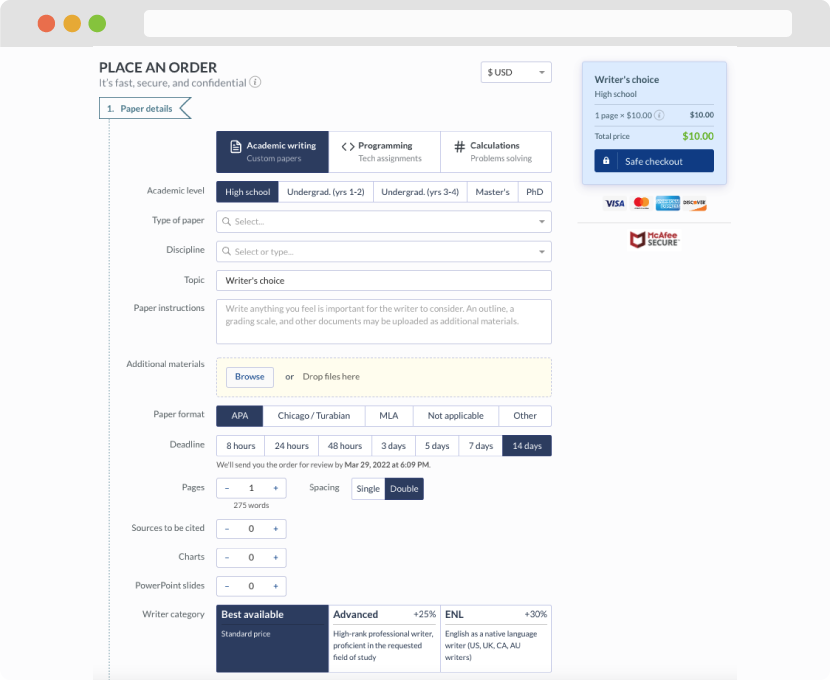
First, you will need to complete an order form. It's not difficult but, if anything is unclear, you may always chat with us so that we can guide you through it. On the order form, you will need to include some basic information concerning your order: subject, topic, number of pages, etc. We also encourage our clients to upload any relevant information or sources that will help.
Complete the order form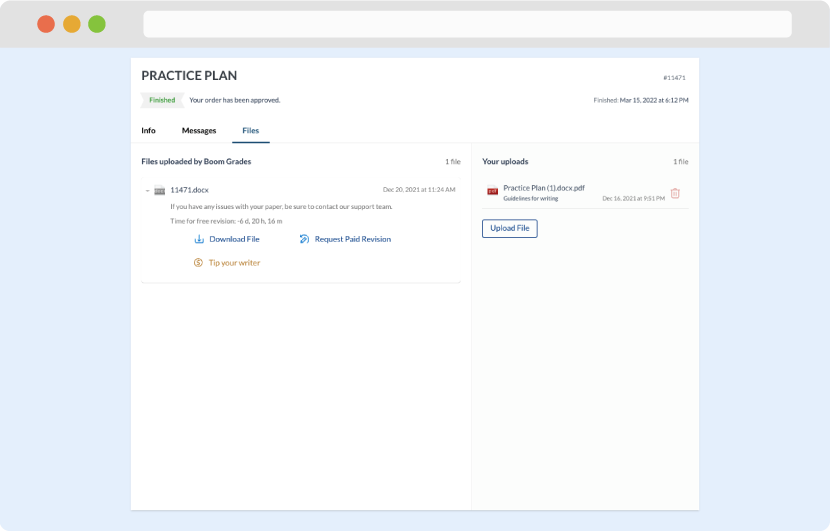
Once we have all the information and instructions that we need, we select the most suitable writer for your assignment. While everything seems to be clear, the writer, who has complete knowledge of the subject, may need clarification from you. It is at that point that you would receive a call or email from us.
Writer’s assignment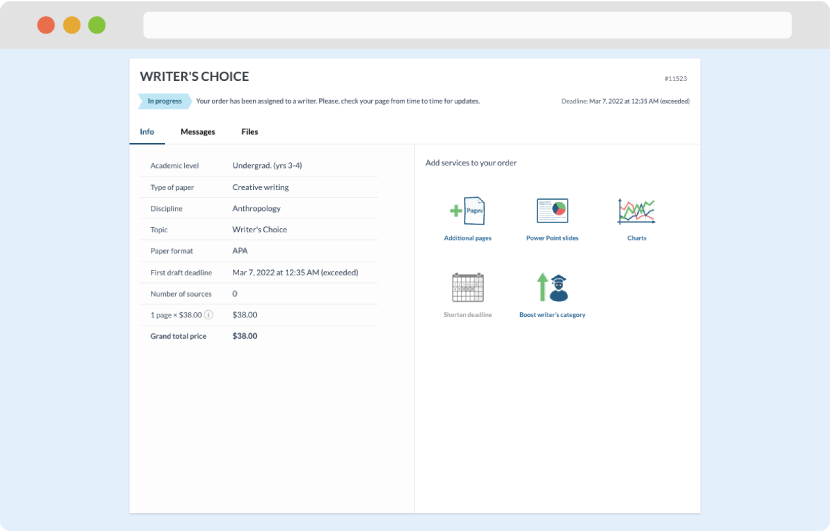
As soon as the writer has finished, it will be delivered both to the website and to your email address so that you will not miss it. If your deadline is close at hand, we will place a call to you to make sure that you receive the paper on time.
Completing the order and download