Anthropology explores human beings, their origins, cultures, languages, biology, and social relationships. Studying the subject can be fascinating, but anthropology assignments often require extensive reading, critical analysis, evidence-based arguments, and careful referencing.
If you are struggling with an anthropology essay, research paper, case study, presentation, or dissertation, Achiever Papers offers anthropology assignment help to support your learning and academic writing. Explore the different branches of anthropology, learn how to approach complex topics, and discover how academic guidance can help you develop stronger research and writing skills.
Whether you are studying cultural anthropology, biological anthropology, archaeology, linguistic anthropology, or medical anthropology, understanding the requirements of your assignment is the first step towards producing a well-organized piece of academic work.
Anthropology is the systematic study of human beings, human societies, cultures, and biological development. It examines how people lived in the past, how communities function today, and how human behavior and social institutions change over time.
Unlike disciplines that focus on only one aspect of human life, anthropology often combines perspectives from the social sciences, humanities, and natural sciences.
For example, an anthropologist studying migration might examine economic conditions, cultural identity, family relationships, language, and historical events. A researcher studying ancient societies might investigate archaeological remains to understand how people lived, worked, traded, and interacted.
This broad approach makes anthropology intellectually rewarding, but it can also make assignments challenging. Students must understand the relevant theories, evaluate research evidence, consider different perspectives, and present their findings in a logical structure.
Anthropology assignments vary depending on the academic level, research question, and course requirements. Students may need help understanding difficult concepts, narrowing a research topic, organizing an essay, evaluating sources, or applying anthropological theories.
Anthropology assignment support can include:
Essay planning: Developing a clear argument, organizing paragraphs, and creating a logical structure.
Research paper guidance: Refining research questions, identifying relevant academic sources, and organizing evidence.
Cultural anthropology assignments: Examining cultural practices, identity, kinship, religion, social norms, and community relationships.
Biological anthropology essays: Exploring human evolution, genetics, primate behavior, adaptation, and human variation.
Archaeology assignments: Interpreting material evidence, ancient settlements, artefacts, and historical societies.
Linguistic anthropology projects: Investigating language, communication, identity, and social interaction.
Medical anthropology research: Examining how culture, society, economics, and healthcare systems influence experiences of health and illness.
Forensic anthropology topics: Understanding the scientific analysis of human skeletal remains and the limitations of forensic evidence.
Presentation preparation: Structuring academic slides, explaining key concepts, and presenting research findings clearly.
Referencing and proofreading: Checking citation consistency, grammar, clarity, and compliance with assignment instructions.
The most suitable form of support depends on the task. Some students need help understanding a theory, while others need feedback on a draft or guidance on academic research methods.
Understanding the major branches of anthropology helps students identify relevant theories, research methods, and assignment topics.

Cultural anthropology examines the beliefs, values, customs, and everyday practices of different communities. It explores how people develop cultural identities and how social norms influence behavior.
Common cultural anthropology assignment topics include:
The influence of cultural identity on individual behavior.
Kinship, marriage, and family structures across societies.
Religion, rituals, and their roles in community life.
Cultural change, globalization, and migration.
Gender roles and social expectations across cultures.
Ethnographic research and participant observation.
A strong cultural anthropology essay should do more than describe a cultural practice. It should explain the practice within its social and historical context, engage with relevant anthropological concepts, and support its interpretation with credible evidence.

Biological anthropology investigates human evolution, biological variation, primate behavior, genetics, and the ways humans adapt to different environments.
Students may encounter assignments on:
Human evolution and the fossil record.
Primate behavior and comparative anatomy.
Human genetic variation.
Natural selection and evolutionary theory.
Human adaptation to environmental conditions.
The relationship between biology, culture, and the environment.
These assignments often require students to distinguish scientific evidence from assumptions and to explain how researchers draw conclusions from fossils, genetic data, and comparative studies.

Archaeology studies past human societies through material remains, including tools, pottery, buildings, burial sites, and other artefacts.
Archaeology assignments commonly explore:
How archaeologists interpret material evidence.
Ancient civilizations and settlement patterns.
The development of agriculture and urban societies.
Archaeological dating methods.
Cultural heritage preservation.
The ethical responsibilities involved in excavating and displaying artefacts.
A well-developed archaeology assignment connects material evidence to a research question and acknowledges the limitations of the available evidence.
Linguistic anthropology examines the relationship between language, culture, identity, and social life. It considers how people use language in different settings and how communication reflects social relationships.
Possible assignment topics include:
Language and cultural identity.
Multilingualism and migration.
Language change and language preservation.
Language, power, and social inequality.
Communication styles across communities.
The role of language in shaping social relationships.
Students should consider both what people say and how language is used within a particular social context.
Medical anthropology examines health, illness, healing, and healthcare through cultural and social perspectives. It investigates how economic circumstances, cultural beliefs, political systems, and access to healthcare influence people’s experiences of illness and treatment.
Potential topics include:
Cultural beliefs about health and illness.
Traditional healing practices and modern healthcare.
Social determinants of health.
Health inequalities across communities.
Medical decision-making and cultural values.
The influence of migration on healthcare experiences.
These assignments benefit from careful source evaluation and a clear distinction between describing cultural beliefs and evaluating scientific evidence.
Forensic anthropology applies knowledge of human skeletal biology to questions arising in legal investigations. It may involve examining human remains to help estimate biological characteristics or investigate the circumstances surrounding death.
Common assignment areas include:
Human skeletal identification.
Estimation of age at death.
Skeletal trauma analysis.
The limitations of biological profile estimation.
The role of forensic anthropologists in investigations.
Ethical issues in the examination and identification of human remains.
Because forensic conclusions involve scientific uncertainty, students should avoid presenting estimates as definitive facts when the evidence does not justify that certainty.
A successful anthropology assignment requires more than gathering information. It should answer the assigned question, use appropriate evidence, and demonstrate critical thinking.
Identify the main instruction in the question. Terms such as analyze, compare, evaluate, and discuss require different approaches.
For example, a question asking you to analyze cultural identity requires you to examine relationships, causes, and implications rather than simply define cultural identity.
Broad subjects are difficult to investigate within a limited word count. Narrow your topic to a manageable issue, population, period, or theoretical question.
Instead of writing about culture in general, you could investigate how migration influences language use and cultural identity within a particular community.
Use scholarly books, peer-reviewed journal articles, university library databases, and relevant primary research. Evaluate the author’s expertise, the publication’s credibility, the research methods used, and the relevance of each source.
Avoid relying entirely on blogs, general websites, or sources that make claims without supporting evidence.
A typical anthropology essay may contain:
Introduction: Introduce the topic, establish the research question, and present the central argument.
Background and theoretical framework: Explain the relevant concepts and theories.
Main analysis: Develop your argument using research evidence, examples, and critical discussion.
Discussion: Consider alternative interpretations, limitations, and wider implications.
Conclusion: Answer the research question and summarize the main findings.
Adapt this structure to your lecturer’s instructions and the requirements of your specific assignment.
Critical analysis is an important part of academic anthropology. Explain how your evidence supports your argument, compare different interpretations, and acknowledge limitations.
For example, when discussing a cultural practice, consider its historical context, the perspectives of community members, and how researchers have interpreted it. Avoid treating entire communities as if every member shares identical beliefs or experiences.
Follow the citation style required by your institution. Anthropology assignments may use APA, Chicago, Harvard, or another specified referencing system.
Ensure that in-text citations correspond to your reference list, quotations are clearly identified, and paraphrased ideas are properly attributed. Never invent references or cite sources you have not consulted.
Check that your work answers the question, each paragraph advances the argument, and the conclusion follows from the evidence presented.
Review grammar, transitions, citation consistency, word count, and formatting before submission.
Anthropology combines different research traditions, making it necessary to understand concepts from several disciplines.
Common challenges include:
Complex theories: Understanding and applying anthropological frameworks can require substantial reading.
Broad research topics: Students may struggle to narrow a subject into a manageable question.
Interpreting cultural differences: Analyzing unfamiliar cultural practices requires context and careful reasoning.
Research methodology: Ethnography, participant observation, interviews, and archaeological methods have different strengths and limitations.
Critical analysis: Students must evaluate evidence and competing explanations rather than merely summarize sources.
Academic referencing: Maintaining consistent citations can be time-consuming.
Deadlines and workload: Balancing research, writing, and other coursework can make planning difficult.
Breaking the task into smaller stages can make it easier to manage. If a particular concept or method remains unclear, targeted tutoring or feedback on a draft may help you understand how to approach it.
Achiever Papers provides an online platform for students seeking academic writing assistance. If you need support with an anthropology assignment, start by identifying the subject area, assignment type, academic level, and specific difficulties you are facing.
Depending on the support available, you may benefit from guidance with essay planning, research organization, understanding anthropological theories, referencing, editing, or presentation development.
Before requesting assistance, prepare your assignment instructions, marking rubric, required referencing style, word count, and deadline. Providing these details helps clarify the scope of the work and the type of guidance you need.
Our aim is to make complex academic tasks more manageable while helping students strengthen their understanding of anthropology and their academic writing skills.
Looking for anthropology assignment help? Visit Achiever Papers to explore the available services and find out how to get started.
Anthropology assignment help refers to academic guidance for students studying human societies, culture, evolution, language, archaeology, and related subjects. It may include research guidance, tutoring, essay planning, proofreading, and feedback on written work.
Yes. Appropriate academic support can help you narrow your research question, understand cultural theories, evaluate ethnographic evidence, organize your argument, and improve your referencing.
Potential topics include cultural identity and migration, kinship systems, language preservation, human evolution, archaeological interpretation, healthcare inequalities, and forensic identification. The best topic is one that fits your course requirements and can be investigated using credible evidence.
Follow the instructions provided by your lecturer or institution. Depending on the course, you may be asked to use APA, Chicago, Harvard, or another referencing style. Do not assume that one format is required for every anthropology assignment.
Begin with a focused research question, use credible academic sources, develop a clear argument, support your claims with evidence, consider alternative interpretations, and proofread the final draft. Feedback from a tutor or academic writing adviser can also help you identify areas for improvement.
Academic presentation support can include organizing slide content, explaining key concepts, selecting relevant evidence, and improving the clarity of your argument. Follow your institution’s rules regarding outside assistance and disclosure.
Visit Achiever Papers, review the available services, and follow the site’s enquiry or ordering instructions. Include your assignment brief, deadline, academic level, and any specific questions so the support can be appropriately scoped.
Essay Writing Service Features
Our Experience
No matter how complex your assignment is, we can find the right professional for your specific task. Achiever Papers is an essay writing company that hires only the smartest minds to help you with your projects. Our expertise allows us to provide students with high-quality academic writing, editing & proofreading services.
Free Features
Free revision policy
$10Free bibliography & reference
$8Free title page
$8Free formatting
$8How Our Dissertation Writing Service Works
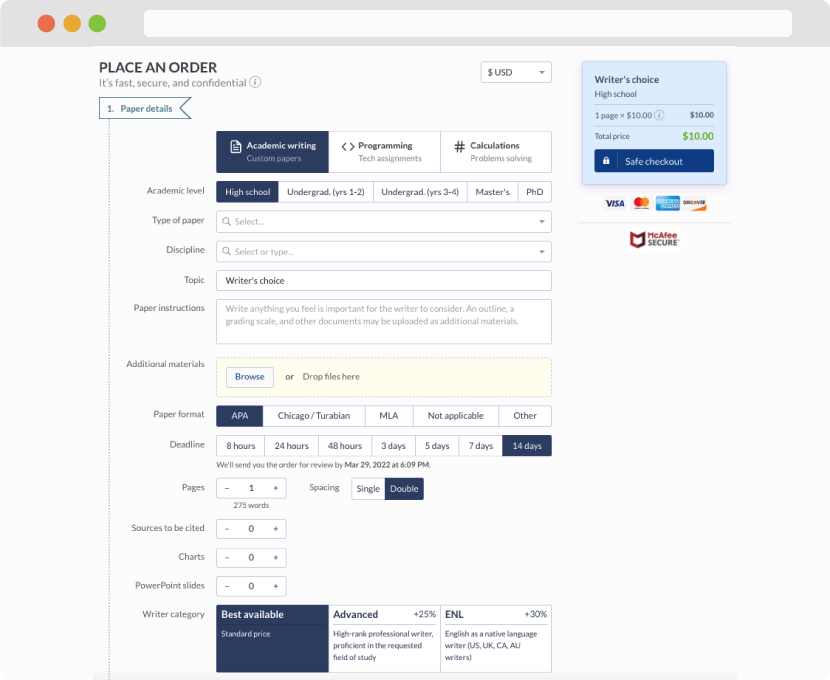
First, you will need to complete an order form. It's not difficult but, if anything is unclear, you may always chat with us so that we can guide you through it. On the order form, you will need to include some basic information concerning your order: subject, topic, number of pages, etc. We also encourage our clients to upload any relevant information or sources that will help.
Complete the order form
Once we have all the information and instructions that we need, we select the most suitable writer for your assignment. While everything seems to be clear, the writer, who has complete knowledge of the subject, may need clarification from you. It is at that point that you would receive a call or email from us.
Writer’s assignment
As soon as the writer has finished, it will be delivered both to the website and to your email address so that you will not miss it. If your deadline is close at hand, we will place a call to you to make sure that you receive the paper on time.
Completing the order and download