ProjectilesPRE-LAB
Projectile Motion
Objectives
To examine projectile motion for objects launched at different angles
Equipment
A computer with internet access
Theory
To predict where a ball will land when it is shot at some angle above the horizontal, it is helpful to know
the initial speed (launch velocity) of the ball. The reverse can also be true and the distance a ball flies,
the height a ball reaches, and the time of flight can be used to determine the launch velocity.
Activity 1: How does launch velocity affect other projectile parameters?
All projectile motion is governed by the kinematic equations given below that you derived in class.
𝑥𝑓 = 𝑥𝑜 + 𝑣𝑥 𝑡
𝑣𝑓𝑦 = 𝑣𝑜𝑦 + 𝑎𝑦 𝑡
𝑦𝑓 = 𝑦𝑜 + 𝑣𝑜𝑦 𝑡 + 12𝑎𝑦 𝑡 2
2
2
𝑣𝑓𝑦
= 𝑣𝑜𝑦
+ 2𝑎𝑦 (𝑦𝑓 − 𝑦𝑜 )
Equation (X1)
Equation (Y1)
Equation (Y2)
Equation (Y3)
For this activity, you will use a simple simulation of a soccer kick to examine the relationships between
the velocity of the kick, the gravitational acceleration, and the distance traveled by the soccer ball.
1. Open the activity titled “Ground to Ground Soccer Kick” using the link below:
http://thephysicsaviary.com/Physics/Programs/Labs/GroundToGroundSoccerKickLab/
2. The simulation allows you to change the following variables:
a. Speed of the kick
b. Angle of the kick
c. Gravitational field of the planet on which the soccer ball is being kicked
3. Click “Desktop” or “Touch” for touch screen, depending on what kind of device you are using.
4. Start by examining the influence of only the angle of the kick. First, pick any kick speed and any
gravitational field (acceleration) by clicking on their respective boxes at the top of the screen
and using the arrows to choose a value. Record what you have chosen in the left column of
Table 1.
5. Now select an angle and click “kick ball”. Record the angle and distance traveled in Table 1.
6. Repeat for two other angles, each 10 degrees apart. Record data in Table 1.
Table 1: Constant Speed and Acceleration Data
Speed (m/s)
Angle (degrees)
Horizontal Distance (m)
Acceleration (m/s2)
Rev 2/8/22 DLD
1
PRELAB
Projectiles
PRE-LAB
Projectile Motion
7. Do you notice any trends or anything unique about the data you have recorded? Note
your observations here.
8. Now you will examine the effect of the initial kick speed keeping your acceleration and angle
constant. Record your choices for angle and acceleration in the left column of Table 2.
9. Choose a “kick speed” and perform the simulation. Repeat this for 2 more speeds, recording the
speeds and distances in Table 2.
Table 2: Constant Angle and Acceleration Data
Angle (degree)
Speed (m/s)
Horizontal Distance (m)
Acceleration (m/s2)
10. Again, do you notice any trends or anything unique about the data you have recorded? Note
your observations here.
11. Finally, examine the effect of “gravitational field,” or acceleration. This time, choose a kick
speed and angle and record them in Table 3.
12. Now select 3 different values of the acceleration and perform the simulation as before,
recording your results in Table 3.
Table 3: Constant Angle and Speed Data
Angle (degree)
Acceleration (m/s2)
Horizontal Distance (m)
Kick Speed (m/s)
Rev 2/8/22 DLD
2
PRELAB
Projectiles
PRE-LAB
Projectile Motion
13. Again, do you notice any trends or anything unique about the data you have recorded? Note
your observations here.
Summarize your observations below:
a) When changing only the launch angle, the greater the angle of launch, the
the distance traveled.
b) When changing only the initial speed, a greater speed means a
distance traveled.
c) When changing only the acceleration, a larger acceleration means a
distance traveled.
Activity 2: Preparing for examining your own projectiles
You will be building your own miniature catapults from the materials in the lab kit and launching a super
ball to try to determine the launch speed for the catapult. This will require that you take careful
measurements and use the kinematic equations to find the launch speed.
𝑥𝑓 = 𝑥𝑜 + 𝑣𝑥 𝑡
𝑣𝑓𝑦 = 𝑣𝑜𝑦 + 𝑎𝑦 𝑡
𝑦𝑓 = 𝑦𝑜 + 𝑣𝑜𝑦 𝑡 + 12𝑎𝑦 𝑡 2
2
2
𝑣𝑓𝑦
= 𝑣𝑜𝑦
+ 2𝑎𝑦 (𝑦𝑓 − 𝑦𝑜 )
Equation (X1)
Equation (Y1)
Equation (Y2)
Equation (Y3)
For this activity, you will need to manipulate these equations to determine what you will use when you
complete the experiment. Your catapult will launch the super ball from a position above the ground at
an angle of with respect to the horizontal (the floor). You will need measurements of the time of flight
and the horizontal distance the ball travels in the air.
14. Draw a sketch of the experiment. Indicate the path of the ball with a dotted line.
Rev 2/8/22 DLD
3
PRELAB
Projectiles
PRE-LAB
Projectile Motion
15. Add a standard Cartesian coordinate system to the sketch with the origin on the ground directly
below the release point of the ball.
16. Draw in the angle of launch of the ball. Where should it be located? Is it relative to the position
of the ball or is it measured on the launcher?
17. Identify the known values for your sketch and write them in the spaces provided below. Make
sure that the values agree with the coordinate system. Put in variables for your unknowns.
𝑥𝑜 =
𝑥𝑓 =
𝑣𝑜𝑥 =
𝑣𝑓𝑥 =
𝑎𝑥 =
𝑡=
𝑦𝑜 =
𝑦𝑓 =
𝑣𝑜𝑦 =
𝑣𝑓𝑦 =
𝑎𝑦 =
𝑡=
18. Substitute your information from number 16 into the numbered kinematic equations given at
the beginning of the activity and rewrite the equations with the substitutions below. Include
values of zero and any unknowns. Do NOT substitute “g” for accelerations.
Equation (X1)
Equation (Y1)
Equation (Y2)
Equation (Y3)
These will be the equations you need to use to analyze your data in the lab.
Rev 2/8/22 DLD
4
PRELAB
Errors
LAB
Experimental Errors: What Are They Exactly and Why Do We Care About Them?
Objectives
To determine why an understanding of experimental error is important
To identify and classify experimental errors
Equipment
A computer with internet access
A printed ruler (supplied by your instructor)
12 pens
A copy of the Determining Gravity lab
Investigation 1 – Identifying Errors
Watch the following video of an experiment designed to determine the acceleration of a freely falling
object.
Video: Free Fall Experiment
The equipment provided for use to collect data will be:
➢ Meter stick (red and white) with moveable pointers
➢ Leybold counter/timer
In Table 1 on the next page is a list of possible errors for the experiment you viewed. You need to
determine if the listed item is an error or not and indicate your answer in the space provided. If you are
having trouble, watch the video again and refer to Activity 2 in the pre-lab handout that describes the
types of experimental errors. For this activity, you don’t need to worry about the type of error, just
whether the listed item should be included in a list of errors for the experiment.
Rev. 1/16/24 DLD
1
LAB
Errors
LAB
Table 1: Possible Errors for the Freely Falling Object Experiment
YES or NO: Is it an Error?
Possible Error
Precision error of the meter stick
Precision error of the counter/timer
The table isn’t level
The timer was not reset after the previous trial
Air resistance is ignored in the experiment
Used the wrong formula in the calculations
Might have recorded a number incorrectly
The yellow pointers are aligned by eye and may
not be at the exact position of the bottom of the
ball at the start and end of flight
The timer is deactivated by a switch that is
depressed. It is unclear how that distance is
accounted for (or not) in the experiment.
The ball doesn’t deactivate the timer sensor
when it hits the lower switch.
There is an error associated with the strength of
the electromagnet holding the ball in the initial
position
Human error
Air currents in the room may cause the ball to fall
in a path that is not straight down
Because it is electronic, the timer could have
zeroing or drift errors
The balance used to measure the mass of the ball
has a precision error of ±0.05g
It’s hard to start the timer at the exact moment
the ball is released
Measurement system
Rev. 1/16/24 DLD
2
LAB
Errors
LAB
Investigation 2 – Classifying Errors
Watch the following video of an experiment designed to confirm the horizontal distance traveled by a
projectile launched horizontally and the acceleration of a freely falling object.
Video: Projectile Motion Lab
The equipment provided for use to collect data will be:
➢ Meter sticks (several)
➢ Cell phone (collect video of the motion)
➢ Cell phone (timer app)
In Table 2 is a completed error analysis for the experiment using the exact procedure that she
demonstrates. All the items listed are errors for the experiment you viewed in the video assuming the
equipment provided in the list was used to collect the data. You need only identify whether each item is
a RANDOM error or a SYSTEMIC error by placing your answer in the space provided. Again, if you are
having trouble, watch the video again and refer to Activity 2 in the pre-lab handout.
Table 2: Errors in the Projectile Motion Experiment
Error Description
Type of Error-RANDOM or SYSTEMIC
Precision error of the meter stick
Precision error of the timer app
Friction is ignored in the experiment
Air resistance is ignored in the experiment
Rolling motion of the marble is ignored
Initial position of the marble is determined by
eye
Marble doesn’t smoothly slide off the ramp or
move smoothly across the table
Difficult to identify the initial position of
projectile in the x-direction
The initial height and horizontal starting point are
estimated by eye-no sensor was used, nor was a
plumb bob to locate the exact point directly
under the edge of the table.
The landing position of the marble is estimated
by eye-no sensor was used
Rev. 1/16/24 DLD
3
LAB
Errors
LAB
Investigation 3 – Data Collection and Evaluating Errors
1. Locate 12 pens; they need not be the same, any 12 will do. A printed ruler has been provided for
you. Please indicate the color of that ruler here
Ruler color ___white___________
2. Using your printed ruler, measure the length of each pen (in centimeters) and record the data in
Table 4.
Table 4: Measurements of Pen Length
Pen Number
1
2
3
4
5
6
7
8
9
10
11
12
Pen Length (cm)
15cm
13.9cm
14.8cm
14.4cm
14.3cm
14.9cm
14.4cm
14.5cm
13.3cm
14.5cm
14.1cm
14.0cm
3. Determine the mean experimental length of a pen. Show all your calculations completed by
hand (equation, substitution with units, answer) in the space indicated.
4. Determine the standard deviation of the mean length of a pen. Show all your calculations
completed by hand (equation, substitution with units, answer) in the space indicated.
Rev. 1/16/24 DLD
4
LAB
Errors
LAB
5. The mean length of a pen, as specified by the pen industry, is 14.20cm. What quantity should
you calculate to demonstrate this comparison and why? (Pure difference, percent difference,
percent error, or something else)
Percent Difference because it will accurately calculate the difference between mean pen length
and industry standard
6. For the answer to the question above, perform the calculation, showing all your work
completed by hand, (equation, substitution, answer) in the space indicated on the next page.
0.70 percent
7. The ruler you were given could have been accurate, reliable (precise) or both. Was your ruler:
• Both accurate and reliable (precise)?
• Accurate, but not reliable (precise)?
• Reliable (precise), but not accurate?
Select one of the 3 options and explain why you have made that choice. Specially, what did you
do to determine your answer?
8. Using what you have learned about experimental errors so far, which error in this exercise of
determining the average pen length do you believe most influences your result?
What kind of error is it, random or systemic?
Exactly how does it influence your result?
Is there something you could do to reduce the error, or perhaps even eliminate it completely?
Rev. 1/16/24 DLD
5
LAB
Errors
LAB
Investigation 4 – Identifying and Classifying Errors
You have recently completed the Determining the Gravity Lab. You will use this lab to identify and
classify your own experimental errors.
Using the information presented in this lab and your recollection of the gravity lab, prepare an analysis
of as many errors as you can identify that were present in the experiment. There are easily more than 6
of them! You will need to find as many errors as you can; don’t stop at 6.
Think about the measuring devices you used, and errors associated with them. Also think about the
procedure for collecting data that might be subject to error. Remember, too, that to be considered an
error, your data and/or results MUST be influenced in some way.
Present your analysis in a table with three columns with the following information:
• A description of the error
• The type of error (systemic or random)
• Why do you think this is an error?
Here are the headers you should use for your table and the first six rows to get you started. You may
either add rows to this table, expanding their height as needed, or produce your own elsewhere.
Description of Error
Rev. 1/16/24 DLD
Type of Error
6
Why is this an Error?
LAB
Errors
Rev. 1/16/24 DLD
LAB
7
LAB
Essay Writing Service Features
Our Experience
No matter how complex your assignment is, we can find the right professional for your specific task. Achiever Papers is an essay writing company that hires only the smartest minds to help you with your projects. Our expertise allows us to provide students with high-quality academic writing, editing & proofreading services.
Free Features
Free revision policy
$10Free bibliography & reference
$8Free title page
$8Free formatting
$8How Our Dissertation Writing Service Works
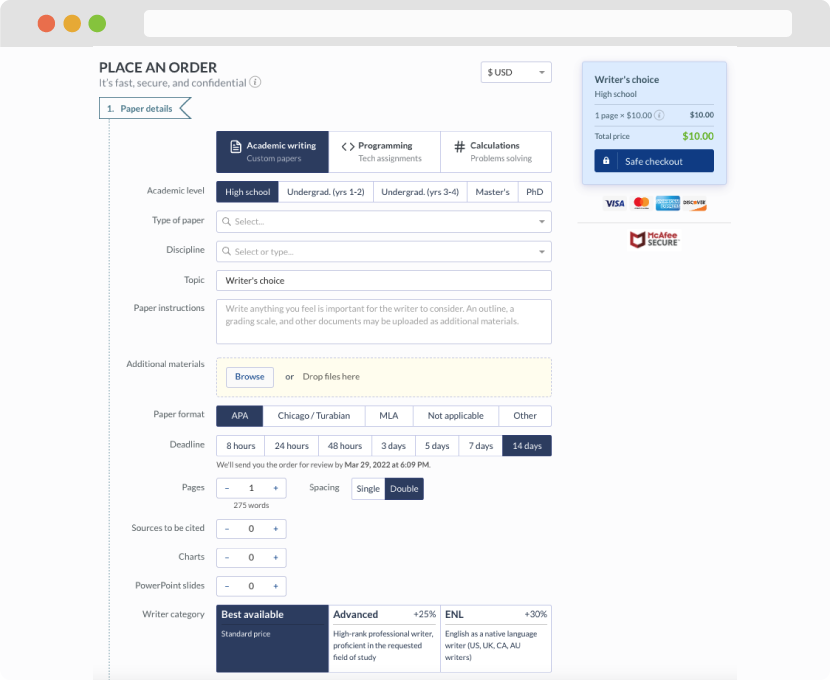
First, you will need to complete an order form. It's not difficult but, if anything is unclear, you may always chat with us so that we can guide you through it. On the order form, you will need to include some basic information concerning your order: subject, topic, number of pages, etc. We also encourage our clients to upload any relevant information or sources that will help.
Complete the order form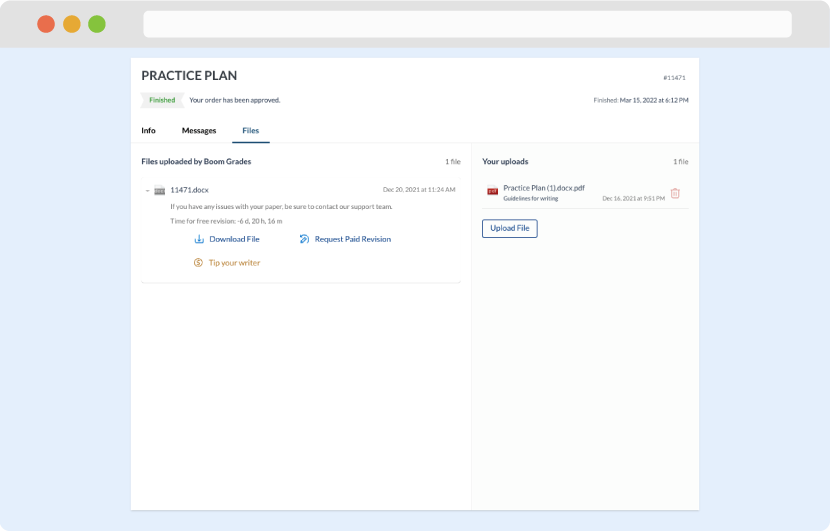
Once we have all the information and instructions that we need, we select the most suitable writer for your assignment. While everything seems to be clear, the writer, who has complete knowledge of the subject, may need clarification from you. It is at that point that you would receive a call or email from us.
Writer’s assignment
As soon as the writer has finished, it will be delivered both to the website and to your email address so that you will not miss it. If your deadline is close at hand, we will place a call to you to make sure that you receive the paper on time.
Completing the order and download