Complete the system evolution table until you use up all the provided random numbers. The conceptualization of such a model would follow the 8 steps described in this document. You will then conduct a manual simulation of the production system to learn the mechanics of the discrete event simulation process. Fill out the attached simulation progress chart and report on the statistics as described in the document.
Please submit a copy of your Excel simulation worksheet here.
Operations Analytics – Assignment #2
1
Assume that your simulation model has been built and it has generated the following random
numbers for part inter-arrival and machine processing times. Track the evolution of the
system using the Excel chart/diagram uploaded in Moodle. Assume that the first part arrives
at time 0. The first two rows have been filled in for you. You must use the random numbers
in each column in order from top to bottom. The random numbers that have already been
used are crossed out. Continue to working on the system evolution until you are out of
random numbers for machine processing times.
When describing the system state, use P1, P2 … to indicate arriving parts to the system that
are in the queue and machines (i.e. P1 is the first arriving part, P2 is the second arriving part
etc.). Write the letter “B” next to a part at M1 if it is blocked; otherwise no letter next to M1
indicates there is no blockage (i.e. M1 is processing). The items in the event calendar do not
need to be listed in chronological order.
Report on the system performance measures below in the chart:
1) M1 usage time so far
2) M2 usage time so far
3) Time for exiting parts
4) Number of exiting parts
2
Evolution of System
Time
Scheduled Events
0
Arrival (P1)
1.3
1.9
Conditional Event(s)
M1 starts
System State Immed
Queue 1 (infinite cap
M2 starts
Queue 1 (infinite cap
M1 starts
Queue 1 (infinite cap
M1 Finishes
Arrival (P2)
Queue 1 (infinite cap
2.1
Arrival (P3)
M1 starts
2.7
Queue 1 (infinite cap
M1 Finishes
Queue 1 (infinite cap
Queue 1 (infinite cap
Queue 1 (infinite cap
Queue 1 (infinite cap
Queue 1 (infinite cap
Queue 1 (infinite cap
Queue 1 (infinite cap
Queue 1 (infinite cap
Queue 1 (infinite cap
Queue 1 (infinite cap
Queue 1 (infinite cap
Queue 1 (infinite cap
Queue 1 (infinite cap
Queue 1 (infinite cap
Queue 1 (infinite cap
Queue 1 (infinite cap
Queue 1 (infinite cap
Queue 1 (infinite cap
Queue 1 (infinite cap
Queue 1 (infinite cap
Queue 1 (infinite cap
Operations Analytics – Assignment #2 Template
System State Immediately Following the Event
Queue 1 (infinite capacity)
M1
Queue 2 (cap. 2)
M2
Queue 2 (cap. 2)
M2
P1
Queue 1 (infinite capacity)
M1
P1
Queue 1 (infinite capacity)
M1
Queue 2 (cap. 2)
P2
Queue 1 (infinite capacity)
M1
P3
Queue 1 (infinite capacity)
M2
P1
Queue 2 (cap. 2)
P2
M2
P1
M1
Queue 2 (cap. 2)
M2
P3
P2
P1
Queue 1 (infinite capacity)
M1
Queue 2 (cap. 2)
M2
Queue 1 (infinite capacity)
M1
Queue 2 (cap. 2)
M2
Queue 1 (infinite capacity)
M1
Queue 2 (cap. 2)
M2
Queue 1 (infinite capacity)
M1
Queue 2 (cap. 2)
M2
Queue 1 (infinite capacity)
M1
Queue 2 (cap. 2)
M2
Queue 1 (infinite capacity)
M1
Queue 2 (cap. 2)
M2
Queue 1 (infinite capacity)
M1
Queue 2 (cap. 2)
M2
Queue 1 (infinite capacity)
M1
Queue 2 (cap. 2)
M2
Queue 1 (infinite capacity)
M1
Queue 2 (cap. 2)
M2
Queue 1 (infinite capacity)
M1
Queue 2 (cap. 2)
M2
Queue 1 (infinite capacity)
M1
Queue 2 (cap. 2)
M2
Queue 1 (infinite capacity)
M1
Queue 2 (cap. 2)
M2
Queue 1 (infinite capacity)
M1
Queue 2 (cap. 2)
M2
Queue 1 (infinite capacity)
M1
Queue 2 (cap. 2)
M2
Queue 1 (infinite capacity)
M1
Queue 2 (cap. 2)
M2
Queue 1 (infinite capacity)
M1
Queue 2 (cap. 2)
M2
Queue 1 (infinite capacity)
M1
Queue 2 (cap. 2)
M2
Queue 1 (infinite capacity)
M1
Queue 2 (cap. 2)
M2
Queue 1 (infinite capacity)
M1
Queue 2 (cap. 2)
M2
Queue 1 (infinite capacity)
M1
Queue 2 (cap. 2)
M2
Queue 1 (infinite capacity)
M1
Queue 2 (cap. 2)
M2
Event Calender (time, event)
(1.3, M1 finishes)
(1.9, Arrival)
(1.9, Arrival)
(3.3, M2 finishes)
(1.9+0.2=2.1, arrival)
(3.3, M2 finishes)
(1.9+0.8=2.7, M1 finishes)
(2.7, M1 finishes)
(3.3, M2 finishes)
(2.1+3.0=5.1, Arrival)
(3.3, M2 finishes)
(5.1, Arrival)
(2.7+3.7=6.4, M1 finishes)
Statistical Accumulators
M1 Usage Time: 0
M2 Usage Time: 0
Time for Exited Parts: 0
Number of Exits: 0
M1 Usage Time: 1.3
M2 Usage Time: 0
Time for Exited Parts: 0
Number of Exits: 0
M1 Usage Time: 1.3
M2 Usage Time: (1.9 – 1.3 = 0.6)
Time for Exited Parts: 0
Number of Exits: 0
M1 Usage Time: 1.3 + 0.2 = 1.5
M2 Usage Time: 0.6 + 0.2 = 0.8
Time for Exited Parts: 0
Number of Exits: 0
M1 Usage Time: 1.5 + (2.7 – 2.1) = 2.1
M2 Usage Time: 0.8 + (2.7-2.1) = 1.4
Time for Exited Parts: 0
Number of Exits: 0
M1 Usage Time:
M2 Usage Time:
Time for Exited Parts:
Number of Exits:
M1 Usage Time:
M2 Usage Time:
Time for Exited Parts:
Number of Exits:
M1 Usage Time:
M2 Usage Time:
Time for Exited Parts:
Number of Exits:
M1 Usage Time:
M2 Usage Time:
Time for Exited Parts:
Number of Exits:
M1 Usage Time:
M2 Usage Time:
Time for Exited Parts:
Number of Exits:
M1 Usage Time:
M2 Usage Time:
Time for Exited Parts:
Number of Exits:
M1 Usage Time:
M2 Usage Time:
Time for Exited Parts:
Number of Exits:
M1 Usage Time:
M2 Usage Time:
Time for Exited Parts:
Number of Exits:
M1 Usage Time:
M2 Usage Time:
Time for Exited Parts:
Number of Exits:
M1 Usage Time:
M2 Usage Time:
Time for Exited Parts:
Number of Exits:
M1 Usage Time:
M2 Usage Time:
Time for Exited Parts:
Number of Exits:
M1 Usage Time:
M2 Usage Time:
Time for Exited Parts:
Number of Exits:
M1 Usage Time:
M2 Usage Time:
Time for Exited Parts:
Number of Exits:
M1 Usage Time:
M2 Usage Time:
Time for Exited Parts:
Number of Exits:
M1 Usage Time:
M2 Usage Time:
Time for Exited Parts:
Number of Exits:
M1 Usage Time:
M2 Usage Time:
Time for Exited Parts:
Number of Exits:
M1 Usage Time:
M2 Usage Time:
Time for Exited Parts:
Number of Exits:
M1 Usage Time:
M2 Usage Time:
Time for Exited Parts:
Number of Exits:
M1 Usage Time:
M2 Usage Time:
Time for Exited Parts:
Number of Exits:
M1 Usage Time:
M2 Usage Time:
Time for Exited Parts:
Number of Exits:
M1 Usage Time:
M2 Usage Time:
Time for Exited Parts:
Number of Exits:
Time between part arrrivals
1.9
0.2
3.0
0.1
3.7
5.7
2.1
1.8
4.3
M1 Processing Time
1.3
0.8
3.7
2.3
0.7
5.0
2.8
4.3
1.5
M2 Processing Time
2.0
6.7
0.5
0.6
0.3
1.7
4.3
3.5
5.2
Essay Writing Service Features
Our Experience
No matter how complex your assignment is, we can find the right professional for your specific task. Achiever Papers is an essay writing company that hires only the smartest minds to help you with your projects. Our expertise allows us to provide students with high-quality academic writing, editing & proofreading services.
Free Features
Free revision policy
$10Free bibliography & reference
$8Free title page
$8Free formatting
$8How Our Dissertation Writing Service Works
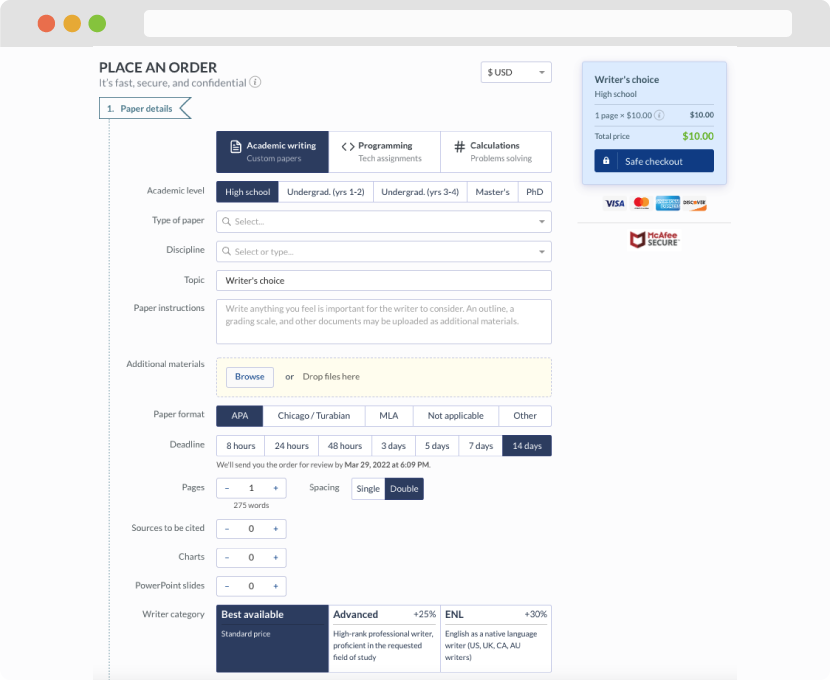
First, you will need to complete an order form. It's not difficult but, if anything is unclear, you may always chat with us so that we can guide you through it. On the order form, you will need to include some basic information concerning your order: subject, topic, number of pages, etc. We also encourage our clients to upload any relevant information or sources that will help.
Complete the order form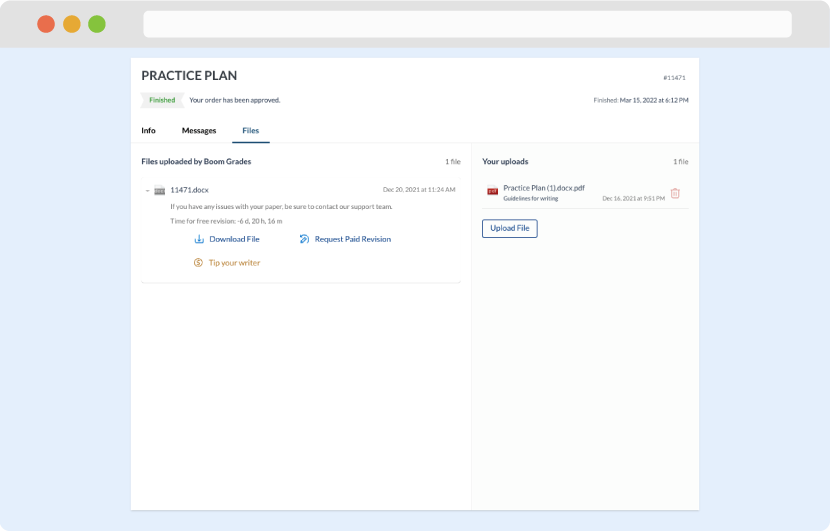
Once we have all the information and instructions that we need, we select the most suitable writer for your assignment. While everything seems to be clear, the writer, who has complete knowledge of the subject, may need clarification from you. It is at that point that you would receive a call or email from us.
Writer’s assignment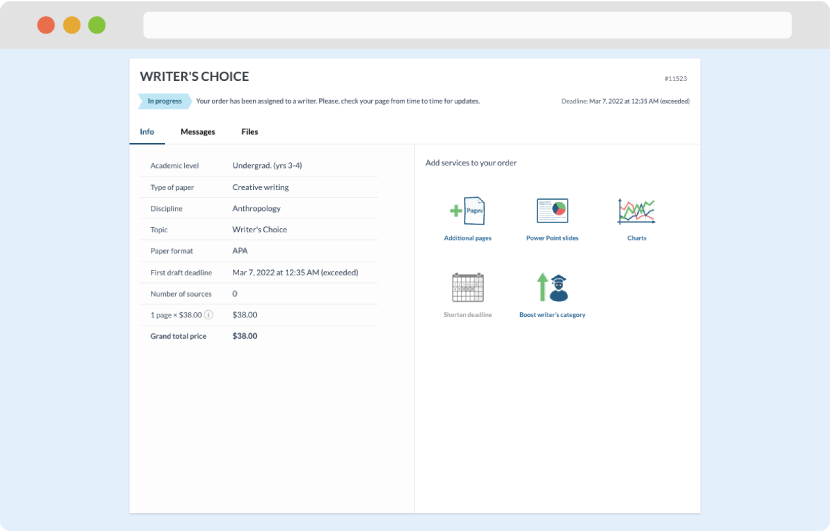
As soon as the writer has finished, it will be delivered both to the website and to your email address so that you will not miss it. If your deadline is close at hand, we will place a call to you to make sure that you receive the paper on time.
Completing the order and download