Week 7 Assignment: LabRequired Resources
Read/review the following resources for this activity:
•
OpenStax Textbook: Chapter 8
•
Introductory Statistics Textbook:
•
8.1 A Confidence Interval for a Population Standard Deviation, Known or Large
Sample Size
•
8.2 A Confidence Interval for a Population Standard Deviation Unknown, Small
Sample Case
•
8.3 A Confidence Interval for A Population Proportion
•
•
8.4 Calculating the Sample Size n: Continuous and Binary Random Variables
Scenario/Summary
The highlight of this week’s lab is confidence intervals and the use of these intervals in
the health sciences. There is a short reading that specifically relates confidence intervals
to health sciences and then you are asked to demonstrate your knowledge of confidence
intervals by applying them in a practical manner.
Deliverables
The deliverable is a Word document with your answers to the questions posed below
based on the article you find.
Required Software
•
•
Microsoft Word
Internet access to read articles
Prepare
•
Download the Week 7 Lab Lecture Notes.
Demonstrate
Steps to Complete the Week 7 Lab
Step 1: Find these articles in the Chamberlain Library. Once you click each link, you will
be logged into the Library and then click on “PDF Full Text”.
•
•
First Article: Confidence Intervals, Part 1 Links to an external site.
Second Article: Confidence Intervals, Part 2 Links to an external site.
Step 2: Consider the use of confidence intervals in health sciences with these articles as
inspiration and insights.
Step 3: Using the data you collected for the Week 5 Lab (heights of 10 different people
that you work with plus the 10 heights provided by your instructor), discuss your
method of collection for the values that you are using in your study (systematic,
convenience, cluster, stratified, simple random). What are some faults with this type of
data collection? What other types of data collection could you have used, and how might
this have affected your study?
Step 4: Now use the Week 6 Spreadsheet to help you with calculations for the following
questions/statements.
a) Give a point estimate (mean) for the average height of all people at the place where
you work. Start by putting the 20 heights you are working with into the
blue Data column of the spreadsheet. What is your point estimate, and what does this
mean?
b) Find a 95% confidence interval for the true mean height of all the people at your place
of work. What
is the interval? [see screenshot below]
c) Give a practical interpretation of the interval you found in part b, and explain carefully
what the output
means. (For example, you might say, “I am 95% confident that the
true mean height of all of the
people in my company is between 64 inches and
68 inches”).
d) Post a screenshot of your work from the t value Confidence Interval for µ from the
Confidence
Interval tab on the Week 6 Excel spreadsheet
Step 5: Now, change your confidence level to 99% for the same data, and post a
screenshot of this table, as well.
Step 6: Compare the margins of error from the two screenshots. Would the margin of
error be larger or smaller for the 99% CI? Explain your reasoning.
Lab 7 Lecture Notes
You will need your Week 5 Lab Data!!
1. Go to Modules in the course room and click on Week 7 Lesson:
Hypothesis Testing
2. Click on Week 7 Assignment: Lab
3. Download the Week 6
4. Let’s look at our data from Lab 5!
Data Set: Ten Grades on the Midterm Exam
50
86
68
86
Mean: ________
74
80
77
78
80
90
Our Score: _________
Standard Deviation: _________
5. Find a 95% confidence interval for the true mean Midterm Average of all
the people in the class. What is the interval? [Provide a Screenshot].
6. Give a practical interpretation of the 95% confidence interval.
7. Find a 99% confidence interval for the true mean Midterm Average of all
the people in the class. What is the interval? [Provide a Screenshot].
8. Give a practical interpretation of the 99% confidence interval. Would the
margin of error be larger or smaller for the 99% CI? Explain your reasoning.
Lab 7 Overview
Name: ___________________
Instructor: __________________ Date: _______
Lab 7 Template
1. Write a paragraph summarizing what you learned from the articles
provided. Consider the use of confidence intervals in health sciences
with these articles as inspiration and insights.
Data Collection
Use the data set you collected for the Week 5 lab (heights of 10 different
people plus the 10 heights provided by your instructor). (NOTE: This is
NOT the data used in the lab video, which is about midterm grades. Do not
use the midterm grades data.)
You will need your Week 5 Lab Data!!
2. Download the Week 6
3a. Provide a screenshot of your Week 5 Data (20 Heights)
3b. Summarize the Preliminary Calculations:
Mean: ______ Your Height: _________Standard Deviation: _______
Write at least one paragraph to answer each of the following questions:
3c. Discuss your method of collection for the values that you are using in
your study (systematic, convenience, cluster, stratified, simple random).
3d. What are some faults with this type of data collection?
3e. What other types of data collection could you have used, and how
might this have affected your study?
Calculations
4. Find a 95% confidence interval for the true mean of heights. What is the
interval? [Provide a Screenshot].
5. Give a practical interpretation of the 95% confidence interval [Write a
complete sentence].
6. Find a 99% confidence interval for the true mean heights. What is the
interval? [Provide a Screenshot].
7. Give a practical interpretation of the 99% confidence interval [Write a
complete sentence].
Compare Margins of Error
8a. Would the margin of error be larger or smaller for the 99% CI? Explain
your reasoning.
8b. As the confidence level increases, what happens to the Margin of
Error?
Empirical Rule using standard error for CONFIDENCE INTERVAL
Enter the data in the blue highlighted area and the results will show in the yellow highlighted are
ANSWER
Empirical Rule68-95-99.7
mean
0.43
Lower number
68% 0.39
Standard error
0.04
95% 0.35
99.70% 0.31
ellow highlighted area.
ANSWER
Note: standard error- Standard deviation of sample means or the standard deviation of sample proportions
68-95-99.7
Note: standard error is not standard deviation.
Upper number
0.47
0.51
0.55
of sample proportions
Enter the data in the blue highlighted area and the results will show in the yellow highlighted area.
Enter values starting from B5 cell
Data
18.4
16.1
19.5
16.5
12.5
17.2
13.8
17.9
19.1
9.8
23.8
18.7
19.1
15
19.2
17
11.5
15.7
22.5
23.7
19.9
17.6
15
17.8
20.7
14.2
15.4
Mean 17.3185
Sample Standard Deviation 3.4029
Enter the data in the blue highlighted area and the results will show in the yellow highlighted area.
t or z Confidence Interval for µ
Confidence Level
n
Mean
StDev
pop stdev
0.950
100
3.9600
4.7500
yes
SE
z
Margin of Error
Lower Limit
Upper Limit
0.475000
1.960
0.931000
3.029000
4.891000
Confidence Interval for p Propor
Enter decimal
Confidence Level
n
Number of Successes
Enter yes if population stdev known
Enter No if population stdev is unknown
Sample Proportion
SE
z
Margin of Error
Lower Limit
Upper Limit
ce Interval for p Proportions
0.950
100
23
0.230000
0.042083
1.960
0.082483
0.147517
0.312483
Enter decimal
Enter the data in the blue highlighted area and the results will show in the yellow highlighted area.
Minimum Sample Size μ for population mean
Confidence Level
StDev
Error
0.950
10
3
z-Value
Minimum Sample Size
1.960
43
Minimum Sample Size p for Proportion
Enter decimal
Confidence Level
Sample Proportion
Error
0.900
0.63
0.01
z-Value
Minimum Sample Size
1.645
6308
e Size p for Proportion
Enter decimal
If sample proportion unknown enter 0.5
Write percentage as decimal
Week 5 Lab
Week 5 Lab
“Please use this template to help answer the questions listed in the lab instructions. The “steps”
below refer to the steps listed in the lab instructions. Type your answers and post your
screenshots in the spaces given below. Then, save this document with your name and submit it
inside the course room.
Step 1. Gather Data
Your instructors will post 10 data values to use for this lab. The data values represent the
HEIGHTS of 10 people. This data set is published in the FILES area in the “Lab Files” folder.
(NOTE: This is NOT the data used in the lab video about midterm grades. Do not use the
midterm grades data.)
1a. Gather 10 MORE heights on your own to add to the ten provided by your instructor. Please
do the following: Survey or measure ten people to find their sizes. Determine the mean and
standard deviation for the 20 values by using the Week 3 Excel spreadsheet. (Round statistics
to two decimals.)
Sample mean =
66.90
Sample standard deviation =
3.75
The mean is the aggregate grade of a group. The sum of the scores was then divided by the total
number of values. If population sampling is tiny, the mean is susceptible to extreme values. For
instance, if two students in a class of 20 scored much better than the others, this will push the
average higher than the remaining scores would imply. Using means is more effective with
bigger sample sizes.
Standard deviation (SD) is a common measure of variation in statistical analysis. It indicates the
amount of deviation from the average. A low SD implies that the measured values are often near
the mean, while a high SD shows that the data span a wide range of values.
1b. Post a screenshot in the space BELOW of the portion of the spreadsheet that helped you
determine these values. The screenshot should show ALL 20 pieces of data. Make sure the
instructor data is listed first and your information is listed under.
1
Heights (in)
61
64
65
66
67
68
68
68
70
72
Name
Age
23
25
19
17
19
24
23
25
20
19
23
22
18
21
20
24
26
23
23
21
Heights (in) Gender
60 M
61 F
62 M
63 F
64 M
64 F
65 M
66 F
67 M
67 F
68 M
68 F
68 M
68 F
69 M
70 F
71 M
72 F
72 M
73 F
Street
Waterside Dr
Cobb PKWY
Elison Lakes CT
Waterside Dr
Elison Lakes CT
Cobb PKWY
Cobb PKWY
Elison Lakes CT
Cobb PKWY
Elison Lakes CT
Waterside Dr
Waterside Dr
Elison Lakes CT
Elison Lakes CT
Cobb PKWY
Waterside Dr
Elison Lakes CT
Waterside Dr
Cobb PKWY
Elison Lakes CT
2
1c. Answer the following two questions. Use at least two sentences to answer each question.
How does your height compare to the mean (average) height of the 20 values? Is your height
taller, shorter, or the same as the mean of the sample?
I am 72 inches; and the mean height is 66.9. It shows my height is above sample mean thus
taller.
Step 2. Data Characteristics
Answer the following questions to give background information on the people you used in your
study. Write at least two sentences for each question.
1. How did you choose the participants for your study? What was the sampling method:
systematic, convenience, cluster, stratified, or random?
Achieving results with statistical significance is contingent upon the sample magnitude of the
analysts, the number of persons from whom they collect data, and the total population size they
aim to comprehend. In a stratified sample, analysts split a population into homogenous
subpopulations, or strata, depending on features, e.g., race, sex, and location. Each member of
the examined population may be in a stratum. Each layer is then selected using a different
sampling method, such as clustering or simple random sampling, so that researchers may derive
statistical metrics for each subpopulation.
When a populace’s features are diverse, and scientists want to show that each characteristic is
well reflected in the selected participants, they employ sampling techniques.
To employ stratification techniques, you must be able to split your populace into mutually
unique groups. It indicates that every individual in the population may be categorized into a
single subgroup. Assuming that groupings will have different average scores for the variable(s)
examined, the stratified selection is the most appropriate probability sampling technique. It has
various possible benefits:
A stratified sample consists of individuals from each category, guaranteeing that it accurately
reflects the variety of your community. It is practicable (albeit improbable) that this would not
happen if another selection techniques, such as sampling randomly, is employed.
ensuring comparable variation
If you desire the variability of the data obtained from each segment to be comparable, you must
choose equal sample sizes for each grouping. Other selection techniques may affect in a small
sample group for precise groupings because of their rarity in the general populace.
I used the stratified sampling method: the heights identified at least two males and two females.
2. What part of the country did your study take place in?
The study occurred in three streets, Waterside Dr, Cobb PKWY, and Ellison Lakes CT in
Georgia.
3
3. What are the age ranges of your participants?
The age range for my sample population is 17- 26.
4. How many of each gender did you have in your study?
I chose two genders, each ten individuals both male and female
5. What are other interesting factors about your group?
The exciting idea on the data is that it has two genders. It consists of an equal number of both
genders. It identifies critical demographic traits within the sample. Similar to a weighting factor,
this group gives a population sample proportionate to the entire population.
Step 3. Data Analysis
Answer the following questions. Use the Week 5 Excel spreadsheets to help analyze the data.
Empirical Rule
1. Determine the 68%, 95%, and 99.7% values of the Empirical Rule in terms of the 20
heights in your height study. (Use the Empirical Rule tab from the spreadsheet).
ANSWER
68-95-99.7
Lower number
Upper number
68%
63.15
70.65
95%
59.4
74.4
99.70%
55.65
78.15
Empirical Rule
mean
66.9
standard deviation
3.75
4
According to the Empirical Rule, 99.7 percent of measured data with a normal curve reside
within three of the mean’s standard deviation.
68% of the dataset falls inside one standard error, 95% within two sd, and 99.7% in three normal
ranges, according to this criterion.
The confidence interval boundaries in statistical process control diagrams and risk analyses, such
as variance, are determined using three-sigma limits that adhere to the empirical rule.
As a result, this probability distribution might be used as an intermediate heuristic, as collecting
the correct data could be time taking or even tricky in certain circumstances. Such factors are
considered when a company reviews its quality control procedures or evaluates its risk exposure.
For instance, value-at-risk presumes that the frequency of risk occurrences is usually distributed.
The empirical method is sometimes employed as a rudimentary test for the “normality” of a
distribution. If an excessive number of observations fall outside of the three standard error limits,
this implies that the data is not regular and may be biased or follow another distribution.
2. What do these values tell you? (Write at least one paragraph.)
As stated previously, the empirical method is beneficial for predicting outcomes inside a data
collection. Once the standard error has been calculated, the data set may be submitted
empirically, indicating where the data points fall within the distribution.
Even without knowing the details of all data, it is feasible to predict where results will fall within
the set given on the 68%, 95%, and 99.7% mandates indicating where all information should
rest.
In most instances, the empirical method is critical for determining consequences when not all
data is accessible. It enables statisticians or anyone analyzing the data to predict where the
information will fall after it is collected. The empirical rule assesses the normality of data
collection. If the data violates the empirical criterion, it is not approximately normal and must be
computed as such.
This data thus shows that:
68% of the height lies between 63.15 and 70.65
95% of the size lies between 59.40 and 74.40
99.7% of the size lies between 55.65 and 78.15
Normal Distribution
3. Based on your study results, what percent of the study participants are shorter than
you? What percent are taller than you? (Use the average probability tab from the
spreadsheet).
Since my height is 72 inches, 91.31% is the total population is short.
8.69% is taller than me.
5
4. Post a screenshot of the normal distribution from the Week 5 Excel spreadsheet to
support your answer above.”
Z score
x
mean
standard deviation
LESS THAN(At most)
AREA LESS THAN
72
66.9
3.75
ENTER
Asked to find x
MORE THAN (at least)
72
Mean
66.9
Stdev
3.75
AREA MORE THAN
ENTER
Asked to find x
Mean
66.9
Stdev
3.75
Probability INBETWEEN
INBETWEEN
72
Z score
Z score
Probability Less than F7
1.36
0.9131
Z score
Probability more than F13
1.36
0.0869
ENTER
Asked to find Large value
73
Asked to find smaller value
Mean
Stdev
60
66.9
3.75
ANSWER
1.36
Probability between F19 and F20 is
ANSWER
0.9152
Step 4. Save and submit this document
Be sure your name is on the Word document, save it, and then submit it. In
the assignment module, click “start assignment” and then “upload file” and
“submit assignment”.
6
Essay Writing Service Features
Our Experience
No matter how complex your assignment is, we can find the right professional for your specific task. Achiever Papers is an essay writing company that hires only the smartest minds to help you with your projects. Our expertise allows us to provide students with high-quality academic writing, editing & proofreading services.
Free Features
Free revision policy
$10Free bibliography & reference
$8Free title page
$8Free formatting
$8How Our Dissertation Writing Service Works
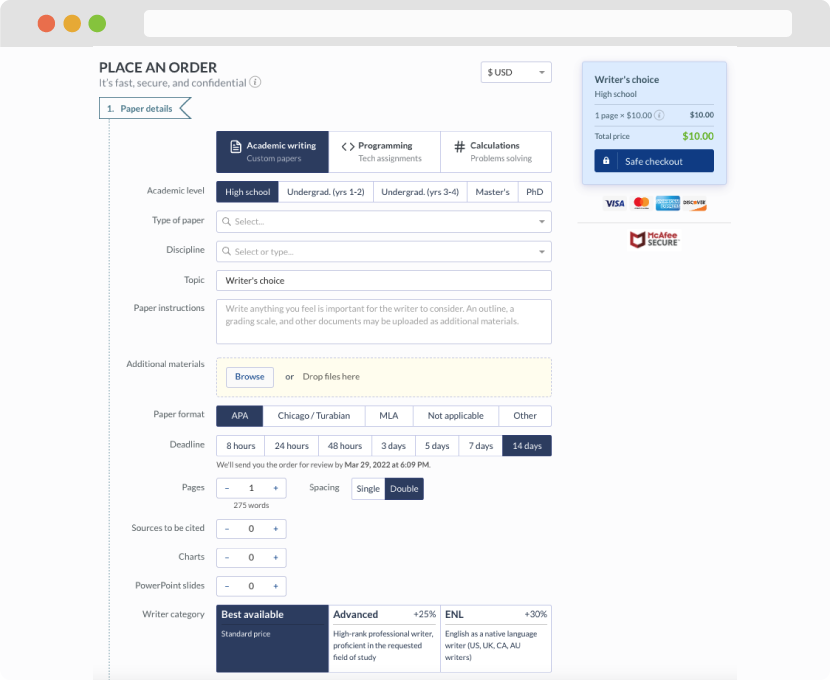
First, you will need to complete an order form. It's not difficult but, if anything is unclear, you may always chat with us so that we can guide you through it. On the order form, you will need to include some basic information concerning your order: subject, topic, number of pages, etc. We also encourage our clients to upload any relevant information or sources that will help.
Complete the order form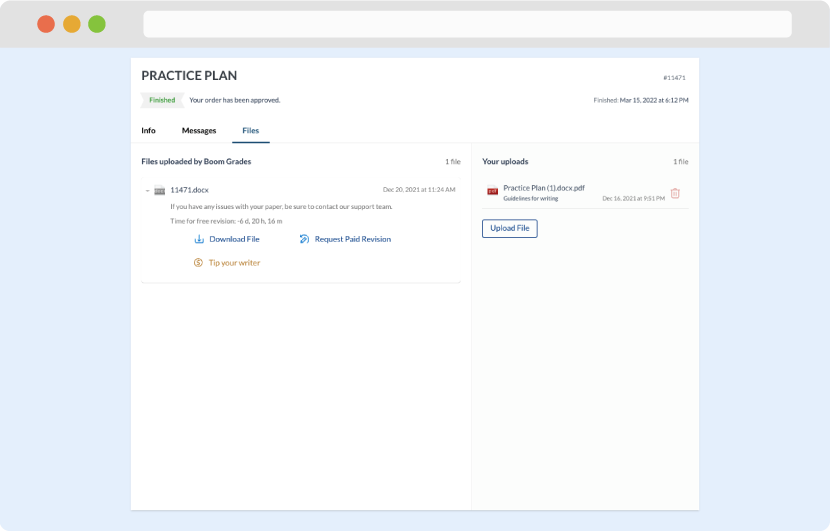
Once we have all the information and instructions that we need, we select the most suitable writer for your assignment. While everything seems to be clear, the writer, who has complete knowledge of the subject, may need clarification from you. It is at that point that you would receive a call or email from us.
Writer’s assignment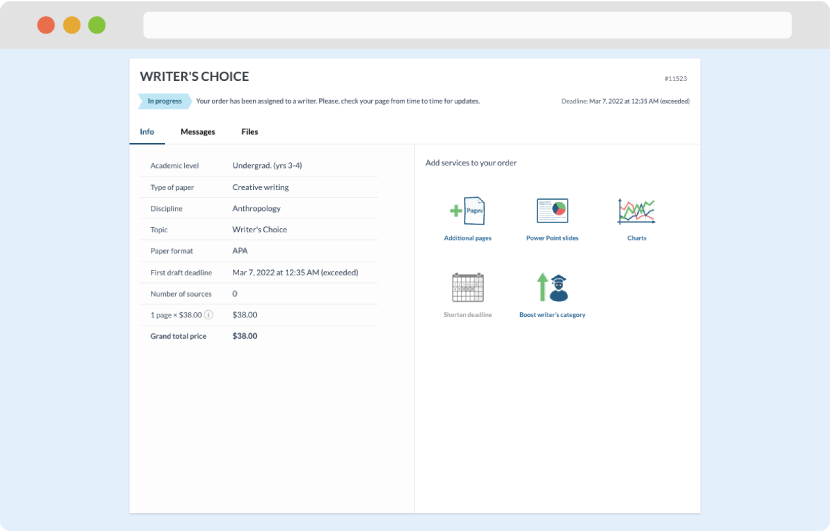
As soon as the writer has finished, it will be delivered both to the website and to your email address so that you will not miss it. If your deadline is close at hand, we will place a call to you to make sure that you receive the paper on time.
Completing the order and download