Basically you would be creating your own problem.Here is the description: you will demonstrate your understanding of data collection and descriptive statistics. You will collect the data, organize, summarize, and describe the data the way it is explained in Chapter 1-Chapter 3. You will, then, create a written report including all parts below and turn in by the stated due date according to the guidelines provided in this paper. Math 227 Sample Project
Project 1 Data Collection and Descriptive Statistics
In this project, you will demonstrate your understanding of data collection and descriptive statistics. You
will collect the data, organize, summarize, and describe the data the way it is explained in Chapter 1Chapter 3. You will, then, create a written report including all parts below and turn in by the stated due
date according to the guidelines provided in this paper.
Required components:
1. Research Questions about a Population (Chapter 1)
Question 1: Come up with a research question on making an estimate about a population
proportion.
(For example: What proportion of Los Angeles Mission College students are full time students?)
State your Question 1 (and your estimated prediction of the results):
________________________________________________________________________
________________________________________________________________________
________________________________________________________________________
Question 2: Come up with a research question on making an estimate about a population mean.
(For example: What is the average number of hours that Los Angeles Mission College students
work each week?)
State your Question 2 (and your estimated prediction of the results):
________________________________________________________________________
________________________________________________________________________
________________________________________________________________________
2. Collecting Data- (Chapter 1)
a) Create a survey and collect the data for responses to your proposed questions above.
For question 1, your survey should have a qualitative variable with only two possible responses,
Write your variable and the question below (For example: full time student status. “Are you a
full-time student, Yes or No?”):
________________________________________________________________________
________________________________________________________________________
________________________________________________________________________
For question 2, your survey should have a quantitate variable. Write your variable and the
question below (For example: number of hours of work in a week. “How many hours do you
work each week?”):
________________________________________________________________________
________________________________________________________________________
________________________________________________________________________
b) Describe the data collecting process including the population of interest. For each question,
address if there was any of the following biases: Sampling bias, Non-response bias, and
Response bias.
c) Enter your raw data in Column 1 (categorical data) and in Column 2 (numerical data) in
StatCrunch. Name each column and save the data (Data>Save>Enter the File Name>Click Save).
To later open the saved data in StatCrunch.com, go to StatCrunch.com>MyStatCrunch>My
Data> Load>My Data> Choose the Name/Notes.)
3. Organizing, Summarizing, and Describing Data using StatCrunch (Chapter 2)
a) Open your saved survey data. Organize your data for your categorical variable in column 1,
into a frequency/relative frequency table. Save the distribution table. (To open the saved
results later in StatCrunch.com, go to StatCrunch.com>MyStatCrunch> My Results>Choose the
Name/Notes.)
b) Construct a bar graph for a frequency distribution and for a relative frequency distribution for
your categorical variable. Display the value above the bar. Save the graph.
c) Construct a pie chart for the categorical variable. Save the result.
d) Create a dotplot and a histogram for your survey’s numerical data in column 2. Make sure
that your histogram has an appropriate width for the bins. Display the value above the bar.
Explain why your choice for the width makes sense for your specific data. Save your graphs.
4. Describing Quantitative Data using StatCrunch (Chapter 3)
a) Open your survey data and the dotplot and the histogram for your survey’s numerical
variable. Create a boxplot for the variable in column 2. Write a description of each graph (What
does each graph show you about your data, that you won’t be able to easily see in the other
graphs?). Save the boxplot.
b) Find the following sample statistics for the data set: Minimum value, Maximum value, Mean,
Median, Mode, Q1, Q3, Range, IQR, and Standard Deviation. For each of these values write a
sentence explaining what it tells you about the results in your survey. Please do not write about
how they are calculated. The purpose of this exercise is to make sure that you understand the
meaning for each of these statistics (not how you find it). So please don’t include steps for
finding each of these. You will be graded on your explanation of what each value tells us
specifically about your sample.
Here’s an example of how I will grade the sentence about the median if it related to the
price of cars assuming that it is worth 6 points:
-The median is 22,000. – I would give this 1 point
-The median price of a car is 22,000 – I would give this 2 point.
-The median price of a car is $ 22,000. – I would give this 3 points.
-The median price of a car is $ 22,000 which means half the cars are less than $22,000 and
half are more than $22,000 – I would give this 5 points
-The median price of a car is $ 22,000 which means half the cars sold cost less than $22,000
and half cost more than $22,000 -I would give this 6 points
c) Describe and analyze the numerical data. What is the overall shape of the data set? Based on
your answer, determine which measure of center (mean, median or mode) you think is best and
why. Determine which measure of spread (IQR / standard deviation or range) you think is best
and why. Write a sentence explaining the real meaning of the center you found and a sentence
explaining the real meaning of the spread you have found for your data.
5. Create a written report including all your findings from the questions above. What did you learn
about the population of your interest from your data analysis? Please don’t forget to address
the answers to your initial research question 1 and question 2. Do you think your data
represented the population well? Did the result match your initial predictions? Why or why not?
You will be graded not only on your analysis and graphs, but also on the quality of your writing.
You should have an introduction paragraph discussing why this topic was important in the world
or important to you and a conclusion paragraph summarizing your findings. Your report should
be at least one and a half pages double spaced (font 12) not counting graphs.
Grades will be based on:
1. Choosing and stating the appropriate research questions about a population in part 1.
[8 pts],
2. Relevance and completeness of the survey and data collection in part 2. [12 pts],
3. Organizing, summarizing, and describing qualitative data using StatCrunch in part 3. [20 pts],
4. Organizing, summarizing, and describing quantitative data using StatCrunch in part 4.
[20 pts]
5. Clear summary of the main findings and completeness of the report in part 5 [30 pts], and
6. Overall quality of the report and adherence of the project guidelines [10 pts].
Submission Guidelines and the due date:
The report including all graphs and symbols must be generated using computer and only the printed
version will be accepted. The report should contain the title, your name, date, course name and
instructor’s name. The report should not contain any misspelled words. The report will not be returned
to you.
The printed project score sheet along with the title of your project and two research questions (page 3-6
of this guidelines), and the electronic copy of your raw data must be submitted to the instructor by:
____________________
The project is due at the beginning of the lab on: ____________________
Note: Late submission will be accepted. However, there will be a 10% per day penalty from your final
project grade.
Math 227 Project 1 Data Collection and Descriptive Statistics (Total 100 points)
Name:________________________________________ Date:__________________________________
Title of the project: ____________________________________________________________________
Research Question 1 on making an estimate about a population proportion:
___________________________________________________________________________________
Research Question 2 on making an estimate about a population mean:
___________________________________________________________________________________
Project Grade: __________________________________
Required components
Grading criteria
1. Research Questions about a Population
2. Choosing and stating
Question 1: Come up with a research question on making an
the appropriate
estimate about a population proportion.
research questions
(For example: What proportion of Los Angeles Mission College
about a population in
students are full time students?)
part 1.
[8 pts]
Question 2: Come up with a research question on making an
estimate about a population mean.
(For example: What is the average number of hours that Los
Angeles Mission College students work each week?)
State your Question 2 (and your estimated prediction of the
results):
2. Collecting Data
a) Create a survey and collect the data for responses to your
proposed questions above.
For question 1, your survey should have a qualitative variable
with only two possible responses, Write your variable and the
question below (For example: full time student status. “Are
you a full-time student, Yes or No?”):
For question 2, your survey should have a quantitate variable.
Write your variable and the question below (For example:
number of hours of work in a week. “How many hours do you
work each week?”):
3. Relevance and
completeness of the
survey and data
collection in part 2.
[12 pts]
Comments/Scores
b) Describe the data collecting process including the
population of interest. For each question, address if there was
any of the following biases: Sampling bias, Non-response bias,
and Response bias.
c) Enter your raw data in Column 1 (categorical data) and in
Column 2 (numerical data) in StatCrunch. Name each column
and save the data (Data>Save>Enter the File Name>Click Save).
To later open the saved data in StatCrunch, (Data> Load>My
Data>Choose the file name.)
3. Organizing, Summarizing, and Describing Qualitative Data
using StatCrunch
a) Open your saved survey data. Organize your data for your
categorical variable in column 1, into a frequency/relative
frequency table. Save the distribution table. (To open the
saved results later in StatCrunch, go to statcrunch.com>
MyStatCrunch> My Results>Choose the name/notes.)
3. Organizing,
summarizing, and
describing qualitative
data using StatCrunch
in part 3. [20 pts]
a)
b) b) Construct a bar graph for a frequency distribution and for a
relative frequency distribution for your categorical variable.
Choose to display the value above bar. Save the graphs.
c)
c) Construct a pie chart for the categorical variable. Save the
result.
d) Create a dotplot and a histogram for your survey’s numerical
data in column 2. Make sure that your histogram has an
appropriate width for the bins. Explain why your choice for the
width makes sense for your specific data. Save your graphs.
4. Organizing, Summarizing, and Describing Quantitative
Data using StatCrunch
a) Open your survey data and the dotplot and the histogram
for your survey’s numerical variable. Create a boxplot for the
variable in column 2. Write a description of each graph (What
does each graph show you about your data, that you won’t be
able to easily see in the other graphs?). Save the boxplot.
b) Find the following sample statistics for the data set:
Minimum value, Maximum value, Mean, Median, Mode, Q1,
Q3, Range, IQR, and Standard Deviation. For each of these
values write a sentence explaining what it tells you about the
results in your survey. Please do not write about how they are
calculated. The purpose of this exercise is to make sure that
you understand the meaning for each of these statistics (not
4. Organizing,
Summarizing, and
describing quantitative
data using StatCrunch
in part 4. [20 pts]
how you find it). So please don’t include steps for finding each
of these. You will be graded on your explanation of what each
value tells us specifically about your sample.
c) Describe and analyze the numerical data. What is the overall
shape of the data set? Based on your answer, determine which
measure of center (mean, median or mode) you think is best
and why. Determine which measure of spread (IQR / standard
deviation or range) you think is best and why. Write a
sentence explaining the real meaning of the center you found
and a sentence explaining the real meaning of the spread you
have found for your data.
5. Create a written report including all your findings from the 5. Clear summary of the
questions above. Write a short summary of the main findings
main findings and
that you discovered. Create a written report including all your
completeness of the
findings from the questions above. What did you learn about
report in part 5
the population of your interest from your data analysis? Please
[30 pts]
don’t forget to address the answers to your initial research
question 1 and question 2. Do you think your data represented
the population well? Did the result match your initial
predictions? Why or why not? You will be graded not only on
your analysis and graphs, but also on the quality of your writing.
You should have an introduction paragraph discussing why this
topic was important in the world or important to you and a
conclusion paragraph summarizing your findings. Your report
should be at least one and a half pages double spaced (font 12)
not counting graphs.
6. Overall quality of the report
6. Overall quality of the
report and
adherence of the
project guidelines
[5 pts]
Essay Writing Service Features
Our Experience
No matter how complex your assignment is, we can find the right professional for your specific task. Achiever Papers is an essay writing company that hires only the smartest minds to help you with your projects. Our expertise allows us to provide students with high-quality academic writing, editing & proofreading services.
Free Features
Free revision policy
$10Free bibliography & reference
$8Free title page
$8Free formatting
$8How Our Dissertation Writing Service Works
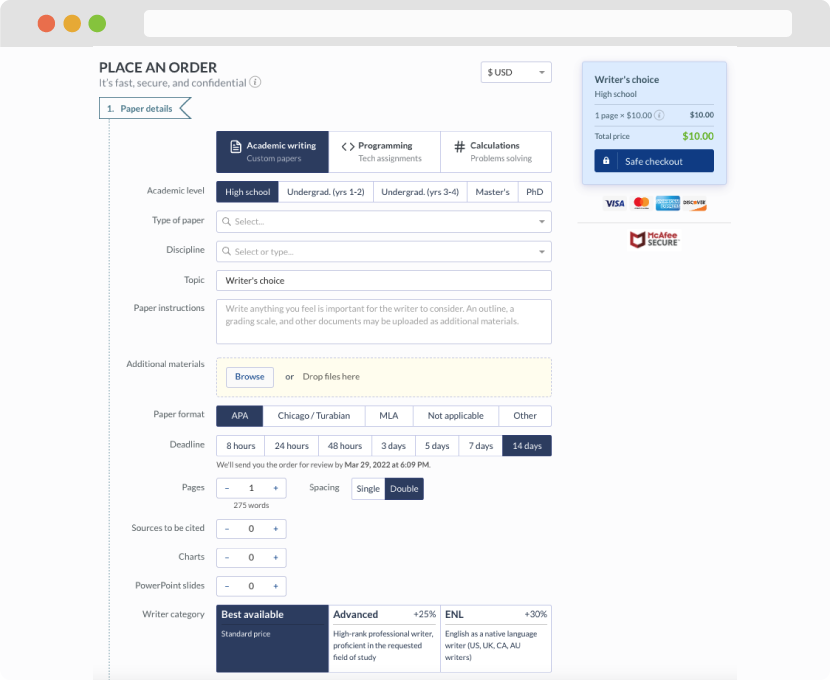
First, you will need to complete an order form. It's not difficult but, if anything is unclear, you may always chat with us so that we can guide you through it. On the order form, you will need to include some basic information concerning your order: subject, topic, number of pages, etc. We also encourage our clients to upload any relevant information or sources that will help.
Complete the order form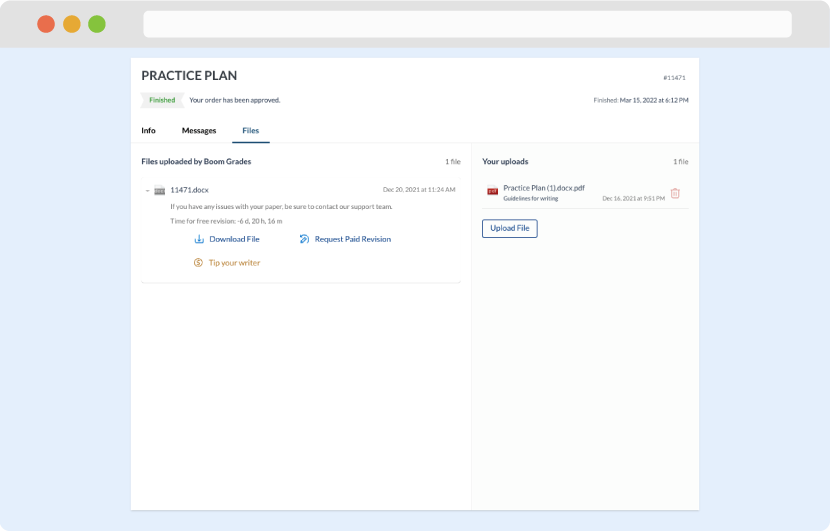
Once we have all the information and instructions that we need, we select the most suitable writer for your assignment. While everything seems to be clear, the writer, who has complete knowledge of the subject, may need clarification from you. It is at that point that you would receive a call or email from us.
Writer’s assignment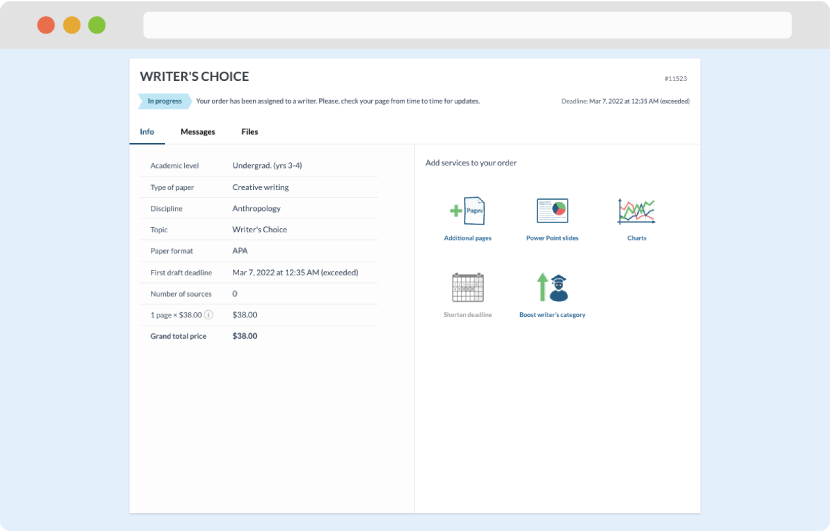
As soon as the writer has finished, it will be delivered both to the website and to your email address so that you will not miss it. If your deadline is close at hand, we will place a call to you to make sure that you receive the paper on time.
Completing the order and download