dfs? -2Using dataset: Breast_Cancer_Survey.sav.
We have n=666 female participants in this dataset. Several health-related variables, were
recorded in this dataset. Please review the codebook in the previous page. Was there any
differences in the perceived benefit scores among different ethnicity groups? (variable:
“Race” & “Benefit”) (30 points)
?
1. (1) What is the data analysis procedure you are going to use? (5 pts) .
To find out if there is any differences in the perceived benefit scores among
different ethnicity groups, we conduct a one way anova test with the dependent
variable being perceived benefit scores and the independent variable being
ethnicity or race. One-way anova is used to test if there are any statistically
difference in means a associated population. Our null hypothesis for this test will
be.
𝐻0:𝜇1 = 𝜇2 = 𝜇3 = 𝜇4 (No difference in means)
H1: Atleast one of the k population means is different.
2. (2) Report the necessary information and make conclusion to answer the research
question. (10 pts) .
One-way Anova results revealed that there was no statistically significant
difference in perceived benefits among the ethnicity groups. The f value was
found to be 1.465 and a p value of 0.211 which is greater than alpha value of 0.05,
thus we fail to reject the null hypothesis.
ANOVA
Benefit
Between
Groups
Within Groups
Total
Sum of
Squares
1.538
172.991
174.530
df
Mean Square
4
.385
659
663
.263
F
1.465
Sig.
.211
3. (3) Do you need a follow-up analysis? If yes, what is your follow-up analysis
result? (5 pts)
There is no need for a post hoc test since there was no statistically significant
difference in perceived benefits among the ethnicity groups.
2. Conduct a correlation analysis for variables “Knowledge_Pre”, “Knowledge_Post”,
“Suscep_Sever”, “Suscept_Server”, “Benefit” and “Barriers”. (20 pts)
1. (1) Report your correlation results in APA format. (10 pts)
A Pearson product-moment correlation to determine the relationship between knonwlwdge Pre
and Knowledge Post revealed that there was a moderate, positive correlation between
Knowledge Pre and Knowledge Post, which was statistically significant (r = 0.590, n = 666, p =
.000).
2. (2) What is the correlation determination for “Barriers” and “Benefit”? What
did it mean? (10 pts) .
The correlation between benefit and Barriers Serval was found to be averagely negative , (0.554) which was statistically signicant(r = 0.554, p = 0.00).
3. Can “Suscep_Sever” score predict “Knowledge_post” score? (20 pts)
1. (1) Write down the simple linear regression model relating to Suscep_Sever
score and the Knowledge_Post score. (5 pts)
𝐾𝑛𝑜𝑤𝑙𝑒𝑑𝑔𝑒 𝑝𝑜𝑠𝑡 = 7.050 ― 0.029 × 𝑆𝑢𝑠𝑐𝑒𝑏 𝑠𝑒𝑟𝑣𝑒𝑟
2. (2) How much variance in Suscep_Sever can be accounted for? (provide the
evidences) (5 pts).
There is no variance in susceb Server that can be accounted for by the regression.
( r square = 0.00). All the variance is as a result of other factors that are not
included in this model.
fi
We have ve variables and you only report two of them, which is incorrect.
This What
-9
???
is notdid
theitanswer
mean?for
-5this question. -10
not correct.
correct -5
-5
-5
3. (3) Is this regression model a good model to explain the linear relationship between
the Suscep_Sever score and the Knowledge_Post score? (provide the evidences) (5
pts).
The regression model is insignificant at 5% significance level (p= .593). Therefore,
we conclude that the regression model is not a good model to explain the linear
relationship between the Susceb Server score and the knowledge post score.
4. (4) Is the Suscep_Sever score a good predictor? (provide the evidences) (5 pts)
The coefficient of Susceb server is insignificant at 5% significance level (p= .593).
Therefore, we conclude that Susceb server is not a good predictor for knowledge post.
4. There were five different race groups in this dataset: Caucasian, Black, Hispanic, Asian
and Other. The researcher roughly estimated that about 60% of participants were
Caucasian, 25% were Black, 7% were Hispanic, 5% were Asian, and the other 3% of
participants others. Was the researcher correct? Using hypothesis testing to see if the
researcher’s estimation was correct. (Variable: “Race”)(20 pts)
1. (1) What type of data analysis procedure can be used to answer the research
question? (5 pts)
The test for this task is z- test for the difference between one proportion, with the
null hypothesis being the researchers claim for each race level.
2. (2) What is your answer toward the research question? (provide evidence) (15
pts)
All the researcher’s claims were insignificant at 5% significance level. We fail to
reject the null hypothesis and conclude that the researcher was correct.
What is your ethnicity?
Frequenc Percent
Valid
y
Percent
Cumulative
Percent
Caucasian
African
American
583
87.5
87.8
87.8
41
6.2
6.2
94.0
Hispanic
Asian
Other
Total
Missing System
Total
14
13
13
664
2
666
2.1
2.0
2.0
99.7
.3
100.0
2.1
2.0
2.0
100.0
96.1
98.0
100.0
Valid
not correct. -5
-15
5. Additionally, the researcher would like to examine if there were similar proportions of
different Race in the those two educational level groups. (hint: both “Race” and
“Education” are nominal scales.) (20 pts)
1. (1) What type of data analysis procedure can be sued to answer the research
question? (5 pts)
The test for this task is z- test for the difference between two proportions requires
that the two variables should be categorical. In this case, the two variables are
categorical. The hypothesis to be tested is:
𝐻0:𝑝1 = 𝑝2; The population proportion for race is equal to the population
proportion for Education, versus
𝐻0:𝑝1 ≠ 𝑝2; The population proportion for race is not equal to the population
proportion for Education
SPSS does not have a specific option for the z- test for the difference between two
proportions. However, we can do the chi-squared test instead. The p- value
resulting from this chi-squared test is equivalent to the two sided p- value that
would have resulted from the z- test.
2. (2) What is your answer toward the research question? (provide evidence) (15
pts)
The results can be reported with the help of the tables below
What is your ethnicity? * What is the highest educational level you have
obtained? Crosstabulation
Count
What is the highest
Total
educational level you have
obtained?
What is your
ethnicity?
High School
diploma or
GED
College and
above
Caucasian
African
American
16
567
583
3
38
41
Hispanic
Asian
Other
0
0
0
19
14
13
13
645
14
13
13
664
Total
Chi-Square Tests
Value
df
Asymp. Sig.
(2-sided)
Pearson Chi-Square
4.135a
4
.388
Likelihood Ratio
4.416
4
.353
Linear-by-Linear
.233
1
.629
Association
N of Valid Cases
664
a. 4 cells (40.0%) have expected count less than 5. The
minimum expected count is .37.
You need
These
areto
answers
interprettoyour
the questions.
results. -15
The chi- square statistic is insignificant at 5% significance level (p= .388).
Therefore, we fail to reject the null hypothesis and conclude that there is no
significant difference between the population proportion for race and the
population proportion for education.
EPY 6214 Final Exam
Dataset: Breast_Cancer_Survey.sav
Codebook for Exam Data
Variable
Age
Race
GPA
Marital
Education
Insurance
Screen
Knowledge_Pre
Knowledge_Post
Suscep_Sever
Benefit
Barriers
Values
Participants’ actual age.
1=Caucasian, 2=Black, 3=Hispanic, 4=Asian, 5=Other
Grade Point Average
1=Married, 2=Divorced/Separated, 3=Widowed, 4=Single
1=High school or below, 2=College or above
1=Yes, 2=No
Mammogram, 1=Yes, 2=No
Breast cancer related score, higher score indicates higher
level of knowledge
Perceived susceptibility and severity pertaining to the
perceived disruption caused by breast cancer, higher score
indicates higher level of perceived susceptibility and severity.
Perceived benefits associated with early detection of breast
cancer. Higher score indicates great benefit to breast cancer
screening.
Barriers to receive mammography exam. Higher scores reflect
higher perceived barriers to mammography screening.
2
1. Using dataset: Breast_Cancer_Survey.sav.
We have n=666 female participants in this dataset. Several health-related
variables, were recorded in this dataset. Please review the codebook in the
previous page. Was there any differences in the perceived benefit scores
among different ethnicity groups? (variable: “Race” & “Benefit”) (30 points)
?
1. (1) What is the data analysis procedure you are going to use? (5 pts)
2. (2) Report the necessary information and make conclusion to answer the
research
question. (10 pts)
3. (3) Do you need a follow-up analysis? If yes, what is your follow-up
analysis result?
(5 pts)
2. Conduct a correlation analysis for variables “Knowledge_Pre”,
“Knowledge_Post”, “Suscep_Sever”, “Suscept_Server”, “Benefit” and
“Barriers”. (20 pts)
1. (1) Report your correlation results in APA format. (10 pts)
2. (2) What is the correlation determination for “Barriers” and “Benefit”?
What did it mean? (10 pts)
3. Can “Suscep_Sever” score predict “Knowledge_post” score? (20 pts)
1. (1) Write down the simple linear regression model relating to
Suscep_Sever score
and the Knowledge_Post score. (5 pts)
2. (2) How much variance in Suscep_Sever can be accounted for? (provide
the
evidences) (5 pts)
3. (3) Is this regression model a good model to explain the linear relationship
between the Suscep_Sever score and the Knowledge_Post score? (provide
the evidences) (5 pts)
4. (4) Is the Suscep_Sever score a good predictor? (provide the evidences) (5
pts)
4. There were five different race groups in this dataset: Caucasian, Black, Hispanic,
Asian and Other. The researcher roughly estimated that about 60% of
participants were Caucasian, 25% were Black, 7% were Hispanic, 5% were
Asian, and the other 3% of participants others. Was the researcher correct?
Using hypothesis testing to see if the researcher’s estimation was correct.
(Variable: “Race”)(20 pts)
1. (1) What type of data analysis procedure can be used to answer the
research question? (5 pts)
2. (2) What is your answer toward the research question? (provide
evidence) (15 pts)
5. Additionally, the researcher would like to examine if there were similar
proportions of different Race in the those two educational level groups. (hint: both
“Race” and “Education” are nominal scales.) (20 pts)
1. (1) What type of data analysis procedure can be sued to answer the
research
question? (5 pts)
2. (2) What is your answer toward the research question? (provide
evidence) (15 pts)
Using dataset: Breast_Cancer_Survey.sav.
We have n=666 female participants in this dataset. Several health-related variables, were
recorded in this dataset. Please review the codebook in the previous page. Was there any
differences in the perceived benefit scores among different ethnicity groups? (variable:
“Race” & “Benefit”) (30 points)
?
1. (1) What is the data analysis procedure you are going to use? (5 pts) .
To find out if there is any differences in the perceived benefit scores among
different ethnicity groups, we conduct a one way anova test with the dependent
variable being perceived benefit scores and the independent variable being
ethnicity or race. One-way anova is used to test if there are any statistically
difference in means a associated population. Our null hypothesis for this test will
be.
𝐻0:𝜇1 = 𝜇2 = 𝜇3 = 𝜇4 (No difference in means)
H1: Atleast one of the k population means is different.
2. (2) Report the necessary information and make conclusion to answer the research
question. (10 pts) .
One-way Anova results revealed that there was no statistically significant
difference in perceived benefits among the ethnicity groups. The f value was
found to be 1.465 and a p value of 0.211 which is greater than alpha value of 0.05,
thus we fail to reject the null hypothesis.
ANOVA
Benefit
Between
Groups
Within Groups
Total
Sum of
Squares
1.538
172.991
174.530
df
Mean Square
4
.385
659
663
.263
F
1.465
Sig.
.211
3. (3) Do you need a follow-up analysis? If yes, what is your follow-up analysis
result? (5 pts)
There is no need for a post hoc test since there was no statistically significant
difference in perceived benefits among the ethnicity groups.
2. Conduct a correlation analysis for variables “Knowledge_Pre”, “Knowledge_Post”,
“Suscep_Sever”, “Suscept_Server”, “Benefit” and “Barriers”. (20 pts)
1. (1) Report your correlation results in APA format. (10 pts)
A Pearson product-moment correlation to determine the relationship between knonwlwdge Pre
and Knowledge Post revealed that there was a moderate, positive correlation between
Knowledge Pre and Knowledge Post, which was statistically significant (r = 0.590, n = 666, p =
.000).
2. (2) What is the correlation determination for “Barriers” and “Benefit”? What
did it mean? (10 pts) .
The correlation between benefit and Barriers Serval was found to be averagely negative , (0.554) which was statistically signicant(r = 0.554, p = 0.00).
3. Can “Suscep_Sever” score predict “Knowledge_post” score? (20 pts)
1. (1) Write down the simple linear regression model relating to Suscep_Sever
score and the Knowledge_Post score. (5 pts)
𝐾𝑛𝑜𝑤𝑙𝑒𝑑𝑔𝑒 𝑝𝑜𝑠𝑡 = 7.050 ― 0.029 × 𝑆𝑢𝑠𝑐𝑒𝑏 𝑠𝑒𝑟𝑣𝑒𝑟
2. (2) How much variance in Suscep_Sever can be accounted for? (provide the
evidences) (5 pts).
There is no variance in susceb Server that can be accounted for by the regression.
( r square = 0.00). All the variance is as a result of other factors that are not
included in this model.
3. (3) Is this regression model a good model to explain the linear relationship between
the Suscep_Sever score and the Knowledge_Post score? (provide the evidences) (5
pts).
The regression model is insignificant at 5% significance level (p= .593). Therefore,
we conclude that the regression model is not a good model to explain the linear
relationship between the Susceb Server score and the knowledge post score.
4. (4) Is the Suscep_Sever score a good predictor? (provide the evidences) (5 pts)
The coefficient of Susceb server is insignificant at 5% significance level (p= .593).
Therefore, we conclude that Susceb server is not a good predictor for knowledge post.
4. There were five different race groups in this dataset: Caucasian, Black, Hispanic, Asian
and Other. The researcher roughly estimated that about 60% of participants were
Caucasian, 25% were Black, 7% were Hispanic, 5% were Asian, and the other 3% of
participants others. Was the researcher correct? Using hypothesis testing to see if the
researcher’s estimation was correct. (Variable: “Race”)(20 pts)
1. (1) What type of data analysis procedure can be used to answer the research
question? (5 pts)
The test for this task is z- test for the difference between one proportion, with the
null hypothesis being the researchers claim for each race level.
2. (2) What is your answer toward the research question? (provide evidence) (15
pts)
All the researcher’s claims were insignificant at 5% significance level. We fail to
reject the null hypothesis and conclude that the researcher was correct.
What is your ethnicity?
Frequenc Percent
Valid
y
Percent
Cumulative
Percent
Caucasian
African
American
583
87.5
87.8
87.8
41
6.2
6.2
94.0
Hispanic
Asian
Other
Total
Missing System
Total
14
13
13
664
2
666
2.1
2.0
2.0
99.7
.3
100.0
2.1
2.0
2.0
100.0
96.1
98.0
100.0
Valid
5. Additionally, the researcher would like to examine if there were similar proportions of
different Race in the those two educational level groups. (hint: both “Race” and
“Education” are nominal scales.) (20 pts)
1. (1) What type of data analysis procedure can be sued to answer the research
question? (5 pts)
The test for this task is z- test for the difference between two proportions requires
that the two variables should be categorical. In this case, the two variables are
categorical. The hypothesis to be tested is:
𝐻0:𝑝1 = 𝑝2; The population proportion for race is equal to the population
proportion for Education, versus
𝐻0:𝑝1 ≠ 𝑝2; The population proportion for race is not equal to the population
proportion for Education
SPSS does not have a specific option for the z- test for the difference between two
proportions. However, we can do the chi-squared test instead. The p- value
resulting from this chi-squared test is equivalent to the two sided p- value that
would have resulted from the z- test.
2. (2) What is your answer toward the research question? (provide evidence) (15
pts)
The results can be reported with the help of the tables below
What is your ethnicity? * What is the highest educational level you have
obtained? Crosstabulation
Count
What is the highest
Total
educational level you have
obtained?
What is your
ethnicity?
High School
diploma or
GED
College and
above
Caucasian
African
American
16
567
583
3
38
41
Hispanic
Asian
Other
0
0
0
19
14
13
13
645
14
13
13
664
Total
Chi-Square Tests
Value
df
Asymp. Sig.
(2-sided)
Pearson Chi-Square
4.135a
4
.388
Likelihood Ratio
4.416
4
.353
Linear-by-Linear
.233
1
.629
Association
N of Valid Cases
664
a. 4 cells (40.0%) have expected count less than 5. The
minimum expected count is .37.
The chi- square statistic is insignificant at 5% significance level (p= .388).
Therefore, we fail to reject the null hypothesis and conclude that there is no
significant difference between the population proportion for race and the
population proportion for education.
Essay Writing Service Features
Our Experience
No matter how complex your assignment is, we can find the right professional for your specific task. Achiever Papers is an essay writing company that hires only the smartest minds to help you with your projects. Our expertise allows us to provide students with high-quality academic writing, editing & proofreading services.
Free Features
Free revision policy
$10Free bibliography & reference
$8Free title page
$8Free formatting
$8How Our Dissertation Writing Service Works
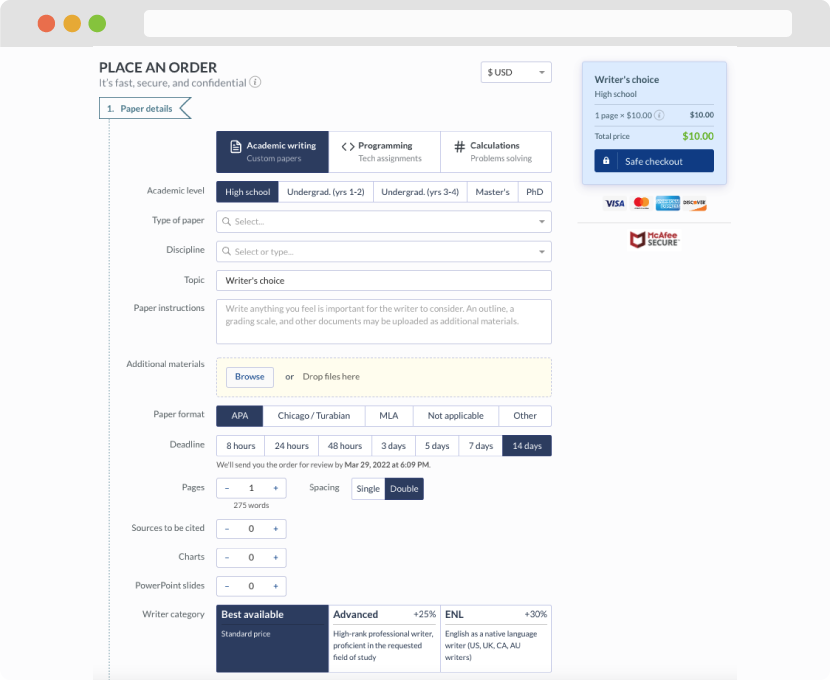
First, you will need to complete an order form. It's not difficult but, if anything is unclear, you may always chat with us so that we can guide you through it. On the order form, you will need to include some basic information concerning your order: subject, topic, number of pages, etc. We also encourage our clients to upload any relevant information or sources that will help.
Complete the order form
Once we have all the information and instructions that we need, we select the most suitable writer for your assignment. While everything seems to be clear, the writer, who has complete knowledge of the subject, may need clarification from you. It is at that point that you would receive a call or email from us.
Writer’s assignment
As soon as the writer has finished, it will be delivered both to the website and to your email address so that you will not miss it. If your deadline is close at hand, we will place a call to you to make sure that you receive the paper on time.
Completing the order and download