Please submit your journal entry or short essay for this week here. You should include your thoughts and reflections on this week’s assigned readings, lectures, additional material, personal experiences, ideas regarding your final project, and concerns. Please do not exceed 200 words. This assignment is graded based on effort. If sufficient effort to reflect on this week’s material is detected, you will receive full credit.
ARE 132: COOPERATIVE
BUSINESS ENTERPRISES
Prof. Kiesel
On Canvas (as Canvas Quiz)
Available for a limited time starting at beginning of class time (no
class)
Looked questions
Multiple choice and True/False Questions first
Two short answer questions requiring typing in your answers
Similar to practice midterm (Question 3 not covered yet)
With competitive prices, profit is only a result of cost
advantages
With market power, profit is a result of higher prices and lower
quantities
If producing at higher output?
Move to closed membership(lower
demand)
Alter the cost structure and
expand physical size
If producing at lower output?
IOF (or first objective) would
reduce output and increased
prices as compared to setting
AR=ATC
Cooperatives could expand to
non-member business, but might
provide no incentives for members
Starting a new co-op
What are the steps to starting a new co-op?
Critical elements of structure of decision making
What are the keys to long-term success?
Nine Steps to Starting A New
Co-op
5. Conduct feasibility study
6. Hold membership drive
7. Develop business plan
8. Prepare legal documents
9. Early start-up phase
1. Preliminary exploration
Begin with concept of multi-owner
business, not necessarily a co-op
Discuss need for group action
(horizontal coordination) and vertical
integration
Identify potential products/services &
economic rationale
Conduct preliminary research
What is the economic rationale
for creating a co-op?
Back to economic theory
Response to what type of market failure?
2. Gauge broader interest
Identify prospective members
Discuss basic concept with them
Benefits include overall cost efficiency and
bargaining power
Opportunity to buy from closed supply channel or
to sell to closed marketing channel
Benefits arising through the role of cooperatives as
competitive yardstick
Opportunity to share in any distribution of income
(Many cooperative bylaws say that a cooperative must do
not more than 50% of its business with non-members)
3. Form steering committee
Assemble 5-9 interested, dedicated
volunteers
Seek out those with broad experience base
Identify leader(s)
Draft mission statement
Discuss potential functions/
activities of firm
4. Clarify purpose of business
Discuss needs with potential members
Fine-tune Mission Statement
Can multiple-owner firm offer a solution?
What specific products/services will be
provided?
PACHAMAMA’S MISSION STATEMENT
Our mission is to provide customers with premium
coffee in the most direct manner possible and, in
doing so, improve the lives of family farmers and
their families.
5. Conduct feasibility study
Market analysis
Operations analysis
Financial analysis
6. Hold membership drive
Discuss findings of feasibility study (objectively) with
potential members
Potential obstacles?
Who will be served?
How will members be served?
What are their projected volumes?
How much investment is needed?
How will firm be operating?
Participation in Ownership
and Control
Customers who use the cooperative are expected to have
ownership:
The easiest way to think about equity investment is direct
investment through purchase of equity shares.
Owners participate in control by setting policies (including the
governance structure of the cooperative)
Write bylaws of the organization which include:
1) classes of membership and their qualifications,
2) the governance system, including the role and
responsibilities of the board of directors and how they are
elected, and
3) rules for certain actions such as annual meetings, bylaw
amendments, or dissolution.
7. Develop business plan
Work out details for market, operations
and financial analyses
Review plan with business advisors
Draft equity program
Estimate debt financing needs &
discuss plan with lenders
8. Prepare legal documents
Determine appropriate business
structure (Co-op, LLC, S-Corp)
Work with attorney to draft Articles of
Incorporation & Bylaws
File Articles of Incorporation with
Secretary of State
9. Early start-up phase
Obtain appropriate licenses and
insurance
Hold first official meeting to elect officers
Acquire capital from members
Hire management
Begin operations!
Members
President/ C. E. O
Division Vice President
Bylaws
describe the
rights and
obligations
(Same as
other
corporations)
Principal
Agent
Management incentives in co-ops
Does board have business acumen to perform
oversight function?
Management might not be inclined to run
cooperative in members interest
No simple barometers of management
performance such as stock prices (IOF)
No stock option incentives
Key to success: Presence of full-time professional
manager that jointly optimizes performance of
cooperative and members;
Management knowledge of cooperative culture
is needed Board oversight needs to be supported
on business knowledge
Control or Principal-Agent
problem in Cooperatives
Control or principal agent problem: is induced by
the divergence of interests between the
membership, their representative board of
directors (principal) and management (agent).
Decision making can be costly
Information asymmetries exist
monitoring of performance is incomplete
Little external pressure is exerted on
management performance due to the
cooperative structure
Developed by Olson (1965)
Challenges optimism of group theory: individuals with common
interests voluntarily act so as to try to further those interests
(Bentley 1949, Truman 1958)
“Unless the number of individuals is quite small, or unless there
is coercion or some other special device to individuals act in
their common interest, rational, self-interested individuals will
not act to achieve their common or group interest” (Olson,
1965, p. 2)
Ostrom’s work addresses: How can individuals jointly using a
common-pool resource be able to achieve an effective form
of governing and managing their own commons?
Evolving rather than completed theory
Rival?
Yes
No
Excludable?
Yes
Pure private
goods:
•Candy bars
•Computer chips
•Congested toll roads
Club goods:
•Country clubs
•Cable TV
•Uncongested toll roads
No
Open-access
goods:
•Deep ocean fisheries
•Groundwater aquifers
•Congested freeways
Pure public goods:
•Biodiversity
•Public radio
•Uncongested freeways
•Public parks
E.g. Players in a game as herders and define a “cooperate” and
“defect” strategy
Classic example:
Each player has a dominant strategy in the sense that the player
is always better off choosing that strategy—to defect—no matter
what the other player does
Solution?
u1=1; u2=1 u1=3; u2=0
u1=0; u2=3 u1=2; u2=2
Suspect 2 (u2)
talk silent
Su
sp
ec
t 1
(u
1)
sil
en
t
ta
lk
“cooperative” strategy
Bylaws are the rules or policies that explain how any
organization, including a cooperative, operates.
The articles of incorporation lay out the basic framework of
the firm and are broader than its bylaws. They describe:
Type of organization (non-stock cooperative, stock
cooperative, cooperative association, etc.),
Purpose of the business, number of shares of common stock
and any preferred stock that might be issued,
Structure including number of directors and how a member
votes on those directors,
Legal definition of membership
Location of the headquarters (legal address)
Asset disposal upon liquidation
Cooperative Bylaws should address:
Membership requirements, rights
Procedures
Election of Directors
Meetings of Directors
Patronage allocation & distribution
Board-management relations
Membership termination
Co-op dissolution
Voting
A. One person, one vote (pure democracy)
B. Patronage or proportional voting
Which is attracting large suppliers?
Why is attracting large suppliers important?
Possible Solution: Mixed voting strategies
𝑣𝑣𝑖𝑖 = 1 + 𝛼𝛼(𝑝𝑝𝑝𝑝𝑝𝑝𝑝𝑝𝑝𝑝𝑝𝑝𝑝𝑝𝑝𝑝𝑝𝑝) 𝑖𝑖 s.t. 𝑣𝑣𝑖𝑖≤ 𝑣𝑣∗
Especially important when large size of diversity
Two main functions: Vote on Bylaws and Board of Directors
Board of Directors
Status of directors
Member of co-op or representative of co-op
Outside directors
Number of directors
2/3 of coops have 6-15 directors
Large regional (federated) coops often have
more
Election of directors
Procedure specified in Bylaws
At large vs. district elections
Time limits
Manner in which corporate directors are chosen is straight-forward:
Potential directors are assumed to have some core of
knowledge( e.g. accounting or finance, governance, human
resources, or strategy)
Desire for broad background in core areas of knowledge plus
additional attributes such as diversity
Usually two members of management (which include the CEO
and another senior leader)
Nominating committees identify directors with certain skill sets
(directors are chosen at-large subject to meeting the needs
identified by the board)
Shareholders in the firm vote for the board based on their
proportion of shares with number of votes linked with their share
of equity.
Stakeholder cast vote for the entire slate of directors as opposed to
each director separately
How Are Directors Selected?
(cont.)
Important difference in selecting directors over non-
cooperative corporations:
Directors are selected from their customers who are members
Many cooperatives use similar tools to identify directors in an
effort to identify suitable candidates for the board, however:
Because of their unique nature, directors are often chosen based
on geography and districts based on the population of its
members are created
Nominating committees consider the pool of directors in that
geographical district only
Board elections in a cooperative ask each member to vote
for each director individually rather than a slate of directors in
IOF
Terms of directors
¾ have 3 year term
Most stager terms to provide continuity
Power of directors
Bylaws outline power
Board is responsible for full oversight of co-op affairs
Members often only indirectly responsible
Member participation in nominating and voting for
Board of Directors is key
Key Question: Are you better off with a co-op structure?
Compare net prices (after payment of discounted
refunds) to net prices being offered through alternative
sources
Yardstick dimension of co-ops; Does co-op make rival
non-co-ops perform better?
Use financial statement comparisons
Must evaluate relative to the performance of joint
entity
Don’t use common measures such as return on equity
(ROI or ROE)
Engage members and measure member satisfaction
Membership upon inception
Organizing co-ops involves free rider problem
Why?
Entrepreneurship not directly rewarded
Membership upon inception
Organizing co-ops involves free rider problem
Why?
Entrepreneurship not directly rewarded
Access to goods and services to everyone once
established
Free-rider problem: arises when members or non-
member can use a resource (Co-op) for their
individual benefit but property rights are not well
defined to ensure that they bear the costs of their
actions.
(Particularly an open-membership problem)
Solutions: Develop a Broad Initial
Coalition and Common Values
1. Appeal to sense of civic responsibility (e.g.
define common cause).
2. Involve as many people as possible to spread
entrepreneurial costs.
Membership upon inception
The larger the membership, the better
Why?
Physical benefits (economies of size)
Pecuniary economies (discounts and price premiums)
Reliability of supply (marketing) and demand
(purchasing)
Discourage ‘wait and see’ behavior
Why?
Need to exploit economies from the outset
Short-run versus long-run costs (important to get members
to join initially)
Reasons for (Physical) Economies of
Size
Membership Issues (cont.)
Membership long term commitment
Encourage long-term commitment
Penalties to failure to meet obligations
Forfeiture of membership
Forfeiture of equity
Hardin (1968) symbolizes expected degradation of the
environment when many individuals use a scare resource
in common:
Uses pasture as an example:
1. Each herder receives direct benefit from letting hi
sherds graze
2. Each herder suffers delayed costs from overgrazing
Each herder is motivated to add more and more
animals because he/she/they receive direct benefits
and only bear a share of the (delayed) costs resulting
from overgrazing
“What is common to the greatest number has the least
care bestowed upon it” (Aristotle)
Membership Issues (cont.)
Membership long term
Encourage long-term commitment
Penalties to failure to meet obligations
Forfeiture of membership
Forfeiture of equity
Horizon problem: arises when members
focus on short-term constraints and
benefits returns and might not adequately
retain commitment, involvement and
equity to ensure longer-term viability.
Midterm Logistics
Competitive versus Monopoly Prices
The Competitive Yardstick
Co-op Objectives
Achieving Minimum Average Total Costs
Decision Making in Cooperatives
1. Preliminary exploration
2. Gauge broader interest
Participation in Benefits
3. Form steering committee
4. Clarify purpose of business
Organization of Co-ops
Management Issues
The Logic of Collective Action
Public v. Private Goods
Prisoners Dilemma
A Blueprint for Cooperatives
Cooperative Bylaws
Voting
Board of Directors
How Are Directors Selected?
Board of Directors (cont.)
Performance Evaluation
Membership Issues
Membership Issues (cont.)
Membership Issues (Cont.)
Membership Issues (cont.)
“Tragedy of the Commons”
Membership Issues (cont.)
Essay Writing Service Features
Our Experience
No matter how complex your assignment is, we can find the right professional for your specific task. Achiever Papers is an essay writing company that hires only the smartest minds to help you with your projects. Our expertise allows us to provide students with high-quality academic writing, editing & proofreading services.
Free Features
Free revision policy
$10Free bibliography & reference
$8Free title page
$8Free formatting
$8How Our Dissertation Writing Service Works
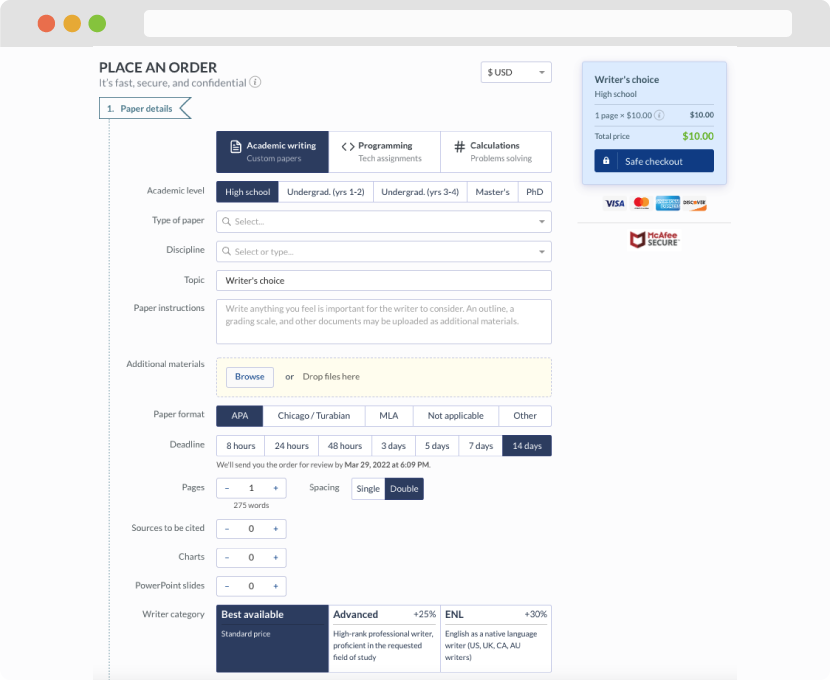
First, you will need to complete an order form. It's not difficult but, if anything is unclear, you may always chat with us so that we can guide you through it. On the order form, you will need to include some basic information concerning your order: subject, topic, number of pages, etc. We also encourage our clients to upload any relevant information or sources that will help.
Complete the order form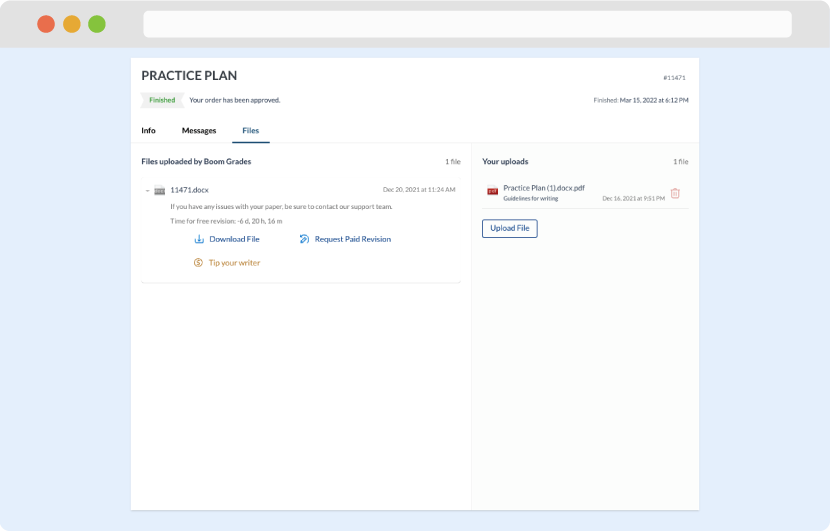
Once we have all the information and instructions that we need, we select the most suitable writer for your assignment. While everything seems to be clear, the writer, who has complete knowledge of the subject, may need clarification from you. It is at that point that you would receive a call or email from us.
Writer’s assignment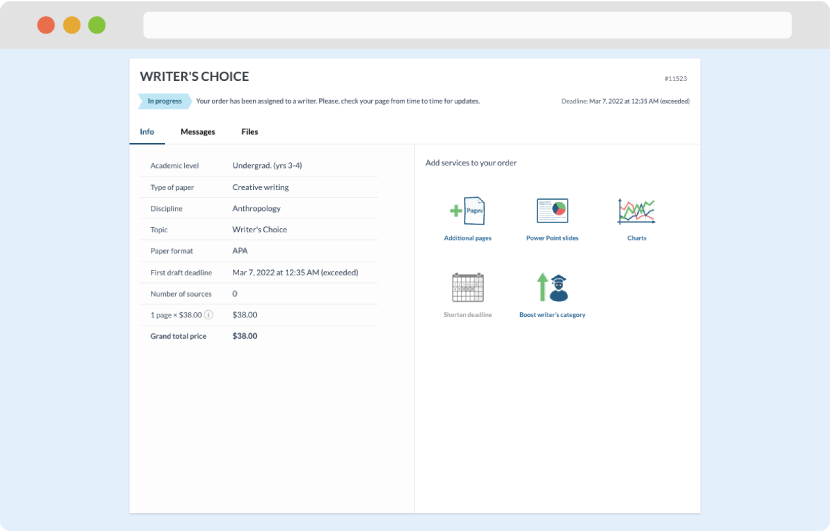
As soon as the writer has finished, it will be delivered both to the website and to your email address so that you will not miss it. If your deadline is close at hand, we will place a call to you to make sure that you receive the paper on time.
Completing the order and download