Need paper complete by 12pm Sunday
1
4
to Improve]
Rolandra Calloway
IHP 604 Healthcare Quality Improvement
1/24/2021
SNHU
The PDSA is an important concept in the field of health because it helps in the finding the best ways to understand the changes and conducting of research within the health standards. It is important to impose the PDSA cycle to help keep track of the changes bound to happen within the health institution and thus help in the improvement of the standards. The major concern in the recent years in health is the diagnostic errors which are a major problem since there are numerous patients and the professionals are bound to give a wrong diagnosis, delay or even miss a certain symptom that influences the entire results and treatment of the patient. The cycle seeks to help understand the extent of the diagnostic errors in health institutions and ways of helping to reduce them and improve the quality of the healthcare. The research should take between three and six months to help come up with conclusive responses on how to deal with such issues which is bound to help improve the quality of healthcare.
Plan
Diagnostic errors involve the delayed, missed or wrong diagnosis of the patients and their conditions in the health institutions. It is evident that diagnostic errors account for approximately 17% of the potential preventable errors in the health sector. Diagnostic errors have been bound for a long time and technology and improvement of the training of the health experts is helping reduce them but it is still bound to happen. The long working hours, poor training, lack of proper supervision, few working personnel influence the performance of the nursing practitioners which makes it a major challenge in the maintaining proper health quality. The concept is an issue because it leads to bad calls for the doctors which are bound to lead to wrongful deaths, long term health misdeeds to the patients and escalation of the health issues among others.
Research proves that approximately 17% – 20% of the potential preventable errors in the health sector is a result of the diagnostic errors (Khullar & Jena, 2016). The health professionals are human and bound to make errors but with the health calls they might result in the wrongful death of the patients or even development of a permanent health issue which should not be the case. It is important to understand that the wrong deeds of the health professionals are a major concern because it is leading to loss of numerous innocent lives and thus it is important to find the proper positive measure to help contain the situation (Khoo, Sararaks, Lee, Liew, Cheong, Samad, Hamid, 2015).). It is evident from the autopsy that numerous people die each year from diagnostic errors that go undetectable for a long time and thus it is only revealed after the error is irreversible. The concept is a major concern because the move might escalate to the issues of doctors breaking their solemn vows to their patient’s health and to their profession which involves protecting their patients lives. According to Berger, Brito, Ospina, Kannan, Hinson, Hess, Newman-Toker (2017), the diagnostic errors might be a small detail that the doctors can miss because they have numerous patients especially in the large and busy institutions. However, in some situations it is evident that some professionals are just clumsy and commit the mistakes without having a second thought which might end up as a case of manslaughter. In addition, it is evident that the health institutions lack proper supervision of the health professionals that then make it a problem especially for the nurses or doctors in training that leaves them without the proper effects which is a major concern for the ethical standards in the health institutions (Chen, Liang & Lin, 2016). It is bound to introduce intervention methods that include proper interventions, the need for clogging in the patient information and details at the same time of diagnosis, proper supervision of the doctors to help with follow ups and interacting with patients and also making sure that the health professionals are held strictly to their code of conduct.
Recommended
ions
The plan to help introduce supervision and clogging all the details of the patients into the system is bound to help reduce the percentage of the preventable diagnostic errors that are increasing in the health institution. The health institution is bound to input the various committees that include the members of the public to help in the formation of the supervision team and oversee the activities of the health professionals. The concept of the team building is bound to be introduced because it will help in making sure that the health professionals interact. The collection of data will involve the use of the online platform, online surveys, questionnaires and surveys, focus groups and interviews.
The introduction of the pilot plan was bound to start after the identification of the problem which is within the first one month. The pilot plan will take place in the health institution because it should be a practical plan that is essential for their performance which is vital for their interactions. The collection of the data will take place between the second and fourth month of the research period that is bound to take six months. It is evident that diagnostic errors in the health institutions is a major problem and addressing it requires the contribution of all the branches of the health institutions. Research proves that proper supervision and clogging in details of the doctors is a positive move towards managing and controlling the diagnostic errors. The first month of the research will involve interacting with patients, the victims of the diagnostic errors and their families, the interaction with the doctors will be the second month and then the management of the health institution while the last three months will be tabling the results.
The data proves that it is evident that there are higher cases of diagnostic errors that contribute to controllable deaths in the health institutions. It is also evident that most of the deaths are not detectable until autopsy which implies that follow ups and supervision is not a common topic and subject in the health institutions. The validation of the results is from the victims, their families, other professions, their records and working conditions in the health institutions do prove that there is a major problem in the management of the patient’s health. The intervention strategies were working for the first three months of the implementation, but in the departments that had fewer nurse to patient ratio it was a major problem. The interventions were focusing on helping to curb the unnecessary deaths and thus it was bound to be positive for the environment which is vital for their performance.
Act
It is important to come up with a positive strategy that will see the introduction of a policy that will see the maintenance of the proper patient-doctor ratio. It is important to come up with the strict routine of making sure that the doctors and nurses do clog the patients details and progress and slight prognosis to make sure that the supervision and follow-ups is swift and helps in making sure that they conduct the positive treatment options. The plan will need to take a longer duration that will see the proper understanding of the issue and experimenting well with the interventions that will see the best options. It will be easier to implement the changes from the management level and then making sure that it is a collaborative strategy that will see the participation of all the parties to help reduce the conflict of interests in the institution.
Berger, Z., Brito, J., Ospina, N., Kannan, S., Hinson, J., Hess, E., Newman-Toker, D. (2017). Patient centered diagnosis: Sharing diagnostic decisions with patients in clinical practice. BMJ: British Medical Journal, 359. doi:10.2307/26951708
Chen, W., Liang, Y., & Lin, Y. (2016). Is the United States in the middle of a healthcare bubble? The European Journal of Health Economics, 17(1), 99-111.
Khoo, E., Sararaks, S., Lee, W., Liew, S., Cheong, A., Samad, A., Hamid, M. (2015). Reducing Medical Errors in Primary Care Using a Pragmatic Complex Intervention. Asia Pacific Journal of Public Health, 27(6), 670-677.
Khullar, D., & Jena, A. (2016). Reducing prognostic errors: A new imperative in quality healthcare. BMJ: British Medical Journal, 352. doi:10.2307/26944306
IHP 60
4
Final Project Guidelines and Rubric
Overview
The final project for this course is the creation of a quality plan—also known as a performance improvement plan—for a healthcare organization. You may
develop this plan for an acute-care facility, a same-day surgery facility, an ambulatory care organization, a clinic setting, a long-term care facility, or some other
type of healthcare organization you may be familiar with given your own professional healthcare work experience. In addressing the critical elements for this
assignment, all APA formatting and citation requirements apply. Further, as this is a scholarly initiative, you must use peer-reviewed or evidence-based sources
for this assignment. Data may be derived from public healthcare databases, or you may use data from your own healthcare organization. The final product
represents an authentic demonstration of competency because quality plans are used as tools by healthcare facilities to provide frameworks for collaboratively
planned, systematic, and organization-wide approaches to improvement. These quality plans are always kept on-site, updated yearly, and reviewed by surveyors
and accreditors.
The project is divided into two milestone journals, which will be submitted at various points throughout the course to scaffold learning and ensure quality final
submissions. These milestones will be submitted in Modules Four and Seven. In these journal assignments, you will reflect on the progress you have made on
your project thus far and ask any clarifying questions that will assist you as you progress on your project. These assignments will also provide you with the
opportunity to submit drafts of your project so that you can receive feedback on them from your instructor. In addition, there are several short papers that you
will complete throughout the course which will help you to understand course concepts, as well as activities that will allow you to practice working with data. All
of these concepts should be incorporated into the final project. The final product will be submitted in Module Nine.
In this assignment, you will demonstrate your mastery of the following course outcomes:
Determine the impact of regulatory requirements and accreditation standards on quality planning for improving patient care
Assess information management systems and patient-care technologies for their ability to promote care coordination and improve patient safety
Recommend performance-improvement initiatives using quality program requirements and quality data metrics
Analyze healthcare reimbursement policies for the impact on patient safety and quality initiatives
Recommend leadership strategies that promote interdisciplinary collaborative care within healthcare organizations in the healthcare ecosystem
Prompt
Specifically, the following critical elements must be addressed:
I. Purpose and Quality Statement: In this section, you will define patient safety and the purpose of a quality plan.
A. Explain the purpose of implementing a quality plan. In your explanation, consider how accreditation standards drive an organization’s patient
safety and quality initiatives.
1
B. Determine the healthcare organization’s commitment to patient safety and quality. Consider the mission statement and policies of the
organization to guide your answer.
C. Describe the various stakeholder groups that have a vested interest in the performance-improvement process (e.g., nursing leadership,
departmental directors). Consider utilizing an organizational chart to depict these stakeholders.
D. Develop a quality statement that outlines the objectives of the quality plan.
II. Status of Quality Tools and Standards: In this section, you will review the status of the information management system and accreditation.
A. Describe the current status of accreditation based on recent accreditation survey reports.
B. Analyze the current information management systems and patient care technologies for their ability to collect data used to report quality
measures and accreditation requirements. Are these systems and technologies adhering to the appropriate policies and regulations to meet the
needs for accreditation and compliance?
C. Explain the impact of meaningful-use implementation at the organization as it pertains to patient safety and quality.
III. Measures and Benchmarks: In this section, you will identify and evaluate the metrics that can be used to measure quality and patient safety at your
organization.
A. Outline how current performance-improvement data and initiatives are tracked through the organization, starting at the department level.
Consider using a visual aid to depict this through specific types of data.
B. Compare how the organization is doing in key safety measures using appropriate benchmark data.
C. Analyze the metrics to determine if the healthcare organization demonstrates compliance for accreditation standards.
D. Explain how reimbursement data is used to identify patient safety and quality issues. Consider the role of core measures in your response.
E. Explain the impact of reimbursement data on the accreditation status.
F. Describe the impact of reimbursement policies on patient safety and quality initiatives.
G. Discuss how leadership is involved in the dissemination and application of quality data at this healthcare organization.
IV. Process Improvements: In this section, you will develop specific actions to address your analysis of key patient safety and quality metrics.
A. Summarize recommendations based on the analysis of the current organization.
B. Develop goals based on the evaluation of the current organization quality measurements and improvement needs.
C. Recommend new technology that could improve one of the patient safety or quality concerns identified in Sections II and III. Explain your
recommendation.
D. Describe leadership strategies that are needed to ensure stakeholder and community input into the quality program.
E. Recommend a policy change to solve the patient safety and quality issues identified. Consider what stakeholders you would need to collaborate
with to execute the policy changes.
V. Evaluation and Reporting: In the last section, you will develop a timeline and make recommendations for evaluating and reporting key measures of
success to stakeholders and accrediting bodies.
A. Create an evaluation plan using principles from Plan-Do-Study-Act (PDSA). Include a project timeline in your plan.
2
B. Justify a timeline for evaluation of performance-improvement activities. Consider using a visual aid.
C. Explain how to measure the successful implementation of the new technology suggested in the Process Improvements section.
D. Describe the changes to the processes for managing data within the organization for accreditation reporting.
Milestones
Milestone One: Check-in Journal
In Module Four, you will submit a check-in journal assignment. The journal assignment should include a reflection of the status of your final project. You also
have the opportunity to submit a draft of the Purpose and Quality Statement and Status of Quality Tools and Standards sections of your final project to your
instructor for review and feedback. This milestone will be graded with the Milestone One Rubric.
Milestone Two: Check-in Journal
In Module Seven, you will submit a check-in journal assignment. The journal assignment should include a reflection of the status of your final project. You also
have the opportunity to submit a draft of the Measures and Benchmarks, Process Improvements, and Evaluation and Reporting sections of your final project to
your instructor for review and feedback. This milestone will be graded with the Milestone Two Rubric.
Final Submission: Quality Plan
In Module Nine, you will submit your final project. It should be a complete, polished artifact containing all of the critical elements of the final product. It should
reflect the incorporation of feedback gained throughout the course. This submission will be graded with the Final Project Rubric.
Final Project Rubric
Guidelines for Submission: Your quality plan should be 10 to 12 pages in length (plus a cover page and references) and written in APA format. Use double
spacing, 12-point Times New Roman font, and one-inch margins. Include at least five references cited in APA format.
Critical Elements Exemplary (100%) Proficient (85%) Needs Improvement (55%) Not Evident (0%) Value
Purpose and Quality
Statement: Purpose
Meets “Proficient” criteria and
explanation demonstrates an
advanced understanding of the
purpose of implementing a
quality plan and the role of
accreditation
Explains the purpose of
implementing a quality plan
using accreditation standards to
support the response
Explains the purpose of
implementing a quality plan but
explanation is unclear or does
not address accreditation
standards in the response
Does not explain the purpose of
implementing a quality plan
6.4
Purpose and Quality
Statement:
Commitment
Meets “Proficient” criteria and
includes exceptional detail to
support determination
Determines the healthcare
organization’s commitment to
patient safety and quality
Determines the healthcare
organization’s commitment to
patient safety and quality but
contains gaps in detail or is
unclear
Does not determine the
healthcare organization’s
commitment to patient safety
and quality
6.4
3
Critical Elements Exemplary (100%) Proficient (85%) Needs Improvement (55%) Not Evident (0%) Value
Purpose and Quality
Statement:
Stakeholder Groups
Meets “Proficient” criteria and
illustrates a sophisticated
understanding of the various
stakeholder roles impacted by
the process
Describes the various
stakeholder groups that have a
vested interest in the
performance-improvement
process
Describes the various
stakeholder groups that have a
vested interest in the
performance-improvement
process, but response is cursory
or is missing key stakeholders
Does not describe the various
stakeholder groups that have a
vested interest in the
performance-improvement
process
4.8
Purpose and Quality
Statement: Quality
Statement
Meets “Proficient” criteria and
demonstrates a sophisticated
understanding of the objectives
needed to implement a quality
plan
Develops a quality statement
that outlines the objectives of
the quality plan
Develops a quality statement
that outlines the objectives of
the quality plan, but plan is
cursory or illogical
Does not develop a quality
statement that outlines the
objectives of the quality plan
2.74
Status of Quality
Tools and Standards:
Status of
Accreditation
Meets “Proficient” criteria and
demonstrates a thorough
understanding of accreditation
survey results
Describes the current status of
accreditation based on recent
accreditation survey results
Describes the current status of
accreditation, but explanation is
cursory or illogical or is not
supported by accreditation
survey results
Does not describe the current
status of accreditation based on
recent accreditation survey
results
6.4
Status of Quality
Tools and Standards:
Information
Management
Systems
Meets “Proficient” criteria and
demonstrates a sophisticated
understanding of the
information management
systems and patient care
technologies
Analyzes the current
information management
systems and patient care
technologies for their ability to
collect data for reporting quality
measures and accreditation
requirements
Analyzes the information
management systems and
patient care technologies, but
analysis is cursory or unclear or
contains inaccuracies
Does not analyze the
information management
systems and patient care
technologies
3.2
Status of Quality
Tools and Standards:
Meaningful Use
Meets “Proficient” criteria and
includes exceptional detail
Explains the impact of
meaningful-use implementation
at the organization as it pertains
to patient safety and quality
initiatives
Explains the impact of
meaningful-use implementation
at the organization, but
explanation is cursory or
unclear or contains inaccuracies
Does not explain the impact of
meaningful-use implementation
at the organization as it pertains
to patient safety and quality
initiatives
3.2
Measures and
Benchmarks:
Performance-
Improvement
Data
Meets “Proficient” criteria and
outline is exceptionally
thorough and detailed
Outlines how current
performance-improvement data
and initiatives are tracked
through the organization
Outlines how current
performance-improvement data
and initiatives are tracked
through the organization, but
outline is cursory, illogical, or
missing components
Does not outline how current
performance-improvement data
and initiatives are tracked
through the organization
3.2
4
Critical Elements Exemplary (100%) Proficient (85%) Needs Improvement (55%) Not Evident (0%) Value
Measures and
Benchmarks:
Benchmark Data
Meets “Proficient” criteria and
comparison is exceptionally
thorough
Compares how the healthcare
organization is doing in key
safety measures using
appropriate benchmark data
Compares how the healthcare
organization is doing in key
safety measures using
appropriate benchmark data,
but comparison is cursory or
unclear or contains inaccuracies
Does not compare how the
healthcare organization is doing
in key safety measures using
appropriate benchmark data
2.74
Measures and
Benchmarks:
Compliance
Meets “Proficient” criteria and
provides sophisticated analysis
of the metrics, demonstrating
deep insight into compliance for
accreditation standards
Analyzes the metrics to
determine if the healthcare
organization demonstrates
compliance for accreditation
standards
Analyzes the metrics to
determine if the healthcare
organization demonstrates
compliance for accreditation
standards, but response is
cursory or illogical or lacks
justification
Does not analyze the metrics to
determine if the healthcare
organization demonstrates
compliance for accreditation
standards
2.74
Measures and
Benchmarks: Patient
Safety and Quality
Issues
Meets “Proficient” criteria and
makes cogent connections
between reimbursement data
and patient safety and quality
issues
Explains how reimbursement
data is used to identify patient
safety and quality issues
Explains how reimbursement
data is used to identify patient
safety and quality issues, but
explanation is cursory or
illogical
Does not explain how
reimbursement data is used to
identify patient safety and
quality issues
6.4
Measures and
Benchmarks: Impact
of Reimbursement
Data
Meets “Proficient” criteria and
makes cogent connections
between reimbursement data
and accreditation status
Explains the impact of
reimbursement data on the
accreditation status
Explains the impact of
reimbursement data on the
accreditation status, but
explanation is cursory or
illogical
Does not explain the impact of
reimbursement data on the
accreditation status
6.4
Measures and
Benchmarks: Policies
Meets “Proficient” criteria and
provides keen insight into the
impact of reimbursement
policies on patient safety and
quality initiatives
Describes the impact of
reimbursement policies on
patient safety and quality
initiatives
Describes the impact of
reimbursement policies on
patient safety and quality
initiatives, but response is
cursory or illogical
Does not describe the impact of
reimbursement policies on
patient safety and quality
initiatives
6.4
Measures and
Benchmarks:
Leadership
Meets “Proficient” criteria and
includes exceptional detail
Describes the role of leadership
in the dissemination and
application of quality data
Describes the role of leadership
in the dissemination and
application of quality data, but
description is cursory, contains
inaccuracies, or lacks
justification
Does not describe how
leadership is involved in the
dissemination and application
of quality data at this healthcare
organization
4.8
5
Critical Elements Exemplary (100%) Proficient (85%) Needs Improvement (55%) Not Evident (0%) Value
Process
Improvements:
Recommendations
Meets “Proficient” criteria and
recommendations demonstrate
a sophisticated analysis of
current organization
Summarizes recommendations
based on the analysis of the
current organization
Summarizes recommendations
based on the analysis of the
current organization, but
recommendations are unclear
or illogical or lack justification
Does not summarize
recommendations based on the
analysis of the current
organization
2.74
Process
Improvements:
Goals
Meets “Proficient” criteria and
demonstrates a sophisticated
understanding of the goals
needed to improve current
quality measures
Develops goals that address the
current organization’s quality
measurements and
improvement needs
Develops goals, but goals are
cursory or do not address
current organization’s quality
measurements and
improvement needs
Does not develop goals based
on the evaluation of the current
organization’s quality
measurements and
improvement needs
2.74
Process
Improvements: New
Technology
Meets “Proficient” criteria and
includes exceptional detail
Recommends a new technology
that addresses one of the
patient safety or quality
concerns with a clear
explanation
Recommends a new technology,
but recommendation does not
address the issues or
explanation is unclear
Does not recommend new
technology that could improve
one of the patient safety or
quality concerns
3.2
Process
Improvements:
Leadership
Strategies
Meets “Proficient” criteria and
demonstrates a sophisticated
understanding of leadership
strategies
Describes leadership strategies
that are needed to ensure
stakeholder and community
input into the quality program
Describes leadership strategies
that are needed to ensure
stakeholder and community
input into the quality program,
but description is cursory or
strategies lack justification
Does not describe leadership
strategies that are needed to
ensure stakeholder and
community input into the
quality program
4.8
Process
Improvements:
Policy Changes
Meets “Proficient” criteria and
recommendation
comprehensively addresses the
issues and demonstrates keen
insight
Recommends a policy change
that addresses the patient
safety and quality issues
Recommends a policy change
that addresses the patient
safety and quality issues, but
recommendation is cursory or
illogical or does not include
rationale
Does not recommend a policy
change that addresses the
patient safety and quality issues
4.8
Evaluation and
Reporting: Plan, Do,
Study, Act (PSDA)
Meets “Proficient” criteria and
plan includes exceptional detail
and demonstrates keen
understanding of the PDSA
model
Creates an evaluation plan using
principles from the PDSA model
Creates an evaluation plan using
principles from the PDSA model,
but plan is missing principles
from the model or plan is
cursory or illogical
Does not create an evaluation
plan using principles from the
PDSA model
2.74
Evaluation and
Reporting: Timeline
Meets “Proficient” criteria and
includes exceptional detail in
explaining the rationale for
timeline
Justifies a timeline for
evaluation of performance-
improvement through
explanation of activities
Justifies a timeline for
evaluation of performance-
improvement but with gaps in
detail or missing key activities
Does not justify a timeline for
evaluation of performance-
improvement activities
2.74
6
Critical Elements Exemplary (100%) Proficient (85%) Needs Improvement (55%) Not Evident (0%) Value
Evaluation and
Reporting: New
Technology
Meets “Proficient” criteria and
response demonstrates
insightful awareness of how to
measure the success of the new
technology
Explains how to measure the
successful implementation of
the new technology suggested
in the Process Improvements
section
Explains plans to measure the
successful implementation of
the new technology suggested
in the Process Improvements
section, but explanation is
cursory or contains missing key
components
Does not explain how to
measure the successful
implementation of the new
technology suggested in the
Process Improvements section
3.2
Evaluation and
Reporting:
Accreditation
Meets “Proficient” criteria and
includes exceptional detail in
describing the changes to the
process
Describes the changes to the
processes for managing data
within the organization for
accreditation reporting
Describes the changes to the
processes for managing data
within the organization, but
description lacks detail or is
unclear
Does not describe the changes
to the processes for managing
data within the organization for
accreditation reporting
3.2
Articulation of
Response
Submission is free of errors
related to citations, grammar,
spelling, syntax, and
organization and is presented in
a professional and easy-to-read
format
Submission has no major errors
related to citations, grammar,
spelling, syntax, or organization
Submission has major errors
related to citations, grammar,
spelling, syntax, or organization
that negatively impact
readability and articulation of
main ideas
Submission has critical errors
related to citations, grammar,
spelling, syntax, or organization
that prevent understanding of
ideas
4.02
Total 100%
7
Overview
Prompt
Milestones
Milestone One: Check-in Journal
Milestone Two: Check-in Journal
Final Submission: Quality Plan
Final Project Rubric
Essay Writing Service Features
Our Experience
No matter how complex your assignment is, we can find the right professional for your specific task. Achiever Papers is an essay writing company that hires only the smartest minds to help you with your projects. Our expertise allows us to provide students with high-quality academic writing, editing & proofreading services.
Free Features
Free revision policy
$10Free bibliography & reference
$8Free title page
$8Free formatting
$8How Our Dissertation Writing Service Works
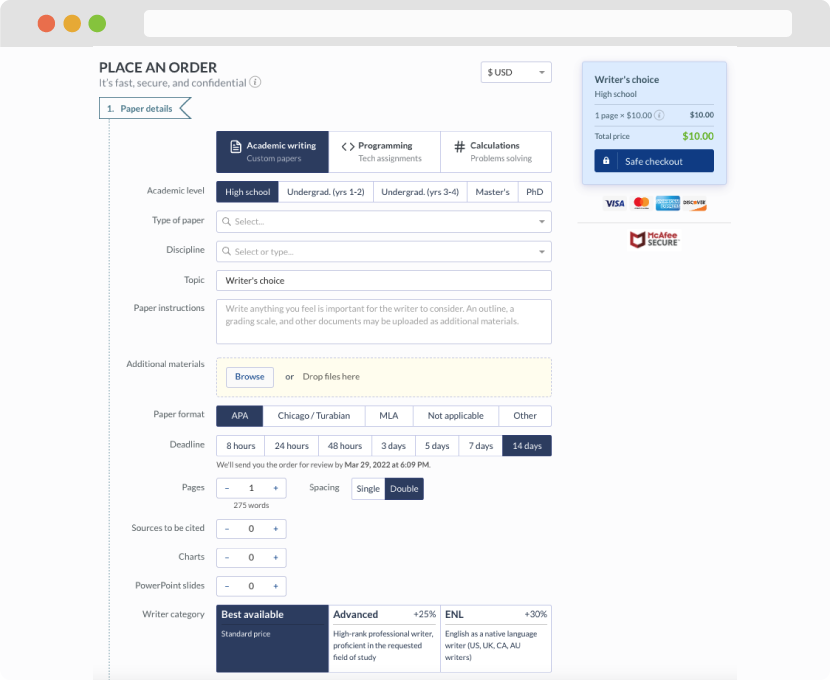
First, you will need to complete an order form. It's not difficult but, if anything is unclear, you may always chat with us so that we can guide you through it. On the order form, you will need to include some basic information concerning your order: subject, topic, number of pages, etc. We also encourage our clients to upload any relevant information or sources that will help.
Complete the order form
Once we have all the information and instructions that we need, we select the most suitable writer for your assignment. While everything seems to be clear, the writer, who has complete knowledge of the subject, may need clarification from you. It is at that point that you would receive a call or email from us.
Writer’s assignment
As soon as the writer has finished, it will be delivered both to the website and to your email address so that you will not miss it. If your deadline is close at hand, we will place a call to you to make sure that you receive the paper on time.
Completing the order and download