Discussion: Basic Statistics Data Used in Everyday Life
Required Resources
Read/review the following resources for this activity:
In your reference for this assignment, be sure to include both your text/class materials AND your outside reading(s). Instructions
Writing Requirements
This article provides some great examples:
Article Link
|
Introductory Statistics Textbook: 1.1 Definitions of Statistics, Probability, and Key Terms 1.2 Data, Sampling, and Variation in Data and Sampling 1.3 Levels of Measurement 1.4 Experimental Design and Ethics |
Lesson: Introduction to Statistics: Data
Collection and Data Concepts
Introduction to Statistics: Data Collection and Data Concepts
Essential Information
Each week will include a Lesson that focuses on the Essential Information for that week.
It is important to read this information for two reasons:
It will give you the skills, concepts, and material necessary to be successful in the
homework, and
• You will find a link to that week’s Excel spreadsheet. Since this course focuses on
the concepts and interpretation of statistics, these spreadsheets are designed to
do the calculations for you. You will need the spreadsheets to complete the
homework effectively and efficiently.
•
Statistics
Statistics is largely a science of collecting, organizing, and interpreting data. From this
definition, we get a good idea of what we will be learning in this class. In Chapters 1 and
2, we will learn about collecting data and how we can use data.
Statistics is an important tool for making a variety of health science decisions. For
example, pharmaceutical companies will use data to see if their drug is improving
health. For surgery decisions, statistics are shown based on proportions of successes or
probable outcomes. Because statistics is used so often, it is important to understand the
concepts when entering the health sciences.
Population Versus Sample
The very basis of statistics is to understand the difference between a population and a
sample.
A population is the all, so to speak. If you are talking about all of the students taking an
introductory statistics class, you have a large population. This could include students
taking introductory statistics at Chamberlain University, at other universities in the
states, at universities in other countries, and even some high schools. Usually, the
population is a very large group.
1
Because of the size of a population, we may want to investigate a smaller subset of that
population. This is our sample. A sample is a more manageable group that represents, or
reflects, the population. For instance, if our population is all students taking an
introductory statistics class, then our sample may be students at Chamberlain taking an
introductory statistics class. While still a large group, it is a subset of the stated
population. As a second example, if we considered all coronary angioplasty patients and
studied 100 of them, the 100 would be our sample of the total population of
angioplasty patients.
The differences between a sample and a population are important to distinguish. In
some cases, different formulas are used if we are talking about a population or a
sample. Further, sample data are used to make decisions about a population.
erforming a Statistical Study
Every statistical study is performed with the same basic steps.
1. State a goal. You will state what you are interested in studying, which will define
the population of interest.
2. Take a sample. Typically, it would be too time consuming or costly to survey or
test every member of your population, so you will need to decide how to create
a manageable subset, or sample. You will decide the best sampling technique
specific to this goal.
3. Collect your data. Now, you need to collect the data. You will also need to decide
the best collection strategy, specific to this goal.
4. Make an inference about the population. This sample data will lead you to make a
decision about your population. In statistics, we make our decisions about a
population from our sample data.
5. Draw a conclusion. Did this sample answer the questions you wanted answered
regarding your original goal? Sometimes, the answer here may be no. If not,
then you may need to refine your goal and start all over.
Understanding the steps of a statistical study will make your task easier. If you do not
plan well, then you may come to the end of your study without the correct data
necessary to make the right decision. Putting the time and thought into the process
from the beginning will lead to better results in the end.
Types of Statistical Studies
Observational: Observe or measure characteristics without influencing the results. An
example would be watching children play to study their interactions.
2
Experimental: Study the effects of a treatment. An experiment could be used to study a
new cold medicine. People with colds would be divided into two groups: one that take a
new medicine and one group that takes a placebo. The results from the two groups are
then compared using statistics to see if the new medicine is effective.
Design of Experiments
Three types of good design methods for experiments include replication, blinding, and
randomization.
Replication is an experiment that is repeated on more than one individual.
Sample sizes must be large enough to show marked effects of treatments.
• Blinding is an experiment in which the subject does not know if he/she is
receiving a treatment or a placebo (a harmless pill or medicine). Blinding is a
way to guard against the placebo effect, which occurs when an untreated
person believes there are improvements, either real or imagined, in his/her
symptoms.
• Randomization occurs when individual subjects are assigment to different
groups through a random selection process.
•
3
Sampling Techniques
There are several basic sampling techniques that you could use. Choosing the correct
technique will depend on your
goal.
1. Systematic sampling—Systematic sampling will choose every nth member. A
good example of a systematic sample is patient satisfaction interviews. If a
quality assurance program wants to gain personal insights into patient
satisfaction, then it could systematically pick every 25th patient discharged to
make sure that a range of patient characteristics are included in the study.
2. Convenience sampling—A convenient sample is created just that way—
conveniently. If you are interested in finding out the predominant eye color of
coffee drinkers, then where is the best place to find coffee drinkers? You may
4
stand outside of a Starbucks and survey everyone’s eye colors. It is convenient
to find coffee drinkers at a Starbucks.
3. Cluster sampling—A cluster sample creates clusters from a population, randomly
selects some of those clusters, and then include all the people or things within
the selected clusters as the sample. For example, if you are interested in
determining the average income per household within your state, you may use
each of the counties of the state as a cluster. If you randomly select two or three
of those counties and survey the households’ incomes in those selected
counties, you would have a cluster sampling of your state.
4. Stratified sampling—A stratified sample is a defined subgroup of the population.
A stratified sample would include a similar percentage in the sample as
represented in the populations. A familiar example of a stratified sample would
be from a hospital unit. If you are interested in seeing if a particular unit has
more satisfaction among the staff, then the strata from your population would
be unit level. If the hospital has 3,000 staff consisting of 30% in surgery, 28% in
neonatal, 25% cardiac, and 17% pediatric, you would create a sample with the
same percentage of levels. Your sample may have only 100 staff, but you would
want the strata to have the same percentage of units represented.
Data, Data, Data
As we know already, we need data.
Classifying Data
Data are defined in several different ways. First, you need to decide what type of data
you have; then, you can decide what level of data you have.
Type of data
Qualitative—Data placed in nonnumerical categories
QuaLitative data—’L’ is for letters, or nonnumeric
Quantitative—Numeric data
QuaNtitative data—’N’ is for numbers
Another type of classification is between discrete and continuous
Discrete—A whole number, like how many students in class would be a discrete number
Continuous—A number that can take on any value. To distinguish, ask yourself if a
decimal place makes sense. An example would be students’ heights.
5
Discrete vs. Continuous Classification
1. Can you have a fraction of a Liter of solution in your patient? Which classification
is it?
View Answer
Yes, you can put a fraction of a Liter of solution into your patient. This
classification is an example of continuous.
2. Can you have a fraction of a cat? Which classification is it?
View Answer
No, it doesn’t make sense to divide up a cat, so, this classification is discrete or
an example of a whole number.
Level of measurements (from lowest to highest)
1. Nominal: Qualitative data—No mathematical application
Names, labels, or categories
Examples: Numbers on a football jersey, models of cars, gender
2. Ordinal: Qualitative data with order—No mathematical application
Qualitative data that is ranked
Examples: First, second, third place; freshman, sophomore, junior, senior
3. Interval: Quantitative—Arbitrary zero
Arbitrary zero does not mean nothing.
Examples: Temperature (in Fahrenheit or Celsius) and year
6
If the temperature outside is zero, does that mean there is no temperature? No,
it is just the designated zero in that temperature system.
4. Ratio: Quantitative—Zero means nothing
All numbers that are used in mathematical operations
Example: If a salesman made zero sales for the month, he sold nothing. Zero
literally means nothing.
Bias in a Statistical Study
Collecting the right data is very important for the integrity of a research study. If the
data does not represent the intended population, you will create a bias in your results. A
biased sample will bring questions to the effectiveness of the research.
Bias can come in several forms:
Selection Bias: Selecting a sample in a biased way. For example, instead of
creating a stratified sample by units, only administrators were surveyed
regarding all staff satisfaction. As administrators may have a different experience
than much of the staff, the data are biased based on the sampling.
• Participation Bias: Voluntary participation. For example, if patient satisfaction
surveys are voluntary, the outcome may be biased and not truly reflect the
satisfaction of most patients.
• For each of the sampling techniques, try to think of examples that would create
bias within the study.
•
Percentages and Indices
Percentages are all around from the 25% discount at the store to a 3% pay increase.
There is a basic structure to finding percentages: (ending – beginning) ÷ beginning
So, if a prescription initially cost $50 and was discounted to $40, you could use this
formula to find the percentage of the discount. This is an absolute change of $10. The
relative change is the same as the percentage change. In this example, the beginning
price is 50 and the ending price is 40. Notice that beginning and ending are based on
time frame, rather than which is smaller or bigger. The price used to be $50 and is now
$40, so it started at $50 and ended at $40.
(40 – 50) ÷ 50 = -10 ÷ 50 = -1 ÷ 5, or -20%
7
So, there was a 20% discount on the original price. The negative in front of the
percentage indicates the value decreased, or went down, from the beginning point to
the ending point.
Indices are calculated using percentage changes. Examples of indices are the Consumer
Price Index for inflation or the cardiac index for heart performance. An index has a
starting point, usually set to 100. Then, the other numbers in the index are stated
relative to that staring point. Let’s say that you want to compare the height of a tree
from the time you moved to your home. If you moved in during 2005 and the tree was 4
feet tall, then a height of 4 feet would be set to an index value of 100. Here is a table of
tree heights
Year
Height of Tree
1995
3 ft
2000
3.8 ft
2005
4 ft
2010
4.6 ft
2015
6.1 ft
Index
100
To find the index value in other years, take the value in the year of interest and divide it
by the starting point value and multiply the result by 100. To find the index for 1995, the
value in that year was 3 ft and you divide that by the starting point value of 4 ft and
then multiply by 100:
3 ÷ 4 × 100 = 75
So, the index value in 1995 was 75. This same process can be used for the other years in
the table.
Year
Height of Tree
Index
1995
3 ft
75
2000
3.8 ft
95
2005
4 ft
100
2010
6.6 ft
165
8
Year
Height of Tree
Index
2015
8.2 ft
205
You can tell from looking at the index that the tree is about twice as tall as it was when
you moved in.
9
Essay Writing Service Features
Our Experience
No matter how complex your assignment is, we can find the right professional for your specific task. Achiever Papers is an essay writing company that hires only the smartest minds to help you with your projects. Our expertise allows us to provide students with high-quality academic writing, editing & proofreading services.
Free Features
Free revision policy
$10Free bibliography & reference
$8Free title page
$8Free formatting
$8How Our Dissertation Writing Service Works
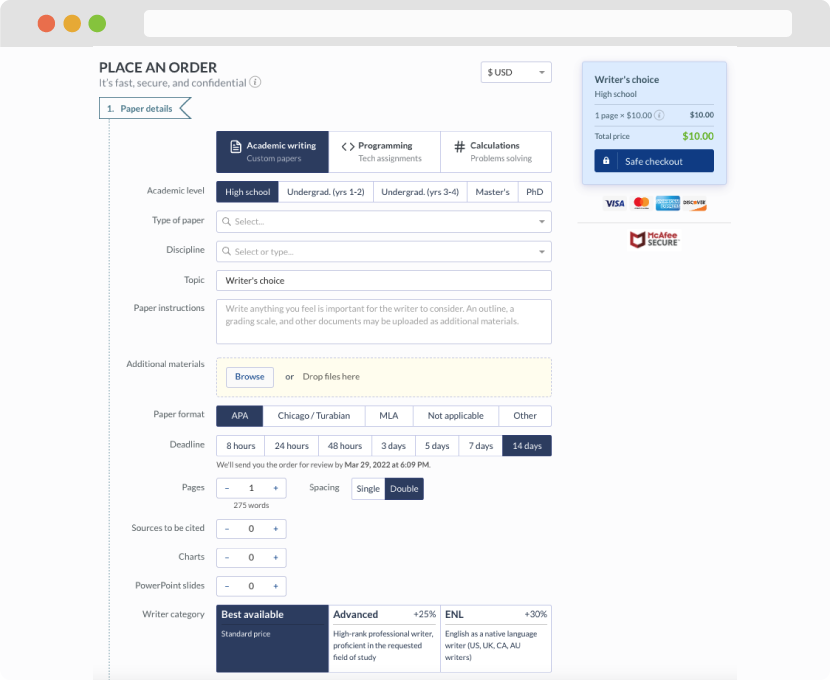
First, you will need to complete an order form. It's not difficult but, if anything is unclear, you may always chat with us so that we can guide you through it. On the order form, you will need to include some basic information concerning your order: subject, topic, number of pages, etc. We also encourage our clients to upload any relevant information or sources that will help.
Complete the order form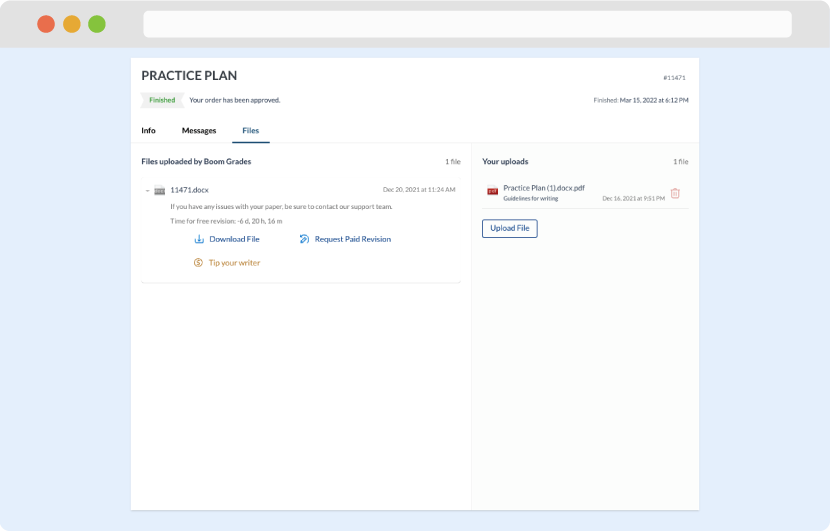
Once we have all the information and instructions that we need, we select the most suitable writer for your assignment. While everything seems to be clear, the writer, who has complete knowledge of the subject, may need clarification from you. It is at that point that you would receive a call or email from us.
Writer’s assignment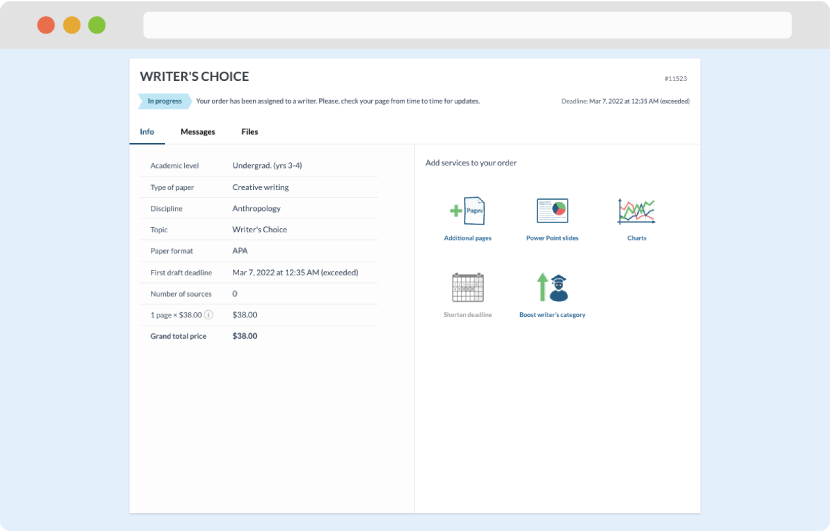
As soon as the writer has finished, it will be delivered both to the website and to your email address so that you will not miss it. If your deadline is close at hand, we will place a call to you to make sure that you receive the paper on time.
Completing the order and download