Answer either question A. or Question B. bellow. Please note that Question A has many sub-parts and relates to the relationships of Chapter 17 relating to the money supply process. Please note that question B attempts to take a current news item and put it into the topics raised in Chapter 16. While question A. asks you to look at some empirical data, really you don’t need to do any analysis but give it a good look-see please. The material in Chapter 17 is kind of a traditional approach. It relies on balance sheet measure of profit maximizing behavior of banks, and on the regulation by the FED. For this discussion question I want you to consider some values and changes in values for some of the key parts of activity by the FED and by Banks as mentioned in Chapter 17. For this part I want you to look at some data easily available and provide some descriptions. For part b you are going to be asked to use those descriptions to make a conclusion about the changing value of the money multiplier. In part c. you are going to be asked if your expectations about the money multiplier were met by the data you saw and explain why or why not.Take a look at FRED and think about the series “Excess Reserves” available at https://fred.stlouisfed.org/series/EXCSRESNS Note the variable name in the FRED data base is EXCRESNS Provide a description as to the behavior of excess reserves over the period from 2006 to 2019. Note the series was never exactly zero. Take at look at FRED and think about the series “Monetary Base Total” available at https://fred.stlouisfed.org/series/BOGMBASE Note the variable name in the FRED data base is BOGMBASE. Provide a description as to the behavior of the monetary base over the period from 2006 to 2019.How does this observation match with your answer to what you learned about “excess reserves” in the prior sub-question.Take a look at FRED and think about the series “Interest Rate on Excess Reserves” available at https://fred.stlouisfed.org/series/IOER Note the variable name in the FRED data base is IOER. Provide a description as to the behavior of interest rates paid on Excess Reserves over the period from Jan 1, 2009 to 2019. You might need to re-set the starting date in Fred to 2008-10-2How would you expect the trends in excess reserves, monetary base total, and interest rate on excess reserves to impact the money multiplier where the money multiplier is as described in Chapter 17? See equation 5 section 17.7.If you take a look at the money multiplier value, shown in FRED at https://fred.stlouisfed.org/series/MULT for say from 2000 up until today, are your expectations met regarding the value of the money multiplier met or not? Either way please provide a full explanation. This question has many parts and each addresses the relationship between the President of the US and the Federal Reserve. For reference the mission of the Federal Reserve is stated at https://www.federalreserve.gov/publications/gpra/2011-mission-values-and-goals-of-the-board-of-governors.htm#subsection-142-21B7B547 . How many members are there to be, by charter, on the Board of Governors of the Federal Reserve? How many members are there currently? If there is a difference between what the charter says and what we currently have, why is there a gap? Citing the mission of the Fed, explain how there could easily be a difference in opinion between the President and the Federal Reserve about what actions are appropriate for the economy. Find one citation of a publicly available source describing an issue that President Trump and the Federal Reserve don’t agree on. Explain what President Trump wants and why he wants that course of action.Explain what the Fed wants and why they want that course of action. Can you provide documentation of Presidents who served before President Obama, i.e. in time before the Obama administration who disagreed with the Federal Reserve? Please explain briefly the setting of the disagreement and include a citation of source.Dhruv Mathur responding to Blanca
“Hi Blanca, this is a great discussion post! Chapter 17 was interesting as it focused heavily on the behavior of banks as well as the role of the FED.
Based on the FRED graph, it shows that the excess reserves has a trend of showing an increase. However around 2015, there seems to a trend showing a bit of a decline. For October 2019, it seems to have been about 1,346,515
The sum of the Fed’s monetary liabilities (currency in circulation and reserves) and the U.S. Treasury’s monetary liabilities (Treasury currency in circulation, primarily coins) is called the monetary base (also called high-powered money). Based on the graph, it seems as there is a general increasing pattern till about 2015, where it then begins to level off and decrease a slightly.
I agree with your point regarding the observation and the concept of excess reserves. Some other things I found interesting to highlight is that the money supply is negatively related to the amount of excess reserves. Also, holding excess reserves constant, the money supply is negatively related to currency holdings.
I noticed a similar observation regarding the Interest Rate on Excess Reserves. From January 1, 2009, to 2019 I also see a constant rate of .25. At 2016, it slowly began to increase. I also noticed that there was steeper growth from 2017-2018 than there was from 2016-2017. That being said around May 2019, the rate started to drop.
You bring up an interesting point regarding the impact on the money multiplier. The money multiplier is a ratio that relates the change in the money supply to a given change in the monetary base. I would also expect the trends to impact the money multiplier by potentially lowering the money multiplier since both the monetary base total and the excess reserves are higher.
When looking at the money multiplier value, my expectations are met. I certainly agree with what you said as the financial crisis in 2008-2009 led to major implications for banks. When the excess reserve was high from 2008, the money multiplier started to decrease in 2008. Your point stating “During the recession, banks were not willing to lend money so they most likely put more money in reserve, yet maybe individuals may not be willing to deposit money in banks so both factors impact the money multiplier,” is interesting, as I never thought of it from that perspective! “
Michael Asante
“I enjoyed reading your discussion professor alston. Your post gave insight on the differences the President could have with the Federal Reserve. In terms of differing opinions between the Federal Reserve and the President, you bring up a good point about independence, which enables the Feds to be distinct from politics and pressures from the President. As such if the President wants a certain decision to be made by the Feds, it cannot be forced. However, I believe that certain decisions made by the President could sway or pressure the Feds to make decisions that would be in line with the opinions of the President. President Trump wanted the Federal Reserve to cut interest rates because of complaints on the increasing interest rates. However, as a result of the tariffs placed on China, the Feds had to cut down interest rates to stabilize the economy.
Over the years different presidents have disagreed with the Federal Reserve over several reasons. I agree with your reasoning to the root cause of these disagreements, in which you stated that each president has their own insights on how the market and interest rates should operate and work. Political aspirations and dreams could also be a factor. For example, President Nixon had disagreements with the Federal Reserve during his time by pressuring Chairman Arthur to lower interest rates. The economy was recovering from a recession at that time, and as a result, wanted the Fed to engage in this monetary policy to increase his re-election chances. “
Essay Writing Service Features
Our Experience
No matter how complex your assignment is, we can find the right professional for your specific task. Achiever Papers is an essay writing company that hires only the smartest minds to help you with your projects. Our expertise allows us to provide students with high-quality academic writing, editing & proofreading services.
Free Features
Free revision policy
$10Free bibliography & reference
$8Free title page
$8Free formatting
$8How Our Dissertation Writing Service Works
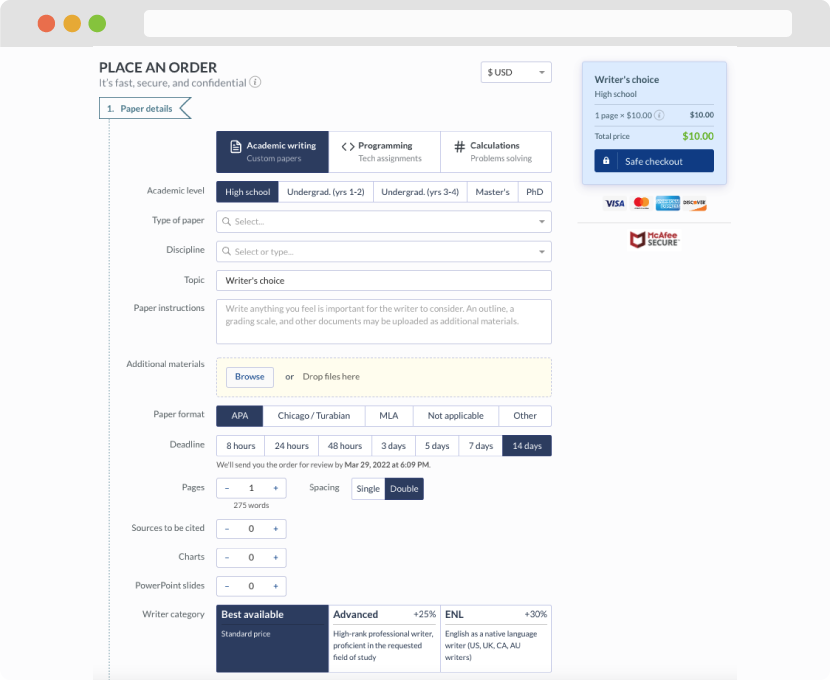
First, you will need to complete an order form. It's not difficult but, if anything is unclear, you may always chat with us so that we can guide you through it. On the order form, you will need to include some basic information concerning your order: subject, topic, number of pages, etc. We also encourage our clients to upload any relevant information or sources that will help.
Complete the order form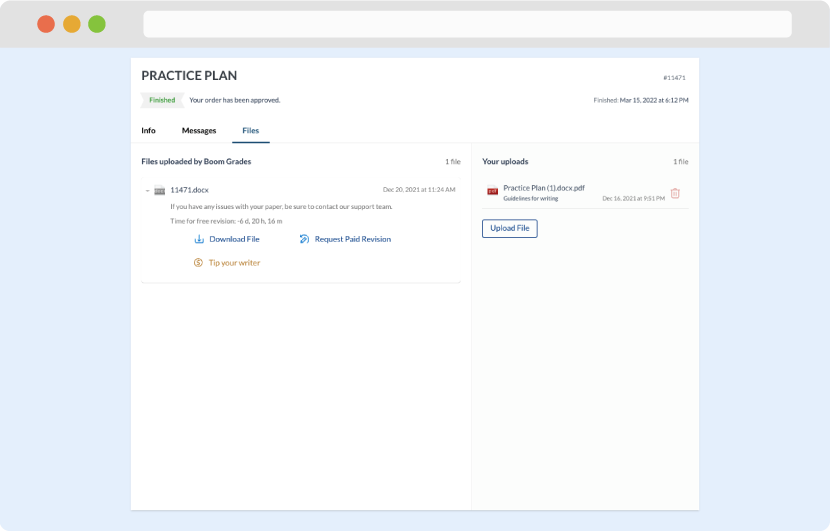
Once we have all the information and instructions that we need, we select the most suitable writer for your assignment. While everything seems to be clear, the writer, who has complete knowledge of the subject, may need clarification from you. It is at that point that you would receive a call or email from us.
Writer’s assignment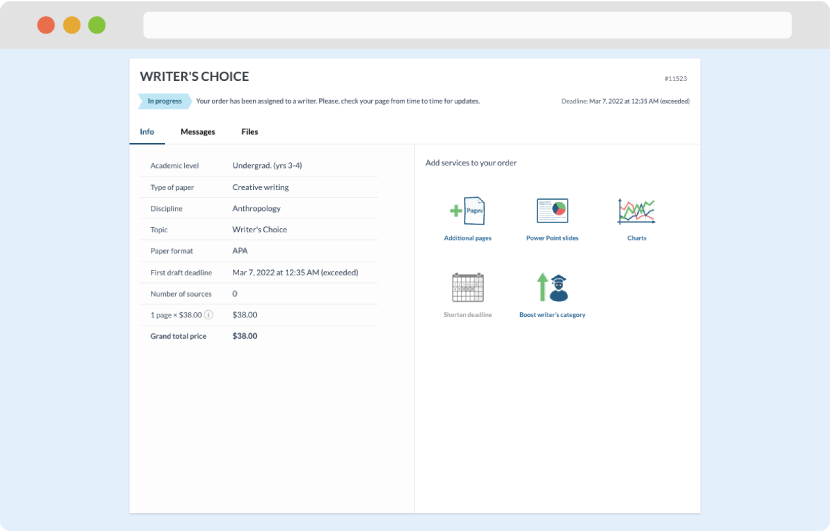
As soon as the writer has finished, it will be delivered both to the website and to your email address so that you will not miss it. If your deadline is close at hand, we will place a call to you to make sure that you receive the paper on time.
Completing the order and download