Question : ANOVA
Discuss the uses of ANOVA in this study. Are there any surprising or interesting results?
What post hoc test did the authors use? What value is there in performing post-hoc tests? Why do you think they choose this particular post-hoc test?
Nurse Education Today 33 (2013) 314–320
Contents lists available at SciVerse ScienceDirect
Nurse Education Today
journal homepage: www.elsevier.com/nedt
The calm before the storm? Burnout and compassion fatigue among undergraduate
nursing students
Barret Michalec a,⁎, Cynthia Diefenbeck b, Margaret Mahoney a
a
b
Department of Sociology, University of Delaware, United States
School of Nursing, University of Delaware, United States
a r t i c l e
i n f o
Article history:
Accepted 23 January 2013
Keywords:
Burnout
Compassion fatigue
Undergraduate nursing students
Nursing education
Clinical experiences
s u m m a r y
Studies have consistently highlighted the deleterious impact of burnout and compassion fatigue on professional
nurses’ well-being and willingness to remain in the profession. Yet, as to what extent these noxious conditions
are suffered among nursing students is still unclear. In this study 436 undergraduate nursing students completed
surveys assessing their experiences of emotional exhaustion, depersonalization, lack of personal accomplishment, burnout, secondary traumatic stress, and compassion satisfaction (factors of burnout and compassion
fatigue). There were no significant differences found between 3rd and 4th year students’ reports of detrimental
conditions and those of the 1st or 2nd year students. Furthermore, 4th year students reported significantly higher
levels of personal accomplishment compared to 1st and 2nd year students. Semi-structured in-depth interviews
with 3rd and 4th year students revealed that their clinical exposure during these years (especially during the 4th
year) may enhance their other-orientation as well as promote role actualization, which may serve as protective
features. Students did, however, express concern regarding an inevitable onset of burnout at some point during
their professional careers. It is suggested that a key to understanding the onset and experience of burnout and
compassion fatigue among nurses is to continue to examine the transition from student to professional nurse
and the cultural atmosphere of nursing education compared to professional practice.
© 2013 Elsevier Ltd. All rights reserved.
Introduction
Extensive research has shown that deleterious conditions such as
burnout and compassion fatigue negatively impact nurses’ wellbeing, job satisfaction, and willingness to remain in the profession
(Kalliath and Morris, 2002; Stewart, 2009). Moreover, there is evidence to suggest that burnout and compassion fatigue experienced
among professional nurses can affect patients’ satisfaction of the
care they receive (Leiter et al., 1998), and a recent study by Cimiotti
et al. (2012) suggests an association between experienced burnout
among nurses and negative patient outcomes. Previous research has
spotlighted particular social, environmental, and structural conditions in the workplace that can trigger and/or exacerbate burnout
and compassion fatigue among nurses, such as: the nature of caring
work (Aycock and Boyle, 2009), lack of social, collegial, and administrative support (Eastburg et al., 1994), workload/shift-related issues
(Aiken et al., 2002), and demands of certain specialties (McHugh et
al., 2011).
It is important to note, however, that nursing students, even those at
the undergraduate level, are exposed to these issues as well, especially
⁎ Corresponding author at: Department of Sociology, University of Delaware, 309 Smith
Hall, 18 Amstel Ave, Newark, DE 19716, United States. Tel.: +1 302 831 8231; fax: +1 302
831 2607.
E-mail address: bmichal@udel.edu (B. Michalec).
0260-6917/$ – see front matter © 2013 Elsevier Ltd. All rights reserved.
http://dx.doi.org/10.1016/j.nedt.2013.01.026
during the more clinically-oriented years of training (i.e., 3rd and
4th years). Although Deary et al. (2003), in their longitudinal study
of nursing students, showed significant association between certain
personality characteristics and reports of emotional exhaustion and
depersonalization (fundamental components of burnout), and a number of studies have suggested that novice nursing professionals are especially vulnerable to burnout (Maslach et al., 2001; Laschinger et al.,
2009), little attention has been paid to if, and to what extent, undergraduate nursing students suffer from burnout and/or compassion fatigue. If there is a connection between the clinical setting and burnout
and compassion fatigue, as previous research suggests, then it is possible that even nursing students are at risk for these noxious conditions because of clinical exposure during their education. During
various types of clinical experiences (either through curriculumrelated clinicals or through independently sought externships) nursing students are frequently confronted with real-life trauma situations
and similar (if not the same) workplace environment and climate as
professional nurses (Ralph et al., 2009; James and Chapman, 2009;
Melincavage, 2011).
Because burnout and compassion fatigue are such a detriment to
nurse well-being and the nursing workforce overall, it is essential to
uncover if and to what extent nurses-in-training may be suffering
from these debilitating affective/cognitive states. By spotlighting specific mechanisms that may trigger or exacerbate burnout and compassion fatigue, interventions can be implemented to protect these
B. Michalec et al. / Nurse Education Today 33 (2013) 314–320
students and perhaps matriculate a resilient and emotionally fortified
nursing workforce. This specific study addresses the following research questions: a) Is there evidence of burnout and/or compassion
fatigue among undergraduate nurses? b) Are there significant differences between grade cohorts’ reports of burnout and compassion
fatigue? c) What impact does clinical exposure have in the experiences of burnout and compassion fatigue among undergraduate nursing students?
This study is meant to provide further insight into the experiences of
undergraduate nursing students and their potential encounters with
emotional exhaustion and burnout so that nursing school instructors
and administrators may be more informed in their mentoring, curriculum development, and overall preparation of the next generation of
professional nurses.
Methodology
Study Setting
The University of Delaware School of Nursing (SON), located in the
U.S., offers nationally accredited programs including the traditional
BSN, Accelerated BSN, RN to BSN and RN to MSN, MSN, and PhD programs in nursing. The traditional BSN program is a four year program
that enrolls approximately 130 students per year. The vast majority of
students are admitted directly to the nursing major, although a small
percentage enter as change of major students at some point during
the 1st year. First time NCLEX-RN pass rate percentages are in the
low 90s. The student body is comprised of approximately 92% female
and 90% Caucasian students. The Clinical Immersion Model is a novel
curriculum model that was pioneered at the University of Delaware
SON in 2004 (Diefenbeck et al., 2006) and has demonstrated positive
results in student-centered outcomes over the long-term (Diefenbeck
et al., 2011). This BSN curriculum model differs from other U.S.-based
nursing programs. In most other U.S. programs, “traditional” clinical
experiences (instructor-led, hospital-based clinical rotations) are
typically spread out over multiple years and concurrently held with
didactic course content. In this unique model of BSN education, all
clinical rotations take place in the 4th year following mastery of
didactic content in preceding years. The concentration of clinical
rotations into one year results in a more intense clinical experience
for the student. Intended benefits of the “clinical immersion model”
include enhanced patient safety and promotion of transition to
professional nursing practice (Diefenbeck et al., 2006).
Surveys
First, second, third, and fourth year traditional (non-accelerated)
undergraduate nursing students were given a questionnaire at the
end (May) of the 2010–2011 academic year. Surveys were administered to each cohort during mandatory classes in the spring semester
by either the lead author or a trained graduate student, neither of
whom were affiliated in any way with the School of Nursing. The
use of human subjects was obtained through IRB approval of this
study. Students were explicitly made aware of the voluntary nature
of the study when the researcher distributed the survey, and the survey contained an informed consent form that required the students’
signature (expressing their willingness to participate).
A total of 436 BSN nursing students completed the questionnaire
(out of 546 enrolled), 123 first-year, 98 second-year, 97 third-year,
and 118 fourth-year. Of the sample, 85% of the students were white,
5% were Black, 4% were Asian, 3% were Latino(a), 1% were Bi-racial,
1% were Indian, and less than 1% considered themselves to be Native
American or of an “other” race. Females and males comprised of 93%
and 7% of the sample respectively. Ages of the participants ranged
from 18 to 58, with the average age being 20. Participants who
315
were 18–22 years of age made up 91% of the sample, 7% were between 23 and 29, and 2% reported their age between 30 and 58.
Measures
The Maslach Burnout Inventory (Human Services Survey) (MBI-HSS)
is a valid, reliable, and widely used tool (Maslach and Jackson, 1986;
Maslach et al., 1996) that measures experienced burnout through scores
on three subscales: emotional exhaustion (EE), Depersonalization (DP),
and Personal Accomplishment (PA). The EE subscale measures how
one’s work may lend to feelings of being emotionally overextended
and exhausted. The DP subscale assesses an “unfeeling” and the tendency to see recipients of one’s care as objects instead of humans. The PA
subscale addresses feelings of competence, achievement, and productivity in one’s work with people. Students were asked to report how often
they had experienced particular statements from Never (0) to Every Day
(6). As noted earlier, a high degree of burnout is reflected in high scores
on the EE and DP subscales and in low scores on the PA subscale.
The Professional Quality of Life (ProQOL) scale, version 5, is a valid,
reliable, and widely used tool (Stamm, 2009) that assesses compassion
satisfaction, as well as compassion fatigue (through subscales measuring burnout and secondary traumatic stress). Compassion satisfaction
is characterized by feeling content and pleased with one’s job and
from one’s acts of caring. Individuals high in compassion satisfaction
feel invigorated by the helping they do. Compassion fatigue is characterized by a sense of severe malaise, being overwhelmed, and being
generally down-trodden by providing care to those who have experienced significant trauma and stress (physical, emotional, and/or social).
Aspects of compassion fatigue, according to Stamm (2009), are Burnout
(sense of disconnectedness, and being “out-of-touch” with oneself),
and Secondary Traumatic Stress (an unhealthy rumination of and
preoccupation with thoughts of people one has cared for and treated,
as well as a sense of being trapped and infected by others’ trauma).
Students were asked to consider their current work/school situation
and select how frequently they experienced certain statements from
Never (1) to Very Often (5).
Each subscale of the MBI-HSS and the ProQOL has been shown to
have excellent internal consistency (Maslach et al., 1996; Stamm,
2009 1). Table 1 features the details of each of the scales utilized in
this study.
Interviews
In-depth, semi-structured interviews were conducted specifically
with 3rd and 4th year undergraduate nursing students to gain a better understanding of how nursing students experience the more
clinically-oriented years of their training, and if particular experiences may have had any impact on their perceived burnout and/or
compassion fatigue. First and second year students were excluded
from the interviews because their nursing curriculum/education is almost exclusively in the classroom setting and although these students
may engage in clinically-oriented internships or shadowing opportunities on their own, it is not required by the institution. Therefore, 3rd
and 4th year students were considered to have extensively more experience in the clinical setting that they could speak of (as compared
to 1st and 2nd year students). These interviews were conducted towards the end of the school year (April/May 2011) by a trained qualitative researcher (the lead author) who was not a faculty member of
or affiliated with the School of Nursing. Each interview participant
was interviewed individually and each interview was recorded
using a digital voice recorder and permission to use the recorder
was requested from every subject prior to recording. At the onset of
the interview participants were reminded of the voluntary nature of
the interview and that they could choose not to answer any question
1
Please see these specific articles for detailed explanations of the scales tested reliability and validity.
Compassion fatigue &
compassion satisfaction
Professional Quality of
Life Scale (ProQOL)
Burnout; secondary traumatic
stress; compassion satisfaction
Total of 30 Likert self-report: burnout (10)
(α = .75, n = 976);
secondary traumatic stress (10)
(α = .81, a = 1135); compassion
satisfaction (10) (α = .88, n= 1130)
Items for each subscale are summed to
acquire raw score.
Range/classifications
EE: 27 or over (high); 17–26 (moderate);
0–16 (low).
DP: 13 or over (high); 7–12 (moderate);
0–6 (low).PA: 0–31 (low); 32–38 (moderate);
39 and over (high).
22 or less (low); 23–41 (average);
42 or more (high).
Scoring
Items for each subscale are summed. PA
scores are interpreted in the opposite
direction from EE and DP.
Subscales
Construct(s)
Burnout
Scale
Maslach Burnout Inventory
Index (MBI)
Table 1
Summary of scales used.
Emotional exhaustion (EE);
depersonalization (DP);
personal accomplishment (PA)
Items
B. Michalec et al. / Nurse Education Today 33 (2013) 314–320
Total of 22 Likert self-report: EE (9)
(α = .90, n = 1316); DP(5) (α = .79, n= 1316);
PA (8) (α = .71, n = 1316)
316
during the interview and could withdraw at anytime. 2 Interviews
were conducted at local coffee shops and eateries. Participants
were offered coffee, tea, or lunch as compensation for their time.
Recruitment of Interview Participants
When completing the consent form for the survey, students were
asked to enter their email address if they were interested in participating in a brief interview regarding their experiences during their
training. Ten 3rd year and ten 4th year students were selected at random from the list of students willing to participate. 3 Once the 20 participants had been randomly selected they were sent an email
reminding them of their willingness to participate in the interview
and asking if they were still willing to do so, and that the interview
was completely voluntary. Of the original 20 contacted, only 2 declined (both cited school work-related issues), and therefore 2
other students were randomly selected (from the list of those willing
to participate) and contacted, both of whom agreed. Of the 20 participants that were interviewed, 16 were female, 4 were male, 15 were
white, 2 were Black, 2 were Latina, and 1 was Asian. Their ages
ranged from 20 to 22.
Statistical Analyses and Interpretation of Qualitative Data
Survey data were entered and analyzed using SPSS 19.0. Basic
means and standard deviations were calculated for variables to explore/describe the sample. The internal consistency (Conbach’s α) for
each subscale was also calculated. One-way ANOVAs were conducted
to explore significant differences in means of each subscale between
each grade cohort. Any significant differences in means were subjected
to post-hoc tests (Games–Howell) to confirm between which specific
cohorts the differences occurred.
Interview data were transcribed into Word files and uploaded
into NVivo 9. Interview data were analyzed using a multi-step coding
process. Interviews were initially coded on the following deductive
codes extracted from the survey and previous literature: clinical experiences, stress, burnout, emotions (positive), emotions (negative), interactions with patients, interactions with health care staff, among
others. Inductive codes, however, such as nurse identity, perceptions
of nursing, “being” a nurse, transition from student, among others,
were identified through multiple readings of interview transcripts
and the initial deducting analysis procedures. These deductive and
inductive codes were then utilized in tandem to identify frequently
appearing themes nested within the data. This coding process
yielded several general themes and these themes were then
employed as codes and all interview data were analyzed extensively
to continually extract processes behind themes. Three specific
themes emerged from these processes, enhanced “otherness”, role actualization/fulfillment, and burnout on the horizon.
For example, regarding the theme enhanced “otherness”, deductive and inductive codes such as emotions, interactions with patients,
nurse identity, and other-orientation (among others) were found to
frequently converge — often relating to the notion of students’ increased sense of wanting/enjoying/desiring to care for others (i.e. patients, family, and even friends). This general theme was then
utilized as a code and the entirety of the data was analyzed again
to further specify the intricacies of the theme and how participants
were truly discussing the issue. When it was felt that the data related
to the theme had been fully extracted and dissected (i.e. saturation
had been reached) the theme was then reformatted to reflect its
2
Each of the participants completed a full interview.
Of the 215 3rd and 4th year students that completed the survey 137 (65 3rd years
and 72 4th years) expressed interest in being interviewed. No significant differences
were found (regarding reports of Burnout or Compassion Fatigue) between those that
were willing to participate and those that were not. Random selection of participants
was conducted by selecting every 7th name on the list until ten 3rd years and ten 4th
years had been selected.
3
B. Michalec et al. / Nurse Education Today 33 (2013) 314–320
317
Table 2
Comparison of means between grade cohorts for each subscale.
MBI
ProQOL
Emotional exhaustion
(n = 430)
Depersonalization
(n = 422)
Personal accomplishment
(n = 434)
Burnout (n = 416)
Secondary traumatic stress
(n = 422)
Compassion satisfaction
(n = 424)
1st years
18.16 (8.42)
moderate
2nd years⁎⁎
3rd years⁎
5.94 (4.63)
low
32.85 (8.59)
moderate
4th years⁎⁎
30.44 (4.41)
average
2nd years⁎
20.58 (6.71)
low
42.39 (6.75)
high
2nd years
22.73 (10.64)
moderate
1st years⁎⁎
22.32 (10.01)
moderate
1st years⁎
19.46 (9.50)
moderate
6.68 (5.51)
low
32.71 (10.38)
moderate
4th years⁎
34.71 (5.79)
moderate
32.19 (5.01)
average
1st years⁎
31.58 (3.36)
average
20.84 (6.60)
low
43.30 (6.07)
high
20.44 (4.88)
low
42.73 (5.36)
high
5.21 (4.18)
low
36.23 (6.77)
moderate
1st years ⁎⁎
2nd years⁎
30.69 (3.28)
average
19.40 (5.07)
low
43.42 (5.17)
high
0.88
0.69
0.88
0.48
0.82
0.90
3rd years
4th years
Cronbach’s α
5.79 (5.33)
low
⁎ p b .05.
⁎⁎ p b .01.
now more concise/succinct nature, enhanced “otherness”. Each of the
themes is discussed in the section that follows.
To ensure a satisfactory level of inter-coder reliability the authors
met at the beginning and end of each stage of analysis to discuss findings, memos, and notations. Differences between team members regarding particular findings were openly discussed and decisions were
based upon consensus.
Results
Quantitative Findings
The means and standard deviations (shown in parentheses) for
each subscale for the sample are featured in Table 2. These means
were then compared to the cut-off scores for each of the MBI and
ProQOL subscales (Maslach et al., 1996; Stamm, 2009). As Table 2
shows, all students, regardless of year, reported moderate/average
levels of emotional exhaustion, personal accomplishment, and burnout, low levels of depersonalization and secondary traumatic stress,
and high levels of compassion satisfaction.
Table 2 also depicts on which subscale grade cohorts differed significantly. One-way ANOVA calculations showed significant differences in mean scores for emotional exhaustion (MBI) (F(3, 426) =
5.45, p = .001), personal accomplishment (MBI) (F(3, 430) = 4.63,
p = .003), and burnout (ProQOL) (F(3, 412) = 3.99, p = .008). Following tests for homogeneity, post-hoc analyses (Games–Howell) revealed that 1st year students reported significantly lower levels of
emotional exhaustion compared to 2nd and 3rd year students (see
Table 2). Similarly, 1st year students reported significantly lower
levels of burnout compared to 2nd year students. Interestingly, 4th
(and 3rd) year students did not report significantly higher levels of
any of the noxious emotional/cognitive conditions. However, 4th
year students did report significantly higher levels of personal accomplishment as compared to 1st and 2nd year students.
b) evidence of role actualization/fulfillment, c) predictions of burnout
on the horizon. The themes presented are representative of the consensus of statements made by participants, and verbatim quotations are
offered as a selection of exemplary evidence of each theme. Table 3 presents the themes identified in the data, the frequency of which they
were referenced by participants, and the degree of coder agreement regarding their presence in the data (prior to consensus being reached). 4
These themes will be presented separately, with examples, but will be
elaborated on more fully in the Discussion section.
The Enhancement of “Otherness”
When questioned whether their clinical experiences had affected
them emotionally in any way students frequently noted that they
felt as though they had become more empathic, caring, and compassionate towards others, especially patients, and that their emotional
connections with others had actually grown and been enhanced.
“Just being around nurses I think, and other people that have similar interests, I’ve become a more caring person I think. I’ve always
been very nice and affectionate and stuff but I think I’ve become so
much more that way and to the point that I see people and I feel
like they’re not just people passing by, I feel like I connect with
more people. I think it happened gradually, but definitely (pause),
actually it happened ever since probably two summers ago when I
started working in the clinical setting. I think just the patient experience has made me become a more caring person.” (4th year)
“You develop these relationships with the patients (pause) and
it’s, you have, you have that compassion for them. It’s so much
stronger than I have ever imagined. So I think, I think that’s been
the biggest change or difference that I have experienced because
of my field experiences.” (3rd year)
Qualitative Findings
As noted earlier, interviews with 3rd and 4th year students were
used to attain a better understanding of their clinical experiences and
how their interactions and ordeals in the clinical setting may impact
and/or exacerbate burnout and/or compassion fatigue. Three main
themes were identified in the interview data, especially relating to the
students’ clinical experiences: a) the enhancement of “otherness”,
4
Regarding Table 3, Sources identifies the number of individual participants where
the theme was identified and Total References represents the number of times it was
identified throughout all the interview data. The percentage of coder agreement appears in parentheses. This original percentage was calculated by summing the total
number of references (of one specific theme) identified by all coders, then tallying
all the concordant identifications among the coders and dividing the concordant sum
by the total sum.
318
B. Michalec et al. / Nurse Education Today 33 (2013) 314–320
Table 3
Frequency of themes and percentage of coder agreement.
Theme
Sources
Total references
The enhancement of “otherness”
Role actualization/fulfillment
Burnout on the horizon
18 (100%)
18 (100%)
17 (100%)
76 (92%)
64 (87%)
61 (91%)
Role Actualization/Fulfillment
A key finding within the qualitative data was that students, especially 4th year students, felt that the clinical experiences made them
feel as though they were actually nurses; that they were “doing”
what they had been learning. Students spoke of how engaging in
their clinical responsibilities provided them with a sense of fulfillment and actualization of their role as nurses, and that this engagement with their future professional role had beneficial effects.
“We’re just finally expected to be nurses. So much responsibility,
you know, it’s like they’ve given us every, all the information,
everything that we need to know and now we’re using it. Real
patients are so much better than mannequins (laughs). But, so, I
mean, it’s actually what we’re doing with our lives so it’s exciting
to see. It’s fun to be actually doing what we’ve learned on real people. Everthing’s kind of coming together. I have felt like a nurse.”
(4th year)
“It’s weird, you know. I didn’t actually feel like a nurse last fall semester, I was just like ‘Oh, I’m a student. Whatever’. I got into the
last semester of rotations and the preceptorship and I was like
‘Wow’, and now I feel kind of confident about what I’m learning
and what I am doing here.” (4th year)
Burnout on the Horizon
Although the interview data suggests that there are many positive
emotional and psychological effects to clinical experience, these nursing students did talk about anticipating experiencing burnout at some
point during their professional careers as though it was inevitable.
“I mean, I feel like it’s [burnout] coming. You know what I mean?
I’m not feeling it, not at all, but maybe someday. I mean, I don’t feel
it now, but I sense that it can happen and I can see it happen.” (4th
year)
“I work at an ICU step-down so we have pretty bad-off patients,
and it’s like really intense. The emotional side, I mean I get, I work
every other weekend, and I have to mentally prepare myself so
much just to like go into the work place. Afterwards, I’m just so
wore out, I can’t go out with my friends afterwards, I have to just
come home and sleep. It’s intense. You see like families upset and
then the patients are depressed, and I think that’s the part that’s
kicking in.” (3rd year)
Discussion
As depicted in Table 2, nursing students reported experiencing
emotional exhaustion, depersonalization, burnout, and secondary
traumatic stress (i.e. burnout and compassion fatigue), but only at
low and moderate/average levels. It should be noted, however, that
the cut-off scores used for comparison (i.e. low, moderate, high) are
calculated from thousands of scores reported by professionals in the
human services fields (i.e. medicine, nursing, education, social work,
psychiatrists, ministers, librarians, and many others) (Maslach et al.,
1996; Stamm, 2009). So, even though these students are reporting
moderate/average and low levels, they are low and moderate/average
levels of a “professional-grade”. From this perspective, this study may
provide evidence that these detrimental experiences do take shape
for nursing students as early as the beginning stages of their training.
Perhaps most interesting is that there was minimal evidence of
significant differences in the reports of these deleterious conditions
found between the more clinically-oriented grade cohorts (3rd and
4th year students, especially 4th years) and the more classroomoriented grade cohorts (1st and 2nd year students). Although 3rd
year students were found to report significantly higher levels of emotional exhaustion compared to 1st years, there were no significant
differences reported in the feelings of depersonalization, burnout, or
secondary traumatic stress. That is to say, there were no significant
differences in the reports of burnout or compassion fatigue between
the grade cohorts suggesting that perhaps the frequency and intensity of clinical experience during nursing school may not be the mechanism by which these conditions are incubated.
Whereas 4th year students did not report significantly higher
levels of burnout or compassion fatigue, they did report significantly
higher levels of personal accomplishment compared to 1st and 2nd
year students. Although this particular finding should be viewed
with some skepticism 5 it does suggest that perhaps there are emotional and psychological benefits to clinical experiences for advanced
nursing students. This notion was echoed in the qualitative data.
Although many interview participants did note that clinical experiences were stressful at times the interview data strongly suggests that
experiences in the clinical setting (during their nursing school years)
may not be the prime mechanisms that instigate burnout and compassion fatigue. From these particular data it appears that these experiences have advantageous qualities that amplify other-orientation, as
well as offer opportunities for students to further embrace their role
as “nurses”.
There is reason to believe, however, that this enhanced otherness
could be a culprit of future burnout and compassion fatigue as Ward
et al.’s (2012) recent study suggests that increased exposure to patient encounters actually led to the decrease in empathy they found
among undergraduate nursing students. Moreover, Miller et al.
(1988), Williamson (1989), and Omdahl and O’Donnell (1999) have
shown that for human service providers (such as those within the
health care fields) there are consequences (e.g., burnout) to exposing
oneself to the emotions of others. Given that the students in this specific study were exposed to the clinical setting mainly in their 4th
year, perhaps the negative effects of clinical experiences have yet to
take shape. Future research must follow students into their professional domains in order to fully understand possible shifts in their
compassion and/or empathy levels.
Students also noted how their clinical experiences provided them a
venue to actually “do” nursing, to practice the skills they had been
learning in the lecture halls and simulation labs, and that these opportunities not only increased their appreciation for the encompassing
nature of the nurse’s role in health care delivery, but also opened their
eyes to vast responsibilities that a nurse must consider in patient care.
These experiences appeared to reconfirm their enjoyment and enthusiasm for their future profession, rather than whittle away at their positive attributes and exacerbate feelings of burnout or compassion
fatigue.
However, the role of the student (as compared to a professional
nurse) may provide a “safety net” in terms of patient responsibility
and the effects on well-being that may accompany such responsibilities. Although 4th year students are expected to perform duties and
5
This finding could be attributed to self-reporting errors, selection bias, and/or the
fact that 4th year students were mere weeks from graduation when the survey was
administered.
B. Michalec et al. / Nurse Education Today 33 (2013) 314–320
tasks similar to those required of professional nurses, it is understood
(by all parties, including the student) that they are, in fact, still students, and that the full burden of the patient’s health outcomes falls
on the professional staff. In this sense, the mantle of “the student”
provides a safety net for the student to perform the tasks and duties
expected of them while remaining somewhat shielded from the
negative side-effects of such activities (i.e., burnout and compassion
fatigue). During the interviews, students even noted this safety net.
For example,
“But they’re [professional nurse/preceptor] supposed to oversee,
like make sure you did everything, and do it too. They’re supposed
to have looked at it too, they don’t just trust the students cause
we, we’re not experienced yet.” (4th year)
“I don’t think I really know how to deal with it all once it gets real.
You know? I just, I get nervous because once it comes like full time
that’s when it (pause) I’m not going to be able to like steal away
for two weeks, it’s going to be like every day.” (4th year)
This last statement reflects not only the safety net aspect of being in
training, but also points to the foreseeable difficulties of transitioning to
the professional realm. As noted above, students could sense the problems they would face as professional nurses, and spoke of how experiences like burnout and compassion fatigue were on the horizon
post-graduation. The interview participants offered specific stories
where they felt vulnerable, as though their emotions were exposed,
and that if these experiences were to be more regular that serious detriment to their emotional and mental health was expected. In this
sense, clinical experiences during nursing school may represent a
mere calm before the storm — foreshadowing lurking dangers.
Taken together, the quantitative and qualitative data suggest that
although clinical experiences during nursing school may subject students to whispers of burnout and compassion fatigue, they also provide students with an arena to actualize their future professional
role while simultaneously providing a safety net that may protect
them from practice-based errors and limit their susceptibility to
these deleterious conditions. This study did not yield evidence to suggest that concerning levels of burnout and compassion fatigue are experienced among more clinically-oriented nursing students, but these
data do present the possibility that the seeds of such conditions are
planted during these formidable years of training.
Imperative next steps must be taken to explore how burnout and
compassion fatigue are experienced in the transition between nursing
student and nurse professional. Kramer et al. (1972) noted that the educational and professional systems (for nursing) are “antithetical” and
the conflict between these systems, and the attempts to negotiate the
transition between them, may have detrimental impact on nurses’
physical, emotional, and mental health. Furthermore, Rudman and
Gustavsson (2011) found that during the first three years of practice,
every fifth nurse reports feeling “burned out” at some point, and that
the second year of practice seems to be particularly stressful. Recently,
these authors (Rudman and Gustavsson, 2012) did find an increase in
exhaustion, disengagement, and study burnout among Swedish nursing
students across the years of their education, and that study burnout was
indeed related to poorer work-related outcomes (i.e. mastery of
occupational tasks, research utilization, and turnover) one year post
graduation. This transition from student to professional appears to
be a particularly sensitive and vulnerable time (Duchscher, 2009;
Laschinger et al., 2009). If the seeds of burnout and compassion fatigue
are indeed planted during nursing school, the transition from student to
professional may be the fertile ground where social, cultural, and environmental cues stimulate the growth of these noxious conditions. In
this sense, increased emphasis on the need for residency or other
319
transition-to-practice programs may be another key to nurse burnout
prevention, early detection, and intervention.
There are limitations with this study. Only one school of nursing
was studied, and this particular school has a very unique curriculum
in regards to when students are fully immersed into the clinical setting. Future research should examine the rates of burnout and compassion fatigue reported among students from nursing schools that
put students in clinical rotations during their 1st and 2nd years. Similarly, the data gathered for this study stems from a very homogenous
(young, white, female) sample, and therefore may not be representative of all nursing students. Furthermore, this data is cross-sectional,
providing a mere snap shot of the presence (or lack thereof) of burnout and compassion fatigue in nurse training. Future research interested in dissecting the if, when, and how regarding the onset of
burnout and compassion fatigue should employ a longitudinal approach, following one specific class through their years of training
and into professional practice. Finally it should be noted that although
the internal consistency (α) for ProQOL’s subscale of burnout has
been shown to be .75 (n = 976) (see Table 1), within this particular
study it was only shown to be .48, thereby lending some skepticism
to the findings related to this particular subscale.
Conclusion
Given the detrimental impact burnout and compassion fatigue can
have on nurse well-being and attrition, this study examined if/how
these conditions are reported among undergraduate nursing students.
It was found that nursing students (of all grade cohorts) reported only
low to moderate/average levels of burnout and compassion fatigue,
and no significant differences were found between the grade cohorts.
Furthermore, all students reported high levels of compassion satisfaction, and 4th year students reported significantly higher levels of
personal accomplishment compared to 1st and 2nd year students. Interview data suggests that clinical experiences may not only enhance
3rd and 4th year nursing students’ other-orientation but also provide
opportunities for these students to further actualize their future professional role while still feeling “protected” by the safety of being
in-training. Taken together, these aspects of clinical training may shield
3rd and 4th year students from the negative emotional and psychological side effects of health care delivery, at least to some extent. Perhaps
what is experienced during these formidable years of training is a “calm
before the storm”. It is suggested that future research should not only
explore individual differences/attributes that may relate to experienced
burnout and compassion fatigue, but also pay special attention to the
potential onset and/or enhanced experience of burnout and compassion
fatigue (and the structural-, interactional-, and individual-based mechanisms behind these experiences) during the transition from student to
professional, and the early stages of nurses’ professional career, times
when they may be most vulnerable and lack valuable social support.
Acknowledgments
This project was carried out with the support of the University of
Delaware General University Research Fund. The authors would also
like to thank Rachel Lee, BSN, and Randy Lascaro, BSN, for their assistance with many aspects of this study.
References
Aiken, L., Clarke, S., Sloane, D., Sochalski, J., Silber, J., 2002. Hospital nurse staffing and
patient mortality, nurse burnout, and job dissatisfaction. Journal of the American
Medical Association 288 (16), 1987–1993.
Aycock, N., Boyle, D., 2009. Interventions to manage compassion fatigue in oncology
nursing. Clinical Journal of Oncology Nursing 13 (2), 183–191.
Cimiotti, J.P., Aiken, L.H., Sloane, D.M., Sloane, D.M., Wu, E.S., 2012. Nurse staffing, burnout,
and health care-associated infections. American Journal of Infection Control 40,
486–490.
320
B. Michalec et al. / Nurse Education Today 33 (2013) 314–320
Deary, I.J., Watson, R., Hogston, R., 2003. A longitudinal cohort study of burnout and
attrition in nursing students. Journal of Advanced Nursing 43 (1), 71–81.
Diefenbeck, C., Plowfield, L., Herrman, J., 2006. Clinical immersion: a residency model
for nursing education. Nursing Education Perspectives 27 (2), 72–79.
Diefenbeck, C., Wade, G., Hayes, E., Herrman, J., 2011. Student-centered outcomes
evaluation of the clinical immersion program: five years later. Journal of Nursing
Education 50 (11), 628–635.
Duchscher, J.E.B., 2009. Transition shock: the initial stages of role adaptation for newly
graduated registered nurses. Journal of Advanced Nursing 65 (5), 1103–1113.
Eastburg, M., Williamson, M., Gorsuch, R., Ridley, C., 1994. Social support, personality,
and burnout in nurses. Journal of Applied Social Psychology 24 (14), 1233–1250.
James, A., Chapman, Y., 2009. Preceptors and patients – the power of two: nursing
student experiences on their first acute clinical placement. Contemporary Nurse
34 (10), 34–47.
Kalliath, T., Morris, R., 2002. Job satisfaction among nurses: a predictor of burnout
levels. Journal of Nursing Administration 32 (12), 648–654.
Kramer, M., McDonnell, C., Reed, J.L., 1972. Self-actualization and role adaptation of
baccalaureate degree nurses. Nursing Research 21 (2), 111–123.
Laschinger, H.K., Finegan, J., Wilk, P., 2009. New graduate burnout: the impact of
professional practice environment, workplace civility, and empowerment. Nursing
Economics 27 (6), 377–383.
Leiter, M., Harvie, P., Frizzell, C., 1998. The correspondence of patient satisfaction and
nurse burnout. Social Science & Medicine 47 (10), 1611–1617.
Maslach, C., Jackson, S., 1986. The Maslach Burnout Inventory Manual, 2nd ed. Consulting
Psychologists Press, Palo Alto, CA.
Maslach, C., Jackson, S.E., Leiter, M.P., 1996. Maslach Burnout Inventory Manual, 3rd ed.
CPP, Inc, Mountain View, CA.
Maslach, C., Schaufeli, W.B., Leiter, M.P., 2001. Job burnout. Annual Review of Psychology
52, 397–422.
McHugh, M., Kutney-Lee, A., Cimiotti, J., Sloane, D., Aiken, L., 2011. Nurses’ widespread
job dissatisfaction, burnout, and frustration with health benefits signal problems
for patient care. Health Affairs 30 (2), 202–210.
Melincavage, S.M., 2011. Student nurses’ experiences of anxiety in the clinical setting.
Nurse Education Today 31, 785–789.
Miller, K., Stiff, J., Ellis, B.H., 1988. Communication and empathy as precursors to burnout
among human service workers. Communication Monographs 55, 250–265.
Omdahl, B.L., O’Donnell, C., 1999. Emotional contagion, empathic concern and communicative responsiveness as variables affecting nurses’ stress and occupational commitment. Journal of Advanced Nursing 29 (6), 1351–1359.
Ralph, E., Walker, K., Wimmer, R., 2009. Practicum and clinical experiences: postpracticum students’ views. Journal of Nursing Education 48 (8), 434–440.
Rudman, A., Gustavsson, J.P., 2011. Early-career burnout among new graduate nurses: a
prospective observational study of intra-individual change trajectories. International Journal of Nursing Studies 48, 292–306.
Rudman, A., Gustavsson, J.P., 2012. Burnout during nursing education predicts lower
occupational preparedness and future clinical performance: a longitudinal study.
International Journal of Nursing Studies 49, 988–1001.
Stamm, B.H., 2009. The Concise ProQOL Manual. ProQOL.org, Pocatell, ID.
Stewart, D., 2009. Casualties of war: compassion fatigue and health care providers.
MEDSURG Nursing 18 (2), 91–94.
Ward, J., Cody, J., Schaal, M., Hojat, M., 2012. The empathy enigma: an empirical study
of decline in empathy among undergraduate nursing students. Journal of Professional Nursing 28 (1), 34–40.
Williamson, C.A., 1989. Empathy and burnout in male and female helping professions.
Research in Nursing and Health 12, 169–178.
Rev. 042718
Appendix B
Each student will be assigned to a group. This is not a group assignment but rather a way for all the questions
to get answered adequately. The students from each group will lead the discussion for the assigned question.
Each student will respond individually to the assigned question and another question of their choosing (try to
not pick the one everyone else is posting on). Recap: Students must answer the assigned question and pick
one other question and respond to it as well. Each student will post at least twice. You will need to post the
response to your assigned question by Friday of each week so that other students will have a chance to read
your response and ask questions also. You are welcome to add additional responses, however each response
should be meaningful and not just a repeat of another response or thanking someone for the explanation.
Each discussion will be assigned points based on quality of answer not just quantity–refer to the rubric for
grading of discussion. I will reassign the groups and questions each week. The discussion will be closed to
posting on Wednesday after the homework due date.
Note that the criteria for 20 points includes citing additional references related to the topic. Excellent
summaries of these topics in the texts and other on-line materials are available on the Internet. Finding and
reading these additional sources may help you understand these concepts more fully. Be sure to cite the spot
where you found the additional information, so the rest can find it, if we would like to read more about that
concept or others.
RUBRIC FOR GRADING DISCUSSION
Promptness and Initiative speaks to the student’s ability to participate in discussions in a timely fashion which
demonstrates self-motivation. It permits commentary on whether or not the student is actively and consistently
engaging in the course content.
Delivery of Post addresses the student’s attention to detail in terms being grammatically correct with rare
misspellings.
The category, Relevance of Post, permits an objective assessment of the student’s ability to post topics that
are relevant to the original discussion with acknowledgement of references if provided. It addresses the student
who stays on topic as well as the student who appears to disengage from the course content.
Expression within the Post addresses the issue of how well opinions are expressed and how ideas or
comments are presented. This category also allows the facilitator to acknowledge the different writing/expression
styles of the students.
Lastly, the category, Contribution to the Learning Community (LC), speaks to the assessment of whether or
not the student makes an effort to further the development of a collaborative learning experience. It provides
distinction between the student who seems relatively indifferent to the building process of a LC and the student
who strives to reinforce the LC as the course develops.
The rating scale ranges from 0 to 4 with 0 being indicative of student participation which is less than
acceptable for the development of a progressive learning community. A score of 4 in any category represents
the attainment of the highest standard of participation and reflects a bonafide contribution to the learning
community. Adapted from: Edelstein, S. & Edwards, J. (2002). If you build it, they will come: Building learning
communities through discussions. Online Journal of Distance Learning Administration, 5(1).
NS 847 Applied Statistics
Category
0-1
2-3
4
Promptness
and Initiative
Does not respond to
most postings; rarely
participates freely.
Responds to
assigned question(s)
by the deadline for
the module.
Responds to assigned
question(s) by Friday of the
week assigned to give others
a chance to respond in a
timely manner. Demonstrates
good self-initiative.
Delivery of Post
Utilizes poor spelling
and grammar in most
posts; posts appear
“hasty”.
Few grammatical or
spelling errors are
noted in posts.
Consistently uses
grammatically correct posts
with rare misspellings.
Relevance of
Post
Posts topics which do
not relate to the
discussion content;
makes short or
irrelevant remarks.
Cites information
related to discussion
content; prompts
further discussion of
topic.
Cites additional references
outside the textbook related
to topic.
Expression
within the
Post
Does not express
opinions or ideas
clearly; no connection
to topic.
Opinions and ideas
are stately clearly.
Expresses opinions and ideas
in a clear and concise
manner. Demonstrates
having read more about topic.
Contribution to
the Learning
Community
Does not make effort
to participate in
learning community
as it develops; seems
indifferent.
Frequently attempts
to direct the
discussion and to
present relevant
viewpoints for
consideration by
group; interacts
freely.
Aware of needs of
community; frequently
attempts to motivate the
group discussion; presents
creative approaches to topic.
TOTAL
© Clarkson College
Syllabus material may not be reproduced without written permission from Clarkson College.
1
POINTS
20 possible
Essay Writing Service Features
Our Experience
No matter how complex your assignment is, we can find the right professional for your specific task. Achiever Papers is an essay writing company that hires only the smartest minds to help you with your projects. Our expertise allows us to provide students with high-quality academic writing, editing & proofreading services.
Free Features
Free revision policy
$10Free bibliography & reference
$8Free title page
$8Free formatting
$8How Our Dissertation Writing Service Works
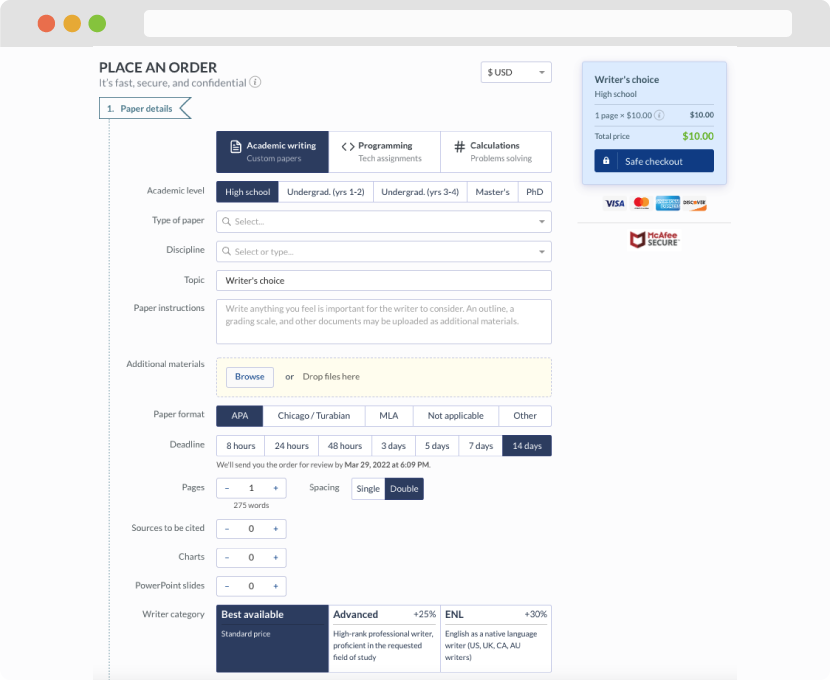
First, you will need to complete an order form. It's not difficult but, if anything is unclear, you may always chat with us so that we can guide you through it. On the order form, you will need to include some basic information concerning your order: subject, topic, number of pages, etc. We also encourage our clients to upload any relevant information or sources that will help.
Complete the order form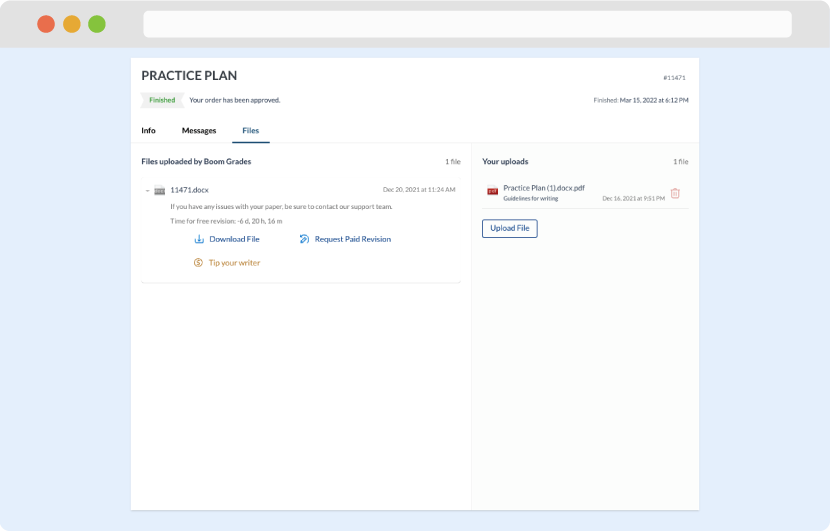
Once we have all the information and instructions that we need, we select the most suitable writer for your assignment. While everything seems to be clear, the writer, who has complete knowledge of the subject, may need clarification from you. It is at that point that you would receive a call or email from us.
Writer’s assignment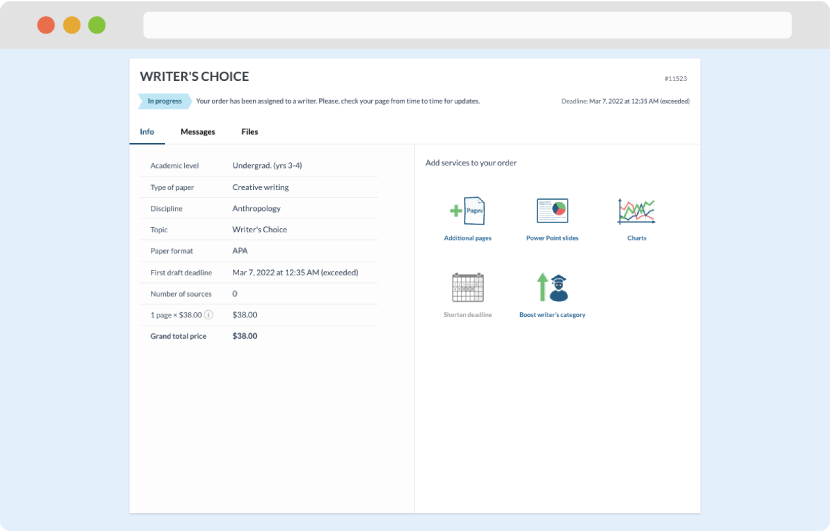
As soon as the writer has finished, it will be delivered both to the website and to your email address so that you will not miss it. If your deadline is close at hand, we will place a call to you to make sure that you receive the paper on time.
Completing the order and download