I will provide boxplots with different categorical variables. Choose two groups of the categorical variable that are most interesting to compare. Then use percentages and descriptions of the center and spread to make comparisons. What do the data suggest? For example, is a particular group from the categorical variable more likely to have a higher/lower IAT score?prompt.Describe the distribution of the quantitative variable grouped by the categorical variable. Then make comparisons and draw conclusions.Make an appropriate graph and provide appropriate numerical summaries.Embed your StatCrunch graph in your response, and be sure to include the Alt Text. Complete each of the following to make the graph more meaningful to the reader.Include a meaningful title above your graph.Underneath your graph, describe the variables represented in the graph.Below your graph, provide a key for the numerical category labels in your graph. Hint: see the category descriptions for your categorical variable in the variable descriptions list for your IAT data set above.Copy and paste the StatCrunch table of numerical summaries into your response.To make it easier for the reader to understand your table, replace any numerical category labels with meaningful words. Hint: see the category descriptions for your categorical variable in thevariable descriptions list for your IAT data set above.Choose two or three groups of the categorical variable that are most interesting to compare. Then use percentages and descriptions of center and spread to make comparisons. What do the data suggest? For example, is a particular group from the categorical variable more likely to have a higher/lower IAT score?Use the data to support your answer.Interpret the result in context. Hint: to learn how to interpret the IAT score, see the variable descriptions link for your IAT data set (included in the Variables section above). Question 1
Stacked Boxplots: Distribution of a IAT-Disability-Score Grouped by Prefers
Variables
Because we chose to stack our boxplots, the quantitative variable, IAT-Disabled-Score, is
graphed on the horizontal axis. And, the categorical variable, Prefers, is graphed on the
vertical axis.
Key for Prefers Labels (Vertical Axis)
Prefers
Subject reports:
1 = Strong preference for disabled people
2 = Moderate preference for disabled people
3 = Slight preference for disabled people
4 = Likes abled people and disabled people equally
5 = Slight preference for abled people
6 = Moderate preference for abled people
7 = Strong preference for abled people
Summary statistics for IAT-Disabled-Score:
Group by: Prefers
Prefers
n
Min
Q1
Median
Q3
Max
Strongly
prefers
disabled
people
17 -0.7717603
0.34175999
0.1664072
4
0.4675793
6
0.6999567
7
Moderatel
y prefers
disabled
people
21 -1.0824432
0.11299241
0.3251443
7
0.5470583
3
1.5718736
Slightly
prefers
disabled
people
65 -1.0494831
0.28955621
0.1638142
1
0.5155327
8
1.3691551
No
preference
56 -1.1576824
0
0.07435755
2
0.4191976
0.7637586
4
1.474671
Slightly
prefers
abled
people
13
5
0.6426457
5
0.22556505
0.5515099
8
0.8544718
5
1.3101415
Moderatel
y prefers
abled
people
47
0.4276033
2
0.33915022
0.6293316
1
0.9925543
6
1.4470579
Prefers
n
Min
Q1
Median
Q3
Max
Strongly
prefers
abled
people
16
0.5636815
7
0.63633898
0.8450604
1
0.9524311
2
1.5150084
Question 2
Before I begin any analysis, I remind myself of what each variable represents so that I am
better prepared to write a conclusion in context.
Quantitative Variable: IAT-Disabled-Score
Score on the Disability IAT where the participant is tested to determine the participant’s
implicit attitude toward disabled and abled people.
Categorical Variable: Prefers
Multiple choice response to a survey question about the participant’s explicit (stated)
attitude toward disabled and abled people.
As an example, I chose to compare only two groups of the categorical
variable, Prefers (group 1 and group 7). However you may have found it more interesting
to compare other groups or more than two groups.
Group 1 = Strong preference for disabled people
The median IAT-Disability-Score for the participants with a stated (explicit) strong
preference for disabled people is approximately -0.17. This is the lowest median score for
all groups, and it makes sense because more negative (lower) scores on the Disability IAT
indicate an implicit association between disabled and good. If we only consider this typical
score on the Disability IAT, we would conclude that the group’s explicit preference for
disabled people aligns with its implicit attitude toward disabled people as measured by
the IAT .
However, as we can see from the boxplots, the typical range of IAT scores for the
group who indicate that they have a strong preference for disabled people is large
compared to the other groups. The IQR for this group is approximately 0.81. Also Q3 =
0.47. If we consider a score of 0 on the IAT as neutral, then a score of 0.47
does not indicate strong preference for disabled people. So, the group of IAT
participants who indicate that they have a strong preference for disabled people are
more inconsistent (larger IQR) in demonstrating that preference implicitly on the IAT
test.
Group 7 = Strong preference for abled people
The median IAT-Disability-Score for the participants with a stated (explicit) strong
preference for abled people is approximately 0.85. This is the highest median score for all
groups, and it makes sense because more positive (higher) scores on the Disability IAT
indicate an implicit association between abled and good. If we only consider this typical
score on the Disability IAT, we would conclude that the group’s explicit preference for
abled people aligns with its implicit attitude toward abled people as measured by the
IAT .
Due to the outliers, the overall range in the Disability-IAT-Score for this group (1.47)
could be misleading. So for the group of participants who indicate a strong preference
for abled people, the better measure of variability is the IQR. As we can see from the
boxplots, the typical range of IAT scores is very small for this group when compared to
the other groups, only 0.32 (from 0.64 to 0.95). This indicates that the middle 50% of
IAT scores are clustered tightly around the median IAT score of 0.85. Furthermore, there
are no negative scores in the typical range from this group. So the group of IAT
participants who indicate that they have a strong preference for abled people are
consistent in demonstrating that preference implicitly on the IAT test (more positive
scores indicate a stronger association between abled and good).
Comparing Groups 1 & 7
The median IAT score for each group represents the typical implicit attitude toward
abled/disabled people. Each group’s median score aligns with the the group’s stated
(explicit) preference for abled or disabled people. However, when we consider the
typical range of IAT scores, the group of participants who explicitly indicate a strong
preference for abled people are more consistent (smaller IQR) in demonstrating that
preference implicitly through the Disability IAT test.
Looking at the boxplots for the two groups, we note that the boxes (Q1 to Q3) do not
overlap. So, at least 75% of the group with an explicit preference for disabled people
scored lower on the IAT, and at least 75% of the group with an explicit preference for
abled people scored higher. This is strong evidence, that on average the group with a
stated preference for abled people scores higher on the Disability IAT than the group
with a stated preference for disabled people. Comparatively, the Disability IAT’s
measurement of implicit attitudes seems to align with each group’s typical range of
stated preferences (lower scores on the IAT indicate an implicit association between
disabled and good while higher scores indicate an implicit association between abled and
good).
1)
Stacked Boxplots: Distribution of an IAT-Weight-Score Grouped by Religiosity
Because we chose to stack our boxplots, the quantitative variable, IAT-Weight-Score, is graphed
on the horizontal axis. And, the categorical variable, Religiosity is graphed on the vertical axis.
Variables
1. Religiosity: 1=Not at all; 2=Slightly; 3=Moderately; 4=Very; 5=Extremely
2. IAT-Weight-Score: Score on the Weight IAT
Summary statistics for Sample(IAT-Weight-Score):
Group by: Sample(Religiosity)
Sample(Religiosity)
n
Min
1=Not at all
360
– 0.13440227 0.44944686 0.71115269
0.88724626
2=Slightly
300
– 0.20191297 0.49188438 0.73991481 1.4819724
0.61736159
3=Moderately
242
– 0.20739227 0.49842581 0.80229974
0.75321814
4=Very
98
– 0.24729012 0.48731773 0.78630671 1.4342795
0.82871809
2)
Quantitative Variable: IAT-Weight-Score
Categorical Variable: Religiosity
Q1
Median
Q3
Max
1.259162
1.489926
Essay Writing Service Features
Our Experience
No matter how complex your assignment is, we can find the right professional for your specific task. Achiever Papers is an essay writing company that hires only the smartest minds to help you with your projects. Our expertise allows us to provide students with high-quality academic writing, editing & proofreading services.
Free Features
Free revision policy
$10Free bibliography & reference
$8Free title page
$8Free formatting
$8How Our Dissertation Writing Service Works
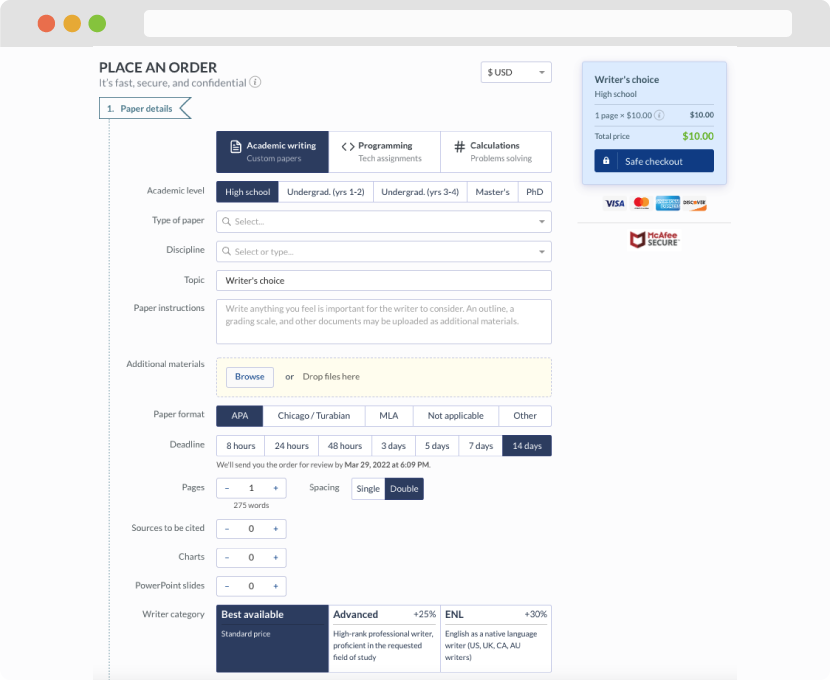
First, you will need to complete an order form. It's not difficult but, if anything is unclear, you may always chat with us so that we can guide you through it. On the order form, you will need to include some basic information concerning your order: subject, topic, number of pages, etc. We also encourage our clients to upload any relevant information or sources that will help.
Complete the order form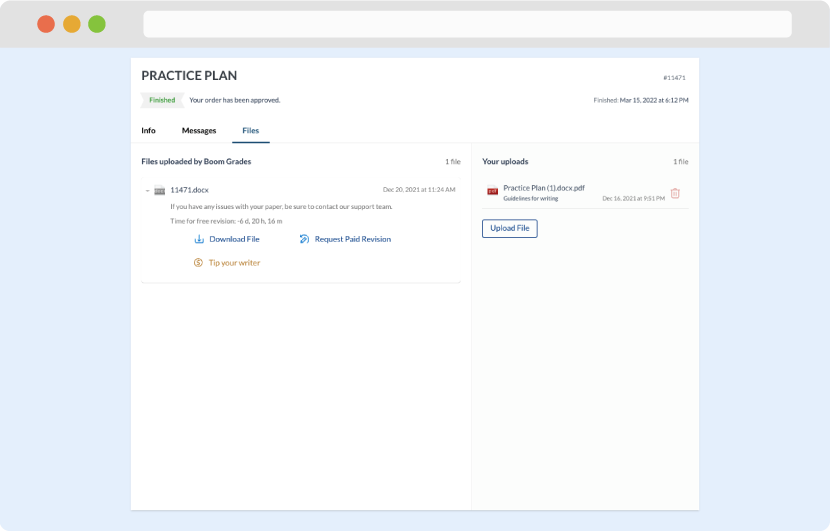
Once we have all the information and instructions that we need, we select the most suitable writer for your assignment. While everything seems to be clear, the writer, who has complete knowledge of the subject, may need clarification from you. It is at that point that you would receive a call or email from us.
Writer’s assignment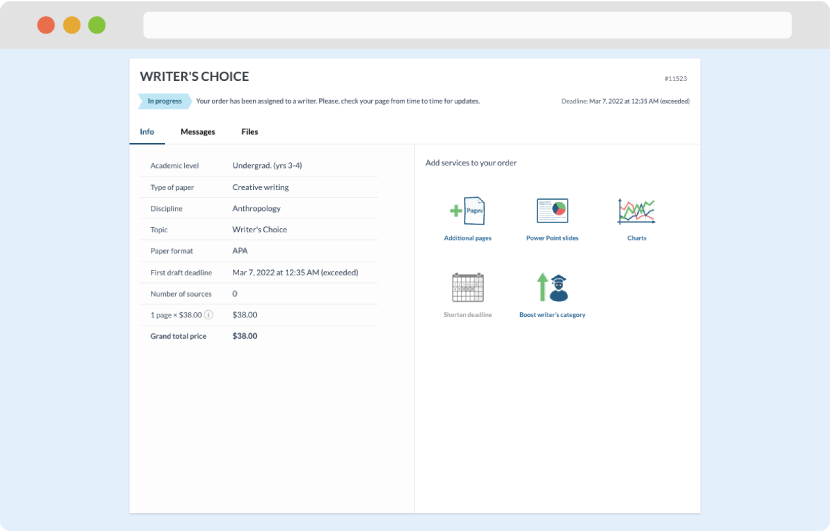
As soon as the writer has finished, it will be delivered both to the website and to your email address so that you will not miss it. If your deadline is close at hand, we will place a call to you to make sure that you receive the paper on time.
Completing the order and download