Case Study13?1 Accounting for Contingent Assets: The Case of Cardinal HealthIn a complaint dated 26 July 2007, and after a four?year investigation, the US Securities and Exchange Commission (SEC) accused Cardinal Health, the world’s second largest distributor of pharmaceutical products, of violating generally accepted accounting principles (GAAP) by prematurely recognizing gains from a provisional settlement of a lawsuit filed against several vitamin manufacturers. Weeks earlier, the company agreed to pay $600 million to settle a lawsuit filed by shareholders who bought stock between 2000 and 2004, accusing Cardinal of accounting irregularities and inflated earnings.* The recovery from the vitamin companies should have been an unqualified positive for Cardinal Health. What happened?BackgroundThe story begins in 1999 when Cardinal Health joined a class action to recover overcharges from vitamin manufacturers. The vitamin makers had just pled guilty to charges of price?fixing from 1988 to 1998. In March 2000, the defendants in that action reached a provisional settlement with the plaintiffs under which Cardinal could have received $22 million. But Cardinal opted out of the settlement, choosing instead to file its own claims in the hopes of getting a bigger payout.The accounting troubles started in October 2000 when senior managers at Cardinal began to consider recording a portion of the expected proceeds from a future settlement as a litigation gain. The purpose was to close a gap in Cardinal’s budgeted earnings for the second quarter of FY 2001, which ended 31 December 2000. According to the SEC, in a November 2000 e?mail a senior executive at Cardinal Health explained why Cardinal should use the vitamin gain, rather than other earnings initiatives, to report the desired level of earnings: “We do not need much to get over the hump, although the preference would be the vitamin case so that we do not steal from Q3.”On 31 December 2000, the last day of the second quarter of FY 2001, Cardinal recorded a $10 million contingent vitamin litigation gain as a reduction to cost of sales. In its complaint, the SEC alleged that Cardinal’s classification of the gain as a reduction to cost of sales violated GAAP. It is worth noting that had the gain not been recognized, Cardinal would have missed analysts’ average consensus EPS estimate for the quarter by $.02.Later in FY 2001, Cardinal considered recording a similar gain, but its auditor at the time, PricewaterhouseCoopers (hereafter PwC), was opposed to the idea. Accordingly, no litigation gains were recorded in the third or fourth quarters of FY 2001. Moreover, PwC advised Cardinal that the $10 million recognized in the second quarter of FY 2001 as a reduction to cost of sales should be reclassified “below the line” as nonoperating income. Cardinal management ignored the auditor’s advice, and the $10 million gain was not reclassified.The urge to report an additional gain resurfaced during the first quarter of FY 2002, and for the same reason as in the prior year: to cover an expected shortfall in earnings. On 30 September 2001, the last day of the first quarter of FY 2002, Cardinal recorded a $12 million gain, bringing the total gains from litigation to $22 million. As in the previous year, Cardinal classified the gain as a reduction to cost of sales, allowing the company to boost operating earnings. However, PwC disagreed with Cardinal’s classification. The auditor advised Cardinal that the amount should have been recorded as nonoperating income on the grounds that the estimated vitamin recovery arose from litigation, was nonrecurring, and stemmed from claims against third parties that originated nearly 13 years earlier.By May 2002, PwC had been replaced as Cardinal’s auditor by Arthur Andersen.† Andersen was responsible for auditing Cardinal’s financial statements for the whole of FY 2002, ended 30 June 2002, and thus, it reviewed Cardinal’s classification of the $12 million vitamin gain. The Andersen auditors agreed with PwC that Cardinal had misclassified the gain. After Cardinal’s persistent refusal to reclassify the gains, Andersen advised the company that it disagreed but would treat the $12 million as a “passed adjustment” and include the issue in its Summary of Audit Differences.‡In spring 2002 Cardinal Health reached a $35.3 million settlement with several vitamin manufacturers. The $13.3 million not yet recognized was recorded as a gain in the final quarter of FY 2002. But while management thought its accounting policies had been vindicated by the settlement, the issue wouldn’t go away.On 2 April 2003, an article in the “Heard on the Street” column in The Wall Street Journal sharply criticized Cardinal Health for its handling of the litigation gains.§ “It’s a CARDINAL rule of accounting:” the article begins, pun intended. “Don’t count your chickens before they hatch. Yet new disclosures in Cardinal Health Inc.’s latest annual report suggests that is what the drug wholesaler has done not just once, but twice.” Nevertheless, management continued to defend its accounting practices, partly on the grounds that the amounts later received from the vitamin companies exceeded the amount of the contingent gains recognized in FY 2001 and FY 2002. Moreover, after the initial settlement, Cardinal Health received an additional $92.8 million in vitamin related litigation settlements, bringing the total proceeds to over $128 million.The OutcomeCardinal management finally succumbed to reality in the following year, and in the Form 10?K (annual report) filed with the SEC for FY 2004, Cardinal restated its financial results to reverse both gains, restating operating income from the two affected quarters. But the damage had already been done. The article in The Wall Street Journal triggered the SEC investigation alluded to earlier. A broad range of issues, going far beyond the treatment of the litigation gains, were brought under the agency’s scrutiny, culminating in the SEC complaint. Two weeks after the complaint was filed, Cardinal Health settled with the SEC, agreeing to pay a $35 million fine.
The purpose of this assignment is to analyze liabilities when making business decisions.
Read Case Study 13-1, “Accounting for Contingent Assets: The Case of Cardinal Health,” from Chapter 13 in the textbook.
In a 250- to 500-word executive summary to the Cardinal Health CEO, address the following:
Essay Writing Service Features
Our Experience
No matter how complex your assignment is, we can find the right professional for your specific task. Achiever Papers is an essay writing company that hires only the smartest minds to help you with your projects. Our expertise allows us to provide students with high-quality academic writing, editing & proofreading services.
Free Features
Free revision policy
$10Free bibliography & reference
$8Free title page
$8Free formatting
$8How Our Dissertation Writing Service Works
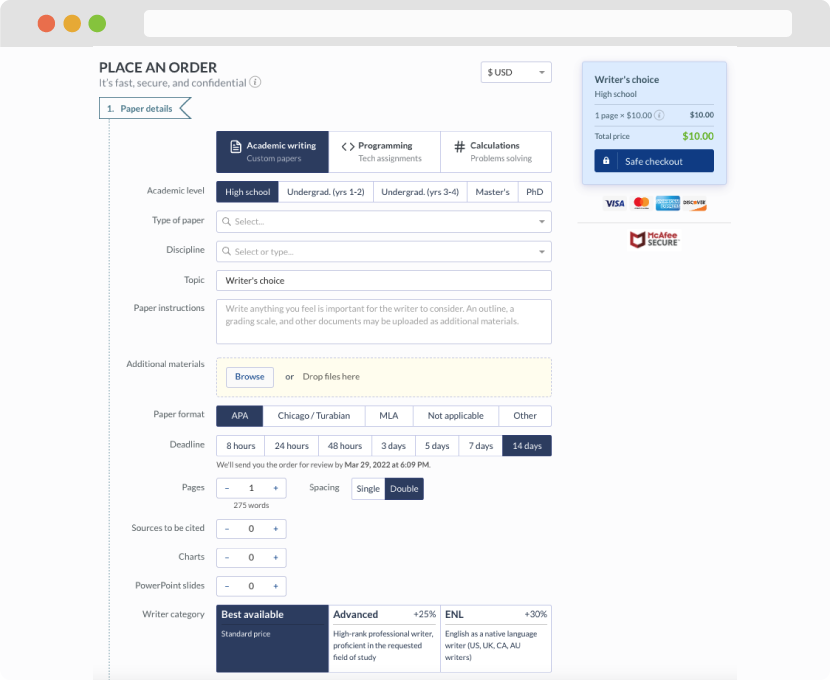
First, you will need to complete an order form. It's not difficult but, if anything is unclear, you may always chat with us so that we can guide you through it. On the order form, you will need to include some basic information concerning your order: subject, topic, number of pages, etc. We also encourage our clients to upload any relevant information or sources that will help.
Complete the order form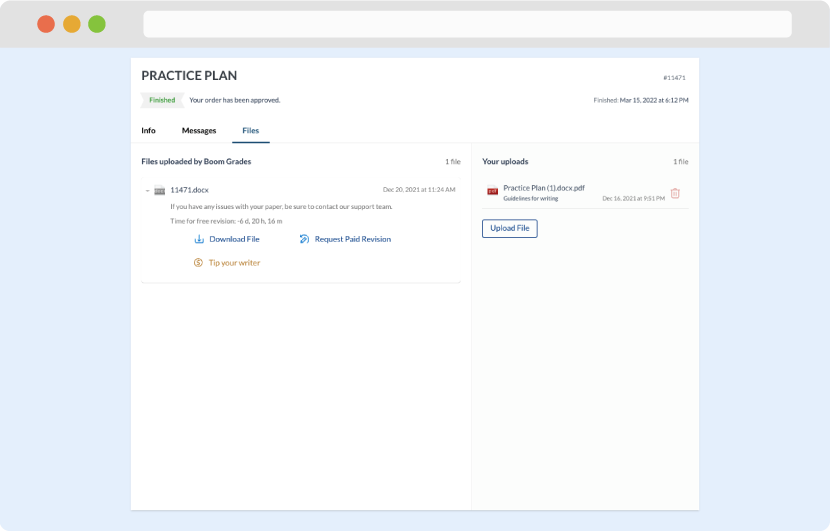
Once we have all the information and instructions that we need, we select the most suitable writer for your assignment. While everything seems to be clear, the writer, who has complete knowledge of the subject, may need clarification from you. It is at that point that you would receive a call or email from us.
Writer’s assignment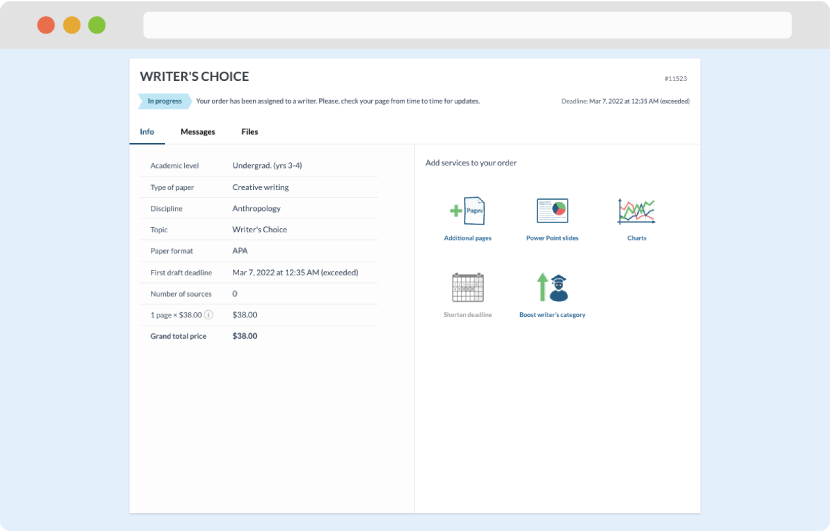
As soon as the writer has finished, it will be delivered both to the website and to your email address so that you will not miss it. If your deadline is close at hand, we will place a call to you to make sure that you receive the paper on time.
Completing the order and download