I. Read
the article here on levers of control by Robert Simons
Download the article here on levers of control by Robert Simons
and summarize the key points for the following levers of control:
1. Diagnostic Systems
2. Belief Systems
3. Boundary Systems
4. Interactive Systems
1- 2 pages of summarizing the key points from this article
Corporate Governance
Control
in
an
Age
of
Empowerment
by Robert Simons
From the Magazine (March–April 1995)
A fundamental problem facing managers in the 1990s is how to
exercise adequate control in organizations that demand
flexibility, innovation, and creativity. Competitive businesses
with demanding and informed customers must rely on employee
initiative to seek out opportunities and respond to customers’
needs. But pursuing some opportunities can expose businesses to
excessive risk or invite behaviors that can damage a company’s
integrity.
Consider the spate of management control failures that have
made headlines in the past several years: Kidder, Peabody &
Company lost $350 million when a trader allegedly booked
fictitious profits; Sears, Roebuck and Company took a $60 million
charge against earnings after admitting that it recommended
unnecessary repairs to customers in its automobile service
business; Standard Chartered Bank was banned from trading on
the Hong Kong stock market after being implicated in an
improper share support scheme. The list goes on. In each case,
employees broke through existing control mechanisms and
jeopardized the franchise of the business. The cost to the
companies—in damaged reputations, fines, business losses,
missed opportunities, and diversion of management attention to
deal with the crises—was enormous.
How do senior managers protect their companies from control
failures when empowered employees are encouraged to redefine
how they go about doing their jobs? How do managers ensure that
subordinates with an entrepreneurial flair do not put the wellbeing of the business at risk? One solution is to go back to the
fundamentals of control developed in the 1950s and 1960s for
machinelike bureaucracies. In that era, managers exercised
control by telling people how to do their jobs and monitoring
them with constant surveillance to guard against surprises.
Although this approach sounds anachronistic for modern
businesses, it is still effective when standardization is critical for
efficiency and yield, such as on an assembly line; when the risk of
theft of valuable assets is high, such as in a casino; or when
quality and safety are essential to product performance, such as at
a nuclear power plant.
However, in most organizations operating in dynamic and highly
competitive markets, managers cannot spend all their time and
effort making sure that everyone is doing what is expected. Nor is
it realistic to think that managers can achieve control by simply
hiring good people, aligning incentives, and hoping for the best.
Instead, today’s managers must encourage employees to initiate
process improvements and new ways of responding to customers’
needs—but in a controlled way.
Fortunately, the tools to reconcile the conflict between creativity
and control are at hand. Most managers tend to define control
narrowly—as measuring progress against plans to guarantee the
predictable achievement of goals. Such diagnostic control
systems are, however, only one ingredient of control. Three other
levers are equally important in today’s business environment:
beliefs systems, boundary systems, and interactive control
systems.
Renew Strategy with the Four Levers of Control
Each of the four control levers has a distinct purpose for
managers attempting to harness the creativity of employees.
Diagnostic control systems allow managers to ensure that
important goals are being achieved efficiently and effectively.
Beliefs systems empower individuals and encourage them to
search for new opportunities. They communicate core values and
inspire all participants to commit to the organization’s purpose.
Boundary systems establish the rules of the game and identify
actions and pitfalls that employees must avoid. Interactive
control systems enable top-level managers to focus on strategic
uncertainties, to learn about threats and opportunities as
competitive conditions change, and to respond proactively.
Harness Employees’ Creativity with the Four Levers of Control
Diagnostic Control Systems
Diagnostic control systems work like the dials on the control
panel of an airplane cockpit, enabling the pilot to scan for signs of
abnormal functioning and to keep critical performance variables
within preset limits. Most businesses have come to rely on
diagnostic control systems to help managers track the progress of
individuals, departments, or production facilities toward
strategically important goals. Managers use these systems to
monitor goals and profitability, and to measure progress toward
targets such as revenue growth and market share. Periodically,
managers measure the outputs and compare them with preset
standards of performance. Feedback allows management to
adjust and fine-tune inputs and processes so that future outputs
will more closely match goals.
But diagnostic control systems are not adequate to ensure
effective control. In fact, they create pressures that can lead to
control failures—even crises. Whether managers realize it or not,
there are built-in dangers when empowered employees are held
accountable for performance goals—especially for difficult ones—
and then left to their own devices to achieve them. For example,
Nordstrom, the upscale fashion retailer known for extraordinary
customer service, recently found itself embroiled in a series of
lawsuits and investigative reports related to its sales-per-hour
performance-measurement system. Used to track the
performance of its entrepreneurial salespeople, the system was
designed to support the service orientation for which Nordstrom
is famous. But without counterbalancing controls, the system
created the potential for both exemplary customer service and
abuse. Some employees claimed that first-line supervisors were
pressuring them to under-report hours on the job in an attempt to
boost sales per hour. Settling those claims cost Nordstrom more
than $15 million.
I recently conducted a study of ten newly appointed chief
executive officers to understand better how they used
measurement and control systems to implement their agendas.
Within the first months of taking charge, many of the new CEOs
established demanding performance goals for division managers
and increased the rewards and punishments associated with
success and failure in achieving those goals. In response to the
pressures, several division managers manipulated financial data
by creating false accounting entries to enhance their reported
performance. The managers were fired, but not before they had
inflicted damage on their organizations. In one memorable case, a
retail company had been making inventory and mark-down
decisions based on the falsified data, a practice that resulted in
significant losses. These are not isolated incidents. The Big Six
accounting firms have observed a substantial increase in errors
and fraud over the past five years as organizations downsize and
reduce the resources devoted to internal controls. With the
elimination of many middle management jobs, basic internal
controls, such as segregation of duties and independent
oversight, have often been sacrificed.
One of the main purposes of diagnostic measurement systems is
to eliminate the manager’s burden of constant monitoring. Once
goals are established and people have performance targets on
which their rewards will be based, many managers believe they
can move on to other issues, knowing that employees will be
working diligently to meet the agreed-upon goals. Yet the
potential for control failures as the performance bar is raised and
employees’ rewards are put at risk underscores the need for
managers to think about the three other essential levers of
control.
Beliefs Systems
Companies have used beliefs systems for years in an effort to
articulate the values and direction that senior managers want
their employees to embrace. Typically, beliefs systems are
concise, value-laden, and inspirational. They draw employees’
attention to key tenets of the business: how the organization
creates value (“Best Customer Service in the World”); the level of
performance the organization strives for (“Pursuit of Excellence”);
and how individuals are expected to manage both internal and
external relationships (“Respect for the Individual”).
Senior managers intentionally design beliefs systems to be broad
enough to appeal to many different groups within an
organization: salespeople, managers, production workers, and
clerical personnel. Because they are broad, beliefs statements are
often ridiculed for lacking substance. But this criticism overlooks
the principal purpose of the statements: to inspire and promote
commitment to an organization’s core values. Still, the statements
achieve their ends only if employees believe, by watching the
actions of senior managers, that the company’s stated beliefs
represent deeply rooted values. If employees suspect that
managers are going through the motions of the latest fad,
cynicism will set in.
Indeed, some managers adopt missions and credos not out of any
real commitment but because they seem fashionable. However,
managers who use their missions as living documents—as part of
a system to guide patterns of acceptable behavior—have
discovered a powerful lever of control. At Johnson & Johnson, for
example, senior managers meet regularly with subordinates
throughout the company to review and reaffirm the beliefs
recorded in J&J’s long-standing credo, which articulates clearly
and passionately the company’s responsibilities to customers,
employees, local communities, and stockholders. Managers
throughout the organization recognize the value that senior
managers place on the exercise and respond accordingly. When
problems arise, such as when J&J faced the Tylenol crisis, the
strong beliefs system embedded in its credo provided guidance
regarding the types of solutions to search for.
In the past, a company’s mission was usually understood without
reference to core values or formal beliefs; employees knew that
they worked for a bank or a telephone company or a company that
made shock absorbers. However, businesses have become much
more complex in recent years, making it more difficult for
individuals to comprehend organizational purpose and direction.
Moreover, in many businesses, downsizing and realignment have
shattered strongly held assumptions about the values and
foundations of businesses and their top-level managers.
Employees no longer know whom to trust. At the same time, their
expectations for meaningful careers have risen as education levels
have increased. Without a formal beliefs system, employees in
large, decentralized organizations often do not have a clear and
consistent understanding of the core values of the business and
their place within the business. In the absence of clearly
articulated core values, they are often forced to make
assumptions about what constitutes acceptable behavior in the
many different, unpredictable circumstances they encounter.
Beliefs systems can also inspire employees to create new
opportunities: they can motivate individuals to search for new
ways of creating value. We all have a deep-seated need to
contribute—to devote time and energy to worthwhile endeavors.
But companies often make it difficult for employees to
understand the larger purpose of their efforts or to see how they
can add value in a way that can make a difference. Individuals
want to understand the organization’s purpose and how they can
contribute, but senior managers must unleash this potential.
Effective managers seek to inspire people throughout their
organizations by actively communicating core values and
missions. As top-level managers rely increasingly on empowered
employees to generate new ideas and competitive advantage,
participants from all parts of an organization need to understand
as clearly as possible their company’s purposes and mission.
Beliefs systems can augment diagnostic control systems to give
today’s managers greater amounts of control. But they are only
part of the answer. Think of them as the yang of Chinese
philosophy—the sun, the warmth, and the light. Opposing them
are dark, cold boundaries—the yin—which represent the next
lever of control.
Boundary Systems
Boundary systems are based on a simple, yet profound,
management principle that can be called the “power of negative
thinking.”1 Ask yourself the question, If I want my employees to
be creative and entrepreneurial, am I better off telling them what
to do or telling them what not to do? The answer is the latter.
Telling people what to do by establishing standard operating
procedures and rule books discourages the initiative and
creativity unleashed by empowered, entrepreneurial employees.
Telling them what not to do allows innovation, but within clearly
defined limits.
Unlike diagnostic control systems (which monitor critical
performance outcomes) or beliefs systems (which communicate
core values), boundary systems are stated in negative terms or as
minimum standards. The boundaries in modern organizations,
embedded in standards of ethical behavior and codes of conduct,
are invariably written in terms of activities that are off-limits.
They are an organization’s brakes. Every business needs them,
and, like racing cars, the fastest and most performance-oriented
companies need the best brakes.
Boundary systems are an
organization’s brakes. And, like
racing cars, the fastest companies
need the best brakes.
Human beings are inventive, and, when presented with new
opportunities or challenging situations, they often search for
ways to create value or overcome obstacles. But empowerment—
fueled by inspiration and performance rewards—should never be
interpreted as giving subordinates a blank check to do whatever
they please. People generally want to do the right thing—to act
ethically in accordance with established moral codes. But
pressures to achieve superior results sometimes collide with
stricter codes of behavior. Because of temptation or pressure in
the workplace, individuals sometimes choose to bend the rules.
As the recent problems at Kidder, Peabody and Salomon Brothers
show, entrepreneurial individuals sometimes blur or misinterpret
the line between acceptable and unacceptable behavior. At
Salomon Brothers, a creative trader attempting to increase
investment returns violated U.S. Treasury bidding rules and
short-circuited existing controls; the aftermath of the scandal
destroyed careers and impaired Salomon’s franchise. Similar
problems at Kidder, Peabody involving fictitious securities trades
resulted in massive losses and ultimately led to the sale of the
business. Clearly, the consequences of a misstep can be severe.
Boundary systems are especially critical in those businesses in
which a reputation built on trust is a key competitive asset. A
well-respected bank with a global franchise states as a part of its
business principles that its three main assets are people, capital,
and reputation. Of all these, it notes, the last is the most difficult
to regain if impaired. To guard against damage to its reputation,
the bank’s code of conduct forbids individuals both from
developing client relationships in “undesirable” industries, such
as gambling casinos, and from acting as intermediaries in
unfriendly takeovers, which senior managers believe could
undermine the perceived trustworthiness of the company.
Large consulting firms like McKinsey & Company and the Boston
Consulting Group routinely work with clients to analyze highly
proprietary strategic data. To ensure that their reputations for
integrity are never compromised, the firms enforce strict
boundaries that forbid consultants to reveal information—even
the names of clients—to anyone not employed by the firm,
including spouses. They also clearly state in their codes of
professional conduct that individuals must not misrepresent
themselves when attempting to gather competitive information
on behalf of clients.
Unfortunately, the benefits of establishing business conduct
boundaries are not always apparent to senior managers. Too
often, they learn the hard way. Many codes of conduct are
instituted only after a public scandal or an internal investigation
of questionable behavior. Over the years, General Electric has
instituted codes of business conduct that prohibit activities
relating to improper payments, price fixing, and improper cost
allocation on government contracts. Each of those codes was
instituted after a major crisis impaired the integrity of the
business. For instance, when GE was forced to suspend its $4.5
billion business as supplier to the U.S. government in 1985, CEO
Jack Welch responded by strengthening internal controls and
issuing a clear policy statement that forbade the behaviors that
had landed GE in trouble: improper cost allocations on
government contracts. Similarly, senior managers at Wall Street
investment firms did not pay much attention to business conduct
boundary systems until the disclosure of improper behavior by a
small number of employees at Salomon Brothers nearly destroyed
the business. Again, senior managers at investment firms across
the country scrambled to install compliance systems to avoid a
similar crisis in their own firms.
Effective managers anticipate the inevitable temptations and
pressures that exist within their organizations. They spell out the
rules of the game based on the risks inherent in their strategy and
enforce them clearly and unambiguously. Some behaviors are
never tolerated: the firing of the manager who inflated his or her
expense report by $50 is a familiar story in many organizations.
On the surface, the punishment may seem too harsh for the
crime, but the purpose of such punishment is to signal clearly to
all managers and employees that the consequences of stepping
over ethical boundaries are severe and nonnegotiable. As
performance-oriented organizations grow and become more
decentralized, the risks of failure increase. Managers must rely
more and more on formal systems in order to ensure that the
boundaries are communicated and understood.
Not all boundaries concern standards of ethical conduct. Strategic
boundaries focus on ensuring that people steer clear of
opportunities that could diminish the business’s competitive
position. A large computer company, for example, uses its
strategic planning process to segregate its product and market
opportunities into what managers call green space and red space.
Green space is the acceptable domain for new initiatives. Red
space represents products and markets in which senior managers
have decided they do not want to pursue new opportunities,
although the organization could compete in those products and
markets given its competencies. A British relief organization uses
a similar system to monitor strategic boundaries; it maintains a
gray list of companies whose contributions it will neither solicit
nor accept. Managers at Automatic Data Processing (ADP) use a
strategic boundary list that delineates the types of business
opportunities that managers must avoid. The guidelines provide
ADP managers with clarity and focus. This technique has
contributed to 133 consecutive quarters of double-digit growth in
earnings per share—a record unmatched by any other company
traded on the New York Stock Exchange.
Beliefs systems can be thought of as
the yang to the yin of boundary
systems.
Working together, boundary systems and beliefs systems are the
yin and yang that together create a dynamic tension. The warm,
positive, inspirational beliefs are a foil to the dark, cold
constraints. The result is a dynamic tension between
commitment and punishment. Together, these systems transform
limitless opportunity into a focused domain that employees and
managers are encouraged to exploit actively. In combination, they
establish direction, motivate and inspire, and protect against
potentially damaging opportunistic behavior.
Interactive Control Systems
When organizations are small, key managers and employees can
sit around the same table and informally explore the impact of
emerging threats and opportunities. But as organizations grow
larger and senior managers have less and less personal contact
with people throughout the organization, new formal systems
must be created to share emerging information and to harness the
creativity that often leads to new products, line extensions,
processes, and even markets. Unfortunately, diagnostic control
systems, which highlight shortfalls against plans, won’t suffice.
Instead, senior managers need sensing systems more like the ones
used by the National Weather Service. Ground stations all over
the country monitor temperature, barometric pressure, relative
humidity, cloud cover, wind direction and velocity, and
precipitation. Balloons and satellites provide additional data.
These data are monitored continuously from a central location in
an effort to identify patterns of change.
Managers need similar scanning mechanisms. Like weathertracking systems, interactive control systems are the formal
information systems that managers use to involve themselves
regularly and personally in the decisions of subordinates. These
systems are generally simple to understand. Through them,
senior managers participate in the decisions of subordinates and
focus organizational attention and learning on key strategic
issues.
Making a control system interactive invariably demands attention
from participants throughout the business. At Pepsico, for
example, the weekly release of new Nielsen market-share
numbers creates a flurry of activity as 60 or 70 people throughout
the organization begin working on the data in anticipation of the
inevitable scrutiny and queries of senior management. Senior
managers schedule weekly meetings to discuss the new Nielsen
information, to challenge subordinates to explain the meaning of
changed circumstances, and to review action plans that
subordinates have developed to react to problems and
opportunities.
Interactive control systems have four characteristics that set them
apart from diagnostic control systems. First, they focus on
constantly changing information that top-level managers have
identified as potentially strategic. Second, the information is
significant enough to demand frequent and regular attention
from operating managers at all levels of the organization. Third,
the data generated by the interactive system are best interpreted
and discussed in face-to-face meetings of superiors, subordinates,
and peers. Fourth, the interactive control system is a catalyst for
an ongoing debate about underlying data, assumptions, and
action plans.
Interactive control systems focus on
constantly changing information that
senior managers consider potentially
strategic.
Interactive control systems track the strategic uncertainties that
keep senior managers awake at night—the shocks to the business
that could undermine their assumptions about the future and the
way they have chosen to compete. Depending on the business,
these uncertainties might relate to changes in technology,
customers’ tastes, government regulation, and industry
competition. Because interactive control systems are designed to
gather information that might challenge visions of the future,
they are, by definition, hot buttons for senior managers.
Interactive control systems track the
uncertainties that keep senior
managers awake at night.
A senior manager’s decision to use a specific control system
interactively—in other words, to invest time and attention in
face-to-face meetings to review new information—sends a clear
signal to the organization about what’s important. Through the
dialogue and debate that surround the interactive process, new
strategies often emerge. Consider the case of a well-known
hospital supply company. The company is a low-cost producer,
supplying disposable hospital products for intravenous drug
delivery such as plasma containers, tubing, and syringes. Even
though efficiency, quality, and cost control are important
competencies, these concerns do not keep managers awake at
night. (They are well understood and can be managed effectively
with diagnostic control systems.) Instead, senior managers worry
that technological breakthroughs will undermine their ability to
deliver products valued by the market. Accordingly, they use a
project management system interactively to focus organizational
attention on a dozen or so emerging technological issues. Senior
managers meet monthly for several days to debate the impact of
technologies—introduced by competitors or in related industries,
or developed in-house—on their business. These meetings
become intense as the managers challenge one another to assess
the impact of new information and develop responses. From this
dialogue, new strategies emerge.
Senior managers at USA Today, Gannett Company’s daily
newspaper, use a similar process to review information contained
in a simple package of reports delivered each Friday. Three weekly
reports give senior managers a picture of how they have done in
the previous week and what conditions lie ahead for the
upcoming few weeks. The data in the Friday packet range from
year-to-date figures to daily and account-specific information.
These data provide insight into changing industry conditions and
the advertising strategies of key customers. They allow managers
to look at the big picture and provide enough detail to identify
specific vulnerabilities, opportunities, and the source of any
problems that require proactive responses.
Each week, senior managers at USA Today schedule intensive
face-to-face meetings with key subordinates to analyze and
interpret the report data. Among the regular topics of discussion
and debate are advertising volume against plan, committed
future volume by issue, and new business by type of client. In
addition to looking for unexpected shortfalls, managers also look
for unexpected successes. From these meetings, significant
innovations have been proposed to deal with unanticipated
downturns and to capitalize on unanticipated opportunities.
Innovations have included launching a new market-survey
service for automotive clients, introducing fractional-page color
advertising, selling exclusive inserts dedicated to specific
customers and products, and using circulation salespeople to sell
ad space in regional locations.
Of course, managers in other businesses choose different kinds of
control systems to use interactively depending on the strategic
uncertainties associated with their business strategies. For
example, Johnson & Johnson uses its profit-planning system
interactively to focus attention on the development and
protection of innovative products in its various markets.
Managers periodically reestimate the predicted effects of
competitive tactics and new product rollouts on their profit plans
for the current and the following year. The recurring questions
posed by managers are: What has changed since our last forecast?
Why? What are we going to do about it? The results are new ideas
and action plans.
Balancing Empowerment and Control
Effective managers empower their organizations because they
believe in the innate potential of people to innovate and add
value. For instance, the reason Nordstrom salespeople provide
exceptional customer service is that they are selected and trained
to act entrepreneurially. In turn, they have the freedom and
motivation to tailor their service to each customer’s needs. To
unleash this type of potential, senior managers must give up
control over many kinds of decisions and allow employees at
lower levels of the organization to act independently. Good
managers work constantly to help employees rise to their
potential. In small organizations, managers do this informally.
While eating or traveling together, they communicate core values
and missions, the rules of the game, and current targets—and
they learn about significant changes. As companies become
larger, more decentralized, and geographically dispersed, senior
managers are no longer in constant contact with all the employees
who will identify and respond to emerging problems and
opportunities. Nonetheless, the guiding principles of
communication and control are every bit as important.
A large international construction company respected for its
quality and customer service provides a clear illustration of how
the control levers support one another. The company has more
than 25 offices in the United States and abroad; as a result, project
managers and employees make multimillion-dollar decisions far
from the company’s top-level managers. The senior managers
who set the company’s overall direction and strategy ensure that
they have adequate control of their far-flung operations by using
all four levers of control.
To communicate core values, they rely on a beliefs system. The
company’s widely circulated credo refers to the importance of
responsibility, of collective pride in engineering quality, of
financial success, and of integrity. It concludes with an overall
objective handed down by the founder: “To be the best.”
These inspirational beliefs are offset by clear boundaries.
Managers are forbidden, for example, to work in certain countries
where facilitating payments and bribes are required to do
business, because these sorts of actions jeopardize the company’s
belief in integrity. The company also maintains a turkey list to
communicate to managers the types of projects that the company
has learned are not profitable and should be avoided. (For
example, senior managers have learned from bitter experience to
steer clear of sewage-disposal-plant construction.) The list is
adjusted from time to time as managers learn where their
competencies lie and where they don’t.
Managers gain still more control by using a variety of diagnostic
controls—among them profit plans, budgets, and goals and
objectives. These control systems do not require very much
attention from senior management other than the time spent
setting annual goals and monitoring exceptions to see that events
unfold according to plan. One control system, however, is used
interactively. The project management system focuses attention
on the strategic uncertainties that managers want everyone to
monitor: the company’s reputation in the trade, the shifting
perceptions of customers, and the ideal skill mix required in
various project teams. The new data are used as a catalyst to force
regular face-to-face discussions in which managers share
information and attempt to develop better ways to customize
their services and adjust their strategies in a changing market.
Collectively, these four levers of control set in motion powerful
forces that reinforce one another. As organizations become more
complex, managers will inevitably deal with increasing
opportunity and competitive forces and decreasing time and
attention. By using the control levers effectively, managers can be
confident that the benefits of innovation and creativity are not
achieved at the expense of control.
1. My colleague, Professor Charles Christenson, coined this term
in a 1972 Harvard Business School working paper.
ABusiness
version Review.
of this article appeared in the March–April 1995 issue of Harvard
RS
Robert Simons is the Charles M. Williams
Professor of Business Administration at
Harvard Business School. He is the author of
Seven Strategy Questions: A Simple Approach
for Better Execution (Harvard Business Review
Press, 2010).
Recommended For You
Why Special Ops Stopped Relying So Much on Top-Down Leadership
Go Ahead, Take a Failure Bow
Why CEOs Should Push Back Against Short-Termism
AUDIO
Stop Initiative Overload
Essay Writing Service Features
Our Experience
No matter how complex your assignment is, we can find the right professional for your specific task. Achiever Papers is an essay writing company that hires only the smartest minds to help you with your projects. Our expertise allows us to provide students with high-quality academic writing, editing & proofreading services.
Free Features
Free revision policy
$10Free bibliography & reference
$8Free title page
$8Free formatting
$8How Our Dissertation Writing Service Works
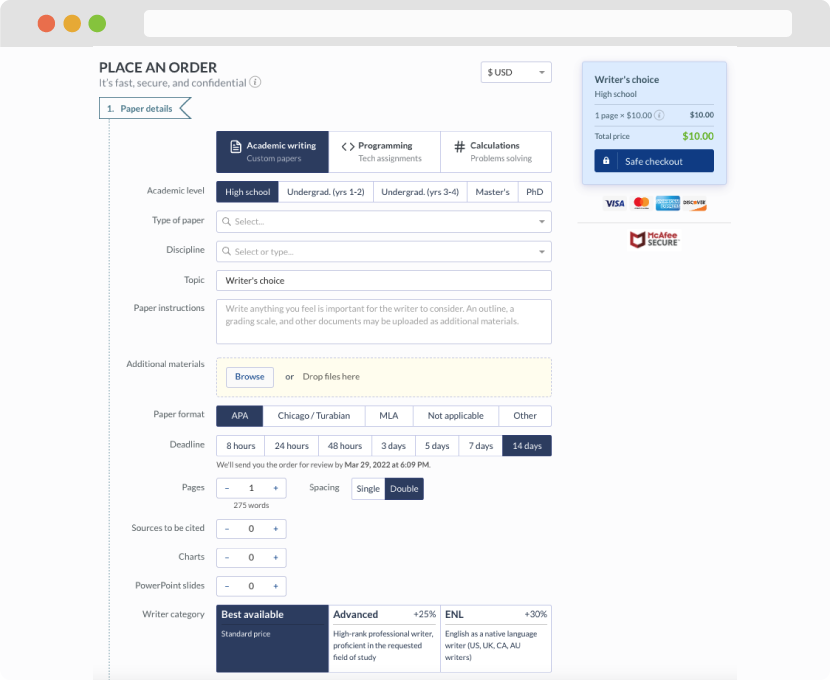
First, you will need to complete an order form. It's not difficult but, if anything is unclear, you may always chat with us so that we can guide you through it. On the order form, you will need to include some basic information concerning your order: subject, topic, number of pages, etc. We also encourage our clients to upload any relevant information or sources that will help.
Complete the order form
Once we have all the information and instructions that we need, we select the most suitable writer for your assignment. While everything seems to be clear, the writer, who has complete knowledge of the subject, may need clarification from you. It is at that point that you would receive a call or email from us.
Writer’s assignment
As soon as the writer has finished, it will be delivered both to the website and to your email address so that you will not miss it. If your deadline is close at hand, we will place a call to you to make sure that you receive the paper on time.
Completing the order and download