Chapter 2
(find the attachment for the chapter 2 )
250 words or more
Considering the concepts discussed in the provided outline, describe a counseling-related scenario that illustrates the presence of independent, dependent, and confounding variables, as well as potential sources of bias. Explain how these variables and biases could influence the interpretation of research results. Additionally, discuss strategies that a researcher in such a counseling-related scenario might employ to control for confounding variables and address sources of bias to ensure the validity of the study.
or
In your response, explain the concepts based on the assigned text readings. Explain it in a manner that demonstrates an integration of the information within your professional interests. Your response should be detailed a demonstrate a graduate level of understanding.
When responding to your classmates, expand on their thoughts according to the discussion guidelines.
TEXTBOOK(S) AND REQUIRED MATERIALS:
Title: Introduction to Research Methods: A Hands-On Approach
Author: Pajo, Bora
Publisher: SAGE Vantage Y
ear Published: 2023
Edition: 2nd ISBN: 19781544391724 (electronic) 9781544391700 (paperback)
Introduction to Research Methods:
A Hands-on Approach,
2nd Edition
Chapter 2: Formulating a Research Question
Selecting Your Research Topic
(1 of 4)
Fundamental vs. Applied Research
Fundamental research.
Applied research.
Pajo, Introduction to Research Methods: A Hands-on Approach, 2nd Edition. © 2023 SAGE Publishing.
2
LO 2.1: Choose a research topic.
Key point: Determining a topic of interest.
Fundamental research: looks at the world at large and tries to generate new ideas or explanation about how the world works and why; may not have application in everyday life in the immediate sense.
Applied research: seeks to solve a specific societal problem or uncover more information about a particular issue; has direct implications in practice.
2
Selecting Your Research Topic
(2 of 4)
Narrowing the Research Topic
Consider constructs and population of interest.
Construct.
Pajo, Introduction to Research Methods: A Hands-on Approach, 2nd Edition. © 2023 SAGE Publishing.
3
LO 2.1: Choose a research topic.
Two features of a broader topic can lead to the research question: the constructs and the population of interest.
Construct: a concept that is possible to measure in a form.
3
Selecting Your Research Topic
(3 of 4)
Pajo, Introduction to Research Methods: A Hands-on Approach, 2nd Edition. © 2023 SAGE Publishing.
4
LO 2.1: Choose a research topic.
Figure 2.1
4
Selecting Your Research Topic
(4 of 4)
Pajo, Introduction to Research Methods: A Hands-on Approach, 2nd Edition. © 2023 SAGE Publishing.
5
LO 2.1: Choose a research topic.
Figure 2.2: Moving from a Broad Topic to a Narrow Topic
5
Operationalization of Constructs
(1 of 2)
Operationalization.
Variable.
Conceptualization.
Pajo, Introduction to Research Methods: A Hands-on Approach, 2nd Edition. © 2023 SAGE Publishing.
6
LO 2.2: Explain how to operationalize research constructs.
Key point: Formulating a research question.
Operationalization: turning constructs into actual variables to measure
Variable: a specific feature or aspect of the construct that can take different values for each participant in a study.
Conceptualization: the process of breaking down constructs into smaller pieces and clarifying to know the precise meaning of each.
6
Operationalization of Constructs
(2 of 2)
Pajo, Introduction to Research Methods: A Hands-on Approach, 2nd Edition. © 2023 SAGE Publishing.
7
LO 2.2: Explain how to operationalize research constructs.
Figure 2.3
7
Types of Variables (1 of 4)
Independent and Dependent Variables
Independent variable.
Dependent variable.
Variables are unique per study.
Pajo, Introduction to Research Methods: A Hands-on Approach, 2nd Edition. © 2023 SAGE Publishing.
8
LO 2.3: Describe the different types of variables.
Key point: Collecting information.
Independent variable: the explanatory or predicting variable that explains the variation in the dependent variable; often constant/doesn’t change for the participant
Dependent variable: the outcome; what researchers want to find out from a study and what they hope is influenced by the independent variable.
Variables are unique to each study; a variable can be dependent in one study and independent in another.
8
Types of Variables (2 of 4)
Control Variables
Control variables.
Help minimize biases and improve accuracy.
Pajo, Introduction to Research Methods: A Hands-on Approach, 2nd Edition. © 2023 SAGE Publishing.
9
LO 2.3: Describe the different types of variables.
Control variables: any variables that are used to control the results; not directly related to the focus of the study but crucial for understanding the relationship between the variables of focus.
They help minimize biases and provide more accurate findings.
9
Types of Variables (3 of 4)
Confounding and Disturbance Variables
Confounding variables.
Disturbance variables.
Pajo, Introduction to Research Methods: A Hands-on Approach, 2nd Edition. © 2023 SAGE Publishing.
10
LO 2.3: Describe the different types of variables.
Confounding variables: influence the independent variable in such a way that the results from the dependent variable become untrustworthy; could not have been controlled or predicted during the study’s design; only become apparent during data collection or analysis.
Disturbance variable: lurks in the background and disturbs the findings of the dependent variable; common characteristics of participants mislead the findings of the study without the researchers’ awareness.
10
Types of Variables (4 of 4)
Moderators and Mediators
Moderators.
Mediators.
Pajo, Introduction to Research Methods: A Hands-on Approach, 2nd Edition. © 2023 SAGE Publishing.
11
LO 2.3: Describe the different types of variables.
Moderators: variables that can strengthen or weaken an already established relationship between the independent and dependent variables.
Mediators: intervening variables that interfere with the relationship between the main variables; when a mediator is present, the relationship between the independent and dependent variables may not even exist anymore.
11
Types of Hypotheses (1 of 4)
Hypothesis.
Generally present in quantitative study.
Pajo, Introduction to Research Methods: A Hands-on Approach, 2nd Edition. © 2023 SAGE Publishing.
12
LO 2.4: Formulate the various types of hypotheses.
Key point: Answers to the research question.
Hypothesis: a statement that predicts a specific phenomenon or behavior.
They are usually present in a quantitative study but not a qualitative one.
12
Types of Hypotheses (2 of 4)
Alternative Hypothesis and Null Hypothesis
Alternative hypothesis.
Null hypothesis.
Research outcome options.
Pajo, Introduction to Research Methods: A Hands-on Approach, 2nd Edition. © 2023 SAGE Publishing.
13
LO 2.4: Formulate the various types of hypotheses.
Alternative hypothesis: the prediction based on literature and theory about what the testing results will be; i.e., what the variables are expected to look like once the data is collected.
Null hypothesis: claims there is no relationship between the variables of interest in the study; this is the hypothesis researchers are actually testing with their findings.
Research outcomes have two options: reject the null hypothesis in favor of the alternative hypothesis, or fail to reject the null hypothesis.
13
Types of Hypotheses (3 of 4)
Directional Hypothesis and Nondirectional Hypothesis
Directional hypothesis.
Nondirectional hypothesis.
Pajo, Introduction to Research Methods: A Hands-on Approach, 2nd Edition. © 2023 SAGE Publishing.
14
LO 2.4: Formulate the various types of hypotheses.
Directional hypothesis: predicts a specific course for the variables
Nondirectional hypothesis: has no direction and simply predicts a relationship between two or more variables; rather than making assumptions on how the variables will behaving, researchers are investigating the possible relationship between variables.
14
Types of Hypotheses (4 of 4)
Open-Ended Question
Used with qualitative studies.
Qualitative studies use different methodologies.
Pajo, Introduction to Research Methods: A Hands-on Approach, 2nd Edition. © 2023 SAGE Publishing.
15
LO 2.4: Formulate the various types of hypotheses.
For qualitative studies rather than quantitative; i.e., when the researcher has many constructs but is not attempting to measure them
A qualitative study asks different types of research questions and has a different methodology to collect data.
15
Visualizing a Research Question
(1 of 3)
Try drawing the research question.
Pajo, Introduction to Research Methods: A Hands-on Approach, 2nd Edition. © 2023 SAGE Publishing.
16
LO 2.5: Create a visualization of a research question.
Key point: Planning a study.
It can be helpful to make a drawing of the research question to help visualize it.
16
Visualizing a Research Question
(2 of 3)
Pajo, Introduction to Research Methods: A Hands-on Approach, 2nd Edition. © 2023 SAGE Publishing.
17
LO 2.5: Create a visualization of a research question.
Figure 2.4
17
Visualizing a Research Question
(3 of 3)
Pajo, Introduction to Research Methods: A Hands-on Approach, 2nd Edition. © 2023 SAGE Publishing.
18
LO 2.5: Create a visualization of a research question.
Figure 2.5: The Relationship Between Constructs and the Breakdown of Constructs
18
image1
image2
image3
image4
image5
Essay Writing Service Features
Our Experience
No matter how complex your assignment is, we can find the right professional for your specific task. Achiever Papers is an essay writing company that hires only the smartest minds to help you with your projects. Our expertise allows us to provide students with high-quality academic writing, editing & proofreading services.
Free Features
Free revision policy
$10Free bibliography & reference
$8Free title page
$8Free formatting
$8How Our Dissertation Writing Service Works
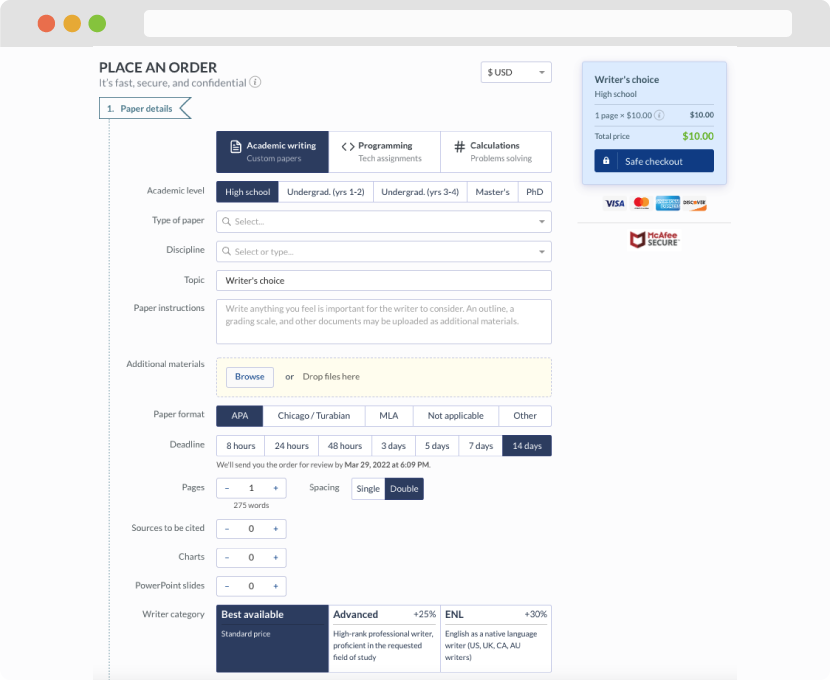
First, you will need to complete an order form. It's not difficult but, if anything is unclear, you may always chat with us so that we can guide you through it. On the order form, you will need to include some basic information concerning your order: subject, topic, number of pages, etc. We also encourage our clients to upload any relevant information or sources that will help.
Complete the order form
Once we have all the information and instructions that we need, we select the most suitable writer for your assignment. While everything seems to be clear, the writer, who has complete knowledge of the subject, may need clarification from you. It is at that point that you would receive a call or email from us.
Writer’s assignment
As soon as the writer has finished, it will be delivered both to the website and to your email address so that you will not miss it. If your deadline is close at hand, we will place a call to you to make sure that you receive the paper on time.
Completing the order and download