Explain the group’s processes and stage of formation.
Explain curative factors that occurred in the group. Include how these factors might impact client progress.
Explain intragroup conflict that occurred and recommend strategies for managing the conflict. Support your recommendations with evidence-based literature NURS 6650 Group Processes and Stages of Formation Essay
This is the video
(2011). Group Therapy: A Live Demonstration [Video file]. Psychotherapy.net. Retrieved January 12, 2021, from Kanopy.
Yalom, I. D., & Leszcz, M. (2005). The theory and practice of group psychotherapy (5th ed.). New York, NY: Basic Books.
The Theory and Practice of Group Psychotherapy, 5th Edition by Yalom, Irvin D. ; Leszcz, Molyn. Copyright 2005 by Hachette Books Group. Reprinted by permission of Hachette Books Group via the Copyright Clearance Center.
Chapter 5, “The Therapist: Basic Tasks” (pp. 117–140)
Chapter 8, “The Selection of Clients” (pp. 231–258)
Chapter 9, “The Composition of Therapy Groups” (pp. 259–280)
Crane-Okada, R. (2012). The concept of presence in group psychotherapy: An operational definition. Perspectives in Psychiatric Care, 48(3), 156–164. doi:10.1111/j.1744-6163.2011.00320.x
1
6
Group Processes and the Stages of Formation
Walden University
NURS 6650-N, Psychotherapy with Groups and Families
October 14, 2018
Introduction
Group process refers to how individuals and members work unitedly to achieve a common goal. Groups are at the core of human experiences and therefore understanding group processes and stage formation is an essential role of the PMHNP. The purpose of this paper is to review and critique the video entitled, “Group Therapy: A live demonstration”, and analyze not only group processes, stage formation, but also curative factors of groups, the impact of curative factors on client progress, and finally strategies for managing intragroup conflict.
The study of group processes encompasses both cognitive and social causes and the effect they have on individuals within a group (usually between three and twelve members). Group process studies how group members interact, their characteristics, and how these factors influence the establishment of effective or ineffective group’s performance (Stangor, 2017). Group processes include fundamental elements such as group norms, group roles, group status, group identity, and group social interaction. These elements are further impacted by trust, inter-member feedback, conflict and resolution. Stages of group formation include forming, storming, norming, performing and adjourning (Castellan, 2013).
Group Process and Stage Formation
In the reviewed video, “Group Therapy: A live demonstration”, the group is comprised of individuals who struggle with social challenges and have sought treatment to provide resolution. As a group the common objective is identified by the cohesion of social challenges and the need to move to a place of greater adaptive functionality. The storming stage of group occurs once a group is established and can be characterized by a period where there is a vying of positions and roles authority is questioned and disagreements arise. Additionally, in this stage some individuals within the group compete for status, control, influence and authority. Noticeable inner conflict, and communication can become challenged where the leaders are “tested”, in the stage of storming (Tuckman, 2010). The current stage of formation in the reviewed video is the storming stage, evidenced by the group having not completed objectives, surfacing differences, and issues of power and control. While the group has been established (forming stage) components of this stage exist as parties such as Pam and Phillip are brought together and ground rules and finding similarities have to be set. The participant Gill, requires pushing and prompting by Bonnie to provide self-disclosure that he avoids by shifting focus to Julius, the therapist health concerns. Such conflicts and competition for authority noted with Pam, and Phillip are common in this stage however, resolution is important to ensure that all parties remain in the group and a culture of support and cohesion is fostered. Movement to the norming stages is essential as this is where group conflict is managed, group norms are found, and harmony is met. Despite some individual conflict within this group all members have agreed to remain and participate as a group until the goal and objective originally set has been achieved (Allen & Spitzer, 2015).
Curative Factors and Impact on Client Progress
Curative factors that influence change and healing within a group include eleven factors, a few of these factors include the instillation of hope, universality, imparting information, and altruism. In the group setting witnessed, hope is instilled as members discuss their willingness to remain a part of the group, and find solutions to their challenges. The ability for group members to remain united by remaining present as a group provides a greater sense of hope and support. Such support allows the focus to look at approaches to problems and how each individual member can develop a more therapeutic approach to challenges through shared experiences. The group setting provides a close glimpse into appropriate social interaction and the impact it has with others, the root cause of differences, and solution creation. A therapist presence works to facilitate and navigate direction in the group leading to outcomes that are positive more quickly. Curative factors noted in this group allowed the group to move to a place of difference, and negative effects to a place of productivity that was solution centric.
Intra-group conflict and Strategies for Managing Conflict
From the outset of the viewed video, intra-group conflict arose due to a dislike of Phillip’s inclusion of the group by Pam, and this conflict threatened the continuation and cohesion of all group members. Pam’s intense verbal disdain for Phillip caused polarization, as the group initially had to choose between keeping Pam or losing Phillip based on her ultimatum. The level of importance and value was brought to the forefront with this intra-conflict, as Phillip felt that Pam’s inclusion in the group as an original member had greater importance than his contracted one. This was reinforced by the other members’ earnest pleas for Pam to remain in the group, excluding Phillips need for reassurance and support. Phillip was able to express these feelings of less value in detail, further indicating the intra-group conflict (Psychotherapy.net, 2011). Many inter-group dynamics are a product of a long history of negative/toxic relationships that can be very hard to overcome like Pam and Phillips.
Conflict within groups is natural and does not have to halt group functioning. Conflict has often worked to help in growth and development of individuals and collectively as groups as solutions arise. Failure to address conflicts within groups will result in added challenges. Intra-group conflicts can be managed by first understanding where the conflict lies, identifying the conflict, looking for the source of conflict, perspective taking, re-categorization, superordinate goals, and reward interdependence. An effective therapist guides the resolution of challenges as they surface, by being open-minded and an active listener that directs compromise and solutions. Not all intra-group conflict is negative as the ability to address and resolve conflict with in the group serves as a baseline for future amicable resolution of problems individually and in other group settings.
Summary
The forming of a successful group takes time and it is important that the PMHNP understands the stages of group formation, processes, and how to deal with intra-group conflict. The ability to resolve conflict in groups allows for effective movement to therapeutic relationships. This movement helps individuals within groups to affirm the benefit of group and how the tools utilized within the group can be used in developing solutions in future states. The therapist within groups works to provide a compass for a solution-centric process within the group where support is fostered.
References
Allen, K. & Spitzer, W. (2015). Social Work Practice in Healthcare: Advanced approaches and emerging trends. Thousand Oaks, CA: SAGE Publications.
Castellan, N. J. (2013). Individual and group decision making: Current issues. Hove, U.K.: Psychology Press.
Psychotherapy.net (Producer). (2011). Group Therapy: A live demonstration. [Video file]. Mill Valley, CA: Author
Stangor, C. (2017). Industrial and Organizational Psychology, Social Psychology. Retrieved from
http://www.psychology.oxfordre.com
Tuckman, B. (2010). Forming, Storming, Norming, & Performing Team Development Model. Retrieved from
http://www.coachingcultureatwork.com
Essay Writing Service Features
Our Experience
No matter how complex your assignment is, we can find the right professional for your specific task. Achiever Papers is an essay writing company that hires only the smartest minds to help you with your projects. Our expertise allows us to provide students with high-quality academic writing, editing & proofreading services.
Free Features
Free revision policy
$10Free bibliography & reference
$8Free title page
$8Free formatting
$8How Our Dissertation Writing Service Works
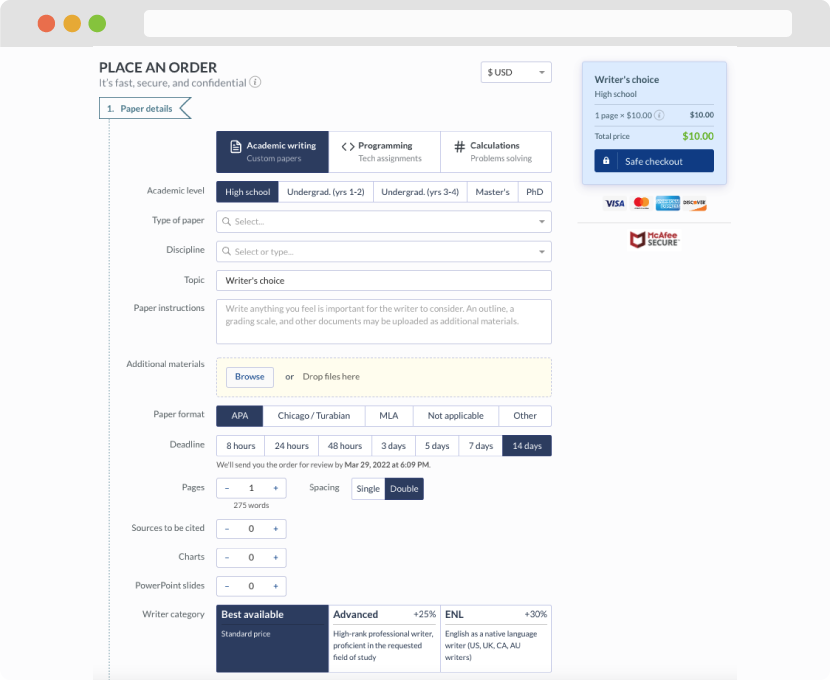
First, you will need to complete an order form. It's not difficult but, if anything is unclear, you may always chat with us so that we can guide you through it. On the order form, you will need to include some basic information concerning your order: subject, topic, number of pages, etc. We also encourage our clients to upload any relevant information or sources that will help.
Complete the order form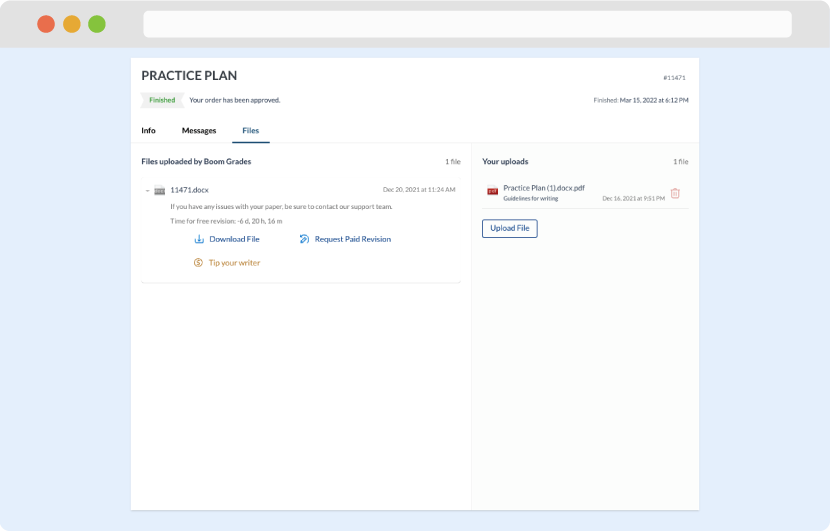
Once we have all the information and instructions that we need, we select the most suitable writer for your assignment. While everything seems to be clear, the writer, who has complete knowledge of the subject, may need clarification from you. It is at that point that you would receive a call or email from us.
Writer’s assignment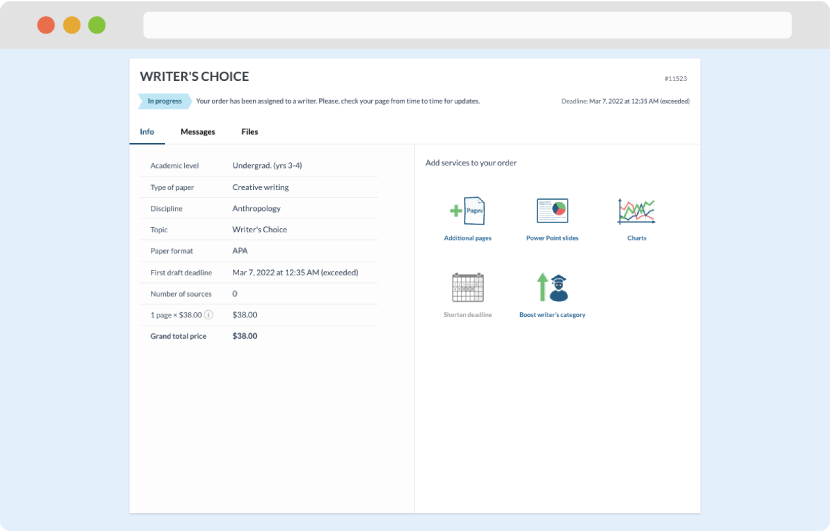
As soon as the writer has finished, it will be delivered both to the website and to your email address so that you will not miss it. If your deadline is close at hand, we will place a call to you to make sure that you receive the paper on time.
Completing the order and download