Conduct a critical appraisal of the four peer-reviewed articles you selected by completing the Evaluation Table within the Critical Appraisal Tool Worksheet Template. Choose a total of four peer- reviewed articles that you selected related to your clinical topic of interest in Module 2 and Module 3.
Note: You can choose any combination of articles from Modules 2 and 3 for your Critical Appraisal. For example, you may choose two unfiltered research articles from Module 2 and two filtered research articles (systematic reviews) from Module 3 or one article from Module 2 and three articles from Module 3. You can choose any combination of articles from the prior Module Assignments as long as both modules and types of studies are represented.
Part 3B: Critical Appraisal of Research
Based on your appraisal, in a 1-2-page critical appraisal, suggest a best practice that emerges from the research you reviewed. Briefly explain the best practice, justifying your proposal with APA citations of the research.
USE ANY 4 FROM THESE STUDIES
Kampiatu, P., & Cozean, J. (2015). A controlled, crossover study of a persistent antiseptic to reduce hospital-acquired infection. African journal of infectious diseases, 9(1),69. https://doi.org/10.4314/ajid. v9i1.2.
Ho, H. J., Poh, B. F., Choudhury, S., Krishnan, P., Ang, B., & Chow, A. (2015). Alcohol handrubbing and chlorhexidine handwashing are equally effective in removing methicillin-resistant Staphylococcus aureus from health care workers’ hands: A randomized controlled trial. American journal of infection control, 43(11), 1246–1248. https://doi.org/10.1016/j.ajic .2015.06.005.
Saito, H., Inoue, K., Ditai, J., Wanume, B., Abeso, J., Balyejussa, J., & Weeks, A. (2017). Alcohol-based hand rub and incidence of healthcare-associated infections in a rural regional referral and teaching hospital in Uganda (‘WardGel’ study). Antimicrobial resistance and infection control, 6, 129. https://doi.org/10.1186/s13756-017-0287-8.
Kritsotakis, E. I., Kontopidou, F., Astrinaki, E., Roumbelaki, M., Ioannidou, E., & Gikas, A. (2017). Prevalence, incidence burden, and clinical impact of healthcare-associated infections and antimicrobial resistance: a national prevalent cohort study in acute care hospitals in Greece. Infection and drug resistance, 10, 317–328.https://doi.org/10. 2147/IDR. S147459
Sadule-Rios, N., & Aguilera, G. (2017). Nurses’ perceptions of reasons for persistent low rates in hand hygiene compliance. Intensive & critical care nursing, 42, 17–21.
https://doi.org/10.1016/j.iccn.2017.02.005
Evaluation Table
Use this document to complete the
evaluation table
requirement of the Module 4 Assessment,
Evidence-Based Project, Part 4A: Critical Appraisal of Research
|
Full APA formatted citation of selected article. |
Article #1 |
Article #2 |
Article #3 |
Article #4 |
|
Evidence Level * (I, II, or III) |
||||
|
Conceptual Framework Describe the theoretical basis for the study (If there is not one mentioned in the article, say that here).** |
||||
|
Design/Method Describe the design and how the study was carried out (In detail, including inclusion/exclusion criteria). |
||||
|
Sample/Setting The number and characteristics of patients, attrition rate, etc. |
||||
|
Major Variables Studied List and define dependent and independent variables |
||||
|
Measurement Identify primary statistics used to answer clinical questions (You need to list the actual tests done). |
||||
|
Data Analysis Statistical or Qualitative findings (You need to enter the actual numbers determined by the statistical tests or qualitative data). |
||||
|
Findings and Recommendations General findings and recommendations of the research |
||||
|
Appraisal and Study Quality Describe the general worth of this research to practice. What are the strengths and limitations of study? What are the risks associated with implementation of the suggested practices or processes detailed in the research? What is the feasibility of use in your practice? |
||||
|
Key findings |
||||
|
Outcomes |
||||
|
General Notes/Comments |
*
These levels are from the Johns Hopkins Nursing Evidence-Based Practice: Evidence Level and Quality Guide
· Level I
Experimental, randomized controlled trial (RCT), systematic review RTCs with or without meta-analysis
· Level II
Quasi-experimental studies, systematic review of a combination of RCTs and quasi-experimental studies, or quasi-experimental studies only, with or without meta-analysis
· Level III
Nonexperimental, systematic review of RCTs, quasi-experimental with/without meta-analysis, qualitative, qualitative systematic review with/without meta-synthesis
· Level IV
Respected authorities’ opinions, nationally recognized expert committee/consensus panel reports based on scientific evidence
· Level V
Literature reviews, quality improvement, program evaluation, financial evaluation, case reports, nationally recognized expert(s) opinion based on experiential evidence
**Note on Conceptual Framework
· The following information is from Walden academic guides which helps explain conceptual frameworks and the reasons they are used in research. Here is the link
https://academicguides.waldenu.edu/library/conceptualframework
· Researchers create theoretical and conceptual frameworks that include a philosophical and methodological model to help design their work. A formal theory provides context for the outcome of the events conducted in the research. The data collection and analysis are also based on the theoretical and conceptual framework.
· As stated by Grant and Osanloo (2014), “Without a theoretical framework, the structure and vision for a study is unclear, much like a house that cannot be constructed without a blueprint. By contrast, a research plan that contains a theoretical framework allows the dissertation study to be strong and structured with an organized flow from one chapter to the next.”
· Theoretical and conceptual frameworks provide evidence of academic standards and procedure. They also offer an explanation of why the study is pertinent and how the researcher expects to fill the gap in the literature.
· Literature does not always clearly delineate between a theoretical or conceptual framework. With that being said, there are slight differences between the two.
References
The Johns Hopkins Hospital/Johns Hopkins University (n.d.). Johns Hopkins nursing dvidence-based practice: appendix C: evidence level and quality guide. Retrieved October 23, 2019 from
https://www.hopkinsmedicine.org/evidence-based-practice/_docs/appendix_c_evidence_level_quality_guide
Grant, C., & Osanloo, A. (2014). Understanding, Selecting, and Integrating a Theoretical Framework in Dissertation Research: Creating the Blueprint for Your” House”. Administrative Issues Journal: Education, Practice, and Research, 4(2), 12-26.
Walden University Academic Guides (n.d.). Conceptual & theoretical frameworks overview. Retrieved October 23, 2019 from https://academicguides.waldenu.edu/library/conceptualframework
Critical Appraisal Tool Worksheet Template
© 2018 Laureate Education Inc.
2
Essay Writing Service Features
Our Experience
No matter how complex your assignment is, we can find the right professional for your specific task. Achiever Papers is an essay writing company that hires only the smartest minds to help you with your projects. Our expertise allows us to provide students with high-quality academic writing, editing & proofreading services.
Free Features
Free revision policy
$10Free bibliography & reference
$8Free title page
$8Free formatting
$8How Our Dissertation Writing Service Works
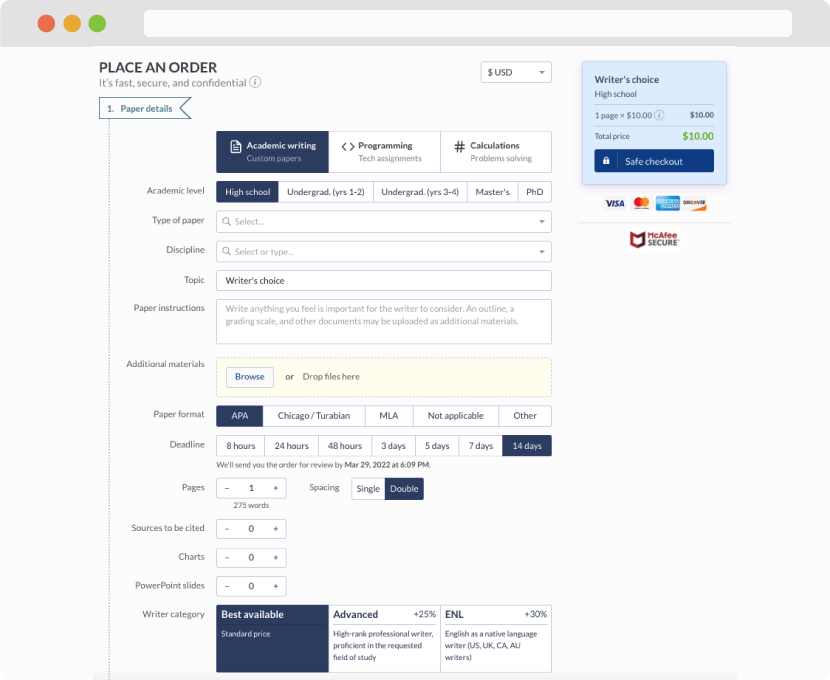
First, you will need to complete an order form. It's not difficult but, if anything is unclear, you may always chat with us so that we can guide you through it. On the order form, you will need to include some basic information concerning your order: subject, topic, number of pages, etc. We also encourage our clients to upload any relevant information or sources that will help.
Complete the order form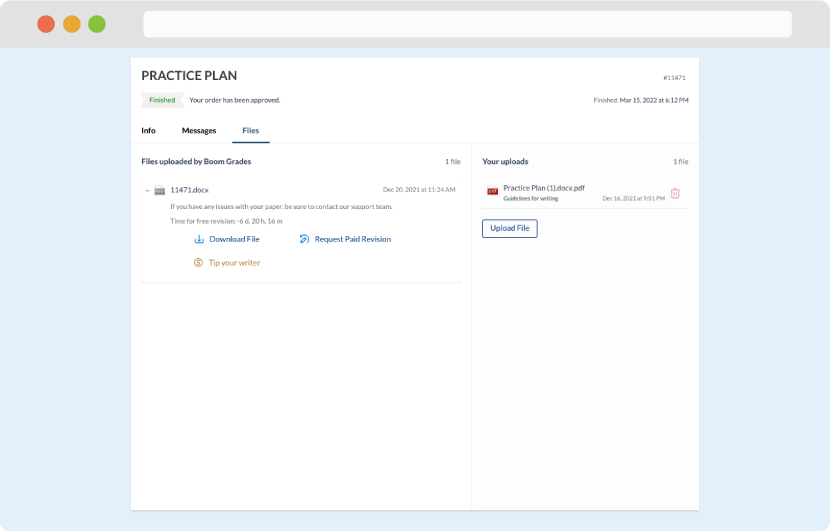
Once we have all the information and instructions that we need, we select the most suitable writer for your assignment. While everything seems to be clear, the writer, who has complete knowledge of the subject, may need clarification from you. It is at that point that you would receive a call or email from us.
Writer’s assignment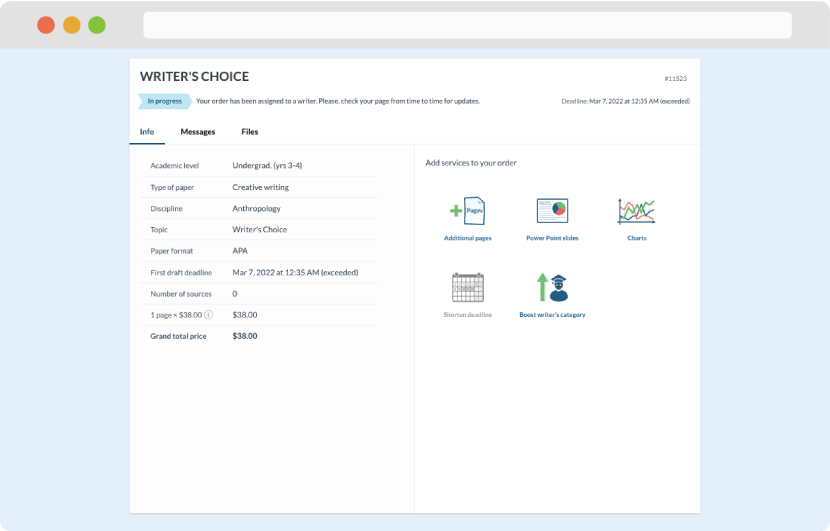
As soon as the writer has finished, it will be delivered both to the website and to your email address so that you will not miss it. If your deadline is close at hand, we will place a call to you to make sure that you receive the paper on time.
Completing the order and download