This assignment re- introduces you to the framework of 21st century skills that you will consider each week as you work to redesign prior coursework for your Folio. Note that a similar format is followed for each of the assignments in this course. You will upload this assignment to the course for evaluation and to your Folio.
Specifically, after reviewing the
Framework for 21st Century Learning (Links to an external site.)
, you will redesign or modify a prior assignment from one of your courses in the master’s program that represents your mastery of your programs learning outcomes (MACI, MAECEL, MAED, MASE or MATLT). An assignment you may want to redesign could be in the form of a lesson plan or teaching unit you previously created for a course. Your redesign of the assignment must show a representation of 21st century learning through incorporation of student outcomes and support systems, which are defined as follows:
When selecting an assignment to redesign, think about how the assignment should consider the diverse strengths, differences, cultures, and communities of students while offering a safe, collaborative, engaging, and inclusive learning environment. If you do not have previous work to use for this assignment, please contact your instructor for guidelines on how to proceed. As needed, refer to your
program learning outcomes (PLOs) list
(MACI, MAECEL, MAED, MASE or MATLT).
NOTE* Before you select the PLO’s you will highlight in this assignment, be sure to read the
final assignment
for this course to ensure that you will cover each of your programs PLOs adequately.
In your paper,
Create your assignment to meet the content and written communication expectations noted below.
Content Expectations
The Redesign expectations explain what you are required to do with the prior coursework you choose to redesign. The Summary expectations are for the separate written portion of this assignment.
Written Communication Expectations
All sources on the references page need to be used and cited correctly within the body of the assignment.
For information related to APA style, including samples and tutorials, please visit the
Ashford Writing Center (Links to an external site.)
.
Aesthetic and Affective Lesson Plan
Sharon A. Mitchell
ECE: 642 Quality Curriculum in Early Childhood
Professor: Latisha Shipley
January 31, 2020
Step 1: Overview
The considerations for planning meaningful activities in the aesthetic domain include the students and age. One should ensure that children are interested in meaningful activities. “When planning activities for young children you will want to keep in mind the age, individual needs, and the socio-cultural background of the children with whom you will be working” (Gibbons, S. L., & Bressan, 2016). Children could be interested in some art forms more than others. Some of the teaching strategies for aesthetics include the provision of creative experiences, integration of art into the classroom and modeling individual expressions.
When planning meaningful activities in the affective domain, one must consider the emotions, beliefs, and values of the children. “This domain includes how we deal with things emotionally, such as feelings, values, appreciation, enthusiasms, motivations and attitudes” (Kaplan, 2017). Children should be motivated by the activities chosen by their instructors to learn. The categories of the affective domain are responding, valuing, characterization, organization, and receiving. The teaching strategies should promote the emotional awareness of the children and enable them to express their emotions.
Step 2: Lesson plan
Goal
· Experience various art forms (music, drama, dance and visual art) (9.4 goals 2)
· Learn satisfying and effective strategies for coping with personal emotions and tensions (10.4 goals 8)
Objective
· To ensure that children learn how to collaborate with their peers and control emotions whenever they disagree with each other.
-To ensure that children learn the art of designing their school uniform from various materials to be provided in class.
Standards Included
IV. Language and Literacy Listening and Understanding
· Listens for a different purpose
· Follows simple directions
· Responds to questions (Porter et al, 2015).
VII Arts
· Generate and conceptualize artistic ideas and work.
· Interpret intent and meaning in artistic work.
Materials
½ gallon cardboard milk cartons
Glue
Scissors
Buttons
Paper bags
Flexible cloth figures
Tape player
Taped musical selections
Introduction
I will get the kids together and ask them to observe and describe the color and design of their school uniform. I will also ask them questions like “Why do we wear clothes and uniforms?”
Lesson Development
Inform the students that they will be making clothes from cartons. Have the children identify the materials they will need to make their skirts, jackets, and shirts. Allow the kids to explore a collection of clothes that have been designed before using cartons and paper bags.
divide them into three groups consisting of five members. One group to make a skirt, the other one designed a jacket and the last group a shirt.
Differentiation
The children will be making the shirts, jackets, and skirts using paper bags and milk cartons. They will engage in discussions on how a shirt, jacket or skirt should look and then cut the carton boxes and paper bags with the scissors to make their clothes. They will also decorate them using various colors to ensure that they look like uniforms.
Students will also sing the song “This is the way we dress”.
Assessment
(Practice/ Checking for
Understanding)
Watching the facial expressions of children as they engage in the cloth-making activity.
Check the way students relate with their peers during group work.
Asking the children to explain their cloth designs
Comparing the design of clothes made by children with the uniform they are wearing.
Closing
Comparing the various designs made by children and expressing unhappiness to those poorly designed and happiness and joy to the designs that look good.
Reminding students to always be happy when participating in group work.
STEP 3: CONCLUSION
This lesson aligns with the affective domain because it teaches them how to accommodate their peers and control their emotions when working in groups. It also aligns with the aesthetic domain because it lets children model their uniforms using various materials provided.
Both the affective and aesthetic domains were connected with the standards because students were able to design various clothes and show various emotions.
REFERENCES
Gibbons, S. L., & Bressan, E. S. (2016). The affective domain in physical education: A conceptual clarification and curricular commitment. Quest, 43(1), 78-97.
Kaplan, S. (2017). Aesthetics, affect, and cognition: Environmental preference from an evolutionary perspective. Environment and Behavior, 19(1), 3-32.
Porter, A., McMaken, J., Hwang, J., & Yang, R. (2015). Common core standards: The new US intended curriculum. Educational Researcher, 40(3), 103-116.
Essay Writing Service Features
Our Experience
No matter how complex your assignment is, we can find the right professional for your specific task. Achiever Papers is an essay writing company that hires only the smartest minds to help you with your projects. Our expertise allows us to provide students with high-quality academic writing, editing & proofreading services.
Free Features
Free revision policy
$10Free bibliography & reference
$8Free title page
$8Free formatting
$8How Our Dissertation Writing Service Works
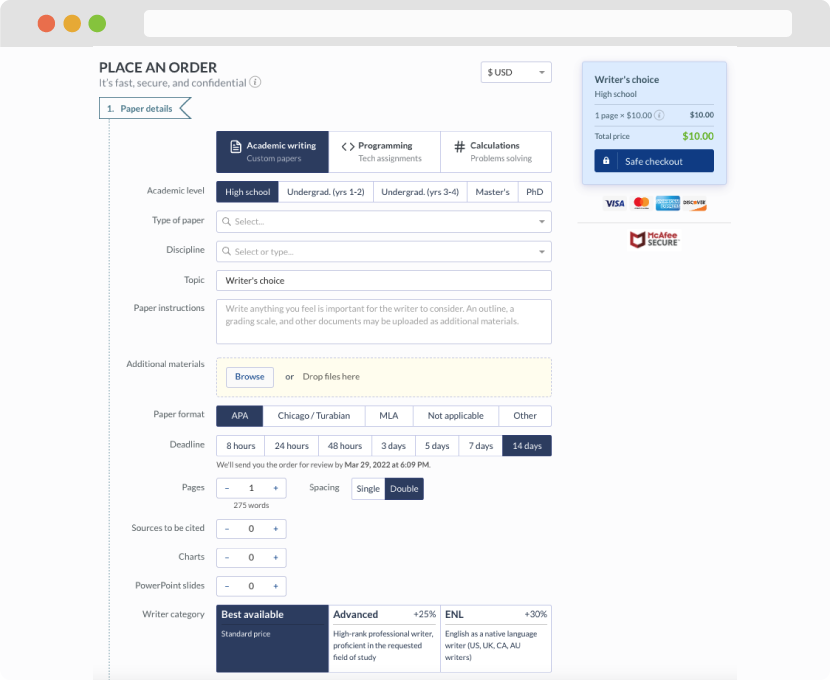
First, you will need to complete an order form. It's not difficult but, if anything is unclear, you may always chat with us so that we can guide you through it. On the order form, you will need to include some basic information concerning your order: subject, topic, number of pages, etc. We also encourage our clients to upload any relevant information or sources that will help.
Complete the order form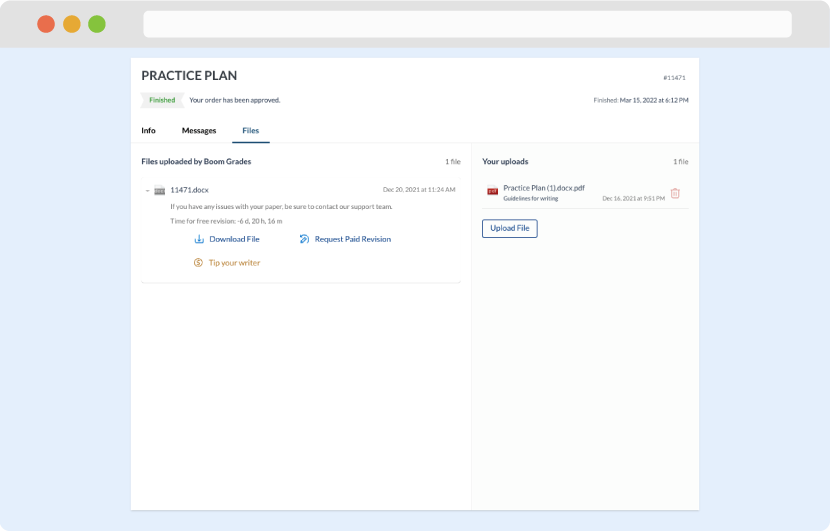
Once we have all the information and instructions that we need, we select the most suitable writer for your assignment. While everything seems to be clear, the writer, who has complete knowledge of the subject, may need clarification from you. It is at that point that you would receive a call or email from us.
Writer’s assignment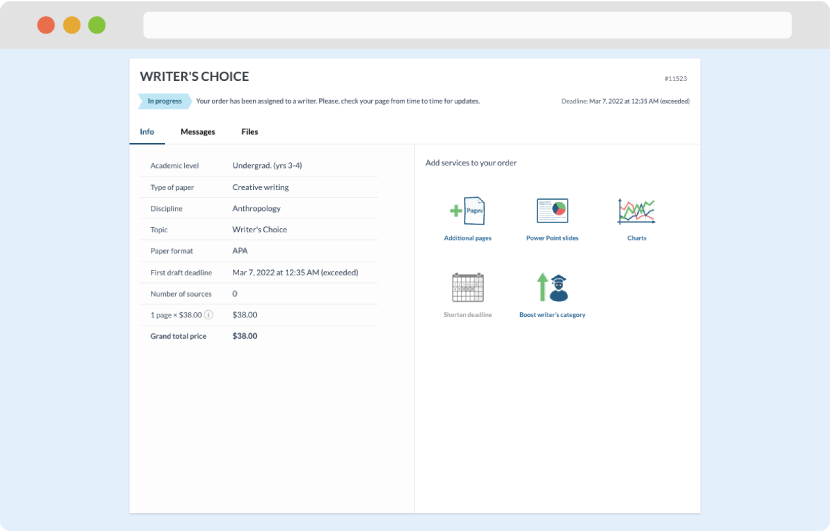
As soon as the writer has finished, it will be delivered both to the website and to your email address so that you will not miss it. If your deadline is close at hand, we will place a call to you to make sure that you receive the paper on time.
Completing the order and download