Read the two Harvard Business Review articles in this assignment.
Construct a critical review of the three major points of each paper.
Describe how the major points of the papers complement and contradict each other.
What personal insights did you derive that would be useful in your remaining collegiate career and will be useful in your next step into your future career.
Suggested length of 1200 words.
Use the APA Style Report Template provided in the templates module
Font 12 Point Times New Roman
Single spaced Sentences, Double spaced between paragraphs.
8/13/2018 What Self-Awareness Really Is (and How to Cultivate It)
https://hbr.org/2018/01/what-self-awareness-really-is-and-how-to-cultivate-it 1/10
MANAGING YOURSELF
What Self-Awareness Really Is
(and How to Cultivate It)
by Tasha Eurich
JANUARY 04, 2018
ARCHI TRUJILLO/GETTY IMAGES
Self-awareness seems to have become the latest management buzzword — and for good reason.
Research suggests that when we see ourselves clearly, we are more confident and more creative. We
make sounder decisions, build stronger relationships, and communicate more effectively. We’re less
likely to lie, cheat, and steal. We are better workers who get more promotions. And we’re more-
effective leaders with more-satisfied employees and more-profitable companies.
https://hbr.org/topic/managing-yourself
https://hbr.org/search?term=tasha+eurich
http://guilfordjournals.com/doi/abs/10.1521/jscp.23.4.475.40307
http://guilfordjournals.com/doi/abs/10.1521/jscp.23.4.475.40307
https://www.jstor.org/stable/20152338?seq=1#page_scan_tab_contents
http://www.emeraldinsight.com/doi/abs/10.1108/02683940310484008
http://www.emeraldinsight.com/doi/abs/10.1108/EJTD-04-2015-0031?journalCode=ejtd
http://guilfordjournals.com/doi/abs/10.1521/jscp.23.4.475.40307
https://www.ncbi.nlm.nih.gov/pubmed/9109286
http://onlinelibrary.wiley.com/doi/10.1111/j.1464-0597.1991.tb01002.x/abstract
http://onlinelibrary.wiley.com/doi/10.1111/j.1464-0597.1991.tb01002.x/abstract
http://amj.aom.org/content/23/2/320.abstract
http://www.idpublications.org/wp-content/uploads/2014/12/Self-Awareness-and-Organizational-performance-Full-Paper
https://hbr.org/
8/13/2018 What Self-Awareness Really Is (and How to Cultivate It)
https://hbr.org/2018/01/what-self-awareness-really-is-and-how-to-cultivate-it 2/10
About Our Research
The major components of our research
included:
Analyzing the results of nearly 800
existing scientic studies to understand
how previous researchers dened self-
awareness, unearth themes and trends,
and identify the limitations of these
investigations.
Surveying thousands of people across
countries and industries to explore the
relationship between self-awareness
and several key attitudes and behaviors,
like job satisfaction, empathy,
happiness, and stress. We also surveyed
those who knew these people well to
determine the relationship between self
and other ratings of self-awareness.
Developing and validating a seven
factor, multi-rater assessment of self-
awareness, because our review of the
research didn’t identify any strong, well-
validated, comprehensive measures.
Conducting in depth interviews
with 50 people who’d dramatically
As an organizational psychologist and executive coach, I’ve had a ringside seat to the power of
leadership self-awareness for nearly 15 years. I’ve also seen how attainable this skill is. Yet, when I
first began to delve into the research on self-awareness, I was surprised by the striking gap between
the science and the practice of self-awareness. All things considered, we knew surprisingly little
about improving this critical skill.
Four years ago, my team of researchers and I embarked on a large-scale scientific study of self-
awareness. In 10 separate investigations with nearly 5,000 participants, we examined what self-
awareness really is, why we need it, and how we can increase it. (We are currently writing up our
results for submission to an academic journal.)
Our research revealed many surprising
roadblocks, myths, and truths about what self-
awareness is and what it takes to improve it.
We’ve found that even though most people
believe they are self-aware, self-awareness is a
truly rare quality: We estimate that only 10%–15%
of the people we studied actually fit the criteria.
Three findings in particular stood out, and are
helping us develop practical guidance for how
leaders can learn to see themselves more clearly.
#1: There Are Two Types of Self-Awareness
For the last 50 years, researchers have used
varying definitions of self-awareness. For
example, some see it as the ability to monitor our
inner world, whereas others label it as a
temporary state of self-consciousness. Still others
describe it as the difference between how we see
ourselves and how others see us.
http://www.danielgoleman.info/on-self-awareness/
http://www.sciencedirect.com/science/article/pii/0022103173900590
https://hbr.org/2015/03/research-were-not-very-self-aware-especially-at-work
8/13/2018 What Self-Awareness Really Is (and How to Cultivate It)
https://hbr.org/2018/01/what-self-awareness-really-is-and-how-to-cultivate-it 3/10
improved their self-awareness to learn
about the key actions that helped them
get there, as well as their beliefs and
practices. Our interviewees included
entrepreneurs, professionals,
executives and even a Fortune 10 CEO.
(To be included in our study,
participants had to clear four hurdles: 1)
they had to see themselves as highly
self-aware, which we measured using
our validated assessment, 2) using that
same assessment, someone who knew
them well had to agree, 3) they had to
believe they’d experienced an upward
trend of self-awareness over the course
of their life. Each participant was asked
to recall their level of self-awareness at
different stages of their life up until the
age they were currently (e.g., early
adulthood: ages 19-24, adulthood: ages
25-34, mid-life: ages 35-49, mature
adulthood: ages 50-80), and 4) the
person rating them had to agree with
the participants’ recollections.)
Surveying hundreds of managers and
their employees to learn more about
the relationship between leadership
self-awareness and employee attitudes
like commitment, leadership
effectiveness, and job satisfaction.
Coauthors on this work are:
Haley M. Woznyj, Longwood University
Phoenix Van Wagoner, Leeds School of
Business, University of Colorado
Eric D Heggestad University of North
So before we could focus on how to improve self-
awareness, we needed to synthesize these
findings and create an overarching definition.
Across the studies we examined, two broad
categories of self-awareness kept emerging. The
first, which we dubbed internal self-awareness,
represents how clearly we see our own values,
passions, aspirations, fit with our environment,
reactions (including thoughts, feelings, behaviors,
strengths, and weaknesses), and impact on
others. We’ve found that internal self-awareness
is associated with higher job and relationship
satisfaction, personal and social control, and
happiness; it is negatively related to anxiety,
stress, and depression.
The second category, external self-awareness,
means understanding how other people view us,
in terms of those same factors listed above. Our
research shows that people who know how others
see them are more skilled at showing empathy
and taking others’ perspectives. For leaders who
see themselves as their employees do, their
employees tend to have a better relationship with
them, feel more satisfied with them, and see them
as more effective in general.
It’s easy to assume that being high on one type of
awareness would mean being high on the other.
But our research has found virtually no
relationship between them. As a result, we identify four leadership archetypes, each with a different
set of opportunities to improve:
8/13/2018 What Self-Awareness Really Is (and How to Cultivate It)
https://hbr.org/2018/01/what-self-awareness-really-is-and-how-to-cultivate-it 4/10
When it comes to
internal and
external self-
awareness, it’s
tempting to value
one over the other.
But leaders must
actively work on
both seeing
themselves clearly
and getting
feedback to
understand how others see them. The highly self-aware people we interviewed were actively
focused on balancing the scale.
Take Jeremiah, a marketing manager. Early in his career, he focused primarily on internal self-
awareness — for example, deciding to leave his career in accounting to pursue his passion for
marketing. But when he had the chance to get candid feedback during a company training, he
realized that he wasn’t focused enough on how he was showing up. Jeremiah has since placed an
equal importance on both types of self-awareness, which he believes has helped him reach a new
level of success and fulfillment.
The bottom line is that self-awareness isn’t one truth. It’s a delicate balance of two distinct, even
competing, viewpoints. (If you’re interested in learning where you stand in each category, a free
shortened version of our multi-rater self-awareness assessment is available here.)
#2: Experience and Power Hinder Self-Awareness
Contrary to popular belief, studies have shown that people do not always learn from experience,
that expertise does not help people root out false information, and that seeing ourselves as highly
experienced can keep us from doing our homework, seeking disconfirming evidence, and
questioning our assumptions.
http://www.insight-quiz.com/
http://www.sciencedirect.com/science/article/pii/0001691880900347
http://journals.sagepub.com/doi/abs/10.1177/0956797615588195
8/13/2018 What Self-Awareness Really Is (and How to Cultivate It)
https://hbr.org/2018/01/what-self-awareness-really-is-and-how-to-cultivate-it 5/10
And just as experience can lead to a false sense of confidence about our performance, it can also
make us overconfident about our level of self-knowledge. For example, one study found that more-
experienced managers were less accurate in assessing their leadership effectiveness compared with
less experienced managers.
Similarly, the more power a leader holds, the more likely they are to overestimate their skills and
abilities. One study of more than 3,600 leaders across a variety of roles and industries found that,
relative to lower-level leaders, higher-level leaders more significantly overvalued their skills
(compared with others’ perceptions). In fact, this pattern existed for 19 out of the 20 competencies
the researchers measured, including emotional self-awareness, accurate self-assessment, empathy,
trustworthiness, and leadership performance.
Researchers have proposed two primary explanations for this phenomenon. First, by virtue of their
level, senior leaders simply have fewer people above them who can provide candid feedback.
Second, the more power a leader wields, the less comfortable people will be to give them
constructive feedback, for fear it will hurt their careers. Business professor James O’Toole has added
that, as one’s power grows, one’s willingness to listen shrinks, either because they think they know
more than their employees or because seeking feedback will come at a cost.
But this doesn’t have to be the case. One analysis showed that the most successful leaders, as rated
by 360-degree reviews of leadership effectiveness, counteract this tendency by seeking frequent
critical feedback (from bosses, peers, employees, their board, and so on). They become more self-
aware in the process and come to be seen as more effective by others.
Likewise, in our interviews, we found that people who improved their external self-awareness did
so by seeking out feedback from loving critics — that is, people who have their best interests in mind
and are willing to tell them the truth. To ensure they don’t overreact or overcorrect based on one
person’s opinion, they also gut-check difficult or surprising feedback with others.
Even though most people believe they are self-
aware, only 10-15% of the people we studied
actually t the criteria.
http://onlinelibrary.wiley.com/doi/10.1111/j.1744-6570.2004.tb02494.x/abstract
https://www.researchgate.net/publication/232559373_Executive_Blind_Spots_Discrepancies_Between_Self-_and_Other-Ratings
https://www.researchgate.net/publication/232559373_Executive_Blind_Spots_Discrepancies_Between_Self-_and_Other-Ratings
https://www.scu.edu/ethics/focus-areas/business-ethics/resources/speaking-truth-to-power-the-role-of-the-executive/
http://www.forbes.com/sites/joefolkman/2015/01/08/top-ranked-leaders-know-this-secret-ask-for-feedback/#b958b9e608fe
http://amj.aom.org/content/34/2/251.abstract
8/13/2018 What Self-Awareness Really Is (and How to Cultivate It)
https://hbr.org/2018/01/what-self-awareness-really-is-and-how-to-cultivate-it 6/10
#3: Introspection Doesn’t Always Improve Self-Awareness
It is also widely assumed that introspection — examining the causes of our own thoughts, feelings,
and behaviors — improves self-awareness. After all, what better way to know ourselves than by
reflecting on why we are the way we are?
Yet one of the most surprising findings of our research is that people who introspect are less self-
aware and report worse job satisfaction and well-being. Other research has shown similar patterns.
The problem with introspection isn’t that it is categorically ineffective — it’s that most people are
doing it incorrectly. To understand this, let’s look at arguably the most common introspective
question: “Why?” We ask this when trying to understand our emotions (Why do I like employee A so
much more than employee B?), or our behavior (Why did I fly off the handle with that employee?), or
our attitudes (Why am I so against this deal?).
As it turns out, “why” is a surprisingly ineffective self-awareness question. Research has shown that
we simply do not have access to many of the unconscious thoughts, feelings, and motives we’re
searching for. And because so much is trapped outside of our conscious awareness, we tend to
invent answers that feel true but are often wrong. For example, after an uncharacteristic outburst at
an employee, a new manager may jump to the conclusion that it happened because she isn’t cut out
for management, when the real reason was a bad case of low blood sugar.
Consequently, the problem with asking why isn’t just how wrong we are, but how confident we are
that we are right. The human mind rarely operates in a rational fashion, and our judgments are
seldom free from bias. We tend to pounce on whatever “insights” we find without questioning their
validity or value, we ignore contradictory evidence, and we force our thoughts to conform to our
initial explanations.
The problem with introspection isn’t that it is
ineffective—it’s that most people are doing it
incorrectly.
https://www.sbp-journal.com/index.php/sbp/article/view/1219
https://deepblue.lib.umich.edu/handle/2027.42/92167
https://deepblue.lib.umich.edu/handle/2027.42/92167
http://www.sciencedirect.com/science/article/pii/S0065260108603111
8/13/2018 What Self-Awareness Really Is (and How to Cultivate It)
https://hbr.org/2018/01/what-self-awareness-really-is-and-how-to-cultivate-it 7/10
Another negative consequence of asking why — especially when trying to explain an undesired
outcome — is that it invites unproductive negative thoughts. In our research, we’ve found that
people who are very introspective are also more likely to get caught in ruminative patterns. For
example, if an employee who receives a bad performance review asks Why did I get such a bad
rating?, they’re likely to land on an explanation focused on their fears, shortcomings, or insecurities,
rather than a rational assessment of their strengths and weaknesses. (For this reason, frequent self-
analyzers are more depressed and anxious and experience poorer well-being.)
So if why isn’t the right introspective question, is there a better one? My research team scoured
hundreds of pages of interview transcripts with highly self-aware people to see if they approached
introspection differently. Indeed, there was a clear pattern: Although the word “why”
appeared fewer than 150 times, the word “what” appeared more than 1,000 times.
Therefore, to increase productive self-insight and decrease unproductive rumination, we should ask
what, not why. “What” questions help us stay objective, future-focused, and empowered to act on
our new insights.
For example, consider Jose, an entertainment industry veteran we interviewed, who hated his job.
Where many would have gotten stuck thinking “Why do I feel so terrible?,” he asked, “What are the
situations that make me feel terrible, and what do they have in common?” He realized that he’d
never be happy in that career, and it gave him the courage to pursue a new and far more
fulfilling one in wealth management.
Similarly, Robin, a customer service leader who was new to her job, needed to understand a piece of
negative feedback she’d gotten from an employee. Instead of asking “Why did you say this about
me?,” Robin inquired, “What are the steps I need to take in the future to do a better job?” This helped
them move to solutions rather than focusing on the unproductive patterns of the past.
Self-awareness isn’t one truth. It’s a delicate
balance of two distinct, even competing,
viewpoints.
https://www.ncbi.nlm.nih.gov/pubmed/16137257
https://www.ncbi.nlm.nih.gov/pubmed/9108698
http://onlinelibrary.wiley.com/doi/10.1111/1467-6494.05005/abstract
https://www.sbp-journal.com/index.php/sbp/article/view/1219
8/13/2018 What Self-Awareness Really Is (and How to Cultivate It)
https://hbr.org/2018/01/what-self-awareness-really-is-and-how-to-cultivate-it 8/10
A final case is Paul, who told us about learning that the business he’d recently purchased was no
longer profitable. At first, all he could ask himself was “Why wasn’t I able to turn things around?”
But he quickly realized that he didn’t have the time or energy to beat himself up — he had to figure
out what to do next. He started asking, “What do I need to do to move forward in a way that
minimizes the impact to our customers and employees?” He created a plan, and was able to find
creative ways to do as much good for others as possible while winding down the business. When all
that was over, he challenged himself to articulate what he learned from the experience — his
answer both helped him avoid similar mistakes in the future and helped others learn from them,
too.
These qualitative findings have been bolstered by others’ quantitative research. In one study,
psychologists J. Gregory Hixon and William Swann gave a group of undergraduates negative
feedback on a test of their “sociability, likability and interest ingness.” Some were given time to think
about why they were the kind of person they were, while others were asked to think about what kind
of person they were. When the researchers had them evaluate the accuracy of the feedback, the
“why” students spent their energy rationalizing and denying what they’d learned, and the “what”
students were more open to this new information and how they might learn from it. Hixon and
Swann’s rather bold conclusion was that “Thinking about why one is the way one is may be no better
than not thinking about one’s self at all.”
All of this brings us to conclude: Leaders who focus on building both internal and external self-
awareness, who seek honest feedback from loving critics, and who ask what instead of why can learn
to see themselves more clearly — and reap the many rewards that increased self-knowledge delivers.
And no matter how much progress we make, there’s always more to learn. That’s one of the things
that makes the journey to self-awareness so exciting.
Tasha Eurich, PhD, is an organizational psychologist, researcher, and New York Times bestselling author. She is the
principal of The Eurich Group, a boutique executive development rm that helps companies—from start-ups to the Fortune
100—succeed by improving the effectiveness of their leaders and teams. Her newest book, Insight, delves into the
connection between self-awareness and success in the workplace.
https://www.linkedin.com/pulse/eight-lessons-i-learned-from-buying-small-business-paul-brothe/
https://www.ncbi.nlm.nih.gov/pubmed/8421251
https://hbr.org/search?term=tasha+eurich
8/13/2018 What Self-Awareness Really Is (and How to Cultivate It)
https://hbr.org/2018/01/what-self-awareness-really-is-and-how-to-cultivate-it 9/10
Related Topics: PSYCHOLOGY | EMOTIONAL INTELLIGENCE
This article is about MANAGING YOURSELF
FOLLOW THIS TOPIC
Comments
Leave a Comment
P O S T
REPLY 1 1
40 COMMENTS
kannan kannan a month ago
The path of spiritual realization is undoubtedly difcult. The Lord therefore advises us to approach a bona de
spiritual master in the line of disciplic succession from the Lord Himself. No one can be a bona de spiritual master
without following this principle of disciplic succession. The Lord is the original spiritual master, and a person in the
disciplic succession can convey the message of the Lord as it is to his disciple. No one can be spiritually realized by
manufacturing his own process, as is the fashion of the foolish pretenders. The Bhagavatam says: dharmam hi
saksad-bhagavat-pranitam—the path of religion is directly enunciated by the Lord. Therefore, mental speculation or
dry arguments cannot help one progress in spiritual life. One has to approach a bona de spiritual master to receive
the knowledge. Such a spiritual master should be accepted in full surrender, and one should serve the spiritual
master like a menial servant, without false prestige. Satisfaction of the self-realized spiritual master is the secret of
advancement in spiritual life. Inquiries and submission constitute the proper combination for spiritual
understanding. Unless there is submission and service, inquiries from the learned spiritual master will not be
effective. One must be able to pass the test of the spiritual master, and when he sees the genuine desire of the
disciple, he automatically blesses the disciple with genuine spiritual understanding. In this verse, both blind
following and absurd inquiries are condemned. One should not only hear submissively from the spiritual master; but
one must also get a clear understanding from him, in submission and service and inquiries. A bona de spiritual
master is by nature very kind toward the disciple. Therefore when the student is submissive and is always ready to
render service, the reciprocation of knowledge and inquiries becomes perfect
POSTING GUIDELINES
JOIN THE CONVERSATION
https://hbr.org/topic/psychology
https://hbr.org/topic/emotional-intelligence
https://hbr.org/topic/managing-yourself
8/13/2018 What Self-Awareness Really Is (and How to Cultivate It)
https://hbr.org/2018/01/what-self-awareness-really-is-and-how-to-cultivate-it 10/10
We hope the conversations that take place on HBR.org will be energetic, constructive, and thought-provoking. To comment, readers must sign in or
register. And to ensure the quality of the discussion, our moderating team will review all comments and may edit them for clarity, length, and relevance.
Comments that are overly promotional, mean-spirited, or off-topic may be deleted per the moderators’ judgment. All postings become the property of
Harvard Business Publishing.
https://hbr.org/sign-in
https://hbr.org/register
4/29/2018 The Right Way to Ask for Help at Work
https://hbr.org/2018/05/how-to-get-the-help-you-need 1/8
MANAGING YOURSELF
How to Get the Help You Need
by Heidi Grant
FROM THE MAY–JUNE 2018 ISSUE
Few of us enjoy asking for help. As research inneuroscience and psychology shows, the social threatsinvolved—the uncertainty, risk of rejection, potential for
diminished status, and inherent relinquishing of autonomy—
activate the same brain regions that physical pain does. And in
the workplace, where we’re typically keen to demonstrate as
much expertise, competence, and confidence as possible, it can
feel particularly uncomfortable to make such requests.
However, it’s virtually impossible to advance in modern
organizations without assistance from others. Cross-functional
teams, agile project management techniques, matrixed or
hierarchy-minimizing structures, and increasingly collaborative
office cultures require you to constantly push for the cooperation
and support of your managers, peers, and employees. Your
https://hbr.org/topic/managing-yourself
https://hbr.org/search?term=heidi+grant
https://hbr.org/
4/29/2018 The Right Way to Ask for Help at Work
https://hbr.org/2018/05/how-to-get-the-help-you-need 2/8
MIGUEL MONTANER
performance, development, and career progression depend more
than ever on your seeking out the advice, referrals, and resources
you need. In fact, estimates suggest that as much as 75% to 90%
of the help coworkers give one another is in response to direct
appeals.
So how can you effectively ask for help? How can you impose
upon people without making them feel imposed upon?
The first step is getting over your reluctance to ask for assistance.
Next, you need to understand that some common and perhaps
intuitive ways of asking for help are ultimately unproductive,
because they make people less likely to want to give it. Finally,
you must learn the subtle cues that motivate people to support you and how to deliver them in the right way.
Costs and Benets
Perhaps the easiest way to overcome the pain of asking for help is to realize that most people are surprisingly willing to lend a hand.
When Vanessa Bohns, a professor at Cornell University and a leading researcher in this area, recently reviewed a group of
experiments that she and her coauthors had done, she found that compliance—the rate at which people provided assistance to
strangers who asked for it—was an average of 48% higher than the help seekers had expected. Clearly, people are much more likely
to be helpful than we think they are. Studies also suggest that we underestimate how much effort those who do agree to help will
put in.
4/29/2018 The Right Way to Ask for Help at Work
https://hbr.org/2018/05/how-to-get-the-help-you-need 3/8
That’s in part because saying no or helping only hal�eartedly carries a psychological cost that we tend to discount. But it’s also
because most helpers know—even if only subconsciously—that giving freely and effectively of themselves has emotional benefits. A
Swiss study published in 2017 found that people who simply pledge to spend even a small amount of money on someone else feel
happier than those who plan to indulge only themselves.
The key to a successful request for help is to shift the focus to these benefits. You want people to feel that they would be helping
because they want to, not because they must, and that they’re in control of the decision. That means avoiding any language
suggesting that you or someone else is instructing them to help, that they should help, or that they have no choice but to do so. This
includes prefaces such as “May I ask you a favor?,” which make people feel trapped, and profuse apologies such as “I feel terrible
asking you for this,” which make the experience seem less positive. Emphasizing reciprocity—“I’ll help you if you help me”—can also
backfire, because people don’t like to be indebted to anyone or to engage in a purely transactional exchange. And minimizing your
need—“I don’t normally ask for help” or “It’s just a tiny thing”—is equally unproductive, because it suggests the assistance is trivial
or even unnecessary.
But you can ask for help in a way that avoids these pitfalls and instead gives people agency over their responses, allowing them to
experience the natural highs associated with helping. That’s by using what I call reinforcements, or cues, which you can incorporate
in specific requests. Perhaps more important, you can also use them in day-to-day interactions to prime the people around you for
greater helpfulness.
Three Reinforcements
In-group.
You can allow people to experience the natural highs
associated with helping.
https://www.nature.com/articles/ncomms15964
4/29/2018 The Right Way to Ask for Help at Work
https://hbr.org/2018/05/how-to-get-the-help-you-need 4/8
One reinforcement you’ll want to give a potential helper is assurance that you’re on his or her team and that the team is important.
This taps into the innate human need to belong to—and ensure the well-being of—supportive social circles. There are several ways to
do this. For example, research by Priyanka Carr and Greg Walton (a graduate student at the time), of Stanford University, shows that
simply saying the word “together” can have an effect. When participants working on puzzles alone were told that they were doing
so in tandem with people performing similar tasks in other rooms and could later exchange tips, they worked 48% longer, solved
more problems correctly, and said they were less depleted by the task than those allowed to believe they were working fully
independently.
You might also cite a common goal, enemy, or trait, such as the desire to exceed your team’s sales targets, rivalry with a competitor
in your industry, or a love of superhero movies. But the best way to create a strong sense of in-group is to highlight shared
experiences, perceptions, thoughts, and feelings. For example, if a senior management team includes only two women, don’t just
say, “We’re the only two women on the team” (emphasizing the trait). Say, “Have you noticed that we get interrupted all the time?”
(shared experience).
Positive identity.
A second cue for potential helpers involves creating or enhancing their recognition that they are uniquely placed (by virtue of their
attributes or role) to provide assistance and that they are not merely people who might help you but helpful people who routinely
come to others’ aid. For example, studies have shown that people contribute more to charity when asked if they would like to “be a
generous donor” (versus “to donate”) and that children as young as three are more motivated to complete tasks such as cleaning up
blocks when told they can “be a helper” (versus “can help”). Remember, however, that people don’t all have the same vision of
positive identity, so tailor your message. Research on pro-environment appeals suggests, for instance, that liberals prefer phrases
such as “care for the natural world” and “prevent the suffering of all life forms,” whereas conservatives respond better to “show your
love for your country” and “take responsibility for yourself and the land you call home.”
4/29/2018 The Right Way to Ask for Help at Work
https://hbr.org/2018/05/how-to-get-the-help-you-need 5/8
What Helpers Need
Gratitude is another powerful way to boost helpers’ positive identity. A recent study by the productivity software company
Boomerang of 350,000 e-mail exchanges found that “Thanks in advance” and “Thanks” yielded average response rates from 63% to
66%, compared with 51% to 54% for other popular options including “Best,” “Regards,” and “Cheers.” Even expressed preemptively,
gratitude can keep people interested and invested in helping you, as long as you focus more on their generosity and selflessness—
and what that says about them as people—than on how you’ll benefit from the help.
Effectiveness.
People want to see or know the impact of the aid they will give. This isn’t an ego thing. Many psychologists believe that feeling
effective—knowing that your actions created the results you intended—is the fundamental human motivation; it’s what truly
engages people and gives their lives meaning. Consider a study that Wharton’s Adam Grant conducted at an outbound call center in
an educational and marketing software company. Employees knew that the revenue they generated supported jobs in another
department, with which they’d previously had no contact. After one of the beneficiaries of their work visited and spoke to them
about their impact on his and others’ jobs, the call center’s sales and revenue doubled. To ensure that your potential helpers know
that their assistance will matter, be very clear about what you need and its projected impact. For example, when asking a colleague
to review a client proposal, you might say, “Would you please review this before I send it to XYZ? Your input really helped my
previous pitch to ABC succeed.”
Promise to follow up afterward, and do so. If possible, also allow people to choose how they help you, and be willing to accept
alternatives to your original request. You want helpers to give what they can—and what will make them feel most effective.
Personal and Professional
People want to see the impact of the aid they give. This isn’t an
ego thing.
Forget “Best” or “Sincerely,” This Email Closing Gets the Most Replies
4/29/2018 The Right Way to Ask for Help at Work
https://hbr.org/2018/05/how-to-get-the-help-you-need 6/8
1. The helper must realize that you need help. Human
beings are, as a rule, preoccupied with their own affairs.
This is particularly true for people in negative moods or
positions of relative power over others. So the rst step is
making people aware of your problem.
2. The helper must believe that you want help. Sometimes
people fail to offer help not because they don’t see the
need but because they’re worried that they’ve
misconstrued the situation or that you prefer to go it
alone. They expect you to come to them, forgetting how
reluctant most of us are to ask for help.
3. The helper must take responsibility for helping. One of
the biggest obstacles to helping is diffusion of
responsibility. A classic error is asking for help via group
e-mail. Instead take the time to ask potential helpers
directly and with unique appeals.
4. The helper must be able to provide what you need.
People are busy, and not all of them have the skills or the
resources to help you. But you can make any request
seem more manageable by being explicit and detailed
about what you are asking for, keeping the request
reasonable, and staying open to receiving help that is
different from what you asked for.
When I explain to people how these strategies work in practice, I
often give an example from my personal life, involving an IKEA
bookshelf. About a year ago, a friend from graduate school asked
me to help her assemble a particularly complicated one, and—this
might surprise you—I eagerly agreed. That same morning, I’d
turned down a request to review a submission to a scientific
journal, ignored an e-mail from my daughter’s school asking for
parent volunteers to help with an ice cream party, and grudgingly
said I would do our family’s laundry but refused to fold it. So why
was the DIY request an easy yes?
One reason is that the person asking was a long-standing friend
with whom I enjoy spending time (in-group reinforcement).
Another is that I’m weirdly good at such projects (owing less to
my construction prowess than to my ability to interpret poorly
written directions), and for years I’d been her go-to gal for help
with them (effectiveness). And finally, whenever we work together
in this way, my friend always wraps up by saying something like
“Heidi, thank you. You are always so helpful and generous”
(positive identity).
I’ve seen situations play out the same way in professional
settings. Consider the head of product development at a learning software company who wanted more input with the sales
department, which was making his team’s work difficult by agreeing that highly customized orders would be delivered according to
4/29/2018 The Right Way to Ask for Help at Work
https://hbr.org/2018/05/how-to-get-the-help-you-need 7/8
near-impossible schedules. He pleaded to be included in discussions with clients but was often ignored; the people in sales believed
that he would slow them down and be an obstacle to their success. Of course, all parties felt they were doing what was best for the
company, but in their own ways.
Eventually, the frustrated executive decided to take a fresh approach to getting the cooperation he needed from his colleagues. He
set up a meeting with sales leaders to talk through the product development process, realizing that most of the team had no idea
what work was involved. In other words, they didn’t understand why their help was needed. He began to emphasize in every
interaction that they all shared the goal of pleasing the customer to ensure repeat business, creating a strong sense of in-group with
the sales team. Suddenly it was clear that everyone was on the same side. He also started describing sales leaders as the protectors
of customer experience and talked about the power they wielded in determining the future of the company’s brand, which gave
them a strong positive identity and motivated them to see and approach their work in a slightly different way.
Finally, whenever salespeople did what he asked and included him in the work proposal process, he made a point of following up
with them to say how important it had been to the ultimate success of the delivery. They saw their help land and felt its effectiveness.
Over time, these strategies dramatically improved relations between the two teams, and the company saw increases in both client
satisfaction and profitability.
When you next find yourself in need of help, remember that people are willing to give it much more often than not. Few will think
less of you for needing assistance. And there is no better way to make someone feel good about himself or herself than to ask for it. It
brings out the best—and the best feelings—in all of us.
A version of this article appeared in the May–June 2018 issue (pp.142–145) of Harvard Business Review.
https://hbr.org/archive-toc/BR1803
https://hbr.org/search?term=heidi+grant
4/29/2018 The Right Way to Ask for Help at Work
https://hbr.org/2018/05/how-to-get-the-help-you-need 8/8
Heidi Grant, Ph.D., is Senior Scientist at the Neuroleadership Institute, and associate director for the Motivation Science Center at Columbia University. She is
the author of the bestselling Nine Things Successful People Do Differently and No One Understands You and What to Do About It. Her latest book is
Reinforcements: How to Get People to Help You. She’s on Twitter @heidgrantphd.
Related Topics: COMMUNICATION | PSYCHOLOGY | DIFFICULT CONVERSATIONS
This article is about MANAGING YOURSELF
FOLLOW THIS TOPIC
Comments
Leave a Comment
P O S T
0 COMMENTS
POSTING GUIDELINES
We hope the conversations that take place on HBR.org will be energetic, constructive, and thought-provoking. To comment, readers must sign in or register. And to ensure the quality of the discussion,
our moderating team will review all comments and may edit them for clarity, length, and relevance. Comments that are overly promotional, mean-spirited, or off-topic may be deleted per the
moderators’ judgment. All postings become the property of Harvard Business Publishing.
JOIN THE CONVERSATION
https://hbr.org/search?term=heidi+grant
https://hbr.org/product/reinforcements-how-to-get-people-to-help-you/10079-HBK-ENG
https://twitter.com/heidgrantphd
https://hbr.org/topic/communication
https://hbr.org/topic/psychology
https://hbr.org/topic/difficult-conversations
https://hbr.org/topic/managing-yourself
https://hbr.org/sign-in
https://hbr.org/register
Essay Writing Service Features
Our Experience
No matter how complex your assignment is, we can find the right professional for your specific task. Achiever Papers is an essay writing company that hires only the smartest minds to help you with your projects. Our expertise allows us to provide students with high-quality academic writing, editing & proofreading services.
Free Features
Free revision policy
$10Free bibliography & reference
$8Free title page
$8Free formatting
$8How Our Dissertation Writing Service Works
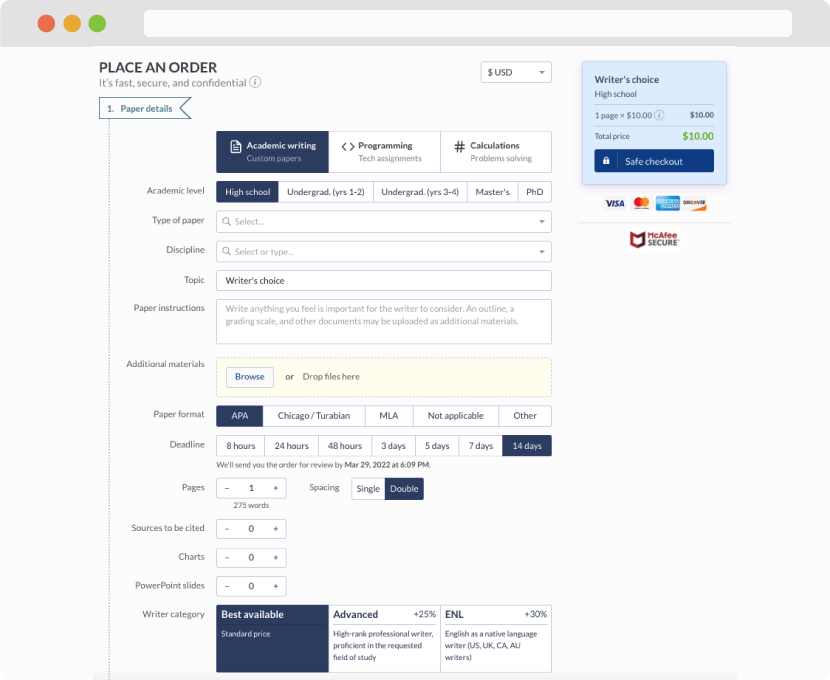
First, you will need to complete an order form. It's not difficult but, if anything is unclear, you may always chat with us so that we can guide you through it. On the order form, you will need to include some basic information concerning your order: subject, topic, number of pages, etc. We also encourage our clients to upload any relevant information or sources that will help.
Complete the order form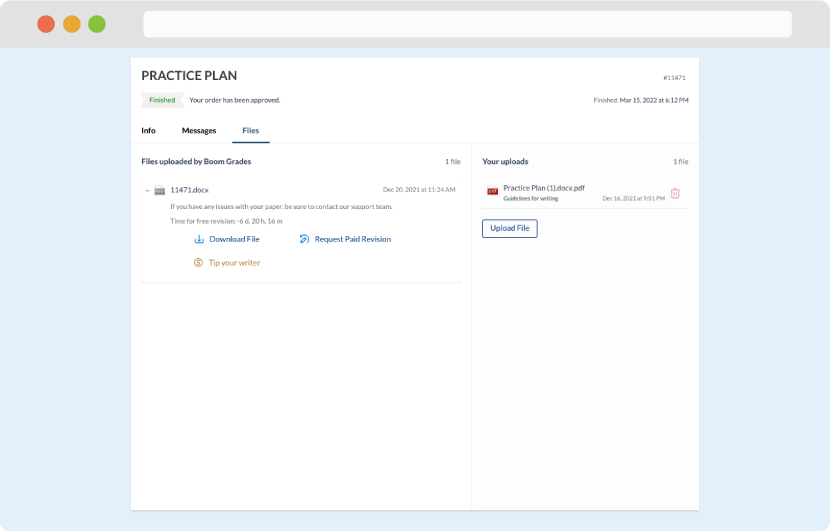
Once we have all the information and instructions that we need, we select the most suitable writer for your assignment. While everything seems to be clear, the writer, who has complete knowledge of the subject, may need clarification from you. It is at that point that you would receive a call or email from us.
Writer’s assignment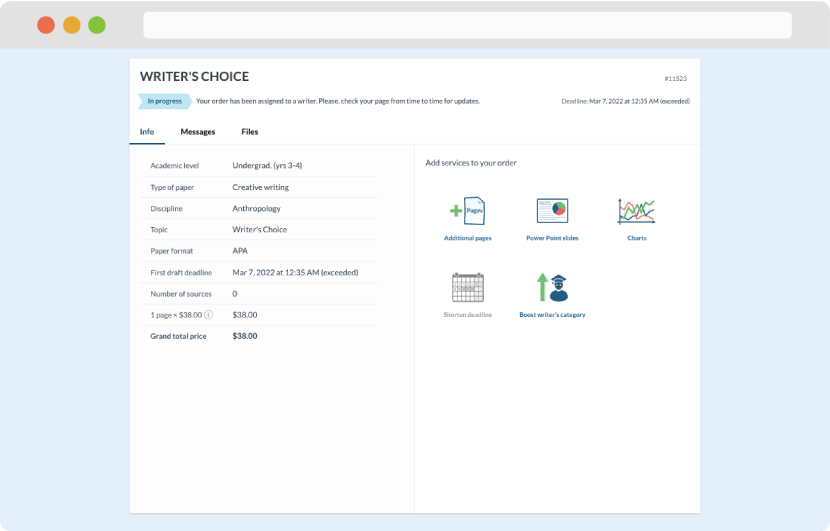
As soon as the writer has finished, it will be delivered both to the website and to your email address so that you will not miss it. If your deadline is close at hand, we will place a call to you to make sure that you receive the paper on time.
Completing the order and download