Morrison, J. (2014). Diagnosis made easier (2nd ed.). New York, NY: Guilford Press.
Chapter 5, “Coping with Uncertainty” (pp. 43–56)
Chapter 13, “Diagnosing Psychosis” (pp. 185–215)
American Psychiatric Association. (2013). Schizophrenia spectrum and other psychotic disorders. In Diagnostic and statistical manual of mental disorders (5th ed.). Arlington, VA: Author. doi:10.1176/appi.books.9780890425596.dsm02
American Psychiatric Association. (2013). Assessment measures. In Diagnostic and statistical manual of mental disorders (5th ed.). Arlington, VA: Author. doi:10.1176/appi.books.9780890425596.AssessmentMeasures
TED Conferences, LLC (Producer). (2012). A tale of mental illness—from the inside [Video file]. Retrieved from https://www.ted.com/talks/elyn_saks_seeing_mental_illness
TEDx Talks. (2017, March 27). I am not a monster: Schizophrenia | Cecilia McGough | TEDxPSU [Video file]. Retrieved from https://youtu.be/xbagFzcyNiM
Osmosis. (2016, March 8). Schizophrenia: Causes, symptoms, diagnosis, treatment & pathology [Video file]. Retrieved from https://youtu.be/PURvJV2SMso
Article Choices for Assignment
Select at least 2 articles from the following list for the Assignment.
Atadokht, A., Ebrahimzadeh, S., & Mikaeeli, N. (2019). The effectiveness of humor skills training on positive and negative symptoms of chronic schizophrenia spectrum. Journal of Holistic Nursing and Midwifery, 29(1), 15-21.
Breitborde, N. J. K., Moe, A. M., Ered, A., Ellman, L. M., & Bell, E. K. (2017). Optimizing psychosocial interventions in first-episode psychosis: Current perspectives and future directions. Psychology Research and Behavior Management, 10, 119–127. doi:10.2147/PRBM.S111593
Cohen, A. N., Hamilton, A. B., Saks, E. R., Glover, D. L., Glynn, S. M., Brekke, J. S., & Marder, S. R. (2017). How occupationally high-achieving individuals with a diagnosis of schizophrenia manage their symptoms. Psychiatric Services, 68(4), 324–329. doi:10.1176/appi.ps.201600031
Hernandez, M., Barrio, C., & Yamada, A.-M. (2013). Hope and burden among Latino families of adults with schizophrenia. Family Process, 52(4), 697–708. doi:10.1111/famp.12042
Kung, W. (2016). Tangible needs and external stressors faced by Chinese American families with a member having schizophrenia. Social Work Research, 40(1), 53–63. doi:10.1093/swr/svv047
Mueser, K. T., Penn, D. L., Addington, J., Brunette, M. F., Gingerich, S., Glynn, S. M., … Kane, J. M. (2015). The NAVIGATE program for first-episode psychosis: Rationale, overview, and description of psychosocial components. Psychiatric Services, 66(7), 680–690. doi:10.1176/appi.ps.201400413
Velthorst, E., Fett, A.-K. J., Reichenberg, A., Perlman, G., van Os, J., Bronet, E. J., & Kotov, R. (2017). The 20-year longitudinal trajectories of social functioning in individuals with psychotic disorders. American Journal of Psychiatry, 174(11), 1075–1085. doi:10.1176/appi.ajp.2016.15111419
Walsh, J., Hochbrueckner, R., Corcoran, J., & Spence, R. (2016). The lived experience of schizophrenia: A systematic review and meta-synthesis. Social Work in Mental Health, 14(6), 607–624. doi:10.1080/15332985.2015.1100153
White, C., & Unruh, A. (2013). Unheard voices: Mothers of adult children with schizophrenia speak up. Canadian Journal of Community Mental Health, 32(3), 109–120. doi:10.7870/cjcmh-2013-025
American Psychiatric Association. (2018). Online assessment measures. Retrieved from https://www.psychiatry.org/psychiatrists/practice/dsm/educational-resources/assessment-measures
Singer, J. B. (Producer). (2008, November 17). Episode 45—Schizophrenia and social work: Interview with Shaun Eack [Audio podcast]. Retrieved from http://socialworkpodcast.blogspot.com/2008/11/schizophrenia-and-social-work-interview.html
In this Discussion, you first present to your peers the case collaboration begun in Week 4. Note: You make this presentation individually—you do not present with your partner. Your colleagues then review your diagnosis for validity, recommending an evidence-based tool to use in your case.
Such tools help confirm the details and validity of a diagnosis. Measures also help clinicians notice other patterns in a disorder that might otherwise be missed. By confirming an accurate diagnosis through a measurement instrument, a social worker ensures that the appropriate evidence-based treatment is used.
Post the following two pieces:
Briefly summarize your case, highlighting the diagnostic symptoms seen in the case.
Describe your decision-making process for identifying the key problems in the case and the differential eliminations for your case.
Identify the diagnosis of the client in the case. Explain the diagnosis by providing the supporting DSM-5 criteria with specific examples of how your client met those criteria.
Include a transcript and/or edit closed captioning on your video to ensure your presentation is accessible to colleagues of differing abilities.
1
3
CASE PRESENTATION – AMOS
INTAKE DATE: FEBRUARY 2020
DEMOGRAPHIC DATA:
This is a voluntary intake for this 53 year old Jewish male. Amos has had several psychiatric hospitalizations in the past. Amos has been married for 29 years and has been separated from his wife for the past ten months. He has been living alone for the past five months. His wife and three daughters live two blocks from him. Amos has had difficulty in jobs and has not been at any job longer than three years.
CHIEF COMPLAINT:
“I miss my family and do not want to live without them”.
HISTORY OF ILLNESS:
Amos reports first seeking psychiatric treatment when he was sixteen years old. He was prescribed anti-depressants, but does not remember what kind. Since they helped his mood, he remained on anti-depressants for several years. In his late teens, he began drinking. His use of alcohol continued into his early thirties. At thirty four years old, he attempted suicide after his wife and children left him. He was hospitalized in a psychiatric unit for thirty days. At that time, Amos was put on lithium with continued successful results for several years, resulting in reconciliation.
In December 2019, Amos returned to his psychiatrist because he was becoming depressed again, feeling sad, fearful, and suicidal. He was given Parnate. Soon after, both Amos and the psychiatrist did not think this was working very well and the psychiatrist added Ritalin to his medication regiment. During the next three months, Amos felt on top of the world sometimes lasting for 10 days. He then would have angry outbursts. His wife asked him to leave the home. He then took an overdose of Klonopin. Amos was then prescribed ECT (shock treatment). Amos returned home after the shock treatment but reported that it was an inhumane experience and felt anger towards his wife believing she forced him to receive ECT to return home.
Amos continued on anti-depressants and lithium. Mrs. Amos was getting continuously concerned about their financial state because Amos would constantly be buying big items that they could not afford. They would have arguments about this all the time. By the end of August, he was asked to leave his home again because he used pills as a suicidal gesture. He began drinking again to cope with the separation. This use and behavior continued up to his current presentation for intake.
PSYCHOSOCIAL HISTORY:
Amos reports growing up as tumultuous. His mother beat him and would lock him out of the house when she became angry. His mother separated from his father on several occasions and sometimes would throw Amos out of the house with the father. His mother made all the decisions and his father played a more passive role. Both parents would often have physical fights, and Amos would try to break up the fighting from as early as he can remember.
Amos is the only child from his parents union. He has an older brother from his mother’s previous marriage. Amos does not have any contact with his brother. Amos was initially considered an underachiever in the early years of school. He had trouble being in fights with other kids because they used to make fun of his wrinkled clothes. Amos always wanted to be a doctor. He spent the following five years after college graduation taking courses but never completed his graduate studies.
Amos has no legal history. He worked in the family business through high school and college. He became a project coordinator at his next job. He stayed there three years.
MEDICAL HISTORY:
Amos states he currently takes Synthroid for a thyroid problem and this helps him keep his weight down.
FAMILY ISSUES AND DYNAMICS:
Amos was first married at age twenty one years old. He reports not loving his first wife but liked the stability of her family and asked her to marry him. They spent one year together. He physically abused her from the beginning of their marriage. His first wife then had an affair that ended the marriage. His first wife said Amos had spoken to her several times about getting involved with other men for sexual pleasure with his knowledge, and she states she just followed through with his wishes. They had no children.
Six months after his first divorce Amos married again. He reports not loving his second wife but thought it was better to be married. His second wife had one child from a previous marriage who Amos adopted. They had two other children together.
The first ten years of their marriage Amos reports physically abusing his wife. He reports hitting the oldest child once. He stopped the physical abuse when his second wife asked for a divorce the first time. Amos reports he always wants people around him. He believed his wife was becoming more distant from him over the past several years which he could not take. Their fighting increased, although he would not become physical with her now.
MENTAL STATUS EXAM:
Amos presents as a neatly dressed male who appears younger than his stated age. His hair is a bit disheveled. His nails are neatly groomed. Facial expressions are appropriate to thought content. Motor activity is appropriate. Thoughts are logical and organized. There is no evidence of hallucinations. Amos admits to a history of suicidal ideation, gestures and attempts. His mood is depressed. During the interview Amos talked fast. Amos is oriented to time, place and person. His intelligence appears above average.
Snapchat-1223446211
Snapchat-1329343614
Snapchat-1911278893
Snapchat-908107708
Snapchat-75542003
Snapchat-1369458872
Snapchat-469247330
Snapchat-118048788
Snapchat-898951307
Snapchat-57148005
Snapchat-1049453433
Snapchat-1314415022
Snapchat-649460647
Snapchat-1683760399
Snapchat-1243274818
Snapchat-1220147284
Snapchat-1510963799
Snapchat-969960801
Essay Writing Service Features
Our Experience
No matter how complex your assignment is, we can find the right professional for your specific task. Achiever Papers is an essay writing company that hires only the smartest minds to help you with your projects. Our expertise allows us to provide students with high-quality academic writing, editing & proofreading services.
Free Features
Free revision policy
$10Free bibliography & reference
$8Free title page
$8Free formatting
$8How Our Dissertation Writing Service Works
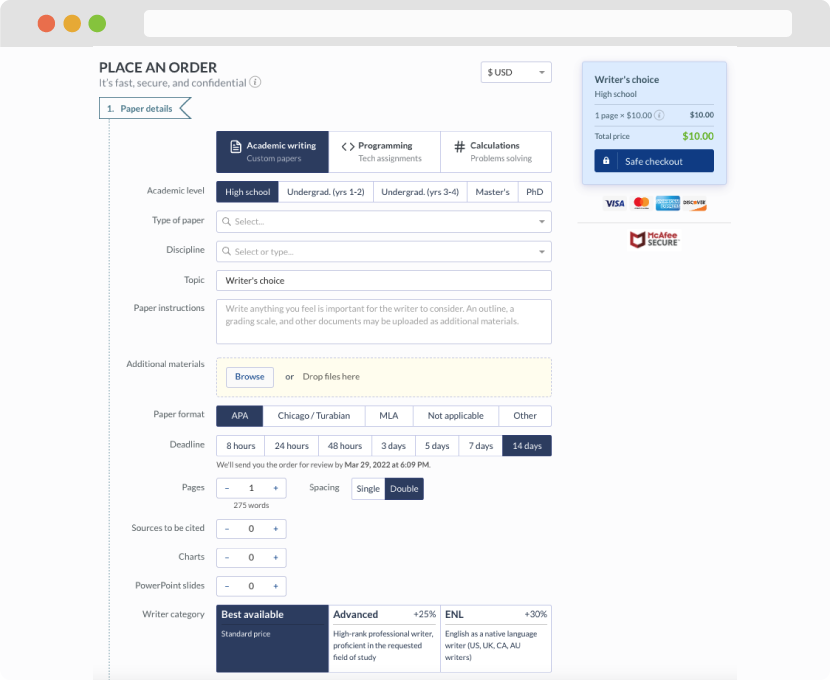
First, you will need to complete an order form. It's not difficult but, if anything is unclear, you may always chat with us so that we can guide you through it. On the order form, you will need to include some basic information concerning your order: subject, topic, number of pages, etc. We also encourage our clients to upload any relevant information or sources that will help.
Complete the order form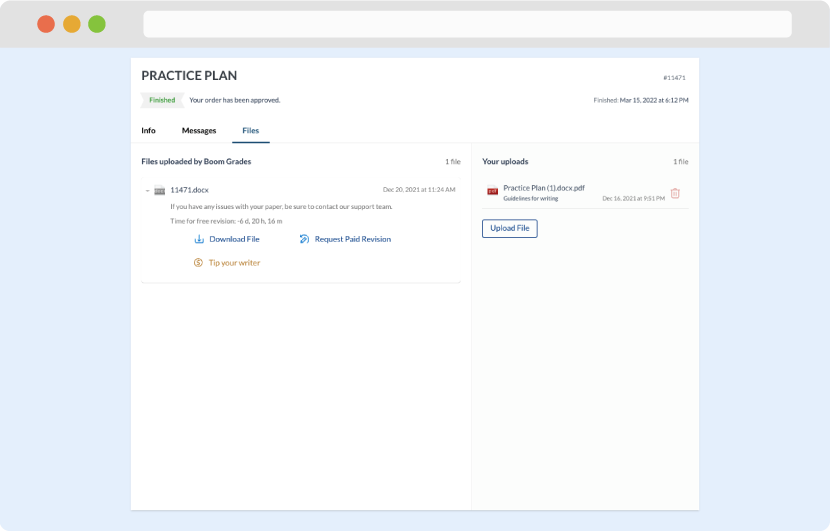
Once we have all the information and instructions that we need, we select the most suitable writer for your assignment. While everything seems to be clear, the writer, who has complete knowledge of the subject, may need clarification from you. It is at that point that you would receive a call or email from us.
Writer’s assignment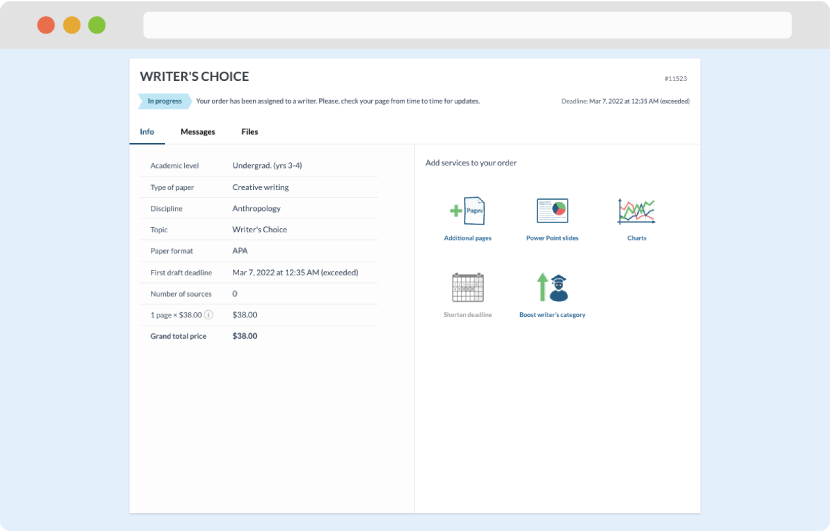
As soon as the writer has finished, it will be delivered both to the website and to your email address so that you will not miss it. If your deadline is close at hand, we will place a call to you to make sure that you receive the paper on time.
Completing the order and download