Week 7 Discussion
Each week, you will be asked to respond to the prompt or prompts in the discussion forum. Your initial post should be 75-150 words in length, and is due on Sunday. By Tuesday, you should respond to two additional posts from your peers.
Peer Review
This week, you will be engaging with the work of other students through Peer Review. In Week 6, you were instructed to submit a copy of your rough draft to the discussion forum. If you have not done so, please submit a copy as an attachment in a new thread with your name as the subject.
This week, you will need to read and respond to at least two other students’ essays and provide them feedback. These responses must include the
Peer Review
rubric
. Use the rubric to provide constructive feedback, incorporating specific, positive remarks as well as helpful suggestions so your peers can see you genuinely evaluated their rough draft.
Your peer reviews should be posted as a response in each student author’s thread.
There are two key things to remember when commenting:
First, avoid giving one sentence answers. Provide positive, detailed feedback as well as constructive criticism. Remember that the idea is to support your classmates’ and let them know what they are doing well as well as what could be improved. Also, focus on the larger issues with the essay (content, structure, organization, use of sources, arguments, thesis, etc.) rather than smaller issues, like editing or proofreading.
Second, please make sure to include a copy of the rubric for each student in your response (filled out in its entirety as you might grade the essay as it is now). This should be included in your response.
A few other reminders:
View your discussion rubric.
1
4
Charity vs Welfare
Charity vs Welfare
Nicholas Cooper
Grantham University
English Composition II (EN102)
Greg Gildersleeve
January 19, 2021
There is a large focus on what the government should provide to citizens so they can stay above the poverty line. John F. Kennedy has many famous quotes, but a lesser known is “ask not what America will do for you, but what together we can do for the freedom of man.” (Kennedy, n.d./1961) We can apply this to our feelings on government welfare and ask ourselves how we can provide for the economic freedom of our friends and neighbors. With a coordinated effort, private charity and welfare programs could completely replace government programs because they have a higher diversity of support, they lose less funding to bureaucracy and have a better pulse on the needs of the community.
The Case for Welfare
Libertarians are often the main proponents for the eradication of the modern welfare state and tout about how poor Americans were supported by the charity of their communities in the early 20th century. Samuel Hammond, director of poverty and welfare policy at the Niskanen Center, writes about how dismal the conditions were during these times for the poorest of the poor. In his article, It (Still) Takes a Nation: Why Private Charity Will Never Replace the Welfare State, Hammond paints a picture of the poor houses which Americans had to resort to live: “Costly to run, the earliest poorhouses depended on charitable bequests and were usually maintained by churches or a member of the local community elected as the “Overseer of the Poor.” Nonetheless, their conditions were wretched, and the working poor were often treated little better than indentured servants.” (Hammond, 2019) Americans understand the growing need for assistance but often overestimate the amount that is being provided. R. Andrew Luccasen III, M. Kathleen Thomas and Philip J. Grossman, business and economics professors, came together at Mississippi State University and conducted an experiment to see how our perceptions about government welfare impact charity. About two-thirds of respondents perceived that government transfer was at or greater than 8% of the federal budget, when in fact only about 1% is allocated for poverty-relief programs. This perception resulted in less charitable giving during the study. The results can be extrapolated and as more Americans embrace the inflated perception of taxes being transferred to the less fortunate, charities see a proportionate decline in donations. (Luccasen, R., Thomas, M., & Grossman, P., 2017)
The Case for Charity
The Church of Jesus Christ for Ladder-day Saints may shine a beacon of hope for the revival of charity and social welfare. The LDS church applies the principal of helping others to help themselves and the importance of hard work and self-reliance. Over their 190 years of growth, the church has been able to support thousands of people through-out the world via coercion free volunteerism, whether through monetary donations or individual service. (Iglesias, 2020) History Professor at the University of Pennsylvania, Michael Katz, explores how the government welfare state fails to keep up with the recent rise in poverty and growing wealth gap. He claims “the goal of public policy, for the most part, has been to keep them [impoverished] alive at the lowest possible cost and, when possible, to improve their morals and change their behavior.” (Katz, 2010) This attitude does little, in comparison to the LDS approach, to actually lift the needy out of state reliance and into self-reliance. By keeping citizens barley stringing along the government perpetuates their need to aid. Katya Melkote, Master of Public Policy student at John F. Kennedy School of Government at Harvard University, echoes this in a story about a single mother, “Laura”, who struggled to survive on government assistance. She was essentially forced to work low-paying jobs and not strive for education beyond her GED due to the strict requirements of minimum working hours to maintain benefits. (Melkote, 2010). This type of instance is a perfect opportunity for charity. Local organizations could provide free, or pay what you can childcare services. Institutions, like Goodwill Industries, could provide tutoring, job placement and skill development opportunities. The localized level of charitable organizations can narrow the focus of services for its community that the government can’t realize.
Brief History of the Welfare State
Prior to the 1900’s, welfare systems started as local public relief programs funded by private charities. As the U.S. became more industrialized and people migrated to urban settings the local charities couldn’t keep up with the demand and state governments began to accept some of the burden. Eventually even the state backed relief wasn’t able to keep up and met its collapse with the Great Depression in the 1930’s. Herbert Hoover enacted the Emergency Relief and Reconstruction Act of 1932 to provide temporary loans to the states to help the state governments. Franklin D. Roosevelt furthered the assistance in 1933 with the Federal Emergency Relief Act. In 1934 Roosevelt issued an executive order which led to the creation of our modern social security program via the Social Security Act of 1935. The social security program added provisions in 1973 and 1975. In 1996 the Temporary Assistance for Needy Families (TANF), or the general idea of welfare, was incorporated under the Social Security Act. (Hansan, 2011) As time has progressed the federal government took on more and more responsibility to provide for citizens and added more and more temporary programs and have ironically become permanent. A reversal on these programs needs to start to return the welfare of the citizens back to the states and subsequently to local private charities.
The End of the Welfare State
The first step for change is stopping the demand for government to expand spending on welfare programs. By retaining more money in their pockets, citizens could get their own affairs in order. Once they are stable, they would be able to reach out a helping hand to their family, friends and neighbors. This boosts the local economies and starts to spread to neighboring communities. With the foundation of the country stable federal assistance can be scaled back and be applied to more targeted areas that still need the assistance. Community stability will grow to city stability and eventually to state stability. The states will no longer rely on federal assistance and the temporary programs can be dissolved. Since now the citizens are taking care of their communities and cities and cities are taking care of the state, the state can take care of its cities and the cities can take care of the citizens.
With the focus changed from how the government should serve its citizens to how the citizens can serve themselves we embody Kennedy’s words. By knowing and addressing the diverse needs of our communities and breaking free of government bureaucracy, Americans can restore the care of the citizens to their communities. It won’t happen overnight and maybe not within our lifetime, but coordinated efforts through private charity can eradicate the dependency on government welfare programs.
References
Hammond, S. P. (2019). It (Still) Takes a Nation: Why Private Charity Will Never Replace the Welfare State. Independent Review, 23(4), 521–537.
Hansan, J. E. (2011). Origins of the State and Federal Public Welfare Programs (1932 – 1935). Social Welfare History Project. https://socialwelfare.library.vcu.edu/public-welfare/origins-of-the-state-federal-public-welfare-programs/.
Iglesias, D. R. (2020). Rethinking Welfare: The LDS Welfare Program vs Public Welfare. Studia Humana, 9(2), 37–44.
https://doi.org/10.2478/sh-2020-0011
Katz, M. B. (2010). The American Welfare State and Social Contract in Hard Times. Journal of Policy History, 22(4), 508–529.
https://doi.org/10.1017/S0898030610000242
Kennedy, J. F. (n.d.). Inaugural Address [Speech Transcript]. John F. Kennedy Presidential Library and Museum.
https://www.jfklibrary.org/learn/about-jfk/historic-speeches/inaugural-address
. (Original work published 1961)
Luccasen, R., Thomas, M., & Grossman, P. (2017). Giving to poverty relief charities: the impact of beliefs and misperceptions toward income redistribution in a real donation experiment. Social Choice & Welfare, 49(2), 387–409.
https://doi.org/10.1007/s00355-017-1070-8
Melkote, K. (2010). Getting Welfare to Work When Times Get Tough. Harvard Kennedy School Review, 10, 16–19.
Essay Writing Service Features
Our Experience
No matter how complex your assignment is, we can find the right professional for your specific task. Achiever Papers is an essay writing company that hires only the smartest minds to help you with your projects. Our expertise allows us to provide students with high-quality academic writing, editing & proofreading services.
Free Features
Free revision policy
$10Free bibliography & reference
$8Free title page
$8Free formatting
$8How Our Dissertation Writing Service Works
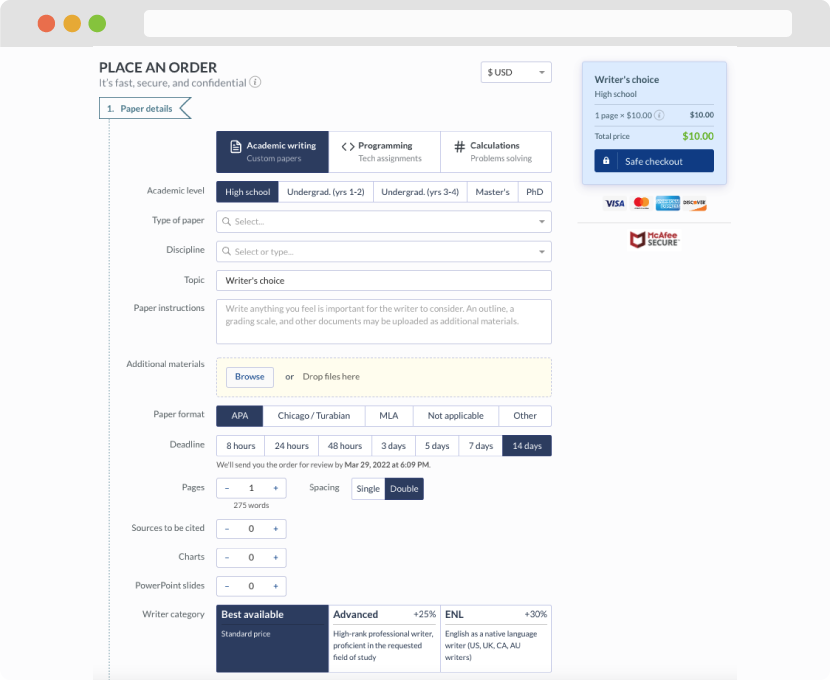
First, you will need to complete an order form. It's not difficult but, if anything is unclear, you may always chat with us so that we can guide you through it. On the order form, you will need to include some basic information concerning your order: subject, topic, number of pages, etc. We also encourage our clients to upload any relevant information or sources that will help.
Complete the order form
Once we have all the information and instructions that we need, we select the most suitable writer for your assignment. While everything seems to be clear, the writer, who has complete knowledge of the subject, may need clarification from you. It is at that point that you would receive a call or email from us.
Writer’s assignment
As soon as the writer has finished, it will be delivered both to the website and to your email address so that you will not miss it. If your deadline is close at hand, we will place a call to you to make sure that you receive the paper on time.
Completing the order and download