Chapter Two
Fundamentals of Data and Signals
Data Communications and Computer Networks: A Business User’s Approach
Eighth Edition
© 2016. Cengage Learning. All right reserved.
*
Data Communications and Computer Networks: A Business User’s Approach, Eighth Edition
© 2016. Cengage Learning. All Rights Reserved.
*
After reading this chapter,
you should be able to:
Distinguish between data and signals, and cite the advantages of digital data and signals over analog data and signals
Identify the three basic components of a signal
Discuss the bandwidth of a signal and how it relates to data transfer speed
Identify signal strength and attenuation, and how they are related
Data Communications and Computer Networks: A Business User’s Approach, Eighth Edition
© 2016. Cengage Learning. All Rights Reserved.
*
Data Communications and Computer Networks: A Business User’s Approach, Eighth Edition
© 2016. Cengage Learning. All Rights Reserved.
*
After reading this chapter,
you should be able to (continued):
Outline the basic characteristics of transmitting analog data with analog signals, digital data with digital signals, digital data with analog signals, and analog data with digital signals
List and draw diagrams of the basic digital encoding techniques, and explain the advantages and disadvantages of each
Identify the different shift keying (modulation) techniques, and describe their advantages, disadvantages, and uses
Data Communications and Computer Networks: A Business User’s Approach, Eighth Edition
© 2016. Cengage Learning. All Rights Reserved.
*
Data Communications and Computer Networks: A Business User’s Approach, Eighth Edition
© 2016. Cengage Learning. All Rights Reserved.
*
After reading this chapter,
you should be able to (continued):
Identify the two most common digitization techniques, and describe their advantages and disadvantages
Identify the different data codes and how they are used in communication systems
Data Communications and Computer Networks: A Business User’s Approach, Eighth Edition
© 2016. Cengage Learning. All Rights Reserved.
*
Data Communications and Computer Networks: A Business User’s Approach, Eighth Edition
© 2016. Cengage Learning. All Rights Reserved.
*
Introduction
Data are entities that convey meaning (computer files, music on CD, results from a blood gas analysis machine)
Signals are the electric or electromagnetic encoding of data (telephone conversation, web page download)
Computer networks and data/voice communication systems transmit signals
Data and signals can be analog or digital
Data Communications and Computer Networks: A Business User’s Approach, Eighth Edition
© 2016. Cengage Learning. All Rights Reserved.
*
Data Communications and Computer Networks: A Business User’s Approach, Eighth Edition
© 2016. Cengage Learning. All Rights Reserved.
*
Introduction (continued)
Table 2-1 Four combinations of data and signals
Data Communications and Computer Networks: A Business User’s Approach, Eighth Edition
© 2016. Cengage Learning. All Rights Reserved.
*
*
Data and Signals
Data are entities that convey meaning within a computer or computer system
Signals are the electric or electromagnetic impulses used to encode and transmit data
Data Communications and Computer Networks: A Business User’s Approach, Eighth Edition
© 2016. Cengage Learning. All Rights Reserved.
Data Communications and Computer Networks: A Business User’s Approach, Eighth Edition
© 2016. Cengage Learning. All Rights Reserved.
*
*
Analog vs. Digital
Data and signals can be either analog or digital
Analog is a continuous waveform, with examples such as (naturally occurring) music and voice
It is harder to separate noise from an analog signal than it is to separate noise from a digital signal (see the following two slides)
Data Communications and Computer Networks: A Business User’s Approach, Eighth Edition
© 2016. Cengage Learning. All Rights Reserved.
Data Communications and Computer Networks: A Business User’s Approach, Eighth Edition
© 2016. Cengage Learning. All Rights Reserved.
*
*
Analog vs. Digital (continued)
Data Communications and Computer Networks: A Business User’s Approach, Eighth Edition
© 2016. Cengage Learning. All Rights Reserved.
Data Communications and Computer Networks: A Business User’s Approach, Eighth Edition
© 2016. Cengage Learning. All Rights Reserved.
*
*
Analog vs. Digital (continued)
Data Communications and Computer Networks: A Business User’s Approach, Eighth Edition
© 2016. Cengage Learning. All Rights Reserved.
Data Communications and Computer Networks: A Business User’s Approach, Eighth Edition
© 2016. Cengage Learning. All Rights Reserved.
*
*
Analog vs. Digital (continued)
Digital is a discrete or non-continuous waveform
Something about the signal makes it obvious that the signal can only appear in a fixed number of forms (see next slide)
Noise in digital signal
You can still discern a high voltage from a low voltage
Too much noise – you cannot discern a high voltage from a low voltage
Data Communications and Computer Networks: A Business User’s Approach, Eighth Edition
© 2016. Cengage Learning. All Rights Reserved.
Data Communications and Computer Networks: A Business User’s Approach, Eighth Edition
© 2016. Cengage Learning. All Rights Reserved.
*
*
Analog vs. Digital (continued)
Data Communications and Computer Networks: A Business User’s Approach, Eighth Edition
© 2016. Cengage Learning. All Rights Reserved.
Data Communications and Computer Networks: A Business User’s Approach, Eighth Edition
© 2016. Cengage Learning. All Rights Reserved.
*
*
Analog vs. Digital (continued)
Data Communications and Computer Networks: A Business User’s Approach, Eighth Edition
© 2016. Cengage Learning. All Rights Reserved.
Data Communications and Computer Networks: A Business User’s Approach, Eighth Edition
© 2016. Cengage Learning. All Rights Reserved.
*
*
Analog vs. Digital (continued)
Data Communications and Computer Networks: A Business User’s Approach, Eighth Edition
© 2016. Cengage Learning. All Rights Reserved.
Data Communications and Computer Networks: A Business User’s Approach, Eighth Edition
© 2016. Cengage Learning. All Rights Reserved.
*
*
Fundamentals of Signals
All signals have three components:
Amplitude
Frequency
Phase
Data Communications and Computer Networks: A Business User’s Approach, Eighth Edition
© 2016. Cengage Learning. All Rights Reserved.
Data Communications and Computer Networks: A Business User’s Approach, Eighth Edition
© 2016. Cengage Learning. All Rights Reserved.
*
*
Fundamentals of Signals – Amplitude
Amplitude
The height of the wave above or below a given reference point
Amplitude is usually measured in volts
Data Communications and Computer Networks: A Business User’s Approach, Eighth Edition
© 2016. Cengage Learning. All Rights Reserved.
Data Communications and Computer Networks: A Business User’s Approach, Eighth Edition
© 2016. Cengage Learning. All Rights Reserved.
*
*
Fundamentals of Signals – Amplitude
Data Communications and Computer Networks: A Business User’s Approach, Eighth Edition
© 2016. Cengage Learning. All Rights Reserved.
Data Communications and Computer Networks: A Business User’s Approach, Eighth Edition
© 2016. Cengage Learning. All Rights Reserved.
*
*
Fundamentals of Signals – Frequency
Frequency
The number of times a signal makes a complete cycle within a given time frame; frequency is measured in Hertz (Hz), or cycles per second (period = 1 / frequency)
Spectrum – Range of frequencies that a signal spans from minimum to maximum
Bandwidth – Absolute value of the difference between the lowest and highest frequencies of a signal
For example, consider an average voice
The average voice has a frequency range of roughly 300 Hz to 3100 Hz
The spectrum would be 300 – 3100 Hz
The bandwidth would be 2800 Hz
Data Communications and Computer Networks: A Business User’s Approach, Eighth Edition
© 2016. Cengage Learning. All Rights Reserved.
Data Communications and Computer Networks: A Business User’s Approach, Eighth Edition
© 2016. Cengage Learning. All Rights Reserved.
*
*
Fundamentals of Signals – Frequency
Data Communications and Computer Networks: A Business User’s Approach, Eighth Edition
© 2016. Cengage Learning. All Rights Reserved.
Data Communications and Computer Networks: A Business User’s Approach, Eighth Edition
© 2016. Cengage Learning. All Rights Reserved.
*
*
Fundamentals of Signals – Phase
Phase
The position of the waveform relative to a given moment of time or relative to time zero
A change in phase can be any number of angles between 0 and 360 degrees
Phase changes often occur on common angles, such as 45, 90, 135, etc.
Data Communications and Computer Networks: A Business User’s Approach, Eighth Edition
© 2016. Cengage Learning. All Rights Reserved.
Data Communications and Computer Networks: A Business User’s Approach, Eighth Edition
© 2016. Cengage Learning. All Rights Reserved.
*
*
Fundamentals of Signals – Phase
Data Communications and Computer Networks: A Business User’s Approach, Eighth Edition
© 2016. Cengage Learning. All Rights Reserved.
Data Communications and Computer Networks: A Business User’s Approach, Eighth Edition
© 2016. Cengage Learning. All Rights Reserved.
*
*
Fundamentals of Signals
Phase
If a signal can experience two different phase angles, then 1 bit can be transmitted with each signal change (each baud)
If a signal can experience four different phase angles, then 2 bits can be transmitted with each signal change (each baud)
Note: number of bits transmitted with each signal change = log2 (number of different phase angles)
(You can replace “phase angles” with “amplitude levels” or “frequency levels”)
Data Communications and Computer Networks: A Business User’s Approach, Eighth Edition
© 2016. Cengage Learning. All Rights Reserved.
Data Communications and Computer Networks: A Business User’s Approach, Eighth Edition
© 2016. Cengage Learning. All Rights Reserved.
*
*
Loss of Signal Strength
All signals experience loss (attenuation)
Attenuation is denoted as a decibel (dB) loss
Decibel losses (and gains) are additive
Data Communications and Computer Networks: A Business User’s Approach, Eighth Edition
© 2016. Cengage Learning. All Rights Reserved.
Data Communications and Computer Networks: A Business User’s Approach, Eighth Edition
© 2016. Cengage Learning. All Rights Reserved.
*
*
Loss of Signal Strength (continued)
Data Communications and Computer Networks: A Business User’s Approach, Eighth Edition
© 2016. Cengage Learning. All Rights Reserved.
Data Communications and Computer Networks: A Business User’s Approach, Eighth Edition
© 2016. Cengage Learning. All Rights Reserved.
*
*
Loss of Signal Strength
Formula for decibel (dB):
dB = 10 x log10 (P2 / P1)
where P1 is the beginning power level and P2 is the ending power level
Data Communications and Computer Networks: A Business User’s Approach, Eighth Edition
© 2016. Cengage Learning. All Rights Reserved.
Data Communications and Computer Networks: A Business User’s Approach, Eighth Edition
© 2016. Cengage Learning. All Rights Reserved.
*
*
Loss of Signal Strength (continued)
So if a signal loses 3 dB, is that a lot?
What if a signal starts at 100 watts and ends at 50 watts? What is dB loss?
dB = 10 x log10 (P2 / P1)
dB = 10 x log10 (50 / 100)
dB = 10 x log10 (0.5)
dB = 10 x -0.3
dB = -3.0
So a 3.0 decibel loss losses half of its power
Data Communications and Computer Networks: A Business User’s Approach, Eighth Edition
© 2016. Cengage Learning. All Rights Reserved.
Data Communications and Computer Networks: A Business User’s Approach, Eighth Edition
© 2016. Cengage Learning. All Rights Reserved.
*
*
Converting Data into Signals
There are four main combinations of data and signals:
Analog data transmitted using analog signals
Digital data transmitted using digital signals
Digital data transmitted using discrete analog signals
Analog data transmitted using digital signals
Let’s look at each these
Data Communications and Computer Networks: A Business User’s Approach, Eighth Edition
© 2016. Cengage Learning. All Rights Reserved.
Data Communications and Computer Networks: A Business User’s Approach, Eighth Edition
© 2016. Cengage Learning. All Rights Reserved.
*
*
1. Transmitting Analog Data with
Analog Signals
In order to transmit analog data, you can modulate the data onto a set of analog signals
Broadcast radio and the older broadcast television are two very common examples of this
We modulate the data onto another set of frequencies so that all the different channels can coexist at different frequencies
Data Communications and Computer Networks: A Business User’s Approach, Eighth Edition
© 2016. Cengage Learning. All Rights Reserved.
Data Communications and Computer Networks: A Business User’s Approach, Eighth Edition
© 2016. Cengage Learning. All Rights Reserved.
*
*
1. Transmitting Analog Data with
Analog Signals (continued)
Data Communications and Computer Networks: A Business User’s Approach, Eighth Edition
© 2016. Cengage Learning. All Rights Reserved.
Data Communications and Computer Networks: A Business User’s Approach, Eighth Edition
© 2016. Cengage Learning. All Rights Reserved.
*
*
2. Transmitting Digital Data with Digital Signals: Digital Encoding Schemes
There are numerous techniques available to convert digital data into digital signals. Let’s examine five:
NRZ-L
NRZI
Manchester
Differential Manchester
Bipolar AMI
These are used in LANs and some telephone systems
Data Communications and Computer Networks: A Business User’s Approach, Eighth Edition
© 2016. Cengage Learning. All Rights Reserved.
Data Communications and Computer Networks: A Business User’s Approach, Eighth Edition
© 2016. Cengage Learning. All Rights Reserved.
*
*
2. Transmitting Digital Data with Digital Signals: Digital Encoding Schemes (continued)
Data Communications and Computer Networks: A Business User’s Approach, Eighth Edition
© 2016. Cengage Learning. All Rights Reserved.
Data Communications and Computer Networks: A Business User’s Approach, Eighth Edition
© 2016. Cengage Learning. All Rights Reserved.
*
*
Nonreturn to Zero Digital Encoding Schemes
Nonreturn to zero-level (NRZ-L) transmits 1s as zero voltages and 0s as positive voltages
Nonreturn to zero inverted (NRZI) has a voltage change at the beginning of a 1 and no voltage change at the beginning of a 0
Fundamental difference exists between NRZ-L and NRZI
With NRZ-L, the receiver has to check the voltage level for each bit to determine whether the bit is a 0 or a 1,
With NRZI, the receiver has to check whether there is a change at the beginning of the bit to determine if it is a 0 or a 1
Data Communications and Computer Networks: A Business User’s Approach, Eighth Edition
© 2016. Cengage Learning. All Rights Reserved.
Data Communications and Computer Networks: A Business User’s Approach, Eighth Edition
© 2016. Cengage Learning. All Rights Reserved.
*
*
Manchester Digital Encoding Schemes
Note how with a Differential Manchester code, every bit has at least one significant change. Some bits have two signal changes per bit (baud rate = twice bps)
Data Communications and Computer Networks: A Business User’s Approach, Eighth Edition
© 2016. Cengage Learning. All Rights Reserved.
Data Communications and Computer Networks: A Business User’s Approach, Eighth Edition
© 2016. Cengage Learning. All Rights Reserved.
*
*
Manchester Digital Encoding Schemes (continued)
Data Communications and Computer Networks: A Business User’s Approach, Eighth Edition
© 2016. Cengage Learning. All Rights Reserved.
Data Communications and Computer Networks: A Business User’s Approach, Eighth Edition
© 2016. Cengage Learning. All Rights Reserved.
*
*
Bipolar-AMI Encoding Scheme
The bipolar-AMI encoding scheme is unique among all the encoding schemes because it uses three voltage levels
When a device transmits a binary 0, a zero voltage is transmitted
When the device transmits a binary 1, either a positive voltage or a negative voltage is transmitted
Which of these is transmitted depends on the binary 1 value that was last transmitted
Data Communications and Computer Networks: A Business User’s Approach, Eighth Edition
© 2016. Cengage Learning. All Rights Reserved.
Data Communications and Computer Networks: A Business User’s Approach, Eighth Edition
© 2016. Cengage Learning. All Rights Reserved.
*
*
4B/5B Digital Encoding Scheme
Yet another encoding technique; this one converts four bits of data into five-bit quantities
The five-bit quantities are unique in that no five-bit code has more than 2 consecutive zeroes
The five-bit code is then transmitted using an NRZI encoded signal
Data Communications and Computer Networks: A Business User’s Approach, Eighth Edition
© 2016. Cengage Learning. All Rights Reserved.
Data Communications and Computer Networks: A Business User’s Approach, Eighth Edition
© 2016. Cengage Learning. All Rights Reserved.
*
*
4B/5B Digital Encoding Scheme (continued)
Data Communications and Computer Networks: A Business User’s Approach, Eighth Edition
© 2016. Cengage Learning. All Rights Reserved.
Data Communications and Computer Networks: A Business User’s Approach, Eighth Edition
© 2016. Cengage Learning. All Rights Reserved.
*
*
3. Transmitting Digital Data with
Discrete Analog Signals
Three basic techniques:
Amplitude shift keying
Frequency shift keying
Phase shift keying
One can then combine two or more of these basic techniques to form more complex modulation techniques (such as quadrature amplitude modulation)
Data Communications and Computer Networks: A Business User’s Approach, Eighth Edition
© 2016. Cengage Learning. All Rights Reserved.
Data Communications and Computer Networks: A Business User’s Approach, Eighth Edition
© 2016. Cengage Learning. All Rights Reserved.
*
*
Amplitude Shift Keying
One amplitude encodes a 0 while another amplitude encodes a 1 (a form of amplitude modulation)
Data Communications and Computer Networks: A Business User’s Approach, Eighth Edition
© 2016. Cengage Learning. All Rights Reserved.
Data Communications and Computer Networks: A Business User’s Approach, Eighth Edition
© 2016. Cengage Learning. All Rights Reserved.
*
*
Amplitude Shift Keying (continued)
Note: here we have four different amplitudes, so we can encode 2 bits
in each signal change (bits per signal change = log2 (amplitude levels)).
Data Communications and Computer Networks: A Business User’s Approach, Eighth Edition
© 2016. Cengage Learning. All Rights Reserved.
Data Communications and Computer Networks: A Business User’s Approach, Eighth Edition
© 2016. Cengage Learning. All Rights Reserved.
*
*
Frequency Shift Keying
One frequency encodes a 0 while another frequency encodes a 1 (a form of frequency modulation)
Data Communications and Computer Networks: A Business User’s Approach, Eighth Edition
© 2016. Cengage Learning. All Rights Reserved.
Data Communications and Computer Networks: A Business User’s Approach, Eighth Edition
© 2016. Cengage Learning. All Rights Reserved.
*
*
Phase Shift Keying
One phase change encodes a 0 while another phase change encodes a 1 (a form of phase modulation)
Data Communications and Computer Networks: A Business User’s Approach, Eighth Edition
© 2016. Cengage Learning. All Rights Reserved.
Data Communications and Computer Networks: A Business User’s Approach, Eighth Edition
© 2016. Cengage Learning. All Rights Reserved.
*
*
Phase Shift Keying (continued)
Quadrature Phase Shift Keying
Four different phase angles used
45 degrees
135 degrees
225 degrees
315 degrees
Data Communications and Computer Networks: A Business User’s Approach, Eighth Edition
© 2016. Cengage Learning. All Rights Reserved.
Data Communications and Computer Networks: A Business User’s Approach, Eighth Edition
© 2016. Cengage Learning. All Rights Reserved.
*
*
Phase Shift Keying (continued)
Data Communications and Computer Networks: A Business User’s Approach, Eighth Edition
© 2016. Cengage Learning. All Rights Reserved.
Data Communications and Computer Networks: A Business User’s Approach, Eighth Edition
© 2016. Cengage Learning. All Rights Reserved.
*
*
Phase Shift Keying (continued)
Quadrature amplitude modulation
As an example of QAM, 12 different phases are combined with two different amplitudes
Since only 4 phase angles have 2 different amplitudes, there are a total of 16 combinations
With 16 signal combinations, each baud equals 4 bits of information (log2(16) = 4, or inversely, 2 ^ 4 = 16)
Data Communications and Computer Networks: A Business User’s Approach, Eighth Edition
© 2016. Cengage Learning. All Rights Reserved.
Data Communications and Computer Networks: A Business User’s Approach, Eighth Edition
© 2016. Cengage Learning. All Rights Reserved.
*
*
Phase Shift Keying (continued)
Data Communications and Computer Networks: A Business User’s Approach, Eighth Edition
© 2016. Cengage Learning. All Rights Reserved.
Data Communications and Computer Networks: A Business User’s Approach, Eighth Edition
© 2016. Cengage Learning. All Rights Reserved.
*
*
4. Transmitting Analog Data with
Digital Signals
To convert analog data into a digital signal, there are two techniques:
Pulse code modulation (the more common)
Delta modulation
Data Communications and Computer Networks: A Business User’s Approach, Eighth Edition
© 2016. Cengage Learning. All Rights Reserved.
Data Communications and Computer Networks: A Business User’s Approach, Eighth Edition
© 2016. Cengage Learning. All Rights Reserved.
*
*
Pulse Code Modulation
The analog waveform is sampled at specific intervals and the “snapshots” are converted to binary values
Data Communications and Computer Networks: A Business User’s Approach, Eighth Edition
© 2016. Cengage Learning. All Rights Reserved.
Data Communications and Computer Networks: A Business User’s Approach, Eighth Edition
© 2016. Cengage Learning. All Rights Reserved.
*
*
Pulse Code Modulation (continued)
Data Communications and Computer Networks: A Business User’s Approach, Eighth Edition
© 2016. Cengage Learning. All Rights Reserved.
Data Communications and Computer Networks: A Business User’s Approach, Eighth Edition
© 2016. Cengage Learning. All Rights Reserved.
*
*
Pulse Code Modulation (continued)
When the binary values are later converted to an analog signal, a waveform similar to the original results
Data Communications and Computer Networks: A Business User’s Approach, Eighth Edition
© 2016. Cengage Learning. All Rights Reserved.
Data Communications and Computer Networks: A Business User’s Approach, Eighth Edition
© 2016. Cengage Learning. All Rights Reserved.
*
*
Pulse Code Modulation (continued)
Data Communications and Computer Networks: A Business User’s Approach, Eighth Edition
© 2016. Cengage Learning. All Rights Reserved.
Data Communications and Computer Networks: A Business User’s Approach, Eighth Edition
© 2016. Cengage Learning. All Rights Reserved.
*
*
Pulse Code Modulation (continued)
The more snapshots taken in the same amount of time, or the more quantization levels, the better the resolution
Data Communications and Computer Networks: A Business User’s Approach, Eighth Edition
© 2016. Cengage Learning. All Rights Reserved.
Data Communications and Computer Networks: A Business User’s Approach, Eighth Edition
© 2016. Cengage Learning. All Rights Reserved.
*
*
Pulse Code Modulation (continued)
Data Communications and Computer Networks: A Business User’s Approach, Eighth Edition
© 2016. Cengage Learning. All Rights Reserved.
Data Communications and Computer Networks: A Business User’s Approach, Eighth Edition
© 2016. Cengage Learning. All Rights Reserved.
*
*
Pulse Code Modulation (continued)
Since telephone systems digitize human voice, and since the human voice has a fairly narrow bandwidth, telephone systems can digitize voice into either 128 or 256 levels
These are called quantization levels
If 128 levels, then each sample is 7 bits (2 ^ 7 = 128)
If 256 levels, then each sample is 8 bits (2 ^ 8 = 256)
Data Communications and Computer Networks: A Business User’s Approach, Eighth Edition
© 2016. Cengage Learning. All Rights Reserved.
Data Communications and Computer Networks: A Business User’s Approach, Eighth Edition
© 2016. Cengage Learning. All Rights Reserved.
*
*
Pulse Code Modulation (continued)
How fast do you have to sample an input source to get a fairly accurate representation?
Nyquist says 2 times the highest frequency
Thus, if you want to digitize voice (4000 Hz), you need to sample at 8000 samples per second
Data Communications and Computer Networks: A Business User’s Approach, Eighth Edition
© 2016. Cengage Learning. All Rights Reserved.
Data Communications and Computer Networks: A Business User’s Approach, Eighth Edition
© 2016. Cengage Learning. All Rights Reserved.
*
*
Delta Modulation
An analog waveform is tracked, using a binary 1 to represent a rise in voltage, and a 0 to represent a drop
Data Communications and Computer Networks: A Business User’s Approach, Eighth Edition
© 2016. Cengage Learning. All Rights Reserved.
Data Communications and Computer Networks: A Business User’s Approach, Eighth Edition
© 2016. Cengage Learning. All Rights Reserved.
*
*
Delta Modulation (continued)
Data Communications and Computer Networks: A Business User’s Approach, Eighth Edition
© 2016. Cengage Learning. All Rights Reserved.
Data Communications and Computer Networks: A Business User’s Approach, Eighth Edition
© 2016. Cengage Learning. All Rights Reserved.
*
*
The Relationship Between Frequency and Bits Per Second
Higher Data Transfer Rates
How do you send data faster?
Use a higher frequency signal (make sure the medium can handle the higher frequency
Use a higher number of signal levels
In both cases, noise can be a problem
Data Communications and Computer Networks: A Business User’s Approach, Eighth Edition
© 2016. Cengage Learning. All Rights Reserved.
Data Communications and Computer Networks: A Business User’s Approach, Eighth Edition
© 2016. Cengage Learning. All Rights Reserved.
*
*
The Relationship Between Frequency and Bits Per Second (continued)
Maximum Data Transfer Rates
How do you calculate a maximum data rate?
Use Shannon’s equation
S(f) = f x log2 (1 + S/N)
Where f = signal frequency (bandwidth), S is the signal power in watts, and N is the noise power in watts
For example, what is the data rate of a 3400 Hz signal with 0.2 watts of power and 0.0002 watts of noise?
S(f) = 3400 x log2 (1 + 0.2/0.0002)
= 3400 x log2 (1001)
= 3400 x 9.97
= 33898 bps
Data Communications and Computer Networks: A Business User’s Approach, Eighth Edition
© 2016. Cengage Learning. All Rights Reserved.
Data Communications and Computer Networks: A Business User’s Approach, Eighth Edition
© 2016. Cengage Learning. All Rights Reserved.
*
*
Data Codes
The set of all textual characters or symbols and their corresponding binary patterns is called a data code
There are three common data code sets:
EBCDIC
ASCII
Unicode
Data Communications and Computer Networks: A Business User’s Approach, Eighth Edition
© 2016. Cengage Learning. All Rights Reserved.
Data Communications and Computer Networks: A Business User’s Approach, Eighth Edition
© 2016. Cengage Learning. All Rights Reserved.
*
*
EBCDIC
Data Communications and Computer Networks: A Business User’s Approach, Eighth Edition
© 2016. Cengage Learning. All Rights Reserved.
Data Communications and Computer Networks: A Business User’s Approach, Eighth Edition
© 2016. Cengage Learning. All Rights Reserved.
*
*
ASCII
Data Communications and Computer Networks: A Business User’s Approach, Eighth Edition
© 2016. Cengage Learning. All Rights Reserved.
Data Communications and Computer Networks: A Business User’s Approach, Eighth Edition
© 2016. Cengage Learning. All Rights Reserved.
*
*
Unicode
Each character is 16 bits
A large number of languages / character sets
For example:
T equals 0000 0000 0101 0100
r equals 0000 0000 0111 0010
a equals 0000 0000 0110 0001
Data Communications and Computer Networks: A Business User’s Approach, Eighth Edition
© 2016. Cengage Learning. All Rights Reserved.
Data Communications and Computer Networks: A Business User’s Approach, Eighth Edition
© 2016. Cengage Learning. All Rights Reserved.
*
*
Data and Signal Conversions In Action:
Two Examples
Let us transmit the message “Sam, what time is the meeting with accounting? Hannah.”
This message leaves Hannah’s workstation and travels across a local area network
Data Communications and Computer Networks: A Business User’s Approach, Eighth Edition
© 2016. Cengage Learning. All Rights Reserved.
Data Communications and Computer Networks: A Business User’s Approach, Eighth Edition
© 2016. Cengage Learning. All Rights Reserved.
*
*
Data and Signal Conversions In Action:
Two Examples (continued)
Data Communications and Computer Networks: A Business User’s Approach, Eighth Edition
© 2016. Cengage Learning. All Rights Reserved.
Data Communications and Computer Networks: A Business User’s Approach, Eighth Edition
© 2016. Cengage Learning. All Rights Reserved.
*
*
Data and Signal Conversions In Action:
Two Examples (continued)
Data Communications and Computer Networks: A Business User’s Approach, Eighth Edition
© 2016. Cengage Learning. All Rights Reserved.
Data Communications and Computer Networks: A Business User’s Approach, Eighth Edition
© 2016. Cengage Learning. All Rights Reserved.
*
*
Data and Signal Conversions In Action:
Two Examples (continued)
Data Communications and Computer Networks: A Business User’s Approach, Eighth Edition
© 2016. Cengage Learning. All Rights Reserved.
Data Communications and Computer Networks: A Business User’s Approach, Eighth Edition
© 2016. Cengage Learning. All Rights Reserved.
*
*
Summary
Data and signals are two basic building blocks of computer networks
All data transmitted is either digital or analog
Data is transmitted with a signal that can be either digital or analog
All signals consist of three basic components: amplitude, frequency, and phase
Two important factors affecting the transfer of a signal over a medium are noise and attenuation
Four basic combinations of data and signals are possible: analog data converted to an analog signal, digital data converted to a digital signal, digital data converted to a discrete analog signal, and analog data converted to a digital signal
Data Communications and Computer Networks: A Business User’s Approach, Eighth Edition
© 2016. Cengage Learning. All Rights Reserved.
Data Communications and Computer Networks: A Business User’s Approach, Eighth Edition
© 2016. Cengage Learning. All Rights Reserved.
*
*
Summary (continued)
To transmit analog data over an analog signal, the analog waveform of the data is combined with another analog waveform in a process known as modulation
Digital data carried by digital signals is represented by digital encoding formats
For digital data to be transmitted using analog signals, digital data must first undergo a process called shift keying or modulation
Three basic techniques of shift keying are amplitude shift keying, frequency shift keying, and phase shift keying
Data Communications and Computer Networks: A Business User’s Approach, Eighth Edition
© 2016. Cengage Learning. All Rights Reserved.
Data Communications and Computer Networks: A Business User’s Approach, Eighth Edition
© 2016. Cengage Learning. All Rights Reserved.
*
*
Summary (continued)
Two common techniques for converting analog data so that it may be carried over digital signals are pulse code modulation and delta modulation
Data codes are necessary to transmit the letters, numbers, symbols, and control characters found in text data
Three important data codes are ASCII, EBCDIC, and Unicode
Data Communications and Computer Networks: A Business User’s Approach, Eighth Edition
© 2016. Cengage Learning. All Rights Reserved.
Data Communications and Computer Networks: A Business User’s Approach, Eighth Edition
© 2016. Cengage Learning. All Rights Reserved.
*
Essay Writing Service Features
Our Experience
No matter how complex your assignment is, we can find the right professional for your specific task. Achiever Papers is an essay writing company that hires only the smartest minds to help you with your projects. Our expertise allows us to provide students with high-quality academic writing, editing & proofreading services.
Free Features
Free revision policy
$10Free bibliography & reference
$8Free title page
$8Free formatting
$8How Our Dissertation Writing Service Works
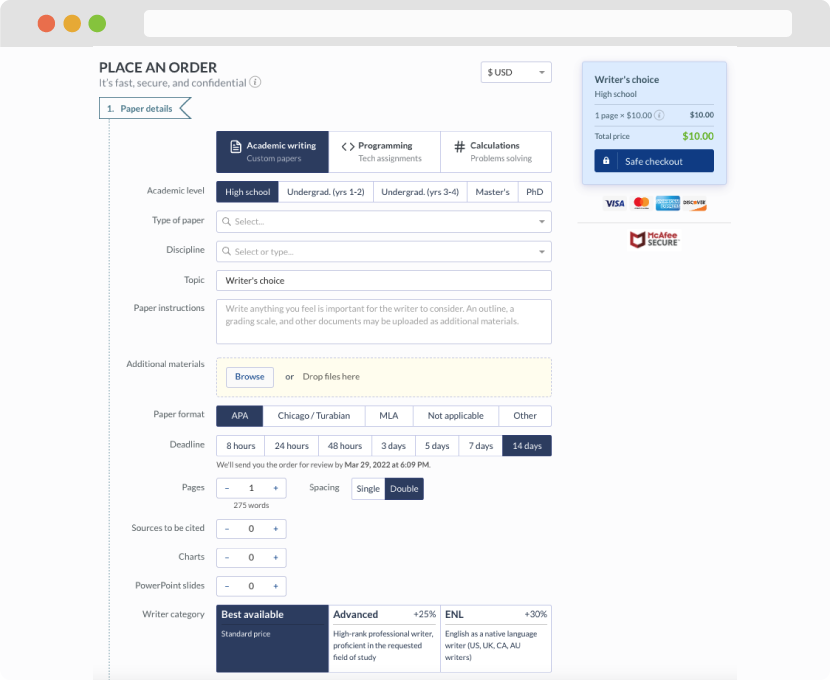
First, you will need to complete an order form. It's not difficult but, if anything is unclear, you may always chat with us so that we can guide you through it. On the order form, you will need to include some basic information concerning your order: subject, topic, number of pages, etc. We also encourage our clients to upload any relevant information or sources that will help.
Complete the order form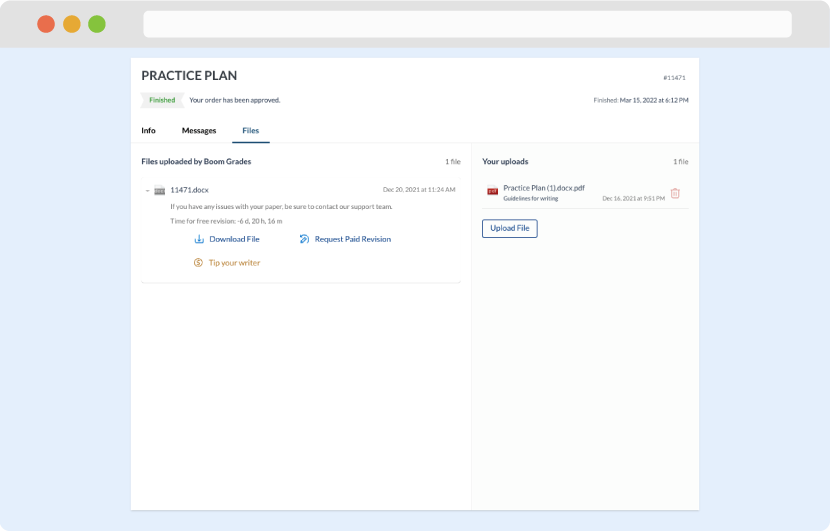
Once we have all the information and instructions that we need, we select the most suitable writer for your assignment. While everything seems to be clear, the writer, who has complete knowledge of the subject, may need clarification from you. It is at that point that you would receive a call or email from us.
Writer’s assignment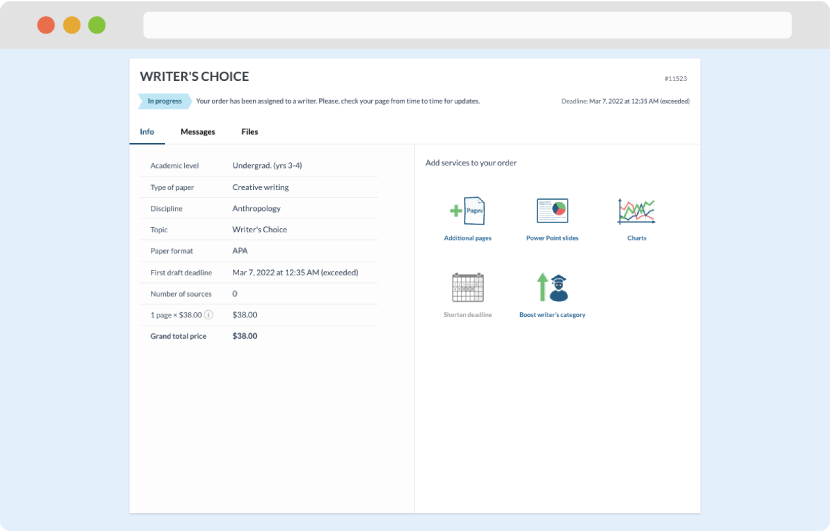
As soon as the writer has finished, it will be delivered both to the website and to your email address so that you will not miss it. If your deadline is close at hand, we will place a call to you to make sure that you receive the paper on time.
Completing the order and download